

FOB Pros and Cons: When Should Importers Use It?
The fob advantages and disadvantages come down to control: FOB suits sea freight buyers who can arrange freight and insurance, and fits poorly for containers, air freight and first-time importers without freight support.
Short answer
FOB suits importers who buy by sea, can arrange ocean freight and insurance, and want control over carrier choice and a visible freight cost. Under FOB, the seller loads the goods on board the buyer's vessel at the named port and handles export formalities, while risk passes on board. Avoid FOB for air freight, containerised cargo handed over at a terminal, and first shipments without freight support; FCA, CIF, or DAP may fit better.
On this page
Key takeaways
Under FOB, the seller delivers the goods loaded on board the buyer's vessel at the named port of shipment, and risk transfers to the buyer at that point.
FOB is for sea and inland waterway transport only; containerised cargo handed over at a terminal and all air freight need a different rule, usually FCA.
FOB gives the buyer control over carrier choice and a separate, visible freight cost, but the buyer must arrange freight, insurance, and import clearance.
The seller has no insurance duty under FOB, so the buyer must arrange cover and record it before the goods sail.
In Bangladesh, the Bill of Export must be approved before loading, and the contract should name the port and Incoterms 2020.
The fob advantages and disadvantages turn on one question: who should control the ocean leg. Under FOB (Free On Board), the seller delivers the goods loaded on board the vessel nominated by the buyer at the named port of shipment, and risk transfers to the buyer at that point.1 The buyer contracts the carrier, pays the freight, and handles import formalities.1
FOB is a sea and inland waterway rule only, under Incoterms 2020.1 2 It does not fit air freight, road freight, or a container handed over at an inland terminal without a careful look at where risk passes. This guide judges FOB against FCA, CIF, and DAP for a specific shipment, instead of accepting it because a quotation already says FOB.
FOB advantages and disadvantages at a glance
FOB offers control and visibility, if the buyer is ready to exercise that control.
Advantage | Disadvantage |
|---|---|
Buyer chooses carrier, sailing, and routing, and sees freight as a separate line | Buyer must arrange freight, insurance, and destination handling |
FOB prices compare easily across sellers, since freight and insurance are excluded | A low FOB price can look cheaper than CIF until freight and insurance are added |
Seller handles transport to the port, loading, and export formalities1 | Risk passes at loading, so voyage damage is the buyer's claim to make |
Duties split in one short line | Buyer must give timely vessel notice, or risk and costs can pass early1 |
Fits bulk and breakbulk cargo loaded directly onto a vessel1 | Fits containerised cargo poorly, since containers reach a terminal days before loading1 |
Use FOB when you buy by sea, can arrange freight and insurance, and want freight control. Choose another rule when any condition fails.
Why this matters for buyers and sellers
For the buyer, the delivery rule decides how much of the journey is visible. Under FOB, the freight invoice arrives in the buyer's name, from the buyer's carrier, so the buyer can compare carriers and change routing on the next order. Under CIF, the seller buys the freight and minimum insurance cover, and the buyer sees one combined price. The Incoterms 2020 rules give each rule a clear allocation of cost, risk, and obligations,3 and that allocation is what makes quotations comparable.
For the seller, FOB keeps the obligation close to home: move the goods to the port, load them, and complete export formalities.1 The seller need not buy ocean freight or judge insurance markets abroad. That simplicity suits a Bangladeshi exporter whose strength is production and origin handling, and the seller's responsibility ends at a visible point: the goods on board.
The risk for both sides is a mismatch between the rule and the physical shipment. If the goods are containerised, the seller typically delivers the container to a terminal rather than onto the vessel, and it may stay there for days.1 A contract that still says FOB leaves a gap between physical handover and the contractual delivery point. See the FOB (Free On Board) guide.
Step-by-step: how it works
Under FOB, the seller transports the goods to the port, loads them on board the vessel nominated by the buyer, and completes export formalities.1 The buyer designates the carrier, pays freight to the destination port, and handles import formalities and transit customs.1 The buyer must inform the seller in time of the vessel name and loading place and point, and the seller must give timely notice of delivery.1
Use the decision flow below before you agree the rule.
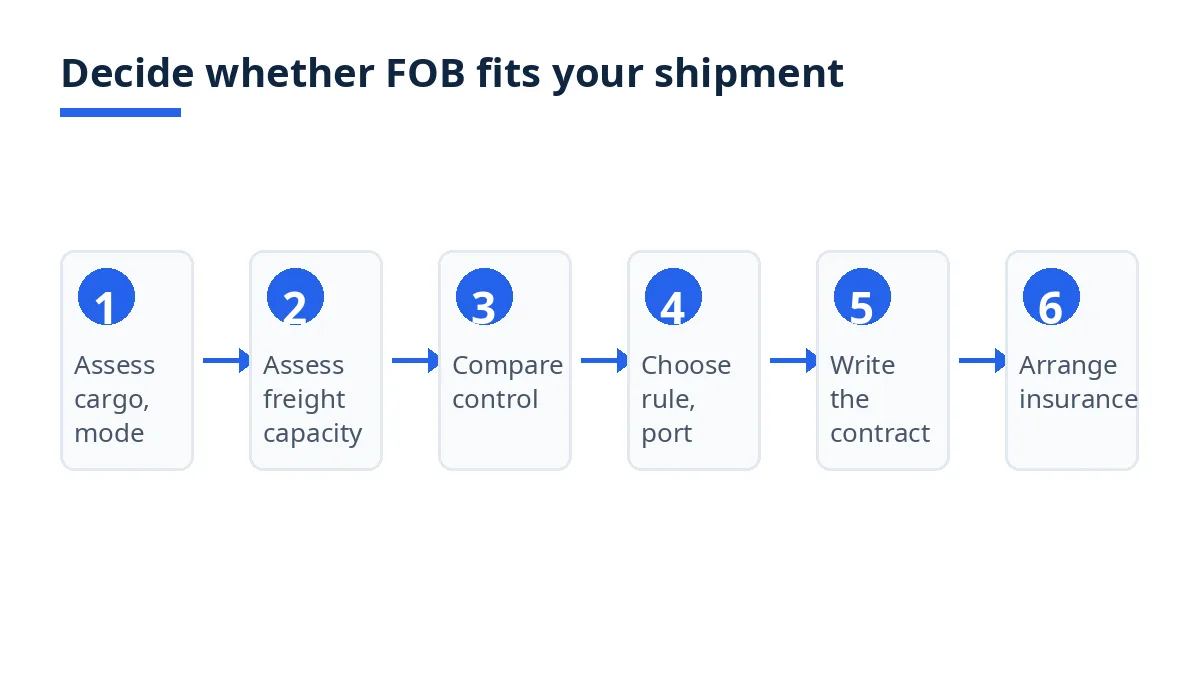
Assess the cargo and the mode. Confirm the goods move by sea or inland waterway and can be delivered loaded on board. If the answer is air, road, rail, or multimodal, FOB is the wrong rule.
Assess your freight capacity. Confirm you, or a forwarder acting for you, can contract the carrier, pay freight, arrange insurance, and clear imports. If not, FOB adds exposure rather than saving money.
Compare control against convenience. Weigh a visible freight cost and carrier choice against one combined price from the seller. Regular shippers usually value control; rare shippers usually value convenience.
Check the handover point. Ask where the goods change hands: on board, or at a container terminal. If the answer is a terminal, compare FCA before accepting FOB.
Choose the rule and name the place. Write the rule, the named port, and the edition, for example "FOB Chattogram, Incoterms 2020". A bare "FOB" leaves the delivery point open to argument.
Write the surrounding duties into the contract. Record who insures, who gives vessel notice and by when, and what happens if the vessel is delayed. If the buyer fails to give timely notice and the goods cannot be loaded, risk and additional costs pass to the buyer.1 If the nominated ship is delayed, the buyer bears the risk and cost of storage at the port.1
Costs, timelines and documents
The cost split
The seller bears costs up to loading on board; the buyer bears costs from that point, including main carriage and import formalities.1 The Incoterms 2020 rules consolidate each rule's costs so users can see the full list at a glance.3 That is the visibility advantage of FOB: the freight line is yours to see and renegotiate.
Insurance needs a separate decision. The Incoterms 2020 overview places insurance duties in the CIF and CIP rules,3 and the ICC Academy summary describes insurance provision as a question arising for CIP and CIF.1 Neither places an insurance duty on the seller under FOB. Treat insurance as the buyer's decision, and record the cover and insured value before the goods sail.
FOB compared with FCA, CIF, and DAP
Rule | Carriage paid by | Risk transfers | Insurance duty | Buyer control |
|---|---|---|---|---|
FOB | Buyer | On board the vessel1 | Buyer decides | High over the ocean leg |
FCA | Buyer | Handover to the carrier1 | Buyer decides | High from handover |
CIF | Seller | On board the vessel1 | Seller, minimum cover3 | Low over the ocean leg |
DAP | Seller | At the named destination | As agreed | Low until delivery |
FCA is the closest alternative for containerised or multimodal cargo, because FCA is a rule for any mode of transport while FOB, FAS, CFR, and CIF are for sea and inland waterway only.2 CIF keeps the same on-board risk point as FOB but moves freight buying and minimum insurance to the seller.1 3 DAP moves delivery and risk to the destination place, with the buyer still handling import clearance and duties.4 For the line-by-line contents of an FOB price, see the FOB price guide.
Timelines and documents
No guide can state a transit time for FOB as a fact, because the sailing, vessel nomination, and export clearance vary by shipment. Plan around three facts you can verify for your order: the deadline for vessel notice,1 approval of the export declaration before loading,5 and the sailing schedule your carrier confirms.
The document set is the export set for the goods, not a separate FOB form. In Bangladesh, goods must not be loaded or stuffed for export unless an export declaration, known as the Bill of Export or Shipping Bill, is submitted to Customs and approved.5 Enclosed documents include the export contract or purchase order where there is no export letter of credit, the commercial invoice, the packing list, the EXP form certified by an authorized dealer, and a certificate of origin issued by the Export Promotion Bureau (EPB) or a Chamber of Commerce and Industry.5 The full set is in the FOB documents guide; the landed cost beyond the FOB price is in the landed cost guide.
Bangladesh-specific rules and tips
Name the port and the edition in every quotation and contract. "FOB Chattogram, Incoterms 2020" tells the seller where delivery happens and which edition governs the split. A quotation saying only "FOB Bangladesh" leaves the delivery point undefined.
Confirm the export declaration position before the cargo-ready date. The Bill of Export must be submitted and approved before goods are loaded or stuffed,5 and the declaration names the exporter, the foreign buyer, and the transport operator.5 Ask which documents are ready and which are outstanding, and keep the certificate of origin and EXP form on that list.5
Decide whether a clearing and forwarding (C and F) agent is involved, and by whom. Clearing and forwarding agents are approved by Bangladesh Customs to complete customs formalities, coordinate with the carrier, and handle shipping and delivery activities.6 Using an agent is not compulsory, but the Trade Portal notes that an agent may save delays.6 Under FOB, the seller handles export formalities, so ask who does that work and whether its cost sits inside the FOB price.
Goods must be cleared at the customs office of the border post where they are imported or exported,6 and declarations through Chattogram port must be entered into the ASYCUDA system.6 Ask the terminal question in plain words: "Where will the container be handed over, and how many days before loading?" If the answer is a container terminal, raise FCA. The ICC Academy guidance is direct: where goods are containerised and delivered to a terminal, FCA is the more appropriate rule.1 For all 11 rules as they apply to shipments from Bangladesh, see the Incoterms guide.
Mistakes and red flags
Using FOB for air freight. FOB has no on-board moment at an airport, so the delivery point cannot operate as written. The air-freight answer is no: use FCA instead, as set out in the FOB for air freight guide.
Using FOB for containerised cargo without addressing the terminal gap. The container reaches a terminal, the seller loses physical control, and the FOB delivery point still sits on board the vessel.1 Raise the gap, and choose FCA where handover is at the terminal.
Writing FOB without a named port or edition. Without a port and an edition, the parties can agree the price and still disagree about where delivery happens. Redraft any quotation omitting either element.
Assuming insurance follows the goods. Under FOB, the seller has no insurance duty; cover must be arranged by the buyer and confirmed in writing before loading.1 3
Assuming the seller carries risk to the destination port. Risk passes on board at the port of shipment, even though the voyage continues.1 A CIF quotation does not change that risk point.3
Accepting FOB with no freight or insurance capacity. FOB rewards buyers who buy freight well. With no forwarder, no insurance contact, and no import clearance support, the control FOB offers is work to buy at short notice, often at a worse price than the seller would have paid. Compare prices across rules only after adding freight, insurance, and destination charges to the FOB side, so each quotation is measured to the same point.
Checklist
Before you agree FOB, every line should be answered in writing.
Goods move by sea or inland waterway and can be delivered loaded on board.
You, or a forwarder acting for you, can contract the carrier and pay the freight.
Insurance is arranged by you, with cover and insured value recorded.
The contract names the rule, the port of shipment, and "Incoterms 2020".
Vessel notice, including vessel name and loading point, and its deadline are recorded.
The handover point matches the rule: on board for FOB, or FCA at a container terminal.
Export formalities, including the Bill of Export and enclosed documents, are confirmed ready or dated.5
Quotations are compared on the same rule, or adjusted with freight and insurance added.
Import clearance and destination handling are assigned to a named party.
Consequences of a delayed vessel, including port storage, are agreed before loading.1
How Exportain helps
State the delivery rule in the request for quotation (RFQ) so suppliers quote against the same term. On Exportain, an RFQ states quantity, target price, destination, Incoterm, required certifications, and deadline, and suppliers in that category can quote against it.7 Ask each reply to name the port and confirm the edition, and hold the comparison until every quotation answers on the same rule.
Test the freight side before committing to FOB. Freight rates published by forwarders can be looked up on Exportain, and quotes can be requested from listed freight, customs, and inspection providers.7 If no forwarder quote is in hand and no insurance is arranged, that is evidence against FOB for that order. Read badges for what they record: badges such as Exportain Verified and Export Verified record which checks the Exportain team has reviewed, and a badge is not a capacity or quality guarantee.7 Verification is a document and photo review, not a factory inspection or a guarantee. Post your RFQ at Exportain RFQs, stating the rule, the named port, and who arranges insurance.
FAQs
When should I use FOB instead of FCA?
Use FOB when the goods are bulk or breakbulk cargo delivered loaded directly onto the vessel, and you want the on-board delivery point with buyer-arranged freight.1 Use FCA when goods are containerised, handed over at a terminal, or moving by more than one mode, because FCA matches the handover point and works for any mode.2
When should I not use FOB for a container shipment?
Do not use FOB where the container is delivered to a terminal and held before loading, unless the contract expressly addresses the gap between terminal handover and loading.1 The seller typically delivers the container to the terminal, where it may stay for days,1 so FCA, which transfers risk at handover to the carrier, avoids that gap.
When does FOB give me better cost visibility than CIF?
FOB gives better visibility when you want freight as a separate line in your own name, from a carrier you chose. Under CIF, the seller pays freight and arranges minimum insurance cover, so both sit inside the seller's price.3 Compare carrier quotations and keep the landed-cost build-up beside the quotation.
When should a first-time importer avoid FOB?
Avoid FOB when there is no forwarder, no insurance contact, and no import clearance support in place, because FOB makes the buyer responsible for the carrier contract, freight payment, insurance, and import formalities.1 In that position, a rule where the seller arranges more of the journey, or a forwarder engaged before the order, lowers the risk of a costly first shipment.
Next steps on Exportain
Post your requirement, including the delivery rule and named port, on the Exportain RFQ board so suppliers quote on the same basis. If any part of the shipment moves by air, read the FOB for air freight guide before writing the rule into a contract. Then follow the how-to-buy guide to arrange freight and inspection through listed providers.
Sources
- FOB & FAS Incoterms® 2020 explained: Key differences. ICC Academy (accessed )
- Air Freight Incoterms: Use FCA, Not FOB. Ovrseas (accessed )
- Incoterms® 2020. International Chamber of Commerce (ICC) (accessed )
- What is CIF? Detailed guide to distinguishing common Incoterms: CIF, FOB, EXW, DAP, DDP. HNT Shipping (accessed )
- Customs Clearance Procedures for Export. Bangladesh Customs, National Board of Revenue (accessed )
- Bangladesh Trade Portal FAQ: Export Registration Certificate (ERC). Bangladesh Trade Portal (accessed )
- How to source and buy from Bangladesh. Exportain (accessed )
About the author
Sourcing from Bangladesh?
Post a request for quotation and suppliers on Exportain can send you their quotes directly.
Post an RFQ


