FAS vs DDP: Key Differences, Costs and Which One to Choose
FAS and DDP are opposite ends of the Incoterms scale: one stops at the ship's side, the other at your door with duties paid. Here is how to choose between them.
Short answer
Under FAS, the seller delivers the goods alongside the vessel at the port of shipment and the buyer pays for loading, freight, insurance, import clearance and duties. Under DDP, the seller delivers to the named destination, clears the goods for import and pays all duties and taxes, bearing the risk until delivery. FAS suits buyers that control their own freight; DDP suits buyers that want one landed price and sellers that can act as importer of record.
On this page
Key takeaways
FAS ends at the ship's side; DDP ends at the buyer's door, duty paid.
FAS is sea-only and suits bulk and breakbulk cargo, not containers.
DDP makes the seller the importer of record, with VAT and bond consequences.
DDP does not require the seller to insure the cargo; write insurance into the contract if you want it.
A FAS price and a DDP price are not comparable on unit price alone.
FAS and DDP sit at opposite ends of the Incoterms 2020 scale. Under FAS (Free Alongside Ship), the seller's job ends when the goods are placed alongside the vessel at the port of shipment. Under DDP (Delivered Duty Paid), the seller's job ends only when the goods arrive at the buyer's named destination, cleared for import with duties and taxes paid. Choosing between them is a choice about how much of the journey each side controls, and how much risk each side carries.
This comparison is for buyers sourcing from Bangladesh by sea, and for Bangladeshi sellers quoting overseas buyers. It covers what each rule makes each side do, where risk passes, what each side pays, and the mistakes that turn a cheap-looking quotation into an expensive shipment.
What FAS means in practice
Under FAS, the seller delivers the goods alongside the vessel nominated by the buyer at the named port of shipment, cleared for export. The seller bears the cost and risk of getting the goods to the ship's side: packing, inland transport to the port, and export clearance.1
Risk passes to the buyer the moment the goods are placed alongside the vessel. From that point the buyer pays for loading the goods on board, the ocean freight, insurance if it wants any, import clearance, duties and taxes, and delivery to its own premises.1 FAS does not require either party to buy cargo insurance, so a buyer that wants cover must arrange it, starting from the alongside-delivery point rather than from loading.1
FAS is written for cargo that is loaded directly onto a vessel: bulk goods, breakbulk cargo and oversize project cargo. It is not a container rule. Containers are usually handed to a terminal days before loading, and under FAS the seller's delivery point is the vessel itself, so containerised cargo should use FCA instead.1
What DDP means in practice
Under DDP, the seller delivers the goods to the named place of destination, on the arriving means of transport, ready for unloading, with import clearance completed and all duties and taxes paid. It is the heaviest obligation any Incoterm places on a seller, and it works for any mode of transport.2
The seller arranges and pays for export clearance, all carriage to the destination, import clearance, and every duty and tax the destination country imposes. Risk stays with the seller until the goods sit on the arriving vehicle at the named destination, cleared for import and ready for the buyer to unload.2 The buyer pays the purchase price, gives the seller the information import customs needs, and unloads the goods, unless the carriage contract already includes unloading.2
Two points catch sellers out. First, DDP does not require the seller to buy insurance: the seller bears the risk of loss or damage during transit but may self-insure, buy a policy, or accept the exposure.2 Second, the seller effectively becomes the importer of record in the buyer's country, which can mean registering for VAT there, appointing a customs broker, and in some countries posting a customs bond.2 A seller that pays import VAT at the destination often cannot reclaim it without a VAT registration there, so the tax becomes a hard cost unless the seller registers or prices it in.2
FAS vs DDP at a glance
FAS | DDP | |
|---|---|---|
Full name | Free Alongside Ship | Delivered Duty Paid |
Transport mode | Sea and inland waterway only | Any mode |
Seller delivers | Alongside the vessel at the named port of shipment | At the named destination, on the arriving vehicle, ready for unloading |
Risk passes to the buyer | When the goods are placed alongside the vessel | When the goods arrive at the destination, cleared for import |
Export clearance | Seller | Seller |
Loading on board | Buyer | Seller (through its carrier) |
Main carriage | Buyer | Seller |
Insurance | Neither party must insure | Seller bears the risk; no insurance is required |
Import clearance, duties and taxes | Buyer | Seller |
Unloading at destination | Buyer | Buyer, unless the seller's carriage contract includes it |
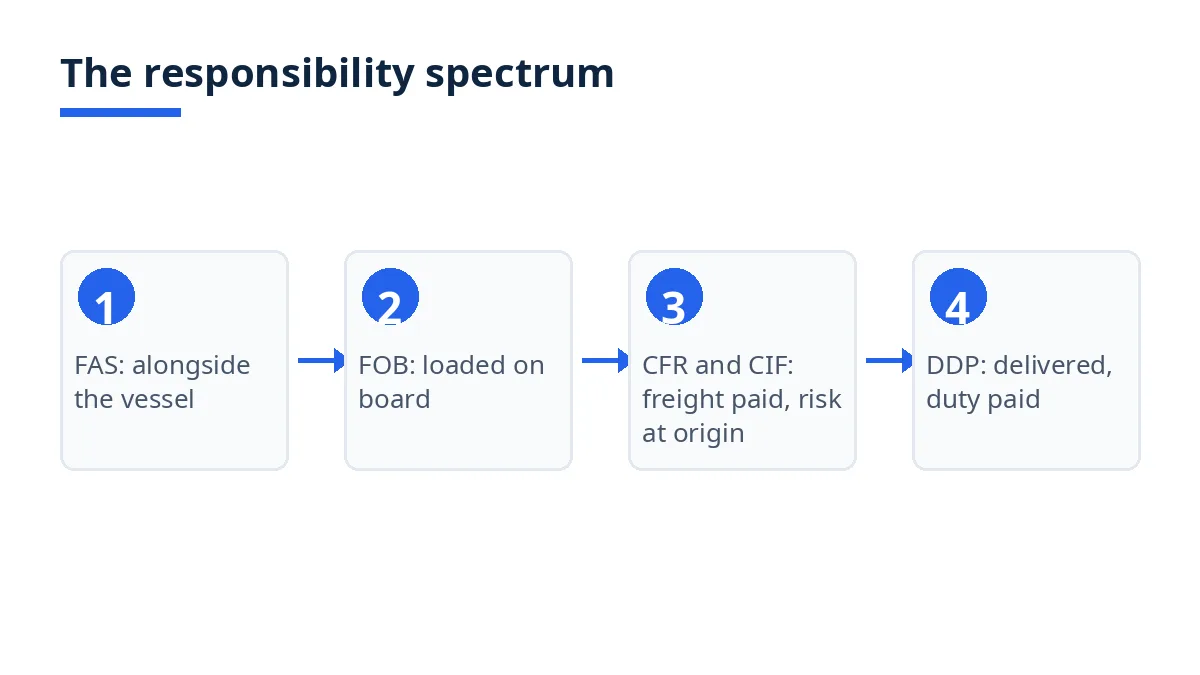
The table shows the real shape of the choice. FAS hands the buyer the whole journey from the ship's side onward. DDP hands the seller the whole journey from the factory to the buyer's door. The rules in between — FOB, CFR, CIF and DAP — split the journey at different points across the 11-rule set, and our comparisons of FAS vs DPU, FAS vs CPT, FAS vs CIF and FAS vs FOB work through those middle positions.3 4
Where the two rules diverge
The first divergence is customs. Under FAS the buyer is the importer: it files the import declaration, pays the duty, and answers to its own customs authority. Under DDP the seller is the importer of record in a country that is usually not its own. That is the step the ICC Academy describes as the one that may be difficult for a foreign seller, and it is the reason DDP suits sellers that already have a broker, a VAT registration or a local partner in the destination country.2
The second divergence is control of the voyage. Under FAS the buyer books the vessel, chooses the routing and negotiates destination free time with its own carrier. Under DDP the seller books everything, so the buyer has no say in the carrier, the routing or the transit time, and no visibility of booking changes at first hand. A buyer that needs a direct service or a tight delivery window gives that control away under DDP.
The third divergence is price transparency. A FAS quotation is a short price: goods, packing, inland transport and export clearance to the ship's side. Everything after that is the buyer's own cost, visible on its own invoices. A DDP quotation is a single landed price that bundles freight, duty and tax, so the buyer cannot see what the freight or the duty actually cost, and cannot check whether the duty was calculated on the right value. The two quotations are not comparable on unit price alone.
The fourth divergence is what happens when something goes wrong. Under FAS, if the goods are damaged during loading or at sea, the loss is the buyer's, to recover from its own insurer. Under DDP, the same loss is the seller's until delivery at the destination. That protection is real, but it is priced into the DDP quotation, and it does not include insurance unless the contract says so.
Worked example: the same shipment under FAS and DDP
Example figures. A buyer in Hamburg orders 500 cartons of jute shopping bags from a supplier in Chattogram. The goods value is $24,000. The figures below are illustrative, for comparing the two rules on the same shipment.
Cost line | FAS: who pays | DDP: who pays |
|---|---|---|
Goods, packing, inland transport, export clearance | Seller, in the $24,000 FAS price | Seller, in the DDP price |
Loading on board at Chattogram | Buyer, $800 | Seller, $800 |
Ocean freight Chattogram to Hamburg | Buyer, $3,400 | Seller, $3,400 |
Cargo insurance | Buyer, $300 (optional) | Seller, $300 if it buys cover |
Import duty, 5% of the $28,500 CIF value in this example | Buyer, $1,425 | Seller, $1,425 |
Delivery to the buyer's warehouse | Buyer, $600 | Seller, $600 |
Buyer's total outlay | $24,000 + $6,525 = $30,525 | $30,525, as one DDP price |
The arithmetic lands in the same place because the same costs are paid by someone either way. The difference is who arranges each step, who carries the risk while it happens, and who can see the cost. Under FAS the buyer spends $6,525 after the $24,000 invoice; under DDP the buyer pays one $30,525 invoice and the seller manages the $6,525. The duty base is an assumption in this example: it is charged here on the CIF value, but each importing country sets its own valuation basis, so confirm it with a customs broker before fixing the rule.3
Common mistakes
The first mistake is treating DDP as "all-in" cover. DDP is all-in on cost and clearance, not on insurance: the seller bears transit risk but is not required to insure it. A buyer that wants a policy it can claim on should write the insurance requirement into the contract, or buy DAP and insure the voyage itself.
The second mistake is using FAS for containers. A container handed to a terminal days before the vessel arrives does not sit "alongside the vessel", so the delivery point does not match the physical movement. Use FCA for containers, and keep FAS for bulk and breakbulk cargo loaded directly at the berth.1
The third mistake is naming a country instead of a place. "FAS Bangladesh" and "DDP Germany" do not fix a delivery point. Write the rule, the named port or address, and the edition, for example "FAS Chattogram, Incoterms 2020" or "DDP Buyer's Warehouse, Hamburg, Incoterms 2020".3
The fourth mistake is a seller agreeing to DDP in a country it has never imported into. Duty rates that turn out higher than expected, permits the seller did not know about, and VAT with no path to recovery all come out of the seller's margin. DAP is usually the safer starting point for a new market: the buyer clears import until the seller understands the destination's rules well enough to own them.2
Which one should you choose?
Choose FAS when the buyer has its own freight and customs arrangements, wants control of the voyage, or is buying bulk or breakbulk cargo that loads directly at the berth. The seller's obligation is short and clear, and the buyer sees every cost it pays after the ship's side.
Choose DDP when the buyer wants a single landed price with no customs work, and the seller already has the destination-country infrastructure: a customs broker, a VAT registration or a local partner, and a clear read on the duty rate. Without that infrastructure, DDP trades a simple quotation for a compliance job the seller may not be set up to do.
For most Bangladesh-to-Europe sea shipments, the practical middle ground is FOB, CFR or CIF, where the seller delivers on board and the buyer keeps import clearance. Start there, and move to FAS only when the buyer wants to control loading, or to DDP only when the seller can genuinely own the destination.
Next steps on Exportain
Compare the middle positions before you decide: FAS vs FOB for the one-step difference at the ship's side, and FAS vs DPU for a delivered term where the buyer still clears import. When you are ready to move, search Bangladeshi suppliers or post an RFQ — include your preferred rule, named place and edition in the requirement. Then read how to buy for the steps after the quotation.
Sources
- FAS Incoterms (Free Alongside Ship): Meaning and Use. iContainers (accessed )
- DDP Incoterms Explained: Who Pays, Risk Transfer & VAT. LegalClarity (accessed )
- FOB vs CIF, CFR or DAP for Food Shipments. Maqboola (accessed )
- Incoterms 2020 Explained: All 11 Rules, Chart & Meaning. Xflowpay (accessed )
About the author
Sourcing from Bangladesh?
Post a request for quotation and suppliers on Exportain can send you their quotes directly.
Post an RFQ