EXW vs CIF: Key Differences, Costs and Which One to Choose
A CIF price carries freight and a Clause C insurance policy to the named destination port; an EXW price carries neither. This comparison prices one tea shipment both ways, reads the policy inside the CIF price, and shows where cost, risk, insurance and clearance change hands.
Short answer
Under EXW, the seller places the goods at the buyer's disposal at the named place, the factory, and the buyer handles loading, export clearance, carriage and insurance from there. Under CIF, the seller clears the goods for export, loads them on board, pays ocean freight to the named destination port, and must buy Institute Cargo Clauses (C) insurance for the buyer. Risk passes on board under CIF, and import clearance and duty stay with the buyer under both terms.
On this page
Key takeaways
Under CIF the seller must buy minimum Institute Cargo Clauses (C) insurance for the buyer, for at least 110 percent of the contract price; under EXW the buyer arranges and pays for any cover itself.
Risk passes to the buyer on board at the port of shipment under CIF, while the seller keeps paying freight and the premium as far as the named destination port.
EXW leaves loading, export clearance, carriage and insurance with the buyer from the factory gate; CIF moves clearance, inland carriage, loading on board, freight and the premium to the seller.
CIF is sea and inland waterway only, needs a named destination port, and fits bulk and break-bulk cargo loaded on board better than factory-stuffed containers.
A CIF quotation usually arrives with a second document behind it: proof of a marine insurance policy, bought by the seller, in the buyer's favour. An EXW quotation arrives with no such document, no freight booking and no export clearance. The EXW figure answers what the goods cost at the factory. The CIF figure answers what the goods, the ocean freight and a minimum level of voyage cover cost together, as far as the named destination port. Comparing the headline figures without separating those parts is how a buyer mistakes a wider price for a dearer one, or mistakes a policy for protection it does not give.
The verdict: a price that carries a policy, against a price that carries neither freight nor cover
Under EXW, the seller's work ends when the goods are made available to the buyer at the named place, ready for loading, and the buyer pays for the lift onto its own vehicle and bears the risk of it.1 Under CIF, the seller delivers by placing the goods on board the vessel at the port of shipment, pays the ocean freight to the named destination port, and contracts insurance cover for the buyer against loss or damage from the port of shipment to the port of destination.2 Risk passes to the buyer on board under CIF, but the buyer already holds a policy the seller paid for. Under EXW the buyer holds whatever cover it bought itself, starting at the factory gate.
Point of comparison | EXW (Ex Works) | CIF (Cost, Insurance and Freight) |
|---|---|---|
Seller's price contains | Goods and export packing only | Goods, export packing, inland carriage, loading on board, ocean freight and the insurance premium |
Delivery and risk point | Goods made available at the named place, ready for the buyer's vehicle | Goods on board the vessel, at the port of shipment |
Ocean freight | Buyer books and pays | Seller books and pays, prepaid to the named destination port |
Marine insurance | Buyer arranges and pays, if cover is wanted | Seller must contract cover for the buyer and pay the premium |
Minimum cover level | None set by the term | Institute Cargo Clauses (C), unless the parties agree more |
Export clearance | Buyer | Seller |
Import clearance and duty | Buyer | Buyer |
Transport mode | Any mode, alone or combined | Sea and inland waterway only |
Choose CIF when the buyer has no insurance of its own, no carrier contract for the ocean leg and no agent in Bangladesh to run export clearance, and when the cargo can genuinely be loaded on board at Chattogram. Choose EXW only when the buyer can run the Bangladesh legs, buy its own cover from the factory gate, and beat the seller's freight and premium figures with its own contracts.
What each term means: the factory gate and the vessel
Under EXW, the seller delivers the goods typically at its own premises by making them available to the buyer, ready for loading onto the collecting vehicle the buyer arranged.1 The seller places the minimum obligation on itself of any Incoterms 2020 rule, handling no export formalities and no onward transport.1 Since the export side falls to the buyer, the guidance urges traders whose goods cross a border to consider FCA instead, and warns that EXW across a border can cause difficulty for seller and buyer alike.1 A buyer with no base in Bangladesh can also leave the seller recorded as the exporter of record, which complicates the export for both sides.1
Under CIF, the seller's obligations are essentially the same as under CFR, with one addition: the seller must contract for insurance cover for the buyer.2 The seller hands over the goods with the contract papers, loads the goods aboard by the agreed date or within the agreed period, pays the checking and packing costs delivery requires, charters and books the vessel, pays the freight and the carriage costs including loading and transport security on the usual routes, and handles export clearance.2 The buyer takes delivery on board at the port of shipment and collects the goods from the carrier at the destination port named in the contract, bearing the risk of loss or damage from the on-board moment and handling import clearance, duties and taxes.2
Only FAS, FOB, CFR and CIF are confined to sea and inland waterway transport. The eleven Incoterms 2020 rules divide into rules for any mode and rules for sea and inland waterway only, and CIF sits in the second group.3 A CIF term written onto an air shipment, a road movement or a multimodal journey that merely touches a vessel part-way names a rule that does not fit the carriage, while EXW carries no mode limit.1
The insurance difference: a policy bought for the buyer, and the gaps inside Clause C
Insurance is the only difference between CIF and CFR, and it is the whole reason CIF exists as a separate rule. Under CIF the seller must contract for insurance cover against the buyer's risk of loss of or damage to the goods, and the buyer can claim directly against the insurer if a covered loss occurs, with the seller not responsible for whether the claim succeeds.2 The seller pays the freight and buys the policy, but does not promise that the goods will arrive intact, in the stated quantity, or at all.2 A CIF price is a price for carriage plus a policy, not a promise of arrival.
The minimum the seller must buy is narrow. Incoterms 2020 kept Institute Cargo Clauses (C) as the default level of cover for CIF, while raising the CIP minimum to Institute Cargo Clauses (A), and the parties may agree a higher level.3 Clause (C) is cover for a selection of expressly named risks, and the sum insured is 110 percent of the goods' sales value in the contract currency.4 The named risks include fire and explosion, stranding, capsizing and general average measures.4 Theft is not insured under that minimum, and a buyer that wants wider protection, for example against war or strikes or for goods that are fragile, valuable or attractive to steal, must agree the wider cover in advance and bear the additional cost.4 The insurance must be taken out with a reputable provider, the cover extends from the point of delivery to the named destination port, and the seller must provide proof of insurance to the buyer.4
Before shipment, ask for the policy or certificate and read four entries: the insured amount against 110 percent of the contract price, the clause letter, the currency, and the destination named in the policy. Compare like with like on cover, not only on premium: an EXW buyer that buys its own Clause (A) cover from the factory gate may hold wider protection than a CIF buyer holding the seller's Clause (C) policy. Put the clause letter and any upgrade in the purchase order. Timing matters too: under EXW the buyer's policy must be live from the moment the goods are placed at its disposal, while under CIF the seller's policy covers the voyage from loading on board to the named destination port.4
Cost, risk and responsibility, leg by leg
Add the buyer-paid column to each seller price before ranking two quotations written on different terms.
Task or cost | EXW: seller | EXW: buyer | CIF: seller | CIF: buyer |
|---|---|---|---|---|
Goods and export packing | Pays | No | Pays | No |
Lifting onto the buyer's vehicle at the premises | No | Pays, at own risk | Pays, inside the move to the port | No |
Inland carriage to the port of shipment | No | Pays and arranges | Pays and arranges | No |
Origin handling and loading on board | No | Pays and arranges | Pays and arranges | No |
Export clearance and documents | No | Pays and arranges | Pays and arranges | No |
Ocean freight to the named destination port | No | Pays and arranges | Pays, prepaid | No |
Marine insurance premium | No obligation | Pays, if wanted, from the factory gate | Pays, minimum Clause (C) cover for the buyer | Pays only for cover above the minimum, where agreed |
Unloading, quay dues and destination handling | No | Pays | Depends on the carriage contract; confirm in writing | Pays unless the carriage contract puts the cost with the seller |
Import formalities, duty and delivery after arrival | No | Pays | No | Pays |
Cost and risk part company under CIF in a way they do not under EXW. Under EXW both move together at the factory gate. Under CIF the seller keeps paying as far as the destination port while the buyer carries the risk from loading on board, because the C rules split the cost point from the risk point, with the seller arranging and paying for transport to the named destination while the buyer bears the risk of that transport.5 The seller pays for transport to the named port and for the export side, including customs clearance, inspections and transport security.4 The buyer pays for unloading at the destination port, quay dues and import and transit expenses unless otherwise specified, and for any higher insurance cover it wants.4
Worked cost example: bagged black tea from Chattogram to Genoa
Example figures only. Ask a forwarder, an insurer and a broker to price every leg again before ordering. The buyer in this example orders bagged black tea in sacks from an estate factory outside Chattogram, shipped break-bulk from Chattogram to Genoa in Italy. Tea suits the CIF pattern: a bulk-type cargo loaded on board at the port, where the seller has direct access to the vessel.2 The insurance leg is priced in both columns: under CIF the premium sits inside the seller's price, and under EXW the same premium is paid separately by the buyer for its own cover, on the same figures for comparability. Actual premiums differ by insurer, clause and cargo.
Price element | EXW at the factory | CIF Genoa |
|---|---|---|
Goods and export packing | 14,800 | 14,800 |
Lifting onto the collecting vehicle at the factory | Buyer pays 95 | 95 |
Export clearance and documents | Buyer pays 275 | 275 |
Inland carriage, factory to Chattogram port | Buyer pays 410 | 410 |
Port handling and loading on board at Chattogram | Buyer pays 235 | 235 |
Ocean freight, Chattogram to Genoa | Buyer pays 2,340 | 2,340 |
Marine insurance premium | Buyer pays 142 | 142 |
Seller's quoted price | 14,800 | 18,297 |
Still to pay after the seller's price, to the destination port | 3,497 | 0 |
Buyer total to Genoa port, before duty and destination charges | 18,297 | 18,297 |
The chart under the table shows the two seller prices with the remaining buyer-paid legs alongside.
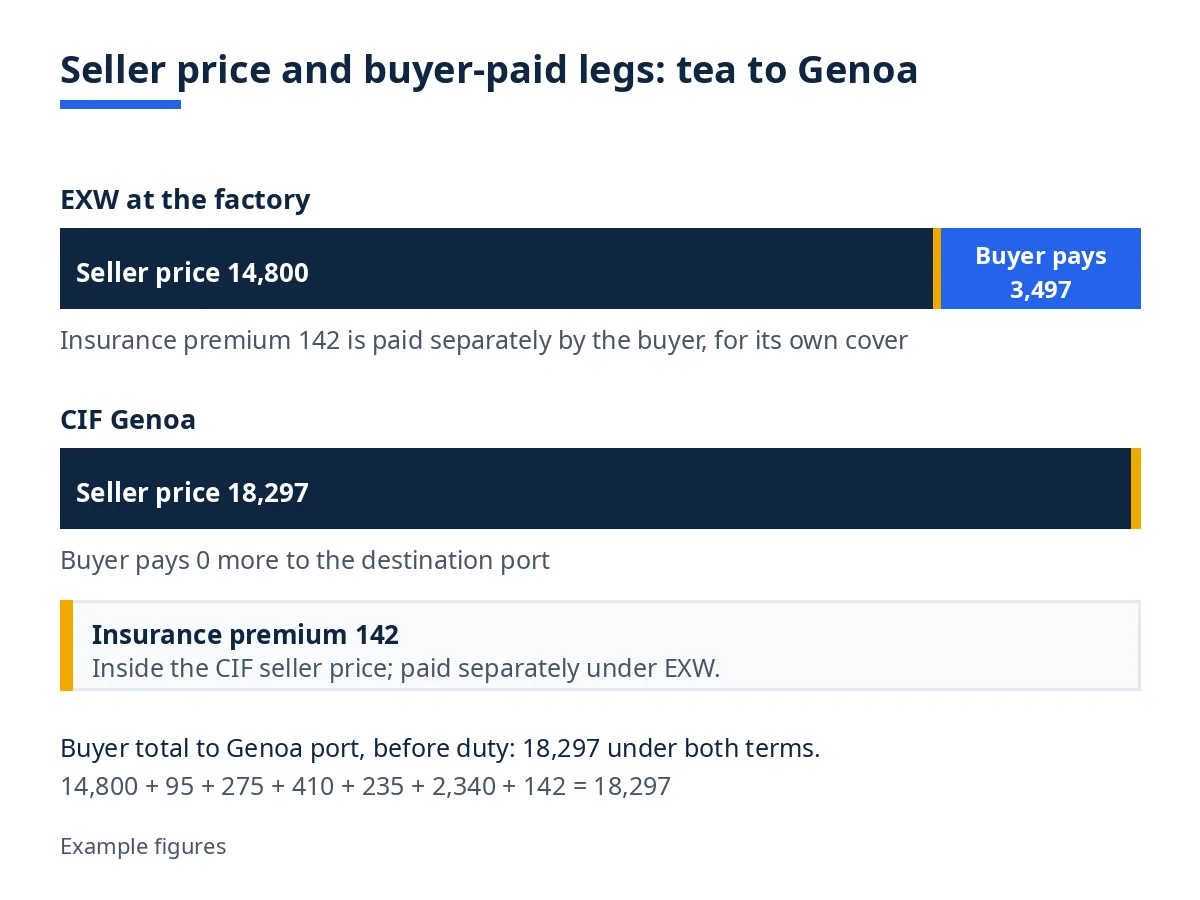
The end figure matches in the two columns: nothing about the cargo or the voyage has changed, only which side settles each leg. The arithmetic is 14,800 plus 95 plus 275 plus 410 plus 235 plus 2,340 plus 142, which equals 18,297, and the quoted-price gap, 18,297 minus 14,800, is 3,497, the legs the CIF seller has absorbed. On these example figures the Clause (C) policy would insure 110 percent of the CIF contract price, which is 20,127, in the contract currency.4 Duty in Italy, import clearance, unloading and quay dues where the carriage contract excludes them, and delivery after arrival all fall outside both totals. No duty rate appears here: take the duty question to a broker before fixing a price. A CIF quote that looks 3,497 higher than an EXW quote is not 3,497 more expensive: it is 3,497 of freight, clearance, handling and insurance still unbought.
When to choose each option: cargo shape, control and the named port
Choose CIF for bulk and non-containerised cargo loaded on board at the port, where the seller has direct access to the vessel and the buyer has no cargo insurance of its own.2 A buyer that cannot buy voyage cover locally, or that wants one price to the destination port with a policy attached, gains the most from it. CIF also fits a buyer that values a single seller-side booking over control of the sailing: the seller chooses the vessel, the line and the usual route, and the buyer accepts that choice in exchange for prepaid freight and a policy it can claim on directly.2
Choose EXW where the buyer already runs the Bangladesh side and wants the freight and insurance decisions in its own hands: a carrier able to collect at the factory, a forwarder able to clear the export, an insurer that covers the cargo from the factory gate on Clause (A) wording, and ocean contracts that beat the seller's rate on the lane. Without that cover, the buyer takes on work it cannot supervise, and clearance is the stage most likely to delay the order.
Two cautions apply to CIF that do not apply to EXW. The first is the container gap. Containers are usually delivered to a terminal and wait there before loading, and the seller cannot always fulfil a CIF delivery that requires the goods to be placed on board by the seller itself; the risk in the terminal-to-loading transition then remains with the seller, and CIP is the better rule for containerised cargo.4 The delivery guidance reaches the same point, treating FCA as typically the better choice for goods in containers even on a sea voyage.5 Reserve CIF for cargo loaded on board in bulk or break-bulk form, loaded where the seller can watch it go aboard.
The second caution is the named destination port. Where no specific port is agreed, the seller may opt for the cheapest nearby port, leaving the buyer with unexpected land transport, storage and delay.5 Write the complete term in the purchase order, CIF Genoa, Incoterms 2020, for example, naming the port and, where it matters, the terminal. Add the clause letter, the currency of the insured sum, and the point up to which the seller bears destination costs, since the stations after arrival each carry a charge and the contract of carriage decides who bears them.4
Bangladesh-specific considerations: clearance, the insurance document and supplier habit
Export clearance in Bangladesh is the practical reason many overseas buyers move from EXW to CIF. Section 131 of the Customs Act, 1969, bars loading or stuffing any export consignment before Customs approves the export declaration, the Bill of Export.6 The declaration records what is being shipped, its value, who exports it, who buys it and who carries it.6 The sale papers are the export letter of credit. Where there is no letter of credit, an approved contract, purchase order or guarantee from the negotiating bank stands in its place.6 The remaining papers travel with it: the packing list, the signed commercial invoice, the authorised-dealer-certified EXP form, the VAT registration certificate, the taxpayer identification number and the certificate of origin.6 Product-specific documents can also apply, including Export Registration Certificates, which jute goods and tea may need.6 Once Customs has checked the papers and inspected the consignment, approval follows, and the export is complete once the vessel leaves the port, with the officer marking the second copy shipped on board.6 Cargo stuffed at a private depot, or on the exporter's own site, can face a gate-officer check before it travels to the port.6 Under CIF the seller files and pays for this clearance. On EXW terms that filing falls to the buyer, which is where an overseas buyer without a Bangladesh agent commonly gets stuck.1
The insurance document has a second use buyers miss. The import-side document list for goods entering Bangladesh includes an insurance policy or cover note among the papers submitted with the import declaration.6 That list concerns imports into Bangladesh, not imports into the buyer's own country, so it does not set the buyer's destination requirements; it does show why a seller that already issues a policy and a certificate under CIF is the side likelier to produce the insurance paper quickly. Ask the seller, under either term, which document evidences the cover and when it will be sent.
Supplier habit follows the same split. A seller that already books sailings and files its own export declarations will usually quote CIF without difficulty. A factory with no export staff and no forwarder relationship will usually quote EXW only. When posting a requirement, name the term and the destination port for a CIF quote, ask for the clause letter and the insured sum, and ask for freight, clearance, handling and premium as separate lines. A CIF quote with no named port, no clause letter and no leg split cannot be compared with anything.
Which is cheaper, EXW or CIF?
The EXW headline sits lower, yet the combined spend for the same movement comes out identical in the example: 18,297 before duty and destination charges, with the same premium counted in both columns. CIF costs more only when the seller's ocean freight or premium exceeds what the buyer could buy for the same sailing and the same clause, or when the seller has added a margin to either leg. Set the quotation beside every cost still to pay, for the same sailing and the same two ports, with cover starting on the same date and the same clause letter, before calling either term cheaper. A CIF total that buys only Clause (C) cover is not cheaper than an EXW total that buys Clause (A) cover if the cargo is the kind Clause (C) leaves exposed.
Which is safer for first-time importers, EXW or CIF?
CIF is safer for a first order, provided the buyer reads the policy. The seller handles export clearance, the move to the port, loading, prepaid freight and a policy the buyer can claim on, so no agent in Bangladesh and no separate insurance purchase is needed for the voyage.2 EXW leaves the buyer carrying the risk from the moment the goods are made available to it, with loading, clearance, carriage and cover to arrange itself, and the guidance warns that EXW across a border can cause difficulty for seller and buyer alike.1 The condition on CIF is the clause: the minimum is Clause (C) cover for named risks only, so a first-time importer of fragile, high-value or theft-prone goods should agree Clause (A) or (B) wording, or buy supplementary cover, before shipment.4 Confirm the destination port in writing and hold the policy or certificate before the vessel sails.
Can I switch terms after the PO?
It can, if both sides agree the change in writing before dispatch and the paperwork is brought into line with the new term. The sale contract is where the term lives, so a change means a revised order, a new price, and invoice, packing list, transport document and any letter of credit all updated to match.2 Moving from EXW to CIF adds the legs the seller takes on, including the premium, and the revision must also record the clause letter, the insured sum and the destination port. Moving the other way takes the premium and the freight out of the seller's price and returns the insurance purchase to the buyer, whose policy must then run from the factory gate. A risk position that has already begun cannot be undone by a later revision: once the goods have been made available under EXW, or loaded on board under CIF, that position stands. Settle the change before dispatch.
Which do Bangladeshi suppliers prefer, EXW or CIF?
It turns on what the seller is set up to do, so record the answer in the RFQ rather than assuming it. A seller that already books sailings and files its own export declarations will usually quote CIF without difficulty, and may favour it because the sailing and the policy stay in its hands. A factory with no export staff and no forwarder relationship will usually quote EXW only, and a seller quoting CIF without naming the port, the clause or the insurer is quoting a price that cannot be checked. In the requirement, name the term and the destination port, ask for the clause letter, the insured sum and the insurer, and ask for freight, clearance, handling and premium as separate lines. What matters is not the seller's habit but the paper behind the price: a CIF quotation with a policy attached, and an EXW quotation with the buyer's own cover already arranged.
Next steps on Exportain
Read CIF in full for the minimum cover and the insured sum. See what EXW covers ahead of any factory-gate quote. The CIF insurance duty page sets out the documents to ask for. Turn both prices into one landed-cost figure, compare the eleven rules, and ask for quotations through how buying works.
Sources
- FCA & EXW Incoterms® 2020 explained: Key differences. ICC Academy (accessed )
- CFR & CIF Incoterms® 2020 explained: Key differences. ICC Academy (accessed )
- Incoterms® 2020. International Chamber of Commerce (ICC) (accessed )
- CIF (Cost Insurance and Freight) | Incoterms 2020. Röhlig Logistics (accessed )
- Place of delivery & risk transfer in trade contracts. ICC Academy (accessed )
- Customs Clearance Procedures for Export. Bangladesh Customs, National Board of Revenue (accessed )
About the author
Sourcing from Bangladesh?
Post a request for quotation and suppliers on Exportain can send you their quotes directly.
Post an RFQ