Private Label Sneakers Manufacturing in Bangladesh: A Brand Owner's Guide
Put your brand on a factory-made sneaker: one versioned brand file, six approval gates, label and box checks per market, and print floors counted per colourway.
Short answer
Private label sneakers from Bangladesh put your brand on a shoe a factory already makes: its shape, pattern, and sole unit are settled, and you add the name, marks, colours, and retail pack. Send one versioned brand file with identity, marks, colour references, size, label wording, box, and ownership sheets, approve artwork, colour, and sample pairs through six signed gates, and check labelling, origin marking, and classification for each market before bulk.
On this page
Key takeaways
Private label starts from a shoe the factory already makes; a new pattern, shape, or sole unit crosses into OEM work and must be priced as OEM work.
One versioned brand file carries the identity, marks, colour references, size, label wording, box, and ownership sheets that every supplier prices against.
Count print floors as well as pairs: labels and boxes carry minimums of their own, and colourways multiply print sets one for one.
Labelling, origin marking, and classification differ by market: EU materials labelling, US origin marking, and broker-settled classification must each be checked on the sealed pair.
Six signed gates, from a locked brand file to bulk inspection against the sealed pair and pack, keep the second order the same shoe as the first.
A private label sneaker order buys a finished shoe and a printed identity at the same time. The name on the tongue, the print inside the shoe, the box, and the code a till scans all come from files the brand owner supplies. This guide is for a buyer in the USA, UK, EU, or UAE who owns the brand. Every money figure is an illustration, marked as example figures.
Private label, white label and OEM: which job is this?
Private label, white label, and OEM are three starting points. In a private label job, the factory offers a shoe it already produces, in an existing shape and build, and the buyer adds a brand layer: name, marks, colors from the factory range, and retail pack. In a white label job, the shoe and pack change hardly at all, and the buyer may add only a sticker or hang tag. In an OEM job, the buyer supplies the design first, as a technical pack, and the factory builds a shoe it has not built before. Settle the starting point in writing before sampling: name the shoe, state which parts the buyer may change, and state which changes turn the job into OEM work.
Ownership follows the same split. The factory normally keeps the shoe shape, pattern, and sole unit. The buyer keeps the brand assets it supplies: word mark, logo artwork, label artwork, and box artwork. Write the split into the order file before sampling, and add any exclusivity by market, period, and style agreed in writing. Check the brand name before artwork goes to print. Search the trademark registers and ordinary trade use for a name already in use, or close enough to an existing one to cause confusion, before adopting it, and take legal advice where a close mark appears: a search done first avoids disputes and wasted print.1 Registering a company name, on its own, creates no trademark rights, and in the United States rights arise first from actual use in commerce.1
What a factory needs in your brand file before it quotes
A factory cannot price a branded shoe from a logo image alone. It needs a brand file: one folder, one version number, holding every file and decision the factory will print, stitch, or pack. Send it before the quotation, so every supplier prices the same branded shoe. A change after the quotation is a new quotation, because a new label size, box print, or color reference can change a print minimum or a sample round.
Brand file item | What to send |
|---|---|
Identity sheet | Word mark, logo versions, smallest sizes, clear space, colors |
Marks sheet | Each mark, position, size, method: print, emboss, or woven label |
Color references | Physical swatch or printed reference per color, per material |
Size sheet | Size system per market, size range, width, size wording |
Label wording sheet | Materials, origin, and care or safety wording per market |
Box and pack sheet | Box artwork, end-label fields, barcode numbers, pairs per carton |
Ownership sheet | Who owns each asset, exclusivity, reuse limits |
Name one file owner to approve every change, and record each approval with file name, version, and date.
How to hand over logo, color and type so the shoe prints right
Send the logo as a vector file the printer can scale without softening, plus a raster copy at the size it will print, so the factory never rebuilds the mark from a small image. Supply a simplified version for small marks, where fine lines close up. Name the typeface, supply the font files or outlined text the printer needs, and state the smallest letter height for each mark.
Judge color on the material it lands on, not on a screen. A color on a woven tongue label, a heel emboss, a cardboard box, and a mesh upper will read as four colors even from the same reference, because each material takes color differently. Agree one physical reference per color and per material, judge every proof against it under one agreed light, and record the reference, material, and light on the proof sheet.
Barcodes belong in the brand file, not in a late email. Each packaging level should carry its own unique Global Trade Item Number (GTIN): the retail pack, inner case, and outer case are different levels, and GS1 UK describes two ways to number them, either a different GTIN-13 at every level or GTIN-14s built from the retail GTIN-13.2 Where sneakers will be supplied into retail, a GTIN-13 must be assigned to the retail pack and carried in an EAN-13 barcode.2 Supply the numbers, barcode artwork, and end-label fields in the brand file, and proof the code by scanning a printed sample.
MOQ, tooling and colorway minimums for a private label run
Three floors sit under a private label minimum, each counted differently. The first is the shoe floor: the smallest run the factory will make of one style, counted per order, per style, or per colorway, as the quotation states. The second is the print floor: labels, boxes, and hang tags come from other suppliers, each with a minimum of its own, and a custom label made only in large runs can drive the order minimum even when the shoe quantity is acceptable. The Exportain MOQ guide records this point, that custom labels, hang tags, printed polybags, and branded cartons each bring their supplier minimum.3 The third is the tooling floor, usually small or zero here, because the sole unit and shoe shape already exist. It returns only when the buyer asks for a new sole, last, or mold, and then the job is OEM work.
Count the order in print sets, not only in pairs. Example figures throughout this section. Two styles in three colorways give six print sets: each combination needs its own label check, box end label, and shade agreement. At 500 pairs per colorway, one style needs 1,500 pairs (500 x 3 = 1,500), and two styles need 3,000 pairs. Order brand materials with spares: for 3,000 pairs, order 3,300 sets of labels and boxes (3,000 + 300 = 3,300). Ask the quotation to state each floor separately, and read the Exportain guide to counting a minimum when comparing quotations. Fewer colorways cut the print floors one for one.
Labeling, packaging and compliance by market
Labeling is the part of the brand layer a regulator reads first. Wording on the shoe, box, and shipping papers must describe the same pair. Build one label sheet per market, checked against the sealed pair.
European Union rules ask for the materials of the outer sole, the upper, and the lining and sock on the footwear label.4 A material is named only when it covers 80 percent or more of its part; otherwise the label gives the two main materials.4 Words or pictograms are both allowed. At least one shoe in each pair must carry the label, which must stay visible, firmly attached, and within reach; for imported footwear, accuracy rests with the person who first places it on the EU market.4 REACH Annex XVII limits harmful chemicals in consumer products, and compliance can be demonstrated by check testing or a raw-materials audit.5 The SATRA summary lists aromatic amines from azo dyes at 30 mg/kg in dyed textiles and leather, chromium VI at 3 mg/kg in leather, cadmium at less than 100 mg/kg in plastics and synthetic rubbers, and polycyclic aromatic hydrocarbons at less than 1 mg/kg in polymers.5 Ask for a test record that names its method and the batch it covers.
United States law requires the English name of the country of origin on every foreign-origin article, marked where the ultimate purchaser will see it, as conspicuously and as durably as the article allows.6 For the United Kingdom, confirm labeling, classification, and duty with the broker for the exact pair, and do not assume EU wording transfers unchanged. Heading 6404 covers footwear with textile uppers and outer soles of rubber, plastics, leather, or composition leather, and the UK schedule puts sports footwear under 6404 11, a subheading covering tennis, basketball, gym, and training shoes.7 Commodity 6404 1100 00 carried a third-country duty of 16.00 percent on the UK tariff page for 5 April 2025.7 For the UAE, ask the broker and a notified body in writing whether the pair falls under a regulated conformity scheme and what Arabic and English wording applies.
Sampling, approval and QC gates
Each gate approves one thing only. Hold bulk until every gate is signed, and require a fresh gate whenever the item it covers changes.
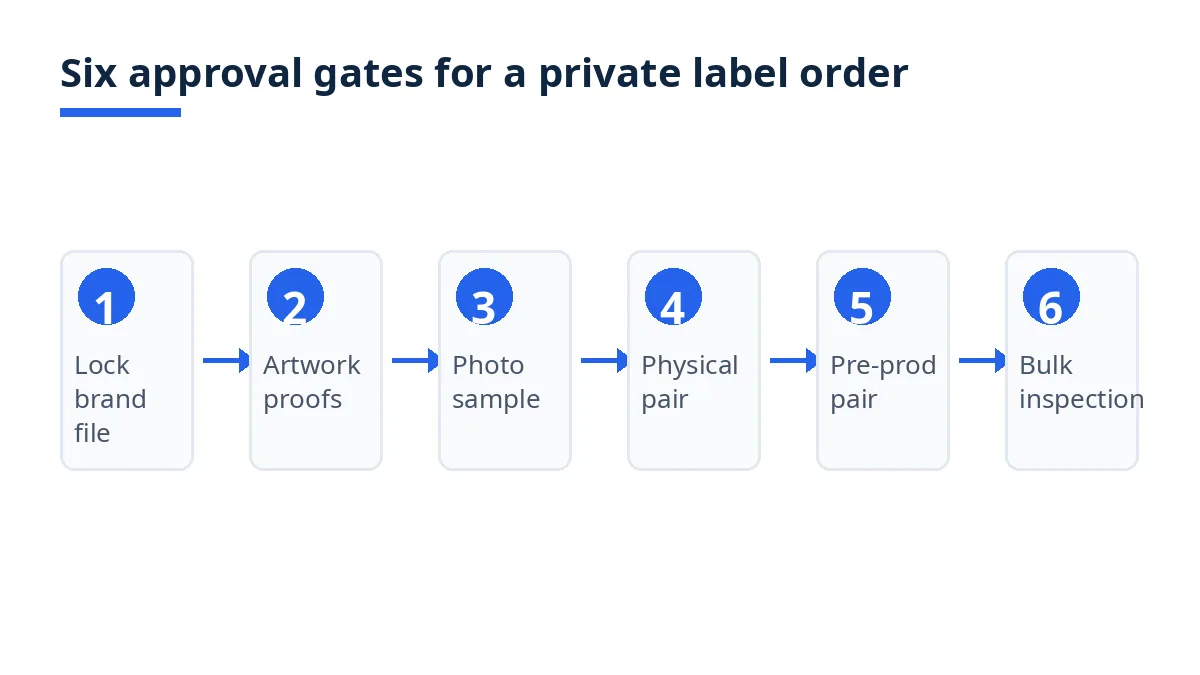
Brand file locked. Identity, marks, color, size, label, box, and ownership sheets at one version number.
Artwork proofs. At actual size, on the actual materials, checked after flexing.
Photograph. The sample pair wearing every mark, so position and scale errors are caught early.
Physical sample pair. Worn and checked for fit, shade, and durability, in three sizes.
Pre-production pair. Made on the bulk line, packed as bulk will be packed.
Bulk inspection. Against the sealed pair and proof sheets.
No gate is passed on a photograph alone, except gate three. Inspect bulk against the sealed pair and pack. Where a gate fails, record the failure, fix, and new version, and re-run the gates the fix touches.
Costs, timelines and payment structure
Ask for four lines in every quotation: the pair price with its delivery rule, brand setup charges, sample charges, and inspection charges, each stated separately with its own validity date. Only FAS, FOB, CFR and CIF are confined to sea and inland waterway transport.8 The ICC Academy advises FCA for containerized sneakers handed to a carrier at a terminal, because a container can sit at the terminal for days before loading.8 Every quotation should name the rule and year, the named place or port, and who clears import customs and pays duty.
Example figures only, for one style in two colorways. Brand setup 620 US dollars, samples across two rounds 340 US dollars, inspection 280 US dollars, and a print-spare reserve 160 US dollars give a brand-side total of 1,400 US dollars (620 + 340 + 280 + 160 = 1,400). A late colorway adds a print run and a sample pair. Put each payment beside the gate it follows, so money never runs ahead of approval.
Mistakes and red flags
A brand name printed before it is cleared. A search after the boxes are printed is a reprint order. Search each selling market first.1
Label wording copied from another market or a catalog. Wording and the responsible person differ by market. Check it against the sealed pair for each market.4 6
A barcode never scanned in print. A code that reads on screen can fail on cardboard. Scan a printed box sample, and number each packaging level with its own code.2
A quotation with one pair total and no print floor. Labels and boxes carry minimums of their own. Ask for the shoe floor, each print floor, and any tooling line separately.3
Checklist: a first private label sneakers order
Do not release bulk until each line below is complete for every style-and-color combination.
Line | Record it exactly |
|---|---|
Starting point | Private label, white label, or OEM, in writing |
Brand name | Clearance search per market, advice where a close mark appears |
Brand file | One folder, one version, all seven sheets |
Artwork | Vector files, smallest sizes, signed proofs at actual size |
Color | Physical reference per color per material, light agreed |
Print floors | Shoe, label, and box floors, count, basis, surcharge |
Label and pack | Wording per market checked on the sealed pair, codes scanned, carton marks agreed |
Gates | Six gates signed; sealed pair and pack held |
Money and delivery | Pair price, setup, samples, inspection, delivery rule, payment per gate |
Evidence | Firm name and address matched across papers |
How Exportain helps a brand owner
Exportain lets a brand owner put the same brand file in front of several Bangladeshi suppliers at once, so every answer addresses the same specification and can be set side by side. Shortlist from the Bangladeshi supplier listings. Open profiles one by one and read each badge record before ranking anyone. Each badge records a document and photograph review by Exportain staff. It records no factory visit, no check against a government database, and no promise about capacity, quality, or delivery.9 Membership plans never grant a badge.9
The Leathergoods and Footwear Manufacturers and Exporters Association of Bangladesh, on its own site, is the sector's trade body.10 Read any certificate evidence for site, scope, and expiry. On Exportain, read how Exportain records each badge check during shortlisting, and test quotations against the Exportain minimum-counting guide, which states the counting basis and trim drivers behind a minimum.3 9 Compare the wholesale sneaker terms for resale assortments.
Can I use a factory catalog shoe as my own private label sneaker?
Yes, where the shoe stays on the factory pattern, shape, and build, and the buyer adds only the brand layer: name, marks, chosen colors, and retail pack. Name the catalog shoe and state which changes cross into OEM work.
What brand files must a sneakers factory receive before it can quote a private label order?
One versioned brand file: identity sheet, marks sheet with position, size, and method, physical color references per material, size sheet per market, label wording sheet per market, box sheet, and ownership sheet.
How do label and box minimums change the smallest private label sneakers order?
Label and box suppliers set minimums of their own, which can drive the order even when the shoe quantity is acceptable.3 Count the order in print sets, one per style-and-color combination, and ask the quotation to state the shoe floor, each print floor, and any surcharge below it separately. In the example figures here, two styles in three colorways need six print sets and 3,000 pairs at 500 pairs per colorway, and dropping one colorway cuts both totals.
Which labeling rules must a private label sneaker meet in the USA, UK, EU, and UAE?
EU: materials of the upper, lining and sock, and outer sole at or above 80 percent, or the two main materials; the first placer answers for accuracy.4 USA: the English country-of-origin name, marked conspicuously and durably for the ultimate purchaser.6 UK and UAE: confirm with the broker and, for the UAE, a notified body, before shipment.
Next steps on Exportain
Send each supplier the same brand file and gate list, so replies can be compared on the shoe, label, and box. Start from the Bangladeshi supplier listings, read how Exportain records each badge check, then test every quotation against the Exportain guide to counting a minimum and accept only quotations that pass it.
Sources
- To Search or Not to Search, That is the Question – Company Name vs. Trademark Clearance. Nelson Mullins, (accessed )
- How do I identify packaging levels?. GS1 UK (accessed )
- MOQ Meaning (Minimum Order Quantity). Exportain (accessed )
- Footwear labelling. European Commission, EUR-Lex (accessed )
- How REACH Annex XVII affects the manufacture of consumer products. SATRA (accessed )
- 19 CFR § 134.11 — Country of origin marking required. Cornell Law Institute (accessed )
- Footwear with outer soles of rubber, plastics, leather or composition leather and uppers of textile materials. GOV.UK (accessed )
- FOB & FAS Incoterms® 2020 explained: Key differences. ICC Academy (accessed )
- How Supplier Verification Works on Exportain. Exportain, (accessed )
- President's Message - LFMEAB. Leathergoods and Footwear Manufacturers and Exporters Association of Bangladesh (LFMEAB) (accessed )
About the author
Sourcing from Bangladesh?
Post a request for quotation and suppliers on Exportain can send you their quotes directly.
Post an RFQ