Wholesale Sneakers From Bangladesh: Prices, MOQ and Reliable Suppliers
Buying wholesale sneakers from Bangladesh is an assortment decision before it is a price decision. This guide covers stock and made-to-order lines, size runs, quotation lines, reorder terms and the documents that must match the pairs in the cartons.
Short answer
Wholesale sneakers from Bangladesh are bought as an assortment of styles, colours and sizes, counted the way the supplier counts the order, and repeated on agreed reorder terms. Settle stock lines against made-to-order lines, plan the size run, compare quotations line by line on the same delivery term, approve a sample pair of each colour, and agree reorder, distributor and document terms in writing before the first shipment. All figures here are example figures, and duty is broker-confirmed.
On this page
Key takeaways
Buy the assortment, not a pair price: styles, colours and the size run, counted on the supplier's stated basis, decide whether a wholesale order works.
Stock lines ship from finished pairs; made-to-order lines are produced for the order. Ask which parts are already held and what can still change, and until when.
No duty rate is stated: the broker confirms the full national code and duty line for the exact pair and destination market before pricing.
Agree the smallest reorder, price validity date, repeat time and distributor terms in writing before the first shipment, and review sell-through before reordering.
A wholesale sneaker order from Bangladesh is an assortment order before it is a price order. A distributor or retailer buys a spread of styles, colours and sizes that must sell together through a season, then buys the same spread again when the first stock runs low. Every price, quantity and time figure here is an example figure, labelled as such. No market price, factory capacity or standard minimum is stated as fact. Export earnings for leather and leather goods reached 1.14 billion US dollars in the 2024-25 financial year, up 10.19 percent on the year before, according to Export Promotion Bureau figures reported in New Age.1
The wholesale decision in brief
The first decision is the channel shape: stock lines that ship from finished stock, made-to-order lines that enter production only after the order is placed, or a mix of the two. The second decision is the assortment: the styles, colours and sizes in one order, counted the way the supplier counts it. The third decision is the repeat: agree reorder terms before the first shipment.
Stock lines, made-to-order lines, and the middle ground
A stock line is a sneaker the supplier already holds as finished pairs, in named colours and sizes. The order moves to packing and shipment without a production run. The advantage is time. The limits are choice and freshness.
A made-to-order line is produced for the buyer's order, to the buyer's chosen colours, materials and size run. The advantage is control. The buyer usually commits to the full quantity in the agreed counting basis. Ask which parts of the pair are already held, and record the answer with a date after which no change is accepted without a new quotation. The Leathergoods and Footwear Manufacturers and Exporters Association of Bangladesh is the sector trade body.2
Build the assortment before you ask for a price
An assortment plan answers four questions before any price is discussed: which styles, which colours of each style, which sizes of each colour, and how many pairs of each size. A supplier may count a minimum per order, per style, per colour, per style and colour together, or per size group. The table below shows how one assortment grows under a per-style-and-colour counting basis, using example figures throughout.
Assortment line | Counting basis (example figures) | Pairs |
|---|---|---|
Style A, 2 colours | 240 pairs per style and colour | 480 |
Style B, 2 colours | 240 pairs per style and colour | 480 |
Style C, 2 colours | 240 pairs per style and colour | 480 |
Whole assortment | 6 style-and-colour combinations | 1,440 |
6 x 240 = 1,440 pairs. If the same supplier instead counted 240 pairs per style, the same three styles would need only 720 pairs. Agree the size list in the buyer's market sizing, with the supplier's size chart beside it. Packing is part of the assortment: agree pairs per carton and carton markings. In the worked example, 1,440 pairs at 12 pairs per carton gives 120 cartons; at 10 pairs per carton, the same order gives 144 cartons.
Run the wholesale cycle: from first RFQ to the second reorder
A wholesale cycle has six stages, and each stage produces a written record the next stage relies on. The diagram puts the cycle on one page.
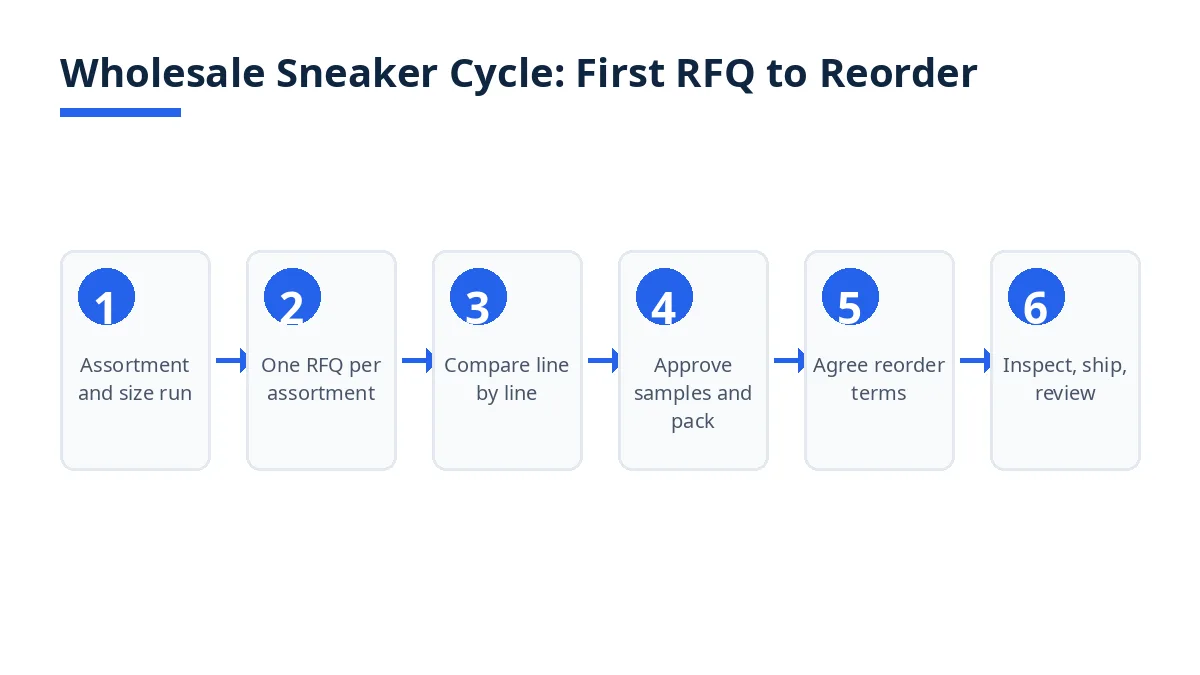
Set the assortment and size run, and write the specification for each style: upper material, lining, sole unit, colour references, labelling, and pack.
Send one request for quotation per assortment, stating the counting-basis question, delivery term, destination, and reorder question, so every supplier answers the same brief.
Compare quotations line by line, on the same counting basis, delivery term, and pack, before ranking on price.
Approve sample pairs and the pack on the same paperwork the bulk order will carry, and record every change that follows the sample.
Agree reorder and distributor terms in writing before the first shipment leaves.
Inspect the finished pairs against the approved sample, ship on the agreed documents, and review sell-through before reordering.
A sample pair approved in one colour does not approve every colour. Approve one pair of each colour, in the pack it will ship in, with the labelling it will carry, and keep one approved pair as the inspection reference.
What a wholesale quotation must state, line by line
Rank quotations only when every line below is present and stated the same way. A quotation that omits a line is not cheaper; it is incomplete.
Quotation line | What to check |
|---|---|
Style, colour and size run | Matches the buyer's plan, in the buyer's sizing |
Counting basis and total pairs | Per order, per style, per colour, or per combination, with the total |
Pair price and price basis | Delivery term and named place or port, with currency |
Pack | Pairs per carton, carton count, box or polybag, markings |
Sample and approval | Sample pairs and approval steps |
Inspection | Who inspects, against what reference pair, and what happens to pairs that fail |
Payment schedule | Deposit, balance, and documents against payment |
Reorder terms | Smallest reorder, price validity period, and repeat production time |
Do not trade away the inspection line or the sample line to cut the price.
The worked example below builds a landed cost from example figures, with duty left for the broker to confirm. No duty rate is stated in this guide, because none was established for the buyer's market and the exact pair.
Landed-cost line (example figures) | Amount |
|---|---|
Pair price, 1,440 pairs at 6.20 US dollars per pair | 8,928.00 US dollars |
Freight and insurance to the destination port (example figure) | 1,150.00 US dollars |
Import charges and broker fees (example figure) | 320.00 US dollars |
Duty | Broker-confirmed rate applied to the customs value; insert here |
Total before duty | 10,398.00 US dollars |
Cost per pair before duty | 7.22 US dollars |
1,440 x 6.20 = 8,928.00; plus 1,150.00 and 320.00 = 10,398.00; divided by 1,440 = 7.22 US dollars per pair, rounded. Rework every line with the broker's duty figure, the carrier's freight figure, and the supplier's confirmed pair price before comparing the result with a domestic purchase or a retail price. No transit time or production time is stated as fact in this guide.
Bangladesh rules that shape a wholesale sneaker order
Classification starts with the Harmonized System, an international classification system developed by the World Customs Organization, organised in sections, chapters of two digits, headings of four digits, and subheadings of six digits, and used by more than 200 countries and territories as the basis for customs tariffs and trade statistics.3 For sneakers, the upper material decides much of the classification. Chapter 64 covers footwear, and the Canadian tariff schedule for 2025 shows heading 6404 for footwear with outer soles of rubber, plastics, leather or composition leather and uppers of textile materials, with subheading 6404.11 for sports footwear such as tennis shoes and training shoes.4 The same schedule states the chapter rule that the material of the upper is the constituent material with the greatest external surface area, ignoring accessories and reinforcements such as ankle patches, edging, ornamentation, buckles, tabs and eyelet stays.4 Treat 6404 as indicative only, and have the broker confirm the full national code, the duty line, and any preference position for the destination market before pricing.
Labelling rules decide what must appear on the pair itself. In the European Union, footwear labelling covers the materials of the upper, the lining and sock, and the outer sole, and only a material covering 80 percent or more of the surface area of the upper or the lining and sock, or 80 percent or more of the volume of the outer sole, needs to be labelled; where no single material reaches 80 percent, the two main materials are labelled.5 The label may be written or in pictogram form, must be visible, securely attached and accessible, and must appear on at least one shoe of each pair.5 Where the footwear is imported, the person who first places it on the EU market is responsible for the label and its accuracy.5
Under Incoterms® 2020, the sea and inland-waterway-only rules are four: FAS, FOB, CFR and CIF. CPT is an any-mode rule, DPU is an any-mode rule, and DDP is an any-mode rule, under which the seller clears the goods for import and pays duty. Only two rules, CIP and CIF, place an insurance obligation on the seller, and in the C rules the seller contracts for freight to the destination while risk passes to the buyer much earlier, at delivery to the carrier or on board at the port of shipment.6 The four sea-only rules are intended for port-to-port shipments and are not suitable for container shipments in their current form.6 Name the rule, the version year, and the named place or port in the contract.
Reorder terms and distributor terms worth agreeing in writing
Agree the reorder terms before the first shipment, in the same document as the first order. Settle in writing the smallest reorder, counted the same way as the first order; the price validity period, stated as a date; the repeat production time, counted from the reorder date; and whether broken sizes can be topped up alone or only as part of a full assortment.
Distributor terms go further. Settle the territory in writing, by country or by region, and state whether exclusivity applies, for how long, and what sales volume keeps it. Settle what happens to remaining stock if the arrangement ends. Settle the handling of faulty pairs: who receives returns, who pays return freight, and how replacements are counted against the next order.
Wholesale mistakes that leave stock you cannot sell
Wholesale mistakes show up as stock, not as paperwork. Ordering the assortment from a catalogue, without a size run shaped by the buyer's own sales, leaves the ends of the run unsold. Comparing quotations on pair price alone, without the counting basis, pack, inspection line and delivery term, ranks an incomplete quotation above a complete one. Approving a sample in one colour and assuming the other colours match misses shade differences that customers see at once. Agreeing reorder terms by conversation, without a written price validity date, leaves the second order open to a new price the buyer did not budget for. Read how Exportain checks the documents and photos behind a badge before shortlisting, and keep the sample, inspection and payment checks in place whatever the profile shows.
Wholesale readiness checklist for the first container
Use this checklist before the first container is booked.
Check | Written answer needed |
|---|---|
Assortment and size run | Styles, colours, sizes and pair counts, in the buyer's sizing |
Counting basis | Per order, per style, per colour, or per combination, with the total in pairs and cartons |
Stock or made-to-order | Which lines ship from stock, which enter production |
Sample approval | One approved pair of each colour, in its pack, with its labelling |
Quotation lines | Pair price, delivery term with named place, pack, inspection, payment schedule, shipment window, reorder terms |
Classification and duty | Full national code and duty position from the broker, for the exact pair and destination |
Labelling | Label artwork, material wording and pictograms agreed, checked on the approved sample pair |
Delivery term | Rule, version year, named place or port, and who clears the goods for import, in the contract |
Documents | Invoice, packing list, transport document, origin proof, and any inspection evidence |
Reorder and distributor terms | Smallest reorder, price validity date, repeat time, territory, and faulty-pair handling, in writing |
What should I settle first about wholesale sneakers from Bangladesh?
Settle the channel shape, the assortment, and the repeat before discussing price in detail. Decide which lines ship from stock and which are made to order, plan the styles, colours and size run, and agree the counting basis the supplier uses. Then agree reorder terms and price validity in writing.
What do wholesale sneaker costs and timelines depend on for a distributor?
Wholesale sneaker costs depend on the pair, the pack, the delivery term, and the duty position for the destination market. The pair price follows upper material, sole unit, lining, trims, closing and lasting work, inspection and packing. The landed cost adds freight, insurance, import charges and duty, each confirmed for the exact consignment. Timelines depend on whether the line ships from stock or enters production, on the shipment window, on carrier schedules, and on entry and inspection at the destination. No production time or transit time is stated as fact in this guide.
Which documents must a wholesale sneaker shipment carry?
The commercial invoice gives the description of the goods, their value, and the terms of sale, and serves as the basis for customs valuation; in Bangladesh the invoice must include the Export Registration Certificate number and the Harmonized System code, and must agree with the other export documents.7 The packing list gives the packaging picture, including each package type, quantity and weight.7 The certificate of origin certifies the country of origin and supports duty and preference positions, and exporters obtain the appropriate certificate from their local chamber of commerce or another authorised body.7 Exporters in Bangladesh must hold an Export Registration Certificate from the Export Promotion Bureau.7 Match the description, value, quantity, code and origin statements across the whole set.
What mistakes most often strand wholesale sneaker stock?
The mistakes that strand stock are assortment mistakes, made early and found late. Buying the full colour range of every style without sales evidence spreads the order thin. Buying a size run copied from another market, without the buyer's own sales pattern, leaves the wrong sizes behind. Approving one sample colour and assuming the rest match misses shade differences. Ranking quotations on pair price without the counting basis, pack, inspection and delivery term compares unlike with unlike. Leaving reorder terms and price validity to conversation leaves the second order without a price. Set a sell-through review date at the first order, count sales by style, colour and size, and let the reorder follow the evidence.
Next steps on Exportain
Start by searching the directory of Bangladeshi suppliers on Exportain with the assortment plan and the reorder questions from this guide in hand, then read the checks behind each badge, explained, and what a minimum order quantity counts, before ranking any quotation.
Post a free RFQ on Exportain and get quotes from verified Bangladeshi suppliers
Sources
- Leather, leather-goods exports see 10pc growth. New Age (accessed )
- President's Message - LFMEAB. Leathergoods and Footwear Manufacturers and Exporters Association of Bangladesh (LFMEAB) (accessed )
- Harmonised System. European Commission (accessed )
- Chapter 64: T2025 — Footwear, gaiters and the like; parts of such articles. Canada Border Services Agency (accessed )
- Footwear labelling. European Commission, EUR-Lex (accessed )
- Insider thoughts: Bob Ronai on Incoterms 2020 Rules; What are they about?. International Chamber of Commerce (accessed )
- Essential export documents for shipping from Bangladesh. DHL (accessed )
- MOQ
- supplier verification
- Incoterms 2020
- HS Codes
- Bangladesh sourcing
- Footwear Bangladesh
- Wholesale buying
- Sneakers
About the author
Sourcing from Bangladesh?
Post a request for quotation and suppliers on Exportain can send you their quotes directly.
Post an RFQ