Custom Sneakers Manufacturer in Bangladesh: OEM Process From Tech Pack to Bulk
A custom sneaker OEM order in Bangladesh runs from a tech pack through six sample gates: proto, fit, salesman sample, size set, pre-production, and top of production, with tooling, materials, labeling, and AQL checks settled in writing before bulk.
Short answer
A custom sneaker OEM order in Bangladesh runs from a tech pack through six sample gates to bulk: proto, fit, salesman sample, size set, pre-production, and top of production. The buyer supplies the design, flats, measurements with tolerances, bill of materials, and construction notes. The factory supplies the last, pattern, tooling, and line. Agree tooling ownership, colorways, labeling, and the AQL inspection plan in writing before bulk starts.
On this page
Key takeaways
OEM means the factory builds your design from your tech pack; private label puts your brand on a shoe the factory already makes.
The pack decides the price and the sample outcome: flats with callouts, measurements with tolerances, a panel-by-panel bill of materials, construction notes, grading, colorways, and labels.
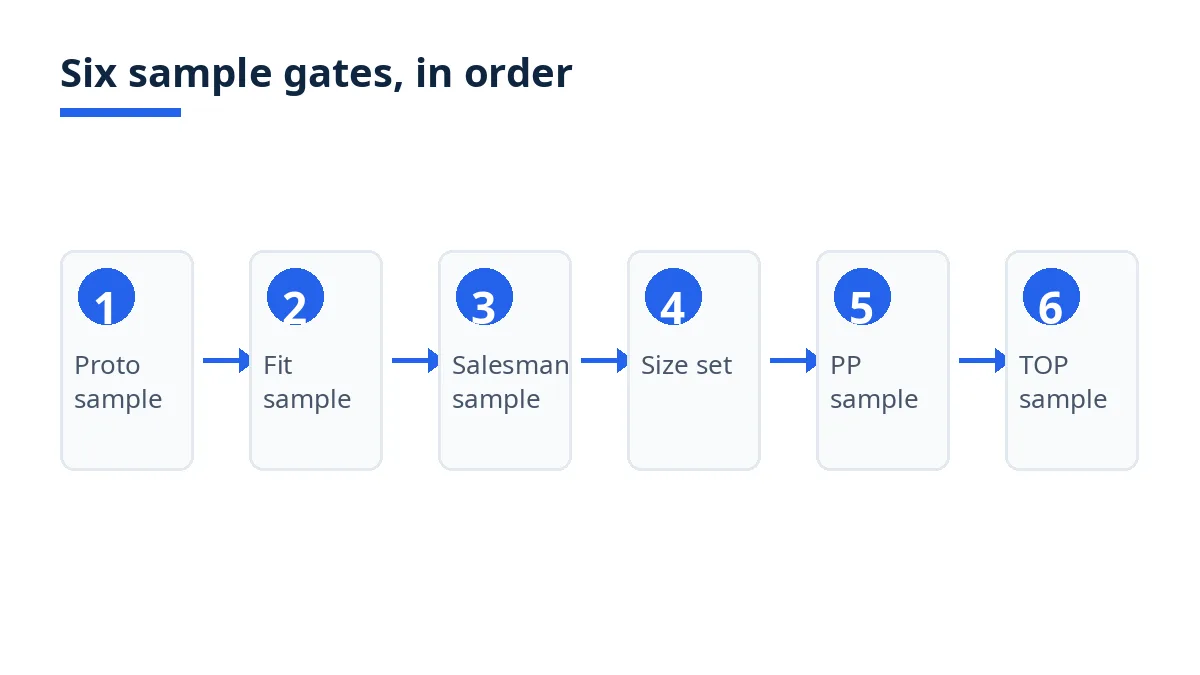
Six gates in order: proto, fit, salesman sample, size set, pre-production, and top of production, each with a decision before the next opens.
Settle tooling and mold ownership, the construction method, colorways, labeling, and the AQL inspection plan in writing before bulk starts.
A custom sneaker order moves through locked decisions. The design is fixed on paper, proved in pairs, proved again across sizes, and only then cut in bulk. A buyer who treats it as one purchase, priced once and checked at arrival, finds each skipped decision again as a correction, a second sample round, or a carton that does not match the approved pair.
This guide follows one custom sneakers order in Bangladesh from the first document to the bulk sign-off, for USA, UK, EU, and UAE buyers. Nothing here presents a price, minimum, or lead time as a fact about Bangladeshi factories. Figures used to show arithmetic are labeled as example figures, and a customs broker must settle the duty figure.
What OEM means for a sneaker, and what it does not
OEM, for sneakers, means the factory builds a shoe to the buyer's design. The buyer owns the silhouette, the panel layout, the sole shape, and the color story. The factory owns the means of making it: the last, the pattern, the tooling, and the line. A private label order works the other way round. The shoe already exists in the factory's range, and the buyer adds a brand, a label, and sometimes a color. A white label order is the same idea sold without a brand, for the buyer to brand later.
Name the route in the first message to a factory and ask the factory to confirm it back in writing, because the route decides which documents change hands: an OEM order needs a full specification, since the factory has no existing shoe to work from, while a private label order needs only a short one. A manufacturing agreement should state, before sampling starts, who owns the drawings, the pack, and any pattern or mold built for the buyer's design, whether the factory may run the design for other buyers, and what happens to patterns and molds when the order ends.1 Release the pack in stages, with a confidentiality term signed first, instead of handing the full design to every factory that quotes.1
The tech pack a sneaker factory prices from
Think of a tech pack as the factory's working instruction for one style: the document it prices from, samples from, and cuts from.1 A sneakers pack gathers the flats, construction notes, measurement pages, bill of materials, and costing sheet for that one style, and every page carries a version number.2 1 A sketch on its own yields only a rough estimate, because no sketch shows the materials, trims, or labor time a price must rest on.1
Start with the size range and the sample size. The factory makes its first mockup from the sample-size measurements, and once that size is accepted, it makes a size set covering every size named in the pack.2 The flats carry the design: side and top views show how the pair must look when built, the pattern maker develops the pattern for the sample size from those drawings, and a callout marks every seam, panel edge, trim position, and logo placement.2 Add the sole view where the tread or the sole edge carries design detail. A fashion illustration leaves proportions and hidden parts for the factory to interpret; a flat with callouts does not.1
The measurement page lists the full length, the width, the height, the sole width at the back, the sole width at the front, the opening, and the opening-to-toe distance, each with a callout showing how the measurement is taken.2 Attach a plus-or-minus value to each point of measure. With no agreed tolerance, nobody can say whether a sample pair or a bulk pair passes or fails.1 The bill of materials is the page factories cost from. Sneakers are built from many parts, from action leather for mudguards to lining materials and lace eyelets, and the bill must name each one, with its supplier or swatch, its color reference, and its quantity per pair.2 From that list, the costing sheet works out what one pair costs and what the full run costs, including labor, the listed materials, labels and tags, and packaging.2 Hold on to each pack version issued, since sampling revises the pack more than once.2
Sampling in order: proto, salesman sample, size set, pre-production, top of production
Sampling runs as a sequence of rounds with separate jobs. After each round, the pack changes to record what was learned, and the approved pre-production pair stays filed beside the pack version it matches, so a wrong bulk delivery can be checked against both.1 Check every pair in hand, against the pack version in force for that round, rather than from photographs.
Proto sample. The first pair tests whether the design works at all, often in substitute materials. Judge construction, proportions, and trims.1
Fit sample. This round tests fit and checks each measurement at the base size, using a form or a wearer. Last assessment looks at whether a last's dimensions suit the market it is aimed at, and it includes fitting trials when a range is new.3 Approval here covers that one size and no other.
Salesman sample. Samples made for buyers, lookbooks, and pre-orders, carrying the final colorways, artwork, and trims.1 Treat this round as a colorway and artwork check, not as a bulk approval.
Size set. One pair per size checks the grading rules across the full range.1 Never start bulk cutting from a base-size approval alone.
Pre-production sample. The PP pair uses the bulk materials and bulk trims, carries the final labels, and ships in the final packing. From here on, it is the standard bulk is measured against.1
Top-of-production sample. The TOP pair comes out of the first bulk run, and its job is to show that production pairs still match the PP pair.1 A mismatch stops bulk until the change behind it is named.
The diagram below shows the six gates in order.
Price the rounds before sampling starts: how many the price covers, the charge for going beyond them, and who pays sample freight. A vendor's figures, not independent research, put complete tech packs at one to two sampling rounds per style against three to five for incomplete ones.1
Tooling and mold decisions you make before sampling ends
Three decisions must be settled while the sample gates are still open, because each is expensive to reopen after PP approval: the sole unit, the construction method, and who owns the lasts, patterns, and molds. The sole unit question is whether the outsole and midsole arrive as a stock unit the factory already buys, or as a custom unit made for this style.
Construction comes first in the pack, because it limits the materials the shoe can use. In cold cement work, the upper is steamed, the last is inserted and pulled tight, temporary laces are pulled tight, and the upper is cooled so it shrinks to the last, often with a Strobel bottom: a thin sheet stitched under the upper that cuts weight and adds flex.4 While the upper is lasted, the sole unit is prepared in a separate stock-fitting step: a rubber sheet sole combined with an EVA foam cushioning part, cemented inside.4 The sole unit and the upper each receive primer and cement, the parts are joined by hand after drying, and the shoe goes through three presses, vertical, toe-and-heel, and side, then cooling to set the bond.4 Cold cement allows modern lightweight plastic, foam, and mesh, because the bonding temperatures stay low.4
Vulcanized construction narrows the material list. Only a metal last survives the curing heat, so plastic lasts are out, and EVA foam is out too, since that heat breaks it down.4 The upper is board lasted, the uncured rubber foxing tape is made just before assembly, the tape must cover 5 mm of the upper for a solid bond, and the shoe is heated in a vulcanizing oven for several hours, with the last still inside, until the tape and sole unit fuse.4 Name the construction in the pack in plain words, and require a fresh sample gate whenever it changes.
Fixed charges thin out per pair as volume rises. Example figures only: a mold and last charge of USD 3,900 spread over 1,300 pairs adds USD 3.00 per pair (3,900 / 1,300 = 3.00). The same charge spread over 6,500 pairs adds USD 0.60 per pair (3,900 / 6,500 = 0.60). Ask whether the charge is billed once or spread into the pair price, across how many pairs it is spread, and how repeat orders are treated. Cover who owns the tooling, where it is stored, how long it is kept, and whether it may be reused, in the quotation too, including the case where the charge is zero because a set already exists. A manufacturing agreement should say that patterns, samples, tech packs, and molds belong to the buyer, that the factory cannot make the styles for anyone else, and that it will return or destroy them at the end.1
Materials, colorways and labeling: the pages that change bulk
Materials are settled panel by panel, not as one material for the whole shoe. The bill of materials names each panel, and the colorway page names each color combination with its color references, the artwork with its size and placement, and which trims change color from one colorway to the next.2 1 Each extra color can carry its own minimum, so an unplanned colorway changes the quote, and a color agreed after the material batch is fixed reopens the shade agreement and the sample pair for that colorway.1 Lock the colorway list before batch orders go in, and approve one pair of each colorway in its final pack.
Labeling is part of the pack, not a packing afterthought. Write the exact label wording and placement yourself, and check it on the approved sample pair.1 For the EU, the label must identify the materials of three parts: upper, lining and sock, and outer sole. A material is named only when it makes up at least 80 percent: 80 percent of the upper's surface area, 80 percent of the lining and sock's surface area, or 80 percent of the outer sole's volume. If no material reaches that share, the label names the two main materials instead.5 Labels may use words or pictograms. Each label must stay visible, firmly attached, and easy to reach, and at least one shoe in every pair must carry it. For imported footwear, responsibility for the label's accuracy sits with whoever first places the shoes on the EU market.5 The USA, UK, and UAE positions are not stated here: ask the broker to confirm the labeling and marking rules for each of those markets.
Start classification from the pair itself. The deciding factors are the upper and outer sole materials, the type and purpose, ankle coverage, insole length, heel height, and the intended wearer.6 For the upper, count the constituent material with the largest external surface area, ignoring accessories and reinforcements like ankle patches; for the outer sole, count the material with the largest ground-contact area.6 A leather-led upper sits in heading 6403, and a textile-led upper sits in heading 6404.6 Do not assume a trainer is sports footwear: the UK guidance lists tennis, basketball, gym, and training shoes under the sports-footwear subheadings, and states that trainers do not classify as sports footwear unless they are tennis shoes, basketball shoes, gym shoes, training shoes, and the like.6 Treat any heading as a starting point only, and ask a broker to settle the duty figure. This guide states no duty rate.
QC gates and AQL-style checks during bulk
Quality control is a set of gates, not one inspection at the end. Inspection and testing run at the raw material, in-process, and finished-product stages, and the amount examined and the characteristics checked are often agreed at the tender stage and form part of the contract.7 Write the inspection plan into the commercial terms before bulk starts: who inspects, at which stages, against which approved pair, and the remedy for failed pairs. In-process gates catch faults a finished-pair check finds too late: check closing, lasting, the sole bond after pressing and cooling, and finishing before packing, each against the pack version current at that stage.
The final gate is a sampling plan, agreed in numbers before shipment. There are no international rules that set sampling requirements specifically for footwear, and a daily or batch-testing regime for key tests is better than testing once per season, per style, or per color.7 The ISO 2859-1 sampling procedures work by attributes: an agreed acceptable quality level (AQL) decides whether a batch is accepted after a percentage of the batch has been inspected, on the assumption that the rest of the batch behaves the same way.7 The inspection level and the batch size fix how many pairs are inspected, and the AQL fixes whether the batch passes or fails.7
Faults are classed before inspection, in words an inspector can apply the same way twice. A critical fault is a potential safety problem, such as a loose heel; a major fault is a potential problem likely to lead to notable returns, such as a failed seam; a minor fault is a potential problem likely to give rise to some returns, such as loose thread ends.7 The inspected batch should contain no critical faults, major faults are often set at 1 percent or 2.5 percent acceptability, and minor faults are often set at 2.5 percent or 4 percent.7 The table below reproduces part of the ISO 2859-1 single sampling plan for normal inspection, showing the sample size and the minimum number of defective pairs that rejects the batch.7
Batch size | Sample size | Critical faults, AQL 0 percent | Major faults, AQL 1 percent | Minor faults, AQL 2.5 percent |
|---|---|---|---|---|
281 to 500 | 50 | 1 | 2 | 4 |
501 to 1,200 | 80 | 1 | 3 | 6 |
1,201 to 3,200 | 125 | 1 | 4 | 8 |
3,201 to 10,000 | 200 | 1 | 6 | 11 |
Use the plan as a starting point for agreement, not as a standard every factory follows. Agree the inspection level, the AQL for each fault class, and the fault list itself in writing, and require that the sample spread covers the ends of the size range and every colorway. When a batch is rejected, the rework and re-inspection terms should already be written: who reworks, who pays, and which gate the reworked pairs re-enter through.
Costs, timelines and payment milestones
Read a quotation as blocks, each tied to a pack section: the bill of materials and grading set the material block, the flats and construction notes set the labor block, the artwork page sets decoration, and the construction and compliance pages set testing.1 Insist that every factory quotes on the same delivery term. On FOB terms, the price stops once the goods are on board at the port of shipment, and freight, insurance, and import costs sit with the buyer; on DDP terms, the seller carries the goods through to delivery with duties paid.1 Only FAS, FOB, CFR, and CIF are confined to sea and inland waterway transport. The rest work on any mode, including CPT, DPU, and DDP, and DDP leaves import clearance and duty with the seller.
Tie payment to the gates, not to the calendar alone. Example figures and an example schedule only: sample and tooling charges settled before bulk, a deposit released at PP approval, and the balance paid against the inspection result and the shipping documents, with each release naming the gate it pays for. Agree in writing what happens to the deposit if a gate fails. No payment split is stated here as a market practice, because none was verified for this order type. Set the calendar gate by gate, naming a date and an owner for each, and treat no day count in this guide as a standard. Mold making, mold trials, and a new colorway each add their own stage, and a sample pair approved from one mold or one colorway does not approve the next.
Before shortlisting on Exportain, read how the checks behind each badge are recorded, and open supplier conversations only once the pack is written and the route is named. Exportain is not a party to the goods contract, and it neither inspects goods nor books freight nor clears customs. Verify the export registration and trade license yourself, and settle in writing, before any money moves, the Incoterm, the payment terms, the inspection plan, and the shipment terms.
Mistakes and red flags on a first custom sneaker order
Sending an illustration instead of flats, so the factory interprets the design and proportions drift.1
Naming a material as a feeling, such as soft mesh, so the factory prices the cheapest material that fits the words.1
Approving the salesman sample as if it were the PP pair, so bulk is judged against a pair made for looks, not for the line.
Changing the construction method after the fit sample, so the fit approval belongs to a shoe built a different way.
Adding a colorway after the batches are fixed, so shade, sample, and count must be settled again.
Changing the last after the fit sample, so the fit approval belongs to a shape bulk will not use.
Judging bulk from photographs, which hide fit, stretch, shade, and sole-bond hold.
Leaving label wording to the factory, so the market's required information is wrong or missing.1
Leaving ownership of patterns, lasts, and molds unwritten, so the first successful order becomes the dispute.
A price with no sample line, no tooling line, and no inspection line is not a lower price. It is a quotation with the fixed costs still to come. Ask for the missing lines before ranking it against a complete one.
The bulk sign-off checklist
A blank row means its gate stays open. Complete each row from the pack version and sample pair named there, never from memory.
Line | Record it exactly |
|---|---|
Pack version | Version number, date, and confirmation that the factory holds the same version |
Route and ownership | OEM route confirmed, design and mold ownership, return or destruction terms |
Last and fit | Last identifier, size system, width, fit-sample result, end-size checks |
Sole unit and tooling | Sole unit, stock or custom mold, construction method, tooling charge and spread |
Materials and colorways | Panel materials, color references, colorway list, batch identity per colorway |
Labels and packing | Label wording and placement, pairs per carton, carton marks, artwork version |
Gates approved | Proto, fit, salesman sample, size set, and PP approvals, with signer, date, and pack version |
Inspection plan | Fault classes, AQL levels, sample size, inspector, rework terms |
Price and payment | Unit price, delivery term, validity, milestone releases, gate-failure terms |
Documents | Quotation, purchase order, gate approvals, inspection record, invoice and packing list |
Can I start a custom sneaker order with a reference pair instead of a tech pack?
A reference pair can start the conversation, but it cannot carry the order. A factory can give a rough estimate from a sketch or a reference pair, but not a reliable price, because the materials, trims, and labor time cannot be read from either one.1 Use the reference pair to settle fit and construction direction, then build the flats, the measurement page, the bill of materials, and the construction notes before the first sample is made. Keep the reference to fit and construction, and put your own design in the pack.
How many sample rounds should a custom sneaker order budget for?
Budget for the six gates, and price the rounds in the quotation before sampling starts. A vendor's figures, not independent research, put complete tech packs at one to two sampling rounds per style against three to five for incomplete ones.1 The number that matters is the number the quotation covers: how many rounds are included, the charge for going beyond them, and who pays sample freight. A gate that fails on a named point is a correction, not a failure of the process; the pack is updated, the version is bumped, and the gate is run again.
When does a new colorway need a new sample pair?
A new colorway needs a sample pair whenever it changes the shade, the material batch, the artwork, or the trims. The salesman sample proves the colorways and artwork, and the PP pair proves them again in bulk materials, so a colorway added after PP approval needs its own PP check in that colorway before bulk. Approval in one colorway says nothing about the shade of another. Set the colorway list in stone before batch orders go in.
What changes force a fresh sample gate after PP approval?
Any change to the last, the construction method, the sole unit or mold, a panel material, the colorway list, or the label artwork forces a fresh gate, because each one changes the shoe the PP pair approved. The new pair is judged against the updated pack version, and the old PP pair is kept beside it, so bulk has one approved standard, not two. Changes agreed in conversation, without a pack update and a version bump, leave nobody able to prove which version was approved.1
Who owns the lasts, patterns and molds after a custom sneaker order?
Ownership follows the manufacturing agreement, not the payment of a tooling charge. The agreement should say that patterns, samples, tech packs, and molds belong to the buyer, that the factory cannot make the styles for anyone else, and that it will return or destroy them at the end.1 Settle storage, retention, and reuse in the quotation as well, including whether a repeat on the same mold set is charged again. If the freelancer who drew the pack holds the rights, get a written assignment before the pack goes to a factory.1
Next steps on Exportain
With the route named and the pack written, shortlist from the Exportain supplier directory. Before you send anything, read the supplier badge checks explained, and use the minimum quantity counting guide to test the order total the colorway list produces. Give every factory the same pack version.
Sources
- Fashion Tech Pack: What a Factory Needs to Quote You. Fashion Law Journal, (accessed )
- How to Create a Tech Pack for a Pair of Sneakers. Techpacker, (accessed )
- Footwear fit and comfort. SATRA (accessed )
- Vulcanized Shoe Construction vs. Cold Cement Process. Shoemakers Academy, (accessed )
- Footwear labelling. European Commission, EUR-Lex (accessed )
- Classifying footwear for import and export. GOV.UK (accessed )
- Assessing footwear using statistical sampling techniques. SATRA (accessed )
About the author
Sourcing from Bangladesh?
Post a request for quotation and suppliers on Exportain can send you their quotes directly.
Post an RFQ