EXW vs CPT: Key Differences, Costs and Which One to Choose
A CPT quotation looks like a delivered price, but risk passed at the first carrier in Bangladesh. This comparison prices one container of towels two ways and shows where cost, risk and paperwork change hands.
Short answer
Under EXW, the seller places the goods at the buyer's disposal at a named place, usually the factory, and the buyer handles loading, export clearance, carriage and insurance. Under CPT, the seller clears the goods for export, hands them to the carrier it contracted, and pays carriage to the named destination, but risk passes to the buyer at handover to the first carrier. The seller owes no insurance under either term.
On this page
Key takeaways
CPT names two places: risk passes at handover to the first carrier, while the seller pays carriage to the named place of destination.
EXW leaves loading, export clearance, carriage and insurance with the buyer; CPT moves export clearance and main carriage to the seller.
Neither term obliges the seller to insure the goods; CIP is the same carriage rule with seller-bought Clause A cover added.
For container loads that change mode, CPT matches the real handover at the first carrier, where CFR and the other sea-only rules do not.
A factory-gate quotation and a freight-paid quotation for the same towels can sit several thousand dollars apart without either side charging more for the towels. The gap is the road to the depot, the export paperwork, the ocean leg and the rail leg to an inland terminal, plus who carries the risk while those legs run. Under one term the buyer settles every leg on its own. Under the other, the seller has settled the carriage to the destination in advance, yet the buyer has carried the risk since the first carrier took the cartons in Bangladesh.
Two places in one contract: the CPT verdict table
CPT names two different places, and reading it as if it named one causes most disputes. The named place of destination is where the seller's freight obligation ends. The place of delivery is where the seller gives the goods to the carrier, and that is where risk moves. In a Bangladesh export those places are usually thousands of miles apart: a depot near Dhaka on the one hand, and a rail terminal, port or airport in the buyer's country on the other.
Point of comparison | EXW (Ex Works) | CPT (Carriage Paid To) |
|---|---|---|
Delivery point | Goods made available for collection at the agreed spot, usually the seller's own site, before loading | Goods handed to the seller's contracted carrier, at the delivery place and point agreed |
Risk passes | At the moment the goods are made available for collection, before loading | When the goods are handed to the first carrier |
Named destination | None in the term itself | Named place of destination, to which the seller pays carriage |
Loading at the factory | Buyer pays for the lift and takes its risk | Covered by the seller's carriage arrangement in the worked example; confirm who loads in the contract |
Export clearance | Buyer | Seller |
Main carriage | Buyer contracts and pays | Seller contracts and pays to the named destination |
Insurance | Buyer arranges any cover; seller owes none | Buyer arranges any cover; seller owes none |
Import clearance and transit customs | Buyer | Buyer |
Onward carriage past the destination | Buyer | Buyer |
Choose CPT when the cargo moves by container through more than one mode and the buyer wants a single freight price to an inland destination, provided the buyer understands that risk started at the first carrier. EXW suits only a buyer with someone on the ground in Bangladesh who can pick the load up, clear it, and book it onward.
What EXW and CPT each require, in plain terms
Under EXW, the seller's job is the smallest the Incoterms® 2020 rules allow. The seller makes the goods available for collection at the agreed spot, most often its own yard or warehouse, ready for the buyer's truck.1 The buyer pays to lift the cartons onto its vehicle, takes the risk on that lift, and deals with all export paperwork.1 The rule works with any mode, or with modes combined, with the buyer arranging the transport contract.1 Because export duties fall on the buyer, traders whose goods cross a border are strongly encouraged to consider another rule instead. Where the buyer has no foothold in the seller's country, the seller can end up recorded as exporter, to neither side's benefit.1
Under CPT, the seller completes delivery by handing the goods to the carrier it has engaged, at the delivery place and point the parties agreed, on the date or within the period agreed.2 Delivery is complete at that handover: it does not happen when the goods are loaded onto an aircraft, train or vessel.2 The seller then arranges and pays for carriage to the named place of destination, completes the export formalities, and meets the transport security requirements at its own cost and risk.2 The buyer completes the import formalities, including any customs procedures in transit countries, and arranges and pays for any further transport past the destination.2 The seller must also give timely notice of delivery, with the information the buyer needs to receive the goods and the date from which it has carried the risk.
Only FAS, FOB, CFR and CIF are confined to sea and inland waterway transport. For sealed containers handed over inland, the distinction is practical: CPT sits with the any-mode rules, applying to sea, road, rail, air or a combination of modes, which is why it fits loads that change mode between factory and destination.2 Under FAS and FOB the seller delivers at the port of shipment, and both rules are limited to sea and inland waterway carriage.3 Under CFR the seller bears cost and freight between the load port and the destination port, and that term only applies to sea or inland waterway transport.4 Writing CFR for a sealed container given to a carrier at an inland depot chooses a risk point, loading on board, that does not match the real handover. CPT matches it, because CPT delivery happens at the first carrier.
The first carrier: how risk moves through a multimodal chain
The first-carrier rule is the heart of CPT. Where a shipment uses several modes, for example truck, vessel and train, delivery happens when the goods are handed to the first carrier, whatever modes follow.2 The seller still pays the transport costs up to the agreed destination, across every mode, but the buyer bears the risk from that first handover onward.2 A container damaged on the ocean leg, or on the rail leg after the port, is the buyer's loss under CPT, even though the seller chose the carriers and paid the freight. The seller's obligation is to ship the goods to the destination under a carriage contract, not to deliver them there at its own risk.5 That distinction separates CPT from the "D" rules, under which delivery and risk transfer happen at the destination itself.5
Later carriers do not restart the clock: with one carrier for road, another for sea and a third for rail, the risk point stays at the first handover. The buyer therefore needs cover from the first handover to the destination, not from sailing: a policy dated from the vessel's departure leaves the road leg and the depot wait uncovered. Ask the seller, before shipment, for the first carrier, the handover depot or terminal, and the date or window, and set the insurance start date to match. Where the parties have not agreed a specific place and point of delivery, the seller may choose the point that best suits its purpose.2 Name both points in the contract: the delivery point where risk moves, and the destination point where the seller's freight ends.
Cost, risk and responsibility, leg by leg
The table below follows one container from the factory gate to the buyer's warehouse. It assumes the contract names the carrier's depot near Dhaka as the delivery point and a rail terminal in Chicago as the destination, with the seller's carriage contract covering the factory-to-depot leg. Other contracts can split the first legs differently, which is why the split must be written down rather than assumed.
Task or cost | EXW: who pays | CPT: who pays |
|---|---|---|
Goods and export packing | Seller | Seller |
Loading at the factory and carriage to the first carrier | Buyer, at own risk | Seller, under the carriage arrangement in this example |
Export clearance and documents | Buyer | Seller |
Transport security for the carriage | Buyer, for the carriage it books | Seller, at own cost and risk |
Main carriage to the named destination | Buyer | Seller |
Insurance during carriage | Buyer, if it buys cover | Buyer, if it buys cover; seller owes none |
Unloading at the destination | Buyer | Depends on the carriage contract; confirm before ordering |
Import clearance, duties and transit customs | Buyer | Buyer |
Onward carriage past the destination | Buyer | Buyer |
Under EXW, cost and risk part together at the factory gate.1 Under CPT, cost runs to the destination while risk stops at the first carrier, so the buyer pays nothing for freight after handover yet carries the risk on freight it did not buy.2 That split is the bargain: the seller takes the freight-buying work, and the buyer takes the transit risk and the insurance decision. A buyer who wants the seller to bear both freight cost and transit risk as far as the destination needs a "D" term, not CPT.5
Under CPT the seller is not obliged to provide insurance once the goods have been handed to the carrier, and from that point the buyer arranges cover at its own risk and cost through to the final destination.2 The seller's timely delivery notice lets the buyer know it has assumed the risk and organise cover accordingly.2 CIP is the same rule with insurance added: the seller must also obtain cover under Institute Cargo Clauses "A", for at least 110% of the contract price, for the buyer or any other party holding an insurable interest, running from delivery to at least the named destination.2 Neither rule keeps transit risk with the seller; CIP only adds a policy intended to protect the buyer.2
One shipment priced both ways: towels to a Chicago rail terminal
The numbers below are illustrations, not quotations. They add up exactly; get each leg priced afresh by a forwarder and a broker before you buy. In this example a buyer orders a single container of cotton towels from a factory beyond Dhaka, bound for a named rail terminal in Chicago. The route is multimodal by design: truck from the factory to a carrier depot at an inland container depot near Dhaka, ocean carriage from Chattogram, then rail from the United States port of arrival to Chicago. The contract names the depot as the delivery point and the Chicago rail terminal as the destination, and the seller's carriage contract covers the factory-to-depot leg including loading at the factory. The same shipment carries two prices: one EXW at the factory, one CPT to the Chicago terminal.
Price element | EXW at the factory | CPT to Chicago rail terminal |
|---|---|---|
Goods and export packing | 21,600 | 21,600 |
Loading at the factory | Buyer pays 140 | 140 |
Export clearance and documents | Buyer pays 290 | 290 |
Inland carriage, factory to depot | Buyer pays 380 | 380 |
Depot handling at the delivery point | Buyer pays 210 | 210 |
Main carriage, depot to Chicago terminal | Buyer pays 3,980 | 3,980 |
Insurance premium, handover to destination | Buyer pays 190 | Buyer pays 190 |
Seller's quoted price | 21,600 | 26,600 |
Buyer-paid remainder after the seller's price | 5,190 | 190 |
Buyer total to Chicago, before duty | 26,790 | 26,790 |
The chart that follows puts the two quoted prices next to each other, with the legs the buyer still pays on each term.
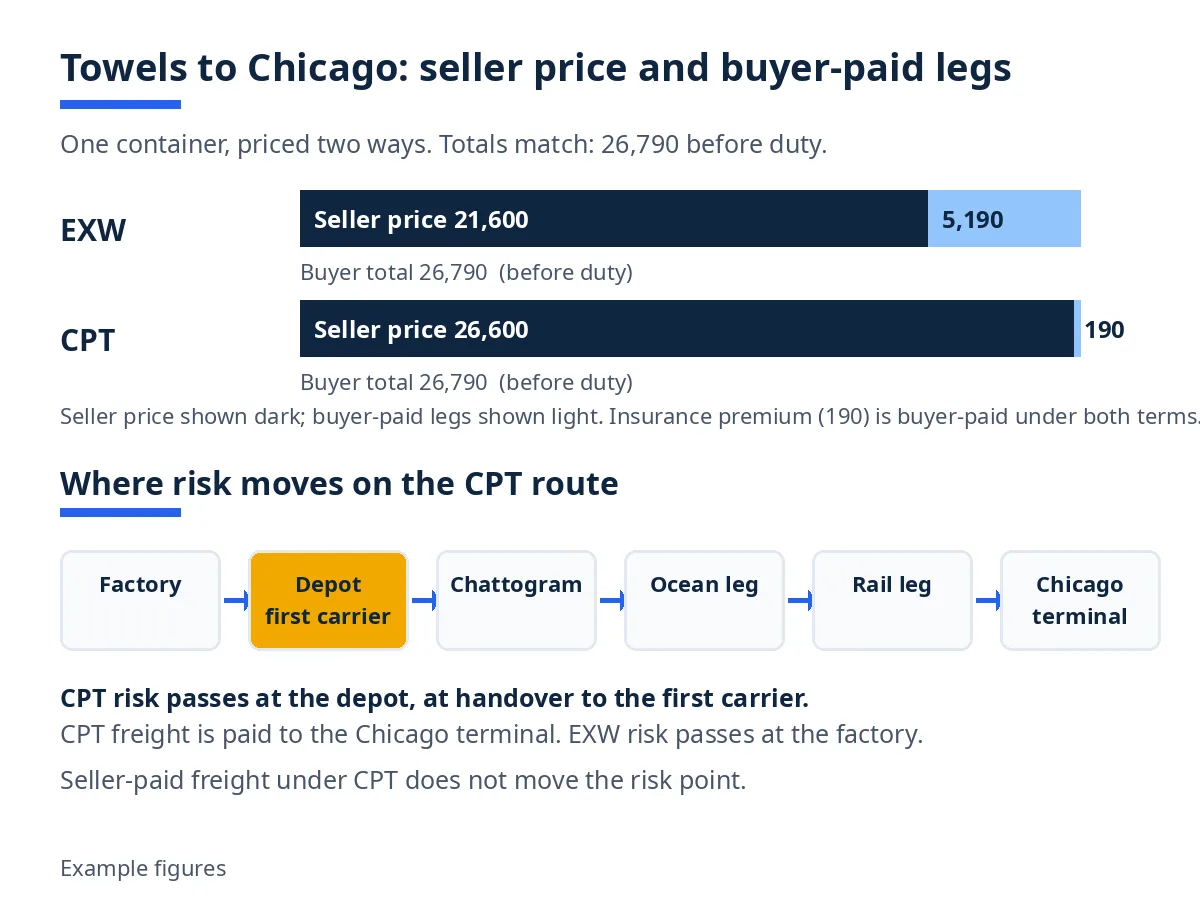
Both columns reach the same end figure because the cargo and the route have not changed. The EXW buyer pays 5,190 after the seller's price; the CPT buyer pays 190, for the premium alone. In each case 21,600 plus 140 plus 290 plus 380 plus 210 plus 3,980 plus 190 equals 26,790. The 5,000 gap between the seller prices is the cost of the legs the CPT seller has taken on, not a discount on the towels. Duty, import clearance and onward carriage from the Chicago terminal sit outside both totals under either term; confirm any duty with a broker, since no duty schedule was opened for this article. Destination unloading is outside the table on the stated assumption that the carriage contract includes it.
CPT or EXW: deciding by cargo, control and cover
CPT fits container loads handed to a carrier well before loading on a vessel, and loads that change mode between origin and destination. Containers may sit at a depot for days before the vessel sails, and a term that fixes delivery at loading on board leaves the depot wait outside the agreed risk point. CPT fixes delivery at the first carrier, so the depot wait, the ocean leg and the rail leg all sit inside one carriage contract the seller has bought, with the buyer carrying the risk throughout.2 CFR, by contrast, suits bulk or non-containerised goods where the seller deals with the vessel itself, and its risk point stays at loading on board.4
Under CPT the seller chooses and contracts the carrier, and the buyer takes the carrier the seller chose.2 That suits a buyer with no freight relationship in Bangladesh who values a single freight price over carrier choice. It does not suit a buyer with a contracted carrier or a consolidation plan of its own. EXW keeps carrier choice with the buyer, but it also keeps every leg's work with the buyer, including export clearance a buyer without a Bangladesh presence may not be able to perform.1
Choose EXW where the buyer can run the Bangladesh legs itself: a local carrier, a forwarder for clearance, and an agreed loading plan. Choose CPT where the buyer wants the seller to buy carriage to a named inland destination and complete export clearance, and accepts early risk plus its own insurance. Choose CIP where the buyer wants seller-bought cover inside the price, and a "D" term where the buyer wants the seller to bear the risk as far as the destination.5 Record the delivery point, the destination point, the first carrier where known, and the unloading position in the purchase order, so the carrier receipt and the seller's notice can evidence the handover.
Ordering from Bangladesh under CPT: clearance, the depot handover and the destination terminal
For many overseas buyers, clearance is the step that decides the term. Section 131 of the Customs Act 1969 bars any consignment from being stuffed or loaded for export until Customs has approved its export declaration, the Bill of Export.6 That declaration states the nature and value of the goods, and names the exporter, the overseas buyer and the carrier.6 The file behind it starts with the sale paper: an export letter of credit, or, failing that, a contract, order or guarantee the negotiating bank has approved.6 Alongside it go a signed invoice describing the goods in detail, a packing list with quantities and weights, and an EXP form endorsed by an authorised dealer so export proceeds can be traced.6 The exporter adds its VAT registration and taxpayer identification number, plus a certificate of origin for the goods.6 Jute goods and tea need an Export Registration Certificate as well.6 Under CPT the seller runs this file; under EXW the buyer must put it together.
The depot handover has its own checkpoint, because under CPT it happens inland. After approval and checks, containers are stuffed, and the export is treated as complete once the carrying ship, truck or aircraft departs.6 At private depots and exporters' own yards, gate officers can inspect the load before it travels to the port.6 Ask for the carrier receipt showing when and where handover happened: that receipt is the evidence that risk moved, and the seller's notice should match it.
At the destination end, the buyer's work begins before the container arrives. The buyer completes import formalities and any transit customs procedures, and arranges onward transport past the named destination.2 For a Chicago rail terminal, the buyer or its broker and carrier must be ready to receive the container, clear it, and move it onward, with unloading charges settled according to the carriage contract: the seller pays them only where that contract makes them the seller's responsibility.5 Appoint the broker and onward carrier when the purchase order is placed, and buy cover dated from the expected handover.
Questions buyers ask before choosing EXW or CPT
Which is cheaper, EXW or CPT, for the same shipment?
Headline prices mislead: the factory-gate figure is the smaller of the two, yet what the buyer spends in total usually comes out equal, 26,790 before duty in the example above. CPT wins on price only when the seller's figures undercut what the buyer's own forwarder would charge for the same legs. Compare the seller's price plus every buyer-paid leg, including the premium and any destination unloading the carriage contract excludes, not the headline prices.
Which is safer for a first-time importer, EXW or CPT?
CPT is safer on paperwork and riskier on risk. CPT removes export clearance and freight booking from the buyer's job list, which is where first orders most often stall.2 But risk passes at the first carrier, long before arrival, and the seller owes no insurance, so a buyer who reads CPT as a delivered price can find itself uninsured for a loss it already owned.2 For a first order, CPT with a policy bought before handover, or CIP with seller-bought cover, is the safer pairing than CPT alone. EXW is the least safe for a first-time importer without a Bangladesh agent, because the buyer must load the goods, clear them for export and book the carriage.1
Can I switch terms after the purchase order is signed?
A change is possible before dispatch, if both sides put it in writing. The term lives in the sale contract, so the revision must re-price the deal and fix the paperwork in one move: a fresh order, a new quotation, and invoice, packing list and transport document all showing the new term.2 1 Moving from EXW to CPT adds the seller's carriage and clearance to the price; moving the other way takes them out and returns freight booking and export clearance to the buyer. Banks compare documents with the credit, so a letter of credit naming the old term needs an amendment too. Risk that moved at the first carrier stays moved, so settle the change, the new price and the cover start date before the goods go.
Which term do Bangladeshi suppliers prefer, EXW or CPT?
Ask the supplier, and put the answer in the request for quotation, because the preference follows the supplier's setup rather than a rule. A seller that already books its own carriage and files its own export declarations can offer CPT readily and keep freight and sailing under its control.6 A factory with no export desk or forwarder link may quote EXW only, leaving the whole journey to the buyer.1 In the requirement, name the term wanted and both places, and ask for freight, clearance, handling, unloading and insurance priced separately. Without a named destination, a delivery point, or a split of the legs, a CPT quote cannot be set beside any other.
Next steps on Exportain
Start with how a CPT price is built up, then check the limits of a factory-gate figure. The CPT risk timeline marks both handover points. Build your full warehouse cost from the two quotes, and run the purchase through Exportain's buying flow.
Sources
- FCA & EXW Incoterms® 2020 explained: Key differences. ICC Academy (accessed )
- CPT & CIP Incoterms 2020 explained: Key differences. ICC Academy (accessed )
- FOB & FAS Incoterms® 2020 explained: Key differences. ICC Academy (accessed )
- CFR & CIF Incoterms® 2020 explained: Key differences. ICC Academy (accessed )
- Incoterms® 2020 C rules vs D rules: Risk transfer explained. ICC Academy (accessed )
- Customs Clearance Procedures for Export. Bangladesh Customs, National Board of Revenue (accessed )
About the author
Sourcing from Bangladesh?
Post a request for quotation and suppliers on Exportain can send you their quotes directly.
Post an RFQ