

What Does a CPT Price Include? Cost Breakdown With a Real Example
Definition
CPT stands for Carriage Paid To. Under CPT, the seller delivers the goods to the first carrier, contracts and pays for carriage to a named place of destination, and completes export formalities, while risk passes to the buyer at handover to that first carrier. The CPT price therefore covers the goods, export packing and clearance, and carriage to the named destination, but it does not include cargo insurance, import clearance, duty, or onward transport after the destination.
By Naim Islam
Published 8 min read
On this page
Key takeaways
A CPT price covers the goods, export packing and clearance, and carriage to the named destination. It does not include cargo insurance, import clearance, duty, or transport after the destination.
Risk passes to the buyer at handover to the first carrier, which can be far earlier than the named destination the seller pays freight to.
The seller has no obligation to insure the goods under CPT. The buyer arranges cover from the handover date, using the seller's delivery notice as the trigger.
Name both places in the contract: the place of delivery, where risk passes, and the named place of destination, where the seller's carriage duty ends.
A CPT quotation answers two questions at once: how much the seller charges, and how far that charge carries the goods. Buyers who read it as an all-in delivered price under-budget for the costs that start after the named destination, and for cover the price does not include. This guide breaks a CPT price into its lines, so each line can be checked against the contract.
Quick answer
CPT stands for Carriage Paid To. Under CPT, the seller delivers the goods to the first carrier, contracts and pays for carriage to a named place of destination, and completes export formalities, while risk passes to the buyer at handover to that first carrier. The CPT price therefore covers the goods, export packing and clearance, and carriage to the named destination, but it does not include cargo insurance, import clearance, duty, or onward transport after the destination.1 2
What CPT means in plain English
CPT is one of the 11 Incoterms 2020 rules published by the International Chamber of Commerce (ICC).3 The three letters name what the seller pays for: carriage, paid to a named place. A complete citation reads "CPT Hamburg, Incoterms 2020", where Hamburg is the named place of destination, the point to which the seller must arrange and pay for transport.1 CPT works for any mode of transport, including sea, road, rail, air, and combinations of modes.1 2
Two places matter, and they are not the same. The place of delivery is where the seller hands the goods to the carrier the seller contracted, which may be a warehouse, a terminal, a port, or an airport in the exporting country. The named place of destination is the point named after the letters CPT, usually a port, airport, or terminal in the buyer's country. Risk passes at the first of these places; the freight bill runs to the second.1 Parties are strongly encouraged to agree both places as precisely as possible, because a contract that names only the destination leaves the risk point to be worked out later.1
How a CPT price is built, step by step
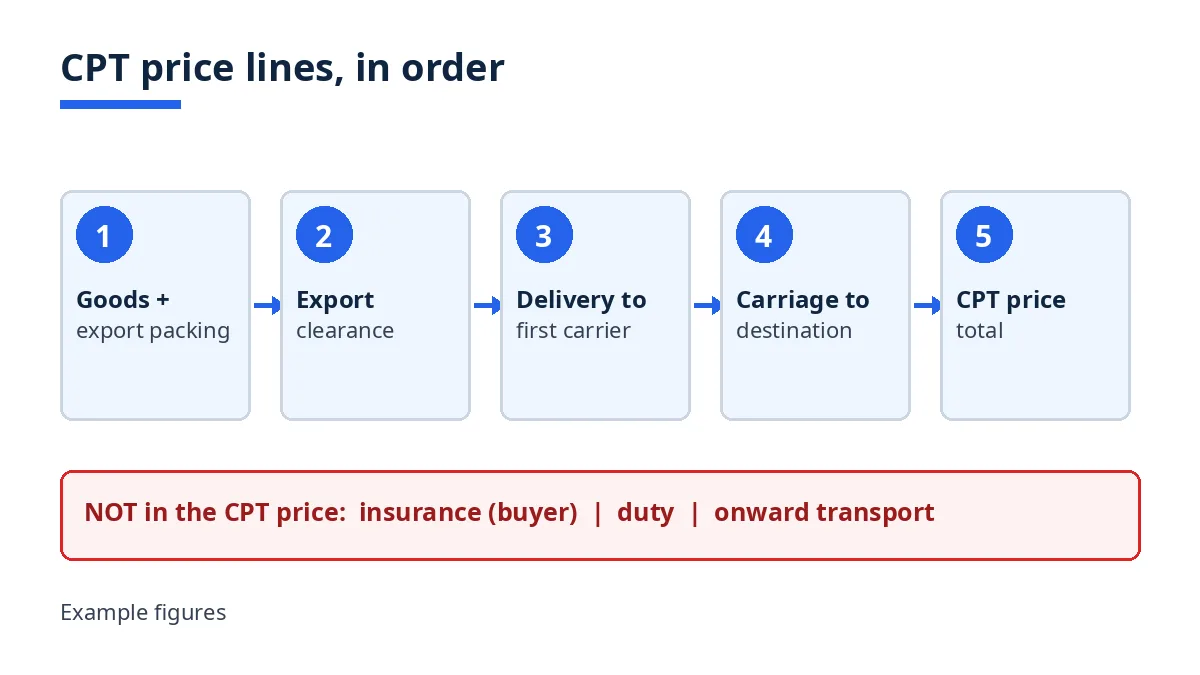
A CPT price is the seller's cost of getting the goods to the carrier, plus the carriage the seller contracts to the named destination. Ask the seller to show each line separately in the quotation.
Goods and export packing. The price of the goods themselves, packed to protect them for the journey agreed. Packing suited to a short road leg may not suit a sea leg, so the packing line should match the modes in the contract of carriage.2
Export clearance and origin handling. The seller completes export formalities at its own cost, including the documents and checks the exporting country requires before the goods can leave.1 In Bangladesh, goods may not be loaded for export until a Bill of Export has been submitted to Customs and approved.4
Delivery to the first carrier. Moving the goods from the seller's premises to the carrier, and handing them over at the agreed place and point of delivery. Delivery is complete at handover, not when the goods are loaded onto a vessel, aircraft, or train.1
Main carriage to the named destination. The freight the seller contracts and pays, from the first carrier to the named place of destination. Where several carriers are involved, the seller pays carriage across the whole chain to that destination, even though risk passed at the first handover.1
Transport security and destination carriage charges. The seller meets transport-related security requirements at its own risk and cost, and the carriage contract may include unloading or terminal charges at the destination. Confirm in writing which destination charges sit inside the CPT price and which fall to the buyer.1 2
Who is responsible for what
Task or cost | Seller | Buyer |
|---|---|---|
Goods and export packing | Pays and arranges | No |
Export clearance | Pays and arranges | No |
Delivery to the first carrier | Pays and arranges | No |
Carriage to the named destination | Contracts and pays | No |
Risk from handover to the first carrier | No | Bears the risk |
Cargo insurance | No obligation | Arranges and pays, if cover is wanted |
Import clearance, duty and taxes | No | Pays and arranges |
Transport after the named destination | No | Pays and arranges |
The split follows the same pattern as the other C terms: the seller pays further than the point where risk passes. Under CPT the gap can be long, because the first carrier may take the goods at an inland point while the named destination is overseas. A buyer who has not arranged cover for that gap carries the loss if the goods are damaged in transit.1 2
The diagram below shows the price lines in order, from the goods to the named destination.
Worked example with numbers: a Bangladesh shipment to Hamburg
Example figures only. Confirm freight, duty, and premium positions with a forwarder and a broker before ordering.
A buyer agrees CPT Hamburg, Incoterms 2020, for a consignment of knit garments loaded at Chattogram, with handover to the first carrier at an inland container depot. The seller's quotation breaks down as follows.
Element of the example CPT price | Example figure (USD) |
|---|---|
Goods and export packing | 24,600 |
Export clearance and origin handling | 650 |
Carriage to the named destination (Hamburg) | 2,900 |
Other export and carriage charges | 350 |
CPT contract price | 28,500 |
Cargo insurance does not appear in the table, because the seller owes none under CPT. The buyer arranges separate cover from the handover point. On these example figures, a premium of USD 180 is shown outside the CPT price, as a buyer cost. Duty and import clearance at Hamburg are also outside the price, as is onward transport from Hamburg to the buyer's warehouse.1 2
CPT beside CIP, CFR and CIF: the price difference is insurance and mode
CIP shares the CPT delivery point, risk point, and carriage duty. The only difference is insurance: under CIP the seller must obtain cover at Institute Cargo Clauses (A) level for at least 110 percent of the contract price, while under CPT the seller owes no insurance at all.1 CFR and CIF are sea and inland waterway terms only, with risk passing on board the vessel; CIF adds seller insurance at Clause C minimum level, while CFR leaves insurance to the buyer.3 2
Term | Where risk passes | Seller pays carriage to | Seller must insure |
|---|---|---|---|
CPT | Handover to the first carrier | Named place of destination | No |
CIP | Handover to the first carrier | Named place of destination | Yes, Clause A, at least 110 percent |
CFR | On board at the port of shipment | Named port of destination | No |
CIF | On board at the port of shipment | Named port of destination | Yes, Clause C minimum |
Common mistakes to avoid
Reading prepaid freight as seller risk. The seller pays carriage to Hamburg, but risk passed at the inland depot. Damage during the main leg is the buyer's risk, and without cover the buyer carries the loss.1
Assuming insurance is included. CPT leaves insurance to the buyer. Arrange cover from the handover date, using the seller's delivery notice as the trigger, or choose CIP so the seller must arrange it.1
Leaving the delivery point unnamed. A contract that names only Hamburg does not say where risk passed. Name the place and point of delivery as well, so a claim can be tied to a handover both parties can prove.1
Forgetting destination charges. Unloading and terminal charges at the destination follow the contract of carriage. Confirm before shipment whether they sit inside the CPT price or fall to the buyer at arrival.1 2
Next steps on Exportain
Compare the full rule in the Incoterms guide for shipments from Bangladesh, read the sea-only counterpart in the CIF cost, insurance and freight guide, and work the buyer-side costs into your landed cost for imports from Bangladesh. The how to buy guide explains the buying steps on Exportain.
Post a free RFQ on Exportain and get quotes from Bangladeshi suppliers → https://exportain.com/rfqs
What is CPT?
CPT stands for Carriage Paid To. It is an Incoterms 2020 rule under which the seller delivers goods to the first carrier, contracts and pays for carriage to a named place of destination, and completes export formalities, while risk passes to the buyer at handover to that carrier. The seller has no obligation to insure the goods.1
How does CPT work in practice?
The seller packs the goods, clears them for export, hands them to the carrier it contracted, and pays carriage to the named destination, then notifies the buyer that delivery has occurred. The buyer bears the risk from handover, arranges any cargo insurance, and handles import clearance, duty, and transport after the destination.1 2
Is CPT used for shipments from Bangladesh?
Yes. CPT is a standard Incoterms rule, not a term limited to any one country, and it can be used for a shipment leaving Bangladesh by sea, air, road, or a combination of modes, provided the delivery point and the named destination are both stated in the contract.1 Export clearance in Bangladesh requires an approved Bill of Export before loading, with the documents Customs lists for the consignment.4
What are common mistakes with CPT?
Assuming the seller keeps the risk because the seller paid the freight, assuming insurance is included, leaving the delivery point unnamed, and forgetting destination charges. Fix each the same way: name both places, state the insurance position in the contract, and confirm in writing which destination charges the CPT price covers.
Sources
- CPT & CIP Incoterms 2020 explained: Key differences. ICC Academy (accessed )
- CPT (Carriage Paid To) Meaning in Incoterms: Risk Transfer and Who Pays. GoFreight, (accessed )
- Incoterms® 2020. International Chamber of Commerce (ICC) (accessed )
- Customs Clearance Procedures for Export. Bangladesh Customs, National Board of Revenue (accessed )
Reviewed by Nourin Tabassum
About the author
Sourcing from Bangladesh?
Post a request for quotation and suppliers on Exportain can send you their quotes directly.
Post an RFQ


