Saudi Arabia LED Bulb Imports From Bangladesh: Checklist
For Saudi Arabia buyers importing LED bulbs from Bangladesh: settle the SABER product and shipment certificate file first, build the IECEE and energy-label evidence for the exact lamp, and price duty and 15% VAT only on broker-confirmed figures, reworking the example landed-cost table.
Short answer
To import LED bulbs from Bangladesh to Saudi Arabia, settle the SABER file first: a product certificate for the exact lamp, a SASO IECEE recognition certificate and the energy efficiency certificate and label, with a shipment certificate for each consignment. Have the broker confirm the tariff line, duty and the 15% import VAT base. Agree the specification, sample, inspection and delivery term in writing, and price the landed cost on broker-confirmed figures.
On this page
Key takeaways
Settle the SABER file before shortlisting: a product certificate for the exact lamp, a SASO IECEE recognition certificate and the energy efficiency certificate and label, plus a shipment certificate for each consignment.
No duty rate is stated for LED lamps: the broker must confirm the Saudi tariff line, the rate in force on the import date, and whether any agreement or preference applies with qualifying origin proof.
The exact lamp decides the file: IEC 62560 safety scope for self-ballasted lamps, and the SASO 2870 or SASO 2902 energy efficiency split by luminous flux and product form.
Import VAT is worked at the 15% standard rate as a working figure only: the broker and tax adviser must confirm the VAT base and accounting treatment before pricing.
Price the landed cost on labeled example figures in riyals only, and rework every line with broker-confirmed duty, VAT base and certificate costs before ordering.
A buyer in Saudi Arabia who orders LED bulbs from Bangladesh meets the conformity system before meeting the product. The lamp must sit inside the Saudi technical rules, the product certificate must exist before the shipment certificate can follow, and the shipment certificate must exist before customs will release the goods. Price, order size and transit matter only after that sequence is understood. This guide states no duty rate, no typical order size and no transit time as fact. Duty, order size and transit appear only as broker-confirmed questions or as labeled example figures.
The SABER file comes before the supplier shortlist
Saudi Arabia runs its product safety program, SALEEM, through an electronic platform that trade practice calls SABER. SASO, the Saudi Standards, Metrology and Quality Organization, now presents the same platform services under the name Sabir on its own site. Ask the conformity assessment body handling the order which portal name the current filing uses, and work from that answer rather than from either name alone. The mechanics are the same under both names. SASO describes product registration, registration of a product conformity certificate for products subject to technical regulations, and a shipment certificate that is required for each incoming shipment and that carries invoice details, the number of products and their quantities.1 A self-declaration covers only a product that is not subject to technical regulations, as a commitment by the establishment that the product complies with the applicable specifications and legislation, without third-party involvement.1 An LED bulb for general lighting is not a product to treat as unregulated on assumption. Confirm the regulated position for the exact lamp with the conformity assessment body before any quotation is compared.
The platform launched on January 1, 2019 for the SALEEM program, at first covering gas products, and was extended on April 1, 2019 to electrical products, including electrical and energy efficiency products.2 Lighting products appear in the list of electrical and gas products covered by SALEEM and registered on the platform by the importer.2 Two certificates carry the work. The product certificate of conformity, the PCoC, certifies the product type against the applicable technical regulation. The shipment certificate of conformity, the SCoC, is issued for one consignment and depends on a valid product certificate already existing for the product in that consignment. Intertek's summary of the technical regulation approach shows lighting products in the energy efficiency row, with an ILAC ISO/IEC 17025 test report and SASO energy labeling requirements, and an SCoC required; the same summary shows lighting products in the SASO recognition certificate row, under the IECEE CB scheme, with an IEC CB test report and CB certificate, and an SCoC required.2 Treat both rows as live questions for the exact lamp: the energy efficiency certificate and label, and the IECEE recognition certificate. Neither is settled by a CE mark, a test report from another market, or a supplier statement that the lamp "meets Saudi standards."
Settle four platform questions in writing with the Saudi importer and the conformity assessment body before the first supplier is contacted: who registers the product on the platform; which conformity assessment body will register the product certificate; which technical regulations the exact lamp falls under; and what evidence the body needs before it registers anything. Record the product certificate number, its expiry date and the model numbers it covers, and diary the renewal date. A product certificate that has expired, or one that names a different model, does not support a shipment certificate for the consignment in front of you.
Why source LED bulbs from Bangladesh
Bangladesh earns its place on a Saudi buyer's shortlist through the buying process, not through a tariff advantage this guide can promise. No preference, exemption or reduced rate is assumed anywhere in this guide, and the broker must confirm the tariff line and whether any agreement or preference applies to the exact lamp. What Bangladesh does offer is direct engagement with factories that make lamps to a written specification, comparison of several quotations through one request, and control over the sample, the test file and the packing before bulk production starts. Those are process advantages. They hold only when the buyer uses them: a specification written before quoting, a sample tested against that specification, and a file that names one model number from the quotation through to the carton.
The risk in sourcing from Bangladesh for Saudi Arabia is a file risk, not a distance risk. A lamp that passes a test in one market can still fail the Saudi file if the test report does not carry the Saudi national differences, if the energy label artwork does not match the tested model, or if the driver changes after the report was issued. Keep the Saudi file, not the catalogue, at the center of the shortlist, and let price comparison start only among suppliers whose file answers arrive in writing, dated, for the exact model.
Name the exact lamp before any test is ordered
A test report, a label and a certificate all attach to one defined product. If the product description changes after testing, the file no longer describes the goods. Write the description down before quoting, in words a laboratory can test against: self-ballasted lamp or module, cap type, rated voltage, integrated or separate driver, dimming behavior, and any wireless control. A finished fitting with built-in sources that cannot be removed is a different product from a replacement bulb, and a bare module that works solely inside a fitting the buyer builds is different again. Ask the conformity assessment body which SASO standard part covers the exact form, and record the answer with the date.
Two SASO energy efficiency standards divide the lighting field, and the split turns on luminous flux and product form. SASO 2870/2018 covers, among other lamp types, LED lamps of the incandescent retrofit type and LED lamps of the halogen retrofit type.3 SASO 2902/2018 covers, among other products, LED lamps including retrofit LED lamps with a luminous flux of 12,000 lumens or more, and directional and non-directional integrated luminaires with non-replaceable lamps.3 A household replacement bulb will usually sit on the SASO 2870 side of that split, and a large high-flux lamp or an integrated fitting will usually sit on the SASO 2902 side, but "usually" is not a classification. The laboratory and the conformity assessment body classify the exact lamp, from its flux figure and its form, before testing starts. Record the flux figure, the form and the standard part in the specification, and reclassify in writing if any of the three changes.
Safety testing for a self-ballasted LED lamp rests on IEC 62560. The standard sets safety and interchangeability tests, with the methods and conditions for showing compliance, for lamps with integrated means for stable operation, made for domestic and similar general lighting, rated up to 60 W, above 50 V up to 250 V, and fitted with caps from its Table 1.4 Lamps above 60 W or at or below 50 V fall outside that scope, and need the standard that covers their own form, which the laboratory names. From February 1, 2019, lighting products in Saudi Arabia need certification and labeling under the newest SASO energy efficiency standards, as well as certification by a SASO IECEE recognition certificate, to receive a valid SASO certificate of conformity.3 Lighting products requiring a SASO IECEE recognition certificate include lamps and lightings, luminaires, control gear and ballasts, and lamp holders.3 A bulb with a separate driver therefore raises two questions, one for the lamp and one for the driver. Ask in writing whether the driver needs its own recognition certificate, and hold both answers before ordering. Wireless control, an application or a sensor may open a further regime beyond the lighting file. Ask before ordering whether any radio or communications approval applies to that model, and do it in writing, so the answer sits in the file rather than in a conversation.
The Saudi file for one lamp: IECEE recognition, energy label and markings
Build the Saudi file in three parts, and keep all three tied to the same model number. First, the safety and recognition part. The IECEE CB scheme route, shown in the SALEEM technical regulation summary, rests on an IEC CB test report and CB certificate.2 The recognition certificate is the Saudi-facing document that follows from that route. Request the CB report, the CB certificate and the recognition certificate for the exact model, naming the driver where the driver is separate. Check that the report covers the Saudi national differences the laboratory applied, and ask the laboratory to confirm in writing that it did. A CB report written for another market, without those differences, is not the same evidence.
Second, the energy efficiency part. The SASO energy efficiency certificate and label sit alongside the recognition certificate, not instead of it.3 The SALEEM summary ties lighting products in the energy efficiency row to testing to SASO energy efficiency standards, an ILAC ISO/IEC 17025 test report, and SASO energy labeling requirements.2 Request the energy efficiency test report, the certificate or registration behind the label, and the label artwork for the exact model. Compare the three: the flux, power, lifetime and class figures on the label must agree with the test report and with the ecodesign-style calculation the laboratory used. This guide states no efficiency class boundary, no lumen maintenance figure and no flicker limit for the Saudi label, because no such figure was established from a source opened for this article. Ask the laboratory which limits the current edition of the applicable SASO standard sets for the exact lamp, and hold the report behind any class or lifetime claim the buyer intends to use in the Saudi market.
The last part covers markings and wording. Approve the marking artwork before it goes to print, then verify it on the sample bulb and carton. Settle with the conformity assessment body which information belongs on the bulb, which belongs on the pack, which languages the wording must use, and where the energy label sits on the pack. Where Arabic wording is required, hold a proof and have it checked by a party who reads Arabic, before artwork approval. English-only artwork should not be assumed to pass, and a supplier translation without a check should not be assumed to match the tested model. Keep a photograph of the sample markings and label with the file for that lot.
Test a supplier on the Saudi file, in writing
Start with roles, not documents. The buyer, the Saudi importer and the conformity assessment body each carry a part of the platform work, and the supplier carries the evidence that feeds it. Agree in a short written note who registers the product, who keeps the product certificate current, who requests each shipment certificate, and who answers a regulator after arrival. Where a supplier cannot name the importer-side counterpart for those tasks, the file is not ready, whatever the catalogue claims.
Then test identity before testing performance. The legal name and address on the quotation, the invoice, the test reports and the shipment certificate must describe one company. A report in another company's name needs a written explanation, kept with the order, before the supplier advances. A brochure or a promise that documents arrive later is not evidence. Ask to see a finished file for a model already sold in Saudi Arabia, with its model number visible on the recognition certificate, the report and the label, so the buyer learns what completeness looks like on a real example.
Request the certificate bundle as one package, and log the date each item arrives: the product certificate details and expiry; the recognition certificate with its CB report and CB certificate for the exact model, driver named; the energy efficiency report with the certificate or registration behind the label and the label artwork; the marking and wording proofs, including any Arabic wording; and the export-document names the broker will use for the invoice, packing list and origin proof. Close the section with a change clause in the order: the supplier gives written notice before altering any of the driver, LED package, cap, housing and pack, and states what re-testing or re-registration that alteration triggers. A model name that stays the same while the goods change is the most common way a sound file stops describing the shipment.
Fix the specification and check every lot against it
Write one specification document and use it for quoting, sampling, inspection and the order. For each claimed value, the document names the evidence that closes it. Where evidence is absent, the claim stays out of the label, the quotation and any advertising.
What to fix | Evidence that closes it |
|---|---|
Lamp form, cap and rated voltage | Report reference that names the form and cap |
Wattage and lumen output claimed | Report plus the test method used |
Colour temperature and colour rendering index | Report reference |
Lifetime claim and its test basis | Laboratory endurance evidence |
Driver, integrated or separate | Report that names the driver, plus the recognition position |
Dimming claim, where made | Test evidence for dimming |
Energy class and its supporting values | Test report, certificate or registration, and label artwork |
Markings, label place and Arabic wording | Approved artwork proof and a sample photograph |
Outdoor or ingress protection claim, where made | Test evidence for the protection claim |
Counting and packing also belong in that document: the unit used for counting, the number of bulbs in each carton and master carton, the carton markings, the label's place, and the short-carton rule. Artwork needs approval before printing. The document also states the consequence of failure: what a failed lot sets in motion, who re-tests, who pays, and which evidence closes the failure.
Inspection starts with paper, then moves to goods. Check that the recognition certificate, reports, label artwork and registration name one model number, and that label values agree with the test report.2 3 Then count the cartons, open a sample of them, and check caps, markings, labels, carton markings, the model number and pack condition. A sample ordered on bulk paperwork, tested against the same document, is the gate for bulk approval. Record the inspection point in the order: the inspector, the place, the document used, and the outcome for a lot that fails. One passed sample proves one sample. Later lots need their own checks.
MOQ, pricing parts and the sample order
Handle minimums variant by variant. A floor agreed for one combination of model, cap, colour temperature and pack does not extend to a mixed assortment, and a floor expressed in cartons differs from a floor expressed in bulbs. Agree the counting unit, the sample basis and the short-carton rule for each variant, in writing, with each supplier. This guide quotes neither a typical order size nor a price: no figure of that kind was established for this product and this market.
Start from the total and work down to its parts before any comparison between quotations. Separate the file charges first: laboratory work, the recognition certificate, and the energy efficiency certificate and label. Then separate the goods charges: packaging and labeling, the bulb, and carriage with insurance under the agreed term. Artwork, inspection and re-testing sit apart from both groups. Two quotations can be set beside each other only when the delivery term and the file behind them match. A low bulb price that leaves out the recognition certificate, the label work or the product certificate will cost more once the file is completed. State the currency, the price basis, whether payment is set by shipped quantity or by usable quantity, who absorbs unusable bulbs, and who pays the platform, certificate and laboratory charges. Make each payment depend on a document: the signed specification and its evidence ahead of production, the inspection report ahead of shipment, and shipping papers that agree with the specification. Show the Saudi file charges as their own line in the order economics from the outset. A sample made out on the bulk paperwork, matching bulk in specification, marking, label and pack, is what earns a bulk order. The sample result should predict the bulk result; if it does not, the specification or the supplier needs attention before production, not after arrival.
Incoterms, the sea move and the Saudi port
Certificates and filings must be ready before the goods move, so the delivery term is settled after them, not before. FASAH serves as the single window for cross-border trade in Saudi Arabia. Run as the national electronic system for trade operations, it joins the organizations that regulate trade, including customs and the ports authority, and lets importers and customs brokers follow a shipment from departure to release at the port of entry.5 The improved clearance program cut what the operator itself submits to two documents: the commercial invoice and the bill of lading, while documents such as the delivery order, certificate of origin, proof of payment and certificate of conformity pass directly between regulatory agencies through FASAH.5 Requested documents can be submitted 72 hours before the consignment reaches the port, and regulatory agencies must review documents and tell ZATCA and the importer about an inspection decision within two hours of receiving the customs declaration.5 The carrier and broker should record, in writing, who files each item and under whose details, so the description, tariff code and parties agree across the filing, the invoice, the packing list and the shipment certificate.
Container freight turns on the handover point written into the contract. FCA fits that move: delivery and risk pass at the moment the carrier receives the goods. FOB instead ties both to loading on board a named vessel, which fits bulk or break-bulk cargo better than a sealed container already handed over at a terminal.6 In the C rules, carriage to the named destination is paid by the seller while risk moves earlier, at handover to the carrier, and CIP adds a seller insurance duty on top of the CPT pattern.6 Choose the rule from the physical move, then write the named places into the contract without ambiguity: where handover happens, which Saudi port receives the goods, where the buyer takes them, and which party unloads at destination.
Only FAS, FOB, CFR and CIF are confined to sea and inland waterway transport. CPT is an any-mode rule. DPU is an any-mode rule. DDP is an any-mode rule, under which the seller clears the goods for import and pays duty. Under DAP, DPU and DDP, delivery happens, and risk passes, at the named destination.6
Write the Saudi port of entry into the contract, and obtain the carrier routing and sailing schedule in writing. No transit figure is stated in this guide for the Bangladesh to Saudi Arabia route. Ask the broker how much time the declaration, customs and any inspection may add after arrival.
Let the warehouse decide the port, not the carrier. On the western coast, Red Sea Gateway Terminal manages the multipurpose terminals at Jeddah Islamic Port; on the eastern coast, Saudi Global Ports manages the multipurpose terminals at King Abdulaziz Port in Dammam; both operate under contracts with Mawani, the Saudi Ports Authority.7 At Dammam, Saudi Global Ports runs two container terminals with deep-sea access and daily rail connections to Riyadh Dry Port.8 Before production, record three written plans: what happens if the Saudi file fails at the border, since no delivery term pays for that refusal; how import clearance works, since a DDP seller does not by itself settle the certificates or the import VAT position; and the waiting place and payer if customs or a regulator holds the goods.
Duty, VAT and the document set at the Saudi border
Duty is priced from the broker's answer sheet, not from a schedule the buyer has not seen. No Saudi tariff schedule page for LED lamps was opened for this guide, so this guide gives no duty rate. The broker confirms the line for the exact lamp in full, the rate in force on the day the goods arrive, and whether any agreement or preference reaches that line with qualifying origin proof. A rate borrowed from another market's schedule, a search listing or a supplier quotation has no standing in the Saudi entry. Heading 8539, covering electric filament or discharge lamps including LED light sources, is where most buyers begin, but a heading does not classify the goods on its own. The broker confirms the line for the exact lamp, module or fitting, and confirms it again when the product description changes. Nothing is priced on the heading alone.
VAT sits apart from duty. ZATCA's VAT guideline puts the standard rate at 15% and applies it to every import into the Kingdom, whatever the goods' classification or the duty rate on them, subject to stated exceptions.9 The base on which that rate falls, the accounting treatment in the buyer's Saudi VAT position, and any deferment arrangement are questions for the broker and tax adviser. Work the VAT amount only from a base and rate confirmed by the broker and tax adviser. In the next section, VAT is calculated at 15% on the duty-inclusive value as a working figure, so the reader can follow the arithmetic; rework it on the confirmed base before ordering.
Keep one file for one consignment, and check it before sailing. It holds the commercial invoice; the certificate of origin, where the broker confirms one is needed; the packing list; the recognition certificate and test file; the energy efficiency certificate or registration with the label artwork; the transport document; and the shipment certificate for that consignment. Through FASAH, the operator submits the invoice and bill of lading, and the other documents pass between agencies on the platform, but the buyer still holds the complete set.5 Every document must carry the same model, parties and quantities. A shipment certificate naming another model, quantity or invoice value does not describe the consignment customs will see. Correct mismatches before the goods move.
Landed cost example in riyals, with example figures
Every figure below is an example figure. The table shows how the parts add up; it does not forecast a price. Duty appears as 1,550.00 riyals provided the broker confirms the line and the rate in writing. VAT appears at 15% on the duty-inclusive value as a working figure, with the base still awaiting broker and tax adviser confirmation. Replace each line with a figure the broker confirms before ordering.
Line | SAR | Status |
|---|---|---|
Goods: 8,000 bulbs at 5.20 riyals each | 41,600.00 | Example figure |
Freight and insurance to Saudi Arabia | 6,100.00 | Example figure |
Duty | 1,550.00 | Example figure only; broker to confirm line and rate |
Duty-inclusive value | 49,250.00 | Goods, freight, insurance and duty combined |
Import VAT, 15 percent | 7,387.50 | Working figure; base to be confirmed |
Brokerage and handling | 1,280.00 | Example figure, counted outside the VAT base here |
Cash needed in this example | 57,917.50 | All lines combined |
Cost per bulb shipped, 8,000 bulbs | 7.24 | Total shared by shipped quantity, rounded |
Cost per usable bulb, 7,600 bulbs at 5 percent assumed loss | 7.62 | Total shared by usable quantity, rounded |
The working can be checked in four additions: 41,600.00 and 6,100.00 make 47,700.00; duty of 1,550.00 lifts that to 49,250.00; VAT at 15 percent adds 7,387.50; brokerage and handling of 1,280.00 brings the total to 57,917.50. That total is 7.24 riyals a bulb on shipped quantity and 7.62 on usable quantity at the assumed loss. Ask the broker how brokerage and handling sit against the VAT base on the real consignment, and rebuild every line after duty if the duty figure is not confirmed. Add certificate, laboratory and platform charges that fall on the buyer, and state whether any comparison with a domestic purchase is made before or after VAT recovery the buyer can claim.
The Saudi import run, in order
Follow the sequence below. The diagram sets out the run.
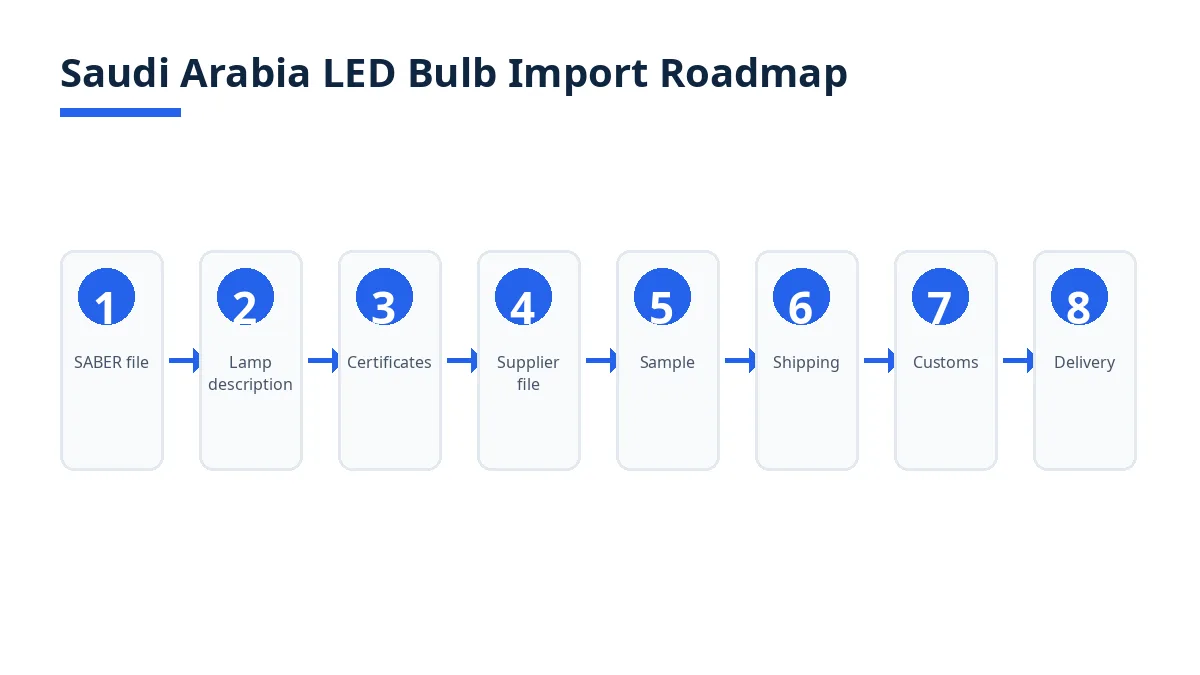
Describe the lamp in testable words: form, cap, voltage, driver, dimming, wireless control, flux and the SASO standard part that covers it.
Ask the broker for the tariff line, the duty position and any preference position, before any price is agreed.
Name the Saudi importer of record and the conformity assessment body, and record who registers the product, who keeps the product certificate current and who requests each shipment certificate.
Settle marking and wording with the conformity assessment body: bulb marking, pack, label place and Arabic wording.
Complete the Saudi gates for that lamp: recognition certificate, energy efficiency certificate and label, and any radio approval for a connected model.
Shortlist suppliers against the certificate bundle, with the date each item arrives logged.
Agree the commercial terms in one document: specification, counting unit, price parts, sample basis, inspection point, failure consequence and change clause.
Test the sample on bulk paperwork against the specification and file, and photograph its marking and label.
Set the delivery term, the named Saudi port, the clearance plan and the FASAH filing in writing, with the failure and holding plans alongside them.
Approve artwork before printing, make and inspect the goods lot by lot, and ship with the invoice, transport document, packing list, origin proof where needed, recognition file and shipment certificate. Declare the goods, pay duty and VAT as confirmed, inspect on arrival, and file the certificates, payment records and lot papers together.
How Exportain helps
Buyers use Exportain to find Bangladeshi suppliers, exporters and trade service providers in one place, and to run a request for quotation, messaging and ordering through the marketplace. Send one request for quotation to several suppliers carrying the same Saudi file questions: the lamp description in testable words, the recognition certificate position, the energy efficiency file, the label artwork and the change clause. Reading the dated answers beside each other shows which suppliers hold a complete file and which hold a catalogue. Using the marketplace does not make Exportain a party to the goods contract. Those checks remain with the buyer, the Saudi importer, the conformity assessment body and the broker, since Exportain takes no part in inspecting goods, booking freight or clearing customs.
What minimum order should a Saudi Arabia buyer agree for LED bulbs from Bangladesh?
Agree it variant by variant, in writing, with the counting unit stated for each one: bulbs or cartons, and which model, cap, colour temperature and pack the minimum covers. No typical figure is quoted in this guide. Before bulk, order a sample on the same paperwork bulk will use, and carry the Saudi certificate, laboratory and platform charges as their own line in the order economics.
How long should a Saudi Arabia buyer allow for LED bulbs to reach Jeddah or Dammam from Bangladesh?
Allow time from carrier schedules, routing and transshipment, plus the declaration, customs and inspection time after arrival. No transit figure is stated here. Get the routing and sailing schedule in writing for the named Saudi port, and ask the broker how long the border steps may add. Filing requested documents ahead of arrival through FASAH, and having the shipment certificate ready before sailing, removes two common sources of delay.5
What import duty and VAT will a Saudi Arabia buyer pay on LED bulbs from Bangladesh?
Duty follows the broker's confirmed tariff line and the rate in force on the day the goods arrive, with any agreement or preference position confirmed alongside it. This guide gives no duty rate. For VAT, ZATCA's guideline puts the standard rate at 15% for imports, whatever the classification or the duty rate, with stated exceptions applying.9 The VAT base and accounting treatment still need broker and tax adviser confirmation. Price both charges only from those confirmed answers.
How does a Saudi Arabia buyer check a Bangladeshi LED bulb supplier before ordering?
Work from the certificate bundle, not the catalogue: product certificate details and expiry, recognition certificate with CB report and CB certificate for the exact model, energy efficiency report with the certificate or registration and label artwork, marking and Arabic wording proofs, and a written change clause. Model numbers and company names must match across the quotation, invoice, test file, label and shipment certificate, and the sample must wear the same marking, wording and label bulk will wear.
Next steps on Exportain
Begin the follow-up with the general import walkthrough and work through it holding the specification and file questions set out here. Then open the supplier directory with the SABER and SASO questions ready, and read the buyer journey page before ordering. Rework the example figures using the companion cost guide and figures confirmed in writing beforehand. Post a free RFQ on Exportain and get quotes from verified Bangladeshi suppliers → https://exportain.com/rfqs
Sources
- Products Tracking. Saudi Standards, Metrology and Quality Organization (SASO) (accessed )
- Exporting Electricals to Saudi Arabia - KSA SALEEM SABER. Intertek, (accessed )
- Saudi Arabia - Market Access; New Requirements for Lighting Products (SASO IECEE and SASO EE). UL Solutions (accessed )
- IEC 62560:2011 - Self-ballasted LED-lamps for general lighting services by voltage > 50 V - Safety specifications. International Electrotechnical Commission, (accessed )
- Saudi Zakat, Tax and Customs Authority (ZATCA) introduces Clearance Within Two Hours Initiative. World Customs Organization (accessed )
- Place of delivery & risk transfer in trade contracts. ICC Academy (accessed )
- Mawani privatizes cargo terminals at 8 Saudi Ports. Asia Cargo News (accessed )
- SGP Container Terminals - Dammam. Saudi Global Ports (accessed )
- VAT Guideline For the Retail Sector. Zakat, Tax and Customs Authority (accessed )
About the author
Sourcing from Bangladesh?
Post a request for quotation and suppliers on Exportain can send you their quotes directly.
Post an RFQ