EXW vs CFR: Key Differences, Costs and Which One to Choose
A CFR price pays the freight to your port, but the risk is yours from loading on board at Chattogram. This comparison prices one jute-bag shipment both ways, EXW and CFR, and shows where cost, risk, insurance and clearance change hands.
Short answer
Under EXW, the seller places the goods at your disposal at a named place, usually the factory, and you handle loading, export clearance, carriage and insurance from there. Under CFR, the seller clears the goods for export, loads them on board at the port of shipment and pays the ocean freight to the named destination port, but risk passes to you on board. Neither term obliges the seller to insure the goods, so you arrange cover yourself.
On this page
Key takeaways
CFR splits cost and risk: the seller pays ocean freight to the named destination port, but risk passes to the buyer when the goods are placed on board at the port of shipment.
Neither EXW nor CFR obliges the seller to insure the goods; under CIF the seller must buy minimum cover, and a CFR buyer that buys no cover sails uninsured.
EXW leaves loading, export clearance, carriage and insurance with the buyer from the factory gate; CFR moves clearance, inland carriage, loading on board and freight to the seller.
CFR is sea and inland waterway only, needs a named destination port, and fits bulk and break-bulk cargo loaded at the port better than factory-stuffed containers.
A CFR quotation can look like a delivered price. The seller has paid the ocean freight to your port, so the goods seem to be the seller's problem until they arrive. They are not. Under CFR, delivery is complete, and the risk is yours, the moment the goods are placed on board the vessel at the port of shipment. The freight the seller paid keeps running to the named destination port, but the risk stopped at the load port. EXW sits at the opposite end of the same question: under EXW, you carry the cost and the risk from the factory gate, and the seller's job ends before the goods are loaded onto your vehicle. The choice between the two terms is a choice about how much of the journey you buy from the seller, and how much you control yourself.
The verdict in one table: a factory-gate price against a price paid to your port
EXW gives the lowest figure on the quotation and the longest list of jobs. CFR gives one price that reaches the named destination port, because the seller clears the goods for export, carries them to the port of shipment, loads them on board, and pays the ocean freight. Neither price includes marine insurance bought for you, and neither includes import clearance or duty at destination.
Point of comparison | EXW (Ex Works) | CFR (Cost and Freight) |
|---|---|---|
Delivery point | Goods at your disposal at the named place, ready for loading | Goods placed on board the vessel at the port of shipment |
Named place in the contract | A place you name, often the factory | A port of destination you name, for example CFR Southampton |
Risk passes | When the goods are placed at your disposal, ready for loading | When the goods are placed on board at the port of shipment |
Who pays ocean freight | You, the buyer | The seller, prepaid to the named destination port |
Export clearance | You, the buyer | The seller |
Marine insurance | You arrange it, if you want it; the seller owes none | You arrange it, if you want it; the seller owes none |
Import clearance and duty | You, the buyer | You, the buyer |
Transport mode | Any transport mode | Sea and inland waterway only |
What each term means: EXW at the factory, CFR on board and paid to the destination port
EXW asks the least of the seller of any Incoterms 2020 rule. The goods are made available at the agreed place, most often the factory or warehouse, ready to be loaded onto a vehicle the buyer sends, and loading, export formalities and the onward transport contract are all the buyer's to arrange and pay for.1 Because the buyer carries the export side, the ICC Academy article describes EXW as safest for domestic trade and urges traders moving goods across a border to look at FCA instead, noting that a seller may be treated as the exporter of record if the buyer is not established where the seller is based.1
CFR reverses the export side. The seller bears the cost of the goods and the freight as far as the destination port, and the rule may be used only for sea or inland waterway carriage.2 The seller provides the goods and the contract documents, puts the goods on board within the agreed date or period, pays for the checks and packing that delivery requires, and carries every cost and risk up to the on-board moment.2 The seller books the vessel, pays the freight and the remaining carriage costs, loading and security included, on the usual routes, and clears the goods for export at its own cost.2
The buyer's part of CFR begins before the ship sails. Delivery to you happens at the load port, when the goods go on board, and you collect them from the carrier at the destination port in the contract, carrying the risk of loss or damage from the on-board moment.2 With no duty on the seller to buy insurance, cover is yours to arrange, and import clearance, duties, taxes and the other import costs are yours as well.2
Both terms belong to the eleven Incoterms 2020 rules. Only FAS, FOB, CFR and CIF are confined to sea and inland waterway transport. CFR is one of the C rules, where the cost point and the risk point do not coincide: the seller funds and books the carriage to the named destination, while the buyer carries the risk of the voyage itself.3 That split is the whole of the CFR question, and it is why a CFR price must never be read as a promise that the goods will arrive.
Cost, risk and responsibility: where the two terms split
The split is best seen leg by leg, from the factory to your warehouse. Confirm each line in writing before you order, and confirm any duty with your broker rather than assuming a rate.
Task or cost | EXW: seller | EXW: buyer | CFR: seller | CFR: buyer |
|---|---|---|---|---|
Goods and export packing | Pays | No | Pays | No |
Loading at the factory | No; buyer loads at own expense and risk | Pays, at own risk | Pays | No |
Inland carriage to the port of shipment | No | Pays | Pays | No |
Origin handling and loading on board | No | Pays | Pays, including loading on board | No |
Export clearance and documents | No | Pays | Pays | No |
Ocean freight to the destination port | No | Pays | Pays, prepaid | No |
Marine insurance for the voyage | No obligation | Arranges, if wanted, from the factory gate | No obligation | Arranges, if wanted, from loading on board |
Import clearance, duty, destination handling, onward carriage | No | Pays | No | Pays |
Cost and risk part company under CFR: the seller keeps paying until the destination port, but stops carrying risk at the load port. Under EXW they part together, at the factory gate. That is why the EXW figure looks low and the CFR figure looks high, even though the buyer's all-in total before duty and destination charges can be identical, as the priced comparison shows. The real differences are who books each leg, who picks the vessel, and the date on which risk changes hands.
The insurance line is where CFR is most often misread, and where it must be kept apart from CIF. CIF requires the seller to buy cover for the buyer for the voyage from load port to destination port, and the seller may buy the limited Institute Cargo Clauses (C) wording rather than the broader Institute Cargo Clauses (A) wording, unless the parties agree otherwise.2 The obligations under CIF are otherwise essentially the same as under CFR, with insurance as the difference, and the ICC summary of the 2020 changes records that the CIF rule keeps Institute Cargo Clauses (C) as the default level of cover.2 4 A buyer who wants insurance inside the seller's price should ask for CIF. Accept CFR without buying cover, and the voyage is uninsured while the risk is already yours.
A second CFR detail follows from the insurance position: notice. The seller arranges the transportation and the buyer handles cargo insurance, so the seller must give notice of loading to the buyer in good time after loading, and a seller that fails to do so may bear the risk of loss of goods in transit.2 The ICC Academy article illustrates the point with a Friday loading, a weekend with no notice, and a fire that damaged cargo before the buyer had arranged cover; its view is that the transit risk may have stayed with the seller, which had not supplied the details the buyer needed to insure.2 Do not rely on that outcome. Agree in the purchase order that the seller will send the vessel name, the bill of lading number and the loading date on the day of loading, so your cover can start at the same point your risk starts.
Carrier choice is the third difference. EXW leaves every carrier decision with you. CFR hands the vessel, the line and the usual-route choice to the seller, which books and pays for the carriage.2 That helps when the seller's volume buys a better ocean rate, and hurts when your own carrier contract or a fixed sailing matters more. Put the line, sailing window and any transhipment in the order if timing matters to stock. The Incoterms 2020 text gathers each rule's costs at article A9/B9.4 Check the CFR quotation against that list, and have your forwarder check the post-arrival costs against a list of your own.
A priced comparison: bicycles from Chattogram to New York
The figures in this section are illustrative. They reconcile exactly, but they are not market rates: have each leg re-priced by a forwarder and a broker before ordering. A buyer orders a container of unassembled bicycles in crates from a factory outside Dhaka, shipped from Chattogram to New York, priced two ways: EXW at the factory and CFR New York. A CFR quotation is built from the goods, export packing, inland carriage to the load port, origin handling, loading on board, and the ocean freight to the destination port.5 It leaves out marine insurance, unloading past the ship's rail, import duty and tax, destination clearance, destination handling where the ocean rate excludes it, and carriage to the warehouse.5
Price element | EXW at the factory | CFR New York |
|---|---|---|
Goods and export packing | 21,750 | 21,750 |
Loading onto the collecting vehicle at the factory | Buyer pays 150 | 150 |
Export clearance and documents | Buyer pays 340 | 340 |
Inland carriage, factory to Chattogram port | Buyer pays 520 | 520 |
Port handling and loading on board at Chattogram | Buyer pays 290 | 290 |
Ocean freight, Chattogram to New York | Buyer pays 1,980 | 1,980 |
Marine insurance premium, buyer-arranged | Buyer pays 185 | Buyer pays 185 |
Seller's quoted price | 21,750 | 25,030 |
Still to pay after the seller's price | 3,465 | 185 |
Buyer total to New York port, before duty and destination charges | 25,215 | 25,215 |
The chart below sets the two quoted prices against each other, with the remaining buyer-paid legs shown in blue.
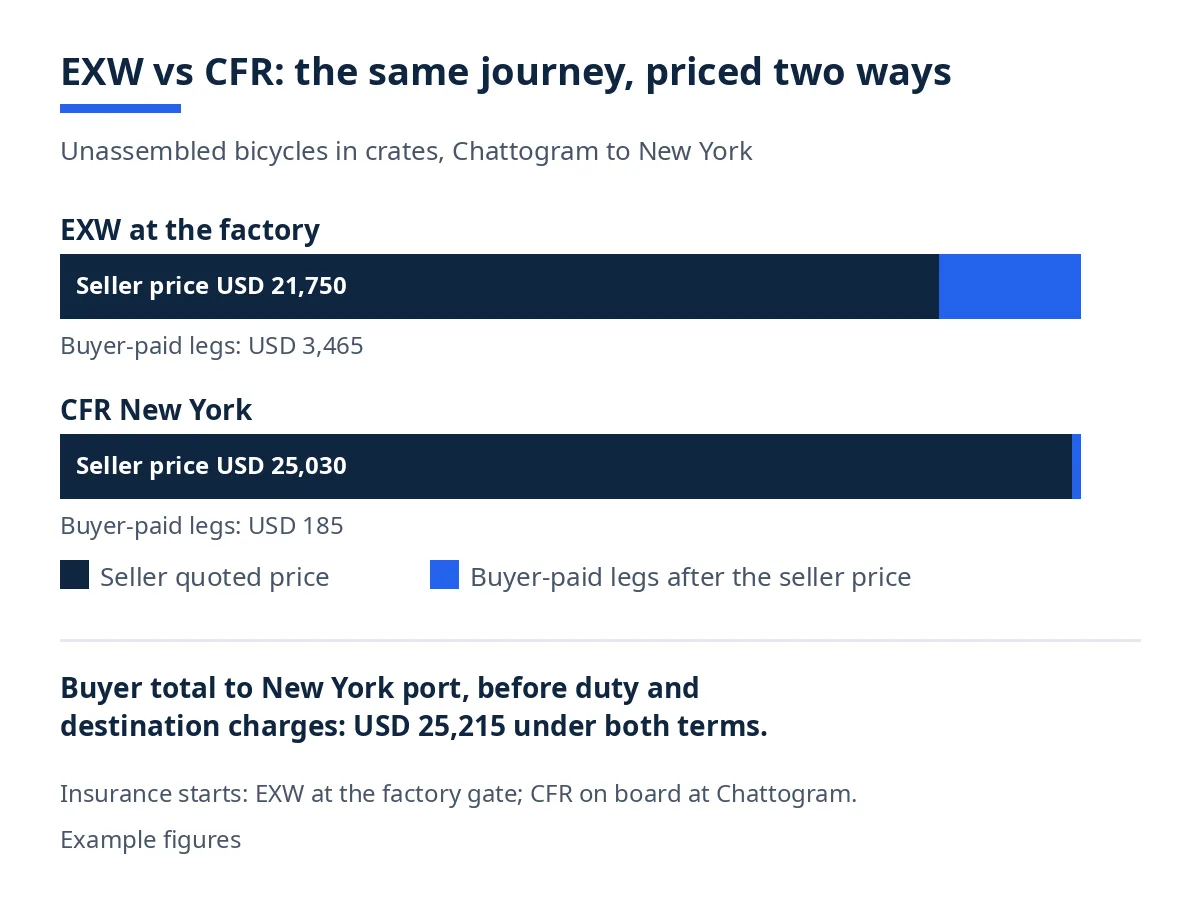
Both columns reach the same total because the cargo, the route and the legs are identical; only the payer changes. After the seller's price, the EXW buyer still pays 3,465, made up of loading, clearance, inland carriage, handling and loading, freight of 1,980 and a premium of 185. The CFR buyer still pays 185, the premium alone. The arithmetic is 21,750 plus 150 plus 340 plus 520 plus 290 plus 1,980 plus 185, which equals 25,215, and the quoted-price gap, 25,030 minus 21,750, is 3,280, the legs the CFR seller has absorbed.
Whether the comparison holds depends on the insurance dates. Under EXW, cover must run from the factory gate. Under CFR, it must run from loading on board, and it must already be in force on the loading date, not the sailing or arrival date. Check the policy start date against the loading date on the bill of lading, which records both the loading and the prepaid freight.5 Duty in the United States, import clearance, destination handling where the ocean rate excludes it, unloading past the ship's rail, and onward carriage all sit outside both totals. Before booking, get written confirmation of whether destination handling is inside the seller's ocean rate: rates differ on this point, and paying the line a second time on a forwarder's invoice means paying for the same handling twice.5
When EXW fits, and when CFR fits
EXW suits a buyer that wants to run the whole journey and has the Bangladesh side covered: a carrier able to collect and load at the factory at the buyer's risk, an agent able to clear the goods for export, and collection arrangements settled before the truck arrives. With a freight partner in Bangladesh, repeat orders on the lane and its own ocean contracts, such a buyer can beat the seller's leg prices. Without local cover, the buyer is buying work it cannot oversee.
CFR suits a buyer that wants a single price to the destination port and accepts the seller's choice of vessel and route. It fits bulk and non-containerised goods and raw materials where the seller has direct access to the vessel, and a buyer that knows the local insurance market and can buy cover more cheaply than the seller.2 The exchange is control for convenience: the sailing choice goes, the voyage risk arrives at loading, and the buyer must arrange the cover and pursue the loading notice.
CFR has no place on an air shipment: the rule covers sea and inland waterway carriage only, and CPT is the any-mode rule under which the seller pays carriage to a named destination. The same caution applies to a container packed at the factory and handed to a carrier at an inland depot days before the vessel sails. Under FOB, CFR and CIF, delivery and risk sit at loading on board, yet the container has already passed out of the seller's hands, which is why those rules are treated as unsuitable for container loads.6 For FOB the delivery-point guidance reaches the same conclusion, describing FCA as typically the better choice for containerised goods even on a sea voyage.3 Where handover happens at a depot or terminal well ahead of the vessel, CPT or FCA matches reality. CFR matches reality where cargo is loaded onto the vessel in bulk or break-bulk form under the seller's eye at the load port.
Precision about the destination port is not optional. 'CFR' alone lets the seller pick the port, and the guidance warns that the choice may be the cheapest port nearby, with the buyer left to pay for extra land transport, storage and delay.3 Put the complete term in the purchase order, CFR New York, Incoterms 2020, for example, naming a port rather than a country or region.
Buying from Bangladesh: clearance, the port of shipment, and the container question
Export clearance in Bangladesh is often what pushes an overseas buyer from EXW to CFR, and it is the first task the CFR seller assumes. Section 131 of the Customs Act, 1969, forbids loading or stuffing goods for export until Customs has approved the export declaration, the Bill of Export or Shipping Bill, which states what the goods are, what they are worth, who exports them, who buys them abroad, and who carries them.7
The Bill of Export is filed with a set of enclosures. The sale papers are the export letter of credit or, failing that, the contract, purchase order or export guarantee approved by the negotiating bank. The goods papers are the signed commercial invoice, the packing list, the EXP form certified by an authorised dealer, and the certificate of origin. The registration papers are the VAT registration certificate and the taxpayer identification number.7 Jute goods and tea may also need an Export Registration Certificate, agricultural goods a phytosanitary certificate, and other products a quality control certificate where one is obligatory.7 The CFR seller files and pays for this clearance. The EXW buyer must do it, and an overseas buyer without an agent in Bangladesh will struggle to complete an EXW purchase at all.
Approval follows a documentary check and physical verification, after which loading proceeds and the export is complete when the vessel departs, the customs officer endorsing the second copy of the shipping bill as shipped on board.7 Goods loaded at a private inland container depot or at the exporter's premises may first be checked by a gate division officer before moving to the port area.7 That checkpoint falls inside the seller's work under CFR. Keep the carrier receipt or shipped-on-board notation showing the handover time and place with the bill of lading: its loading date is the date the buyer's risk began and the date the buyer's insurance had to be live.
Containers packed at a factory or private depot and trucked to Chattogram create the same timing problem in Bangladesh: the on-board risk point arrives days after the container left the seller. The order should settle stuffing, sealing, carriage to the port, insurance for the road leg, and the evidence each side will keep. Where the carrier collects the container at the factory, FCA or CPT fits the shipment better; reserve CFR for cargo loaded in bulk or break-bulk at the port.
Which is cheaper, EXW or CFR?
The EXW figure is lower, but the all-in total for the identical journey is the same in the priced comparison: 25,215 before duty and destination charges. CFR costs more only when the seller's ocean freight exceeds what you could buy for the same sailing, or when the seller has added a margin to the freight. EXW costs less only when your forwarder beats the seller's price on a leg. Set the quotation beside every cost you still have to pay, on the same sailing and port pair, with the same insurance start date, before calling either term cheaper.
Which is safer for a first-time importer, EXW or CFR?
For a first order, CFR is the safer of the two, provided one condition is met. The seller handles export clearance, the move to the port, loading, and the prepaid freight, so no agent in Bangladesh is needed for the export legs.2 EXW puts the buyer at risk from the instant the goods are put at its disposal, with loading and clearance to arrange itself, and the ICC Academy article cautions that cross-border EXW use can create problems for both sides.1 The condition is cover: CFR includes none, so the buyer must arrange voyage insurance effective from loading and pursue the seller's loading notice.2 Meet that condition, confirm the destination port in writing, and a first CFR order is workable. Assume the freight payment included insurance, and the voyage is uninsured.
Can the term be changed after the purchase order?
Yes, by written agreement before the goods ship, in an amended purchase order with a fresh quotation and corrected documents. The term chosen fixes the parties' obligations in the sale contract: chartering, freight payment and export clearance for the CFR seller, insurance and import clearance for the buyer.2 Once loading has happened, the risk position at loading cannot be rewritten, and once the bill of lading is issued, its freight-prepayment entry cannot be rewritten either.5 Settle the change, the price adjustment and the insurance start date before dispatch, correct the invoice, packing list and transport document, and amend any letter of credit, since the bank checks the documents against the term the credit names.
Which term do Bangladeshi suppliers prefer, EXW or CFR?
The answer depends on the seller's setup, so ask and put it in writing in the RFQ. A seller already booking ocean freight, holding the export papers and running the Customs routine can offer CFR as a matter of course and keep the promised sailing under its control. A factory without an export desk or forwarder link may offer EXW and nothing else, leaving the whole journey to the buyer. When you post the requirement, state the term wanted, name the destination port for a CFR quote, and ask for freight, clearance and handling to be priced as separate lines. A CFR quote with no named port, or with no leg split, cannot be compared with anything.
Next steps on Exportain
Begin with what a CFR quotation already contains, so the freight, handling and insurance lines can be separated, and check what an EXW figure covers on its own before signing a factory-gate quotation. Read all eleven rules together to see where CFR sits among the sea-only and any-mode rules, then build the full warehouse cost from the two quotations. If a seller offers cover in the price, see the CIF rule, under which the seller buys the policy, and use the buying steps on Exportain to ask for quotations on the term chosen.
Sources
- FCA & EXW Incoterms® 2020 explained: Key differences. ICC Academy (accessed )
- CFR & CIF Incoterms® 2020 explained: Key differences. ICC Academy (accessed )
- Place of delivery & risk transfer in trade contracts. ICC Academy (accessed )
- Incoterms® 2020. International Chamber of Commerce (ICC) (accessed )
- CFR Incoterms 2026: Cost and Freight Explained for Freight Forwarders. GoFreight (accessed )
- Suez Canal blockage: ripple effects on global trade stakeholders. International Chamber of Commerce (accessed )
- Customs Clearance Procedures for Export. Bangladesh Customs, National Board of Revenue (accessed )
About the author
Sourcing from Bangladesh?
Post a request for quotation and suppliers on Exportain can send you their quotes directly.
Post an RFQ