

How to Compare EXW Quotations From Bangladeshi Suppliers
No single EXW headline ranks suppliers fairly: normalize scope, named place and terms first, then compare landed cost per unit.
Short answer
To compare EXW quotations from Bangladeshi suppliers, fix one specification, rewrite each quote onto the same lines for scope, named place, packing, loading, export clearance, validity and payment terms, add the same onward costs to every quote, and rank the result by landed cost per unit rather than by headline price.
On this page
Key takeaways
Fix one specification and send it in the same words to every supplier, or the quotes are not comparable.
Under EXW the buyer takes over at the named place, so loading, export clearance and all onward costs sit with the buyer and must be added to every quote.
Record the full named place, price split, validity, payment terms and document supplier for every quote before ranking any of them.
Rank by landed cost per unit using the same forwarder basis and destination warehouse, not by the headline EXW unit price.
Take duty from the schedule for your confirmed code, confirmed with your broker, never from a guessed rate or another product.
Two EXW quotations for the same goods can look far apart, and the lower unit price can still be the more expensive order. That happens when the quotes do not cover the same scope, named place, packing, or payment and validity terms. An EXW quotation only prices the goods at the named place, so every cost after that place falls on the buyer and must be added before any ranking.
The method here is to fix one specification, rewrite each quotation onto the same lines, add the same onward costs to every quote, and rank the result by landed cost per unit. A ranking made from headline unit prices alone is a guess, not a comparison.
Under Incoterms 2020, EXW means the seller delivers by placing the goods at the disposal of the buyer at a named place, and the seller is not required to load the goods on a collecting vehicle or to clear the goods for export.1 The Incoterms 2020 rules are eleven three-letter trade terms that clarify the tasks, costs and risks in the delivery of goods from sellers to buyers.2 Landed cost is the total expense of a product after it has arrived at its final destination, including product cost, shipping, duties, taxes, insurance, handling and other charges.3
Why this matters for buyers and sellers
For a buyer, the risk is paying for the same item twice: once inside a unit price that already includes it, and again in an onward charge for it. One supplier may include export packing in the EXW price, while another prices standard packing and charges separately for export packing. The unit prices differ, but the goods do not.
For a seller, a clear comparison request is also useful. When every buyer asks for the same lines, the seller can answer without guessing what is included, and a later dispute about loading, packing or export help has a written answer. The ICC Academy notes that under EXW the buyer handles export formalities, which can lead to complications where the buyer is not established in the seller's country.1 Ask who will file the export papers, and at whose cost, before you rank quotes, so a ready shipment is not left unable to move.
Step-by-step: how it works
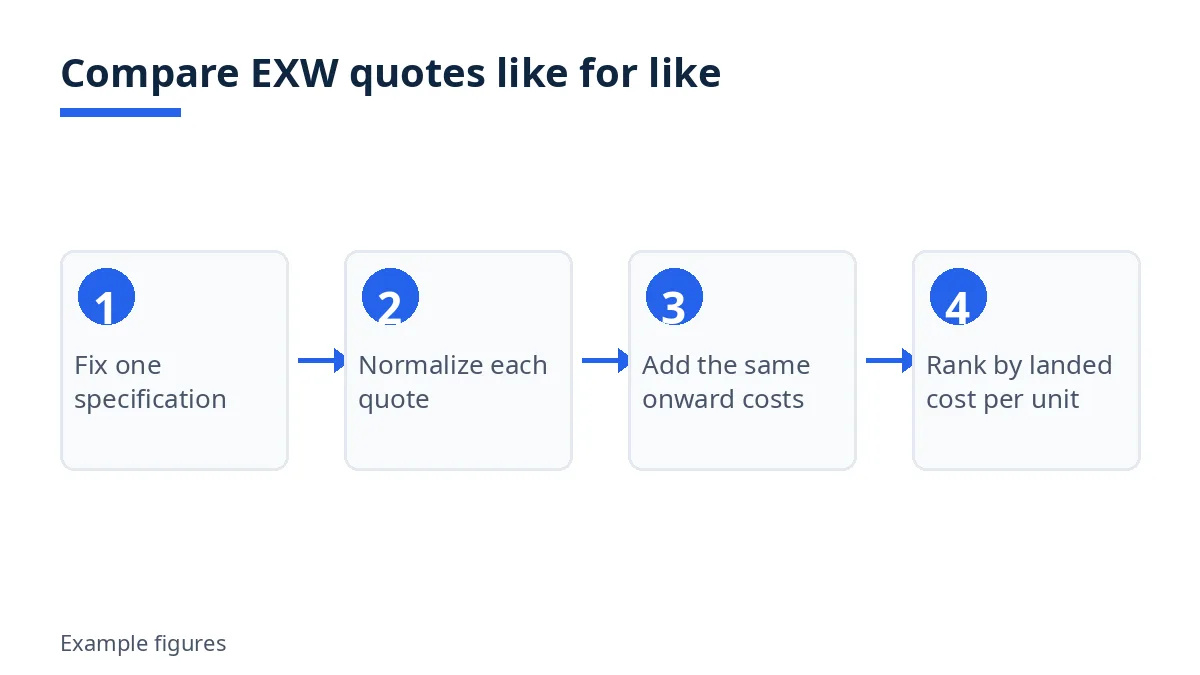
Keep one comparison sheet for all suppliers. Do not rank any quote until every line on the sheet is filled or marked as not applicable, with the reason noted.
Fix one specification. Send the same product, material, size, colour, quantity, packing, marking and inspection requirement to every supplier. A supplier answering a different specification is not yet comparable.
Demand the named place in full. Record the full address, not only a city or district. Under EXW, delivery and the transfer of risk and costs to the buyer happen at that named place, typically at the seller's own premises.1 Inland transport from that place differs by supplier.
Split the EXW price. Ask for goods, packing, marking, loading help if offered, and any charge for help with export documents, each on its own line. Under the default EXW rule, loading and export clearance are for the buyer, so seller help must be priced in writing, not assumed.1
Record validity, timing and payment. Note the price expiry date, the production or ready date, the payment method and timing, the currency, and who bears bank charges. A quote that expires before your decision date needs a revised quote first.
Add the same onward costs. Use one forwarder or broker basis for loading, inland transport, export handling, main carriage, insurance, destination handling, duty and taxes, and warehouse delivery. Use the same destination warehouse for every supplier.
Rank by landed cost per unit. Divide each total by the units that will actually arrive, after any agreed tolerance. Check the top-ranked quote again for validity, readiness and documents before accepting it.
Confirm in writing. Repeat the specification, named place, price lines, validity and payment terms to the winning supplier. Keep the other quotes and their onward costs on file, so a later price change can be checked against the same sheet.
Line | Record for every quote | Why it changes the ranking |
|---|---|---|
Specification | Product, material, size, colour, quantity, packing, marking | A different spec is a different product |
Named place | Full address and collection point | Inland transport differs by supplier |
EXW lines | Goods, packing, marking, loading help, export help | A hidden included item looks cheaper |
Validity | Price expiry and ready date | An expired quote is not comparable |
Payment | Method, timing, currency, bank charges | Timing and charges change cash cost |
Onward costs | Same forwarder basis for all | Otherwise you compare factory prices only |
Duty basis | Confirmed code and schedule amount | Duty follows the code and schedule |
What should I know first about EXW?
Know first that EXW places the minimum obligation on the seller in terms of risks and costs.1 The seller delivers and transfers risk and costs to the buyer typically at the seller's own premises, without transporting the goods elsewhere or handling customs formalities.1 The buyer therefore arranges loading, export clearance, carriage, insurance, import clearance and onward delivery. If your logistics cannot file export papers in Bangladesh or collect at the named place, resolve that before comparing prices: the ICC Academy encourages traders to consider FCA instead of EXW where goods are crossing a border.1
Costs, timelines and documents
What are the typical costs and timelines?
There are no typical costs or timelines for every EXW order, because the named place, route, transport mode and destination duty schedule all change the total. The structure is stable: landed cost is product cost plus shipping plus duties plus taxes plus insurance plus handling plus other charges.3 Build the total in this order: EXW goods price, packing and marking if not included, loading, inland transport, export handling, main carriage, insurance, destination handling, duty and taxes from your confirmed code's schedule, broker fees, and warehouse delivery.
For timelines, ask for separate dates: price expiry, production finish, readiness at the named place, collection window, and expected warehouse arrival. One delivery promise hides which date it means, and a missed collection window can leave goods waiting while onward bookings lapse.
The table below uses example figures only. Replace every onward line with a forwarder or broker figure for your shipment, and replace the duty line with the amount from the schedule for your confirmed code. Do not use the example duty amount as a rate or for another product.
Example figures, 2,000 canvas tote bags | Supplier A | Supplier B | Supplier C |
|---|---|---|---|
EXW price per unit | $3.20 | $2.95 | $3.40 |
EXW total | $6,400 | $5,900 | $6,800 |
Onward transport and handling | $1,150 | $1,780 | $890 |
Insurance, example figure | $120 | $120 | $120 |
Duty and taxes, example schedule amount | $480 | $440 | $510 |
Broker and handling, example figure | $260 | $260 | $260 |
Total landed cost, example figures | $8,410 | $8,500 | $8,580 |
Landed cost per unit, example figures | $4.21 | $4.25 | $4.29 |
Supplier B has the lowest EXW price, but the highest onward transport cost here, because its named place sits farther from the port used. Supplier A, with a higher EXW price, has the lowest landed cost per unit. That reversal is why you rank on landed cost per unit. Change any onward line and the ranking can change again, so the sheet must show its working.
Which documents are needed?
Ask each supplier, at quotation stage, which papers it will supply and which you or your forwarder must obtain. At a minimum, confirm the commercial invoice, packing list, correct product code for your destination schedule, and the carrier's transport document. Accurate paperwork matters, including invoices, packing lists and product codes, and a wrong code can raise the duty payable.3 Confirm who supplies any certificate of origin your schedule requires, and who holds the export papers where the buyer carries export formalities under EXW.1 A quotation that leaves the document supplier unnamed should not be ranked yet.
Bangladesh-specific rules and tips
The named place matters more in Bangladesh than a city name suggests, because suppliers sit at different distances from the port and from inland collection points, and that distance feeds directly into the onward transport line. Compare a near-port supplier with an inland supplier on the same forwarder basis and the same port, or the inland supplier will look dearer for a route reason, not a factory price reason.
Confirm export filing in writing before you rank. Under EXW, export responsibilities are for the buyer, and the ICC Academy warns of complications where the buyer is not established in the seller's country.1 Ask your forwarder or broker whether it can file the export papers for collection at that named place, and what it charges. If it cannot, ask the supplier whether it will help, at what price, or ask for a quote on a term under which the seller clears the goods for export, such as FCA, where the seller carries out export clearance.1 That is a different quotation, so it needs its own comparison sheet.
Use one destination schedule for every quote, and check the code with your broker rather than copying a code from a supplier catalogue, since misclassification can raise duty.3 Keep the code, schedule amount and broker's note on the sheet. Also confirm collection practicalities at the named place: the collection point inside the site, collection hours, who loads the vehicle and at whose risk and cost, and the notice given when goods are ready. Under EXW, loading is done at the buyer's expense and risk.1
Mistakes and red flags
What are the most common mistakes?
Ranking headline EXW prices. The headline excludes loading, inland transport, export handling, carriage, insurance, duty and delivery. Rank only after the same onward costs are added and the total is divided by the same quantity.
Comparing different named places as if they were equal. A distant named place and a near-port named place are not on the same basis until inland transport is added. Record the full address and use one onward route basis.
Assuming packing, loading or export help is included. Under EXW, the seller is not required to load the collecting vehicle or to clear the goods for export.1 If a quote does not price those items, treat them as buyer costs and add them.
Using a guessed duty rate. Use the amount from the schedule for your confirmed code, confirmed with your broker, and note the code on the sheet. A guessed duty line can reverse a ranking after shipment.
Comparing quotes with different validity or payment terms. An expired price, or payment terms your process cannot meet, is not comparable with a live price. Ask for a refreshed quote on the same terms first.
Red flags. Watch for a named place given only as a city, a specification that omits packing or marking, an expired validity date, payment terms that change after acceptance, and a refusal to state packing or loading lines separately. Ask for the missing line in writing, and do not rank the quote until it arrives.
Checklist
Before you accept any EXW quotation from a Bangladeshi supplier, confirm in writing:
One specification sent in the same words to every supplier, including packing, marking and quantity.
Full named place and collection point for every quote.
EXW price split into goods, packing, marking, loading help and export-document help.
Validity, ready date and collection window recorded.
Payment method, timing, currency and bank charges recorded.
Same onward costs applied to every quote, through to warehouse delivery.
Duty and taxes from the schedule for your confirmed code, with the code noted.
Document suppliers confirmed, including any certificate of origin.
Export filing confirmed: who files, and at whose cost, at the named place.1
Landed cost per unit on the same quantity, with the ranking and working kept on file.
How Exportain helps
On Exportain, browse suppliers and post the same specification, quantity, packing requirement and named-place question on the RFQ board, so each supplier answers the same inquiry. Ask each reply for the normalization lines: full named place, price split, validity, payment terms and document supplier. That shared inquiry is what makes the replies comparable.
For background on the price, read What Does an EXW Price Include? and the EXW explainer. For the wider delivery terms, read Incoterms for Shipments From Bangladesh, and for the full journey cost, read Landed Cost for Imports from Bangladesh. For a sea-freight alternative, compare it on the same sheet with the FOB explainer, rather than mixing an EXW price with a freight-included price.
FAQs
What should I know first about EXW?
EXW places the minimum obligation on the seller in terms of risks and costs, and the buyer takes over at the named place, typically at the seller's own premises, without the seller transporting the goods elsewhere or handling customs formalities.1 The buyer arranges loading, export clearance, carriage, insurance, import clearance and onward delivery. Confirm collection and export filing before comparing prices.
What are the typical costs and timelines?
There are no typical figures for every order. Build the total as product cost plus shipping plus duties plus taxes plus insurance plus handling plus other charges,3 with each onward line priced for your named place, route and warehouse. Ask for separate dates for price expiry, readiness, collection and warehouse arrival, rather than one delivery promise.
Which documents are needed?
Confirm the commercial invoice, packing list, confirmed product code and transport document, plus any certificate of origin your schedule requires. Confirm in writing who supplies each paper and who files the export papers, since export formalities sit with the buyer under EXW.1 A wrong code can raise the duty payable.3
What are the most common mistakes?
Ranking headline EXW prices without onward costs, comparing different named places as if equal, assuming loading or export help is included, using a guessed duty rate, and comparing quotes with different validity or payment terms. Fix all of them with one specification, one normalization sheet, and a landed cost per unit for every supplier.
Next steps on Exportain
Browse suppliers, then post your fixed specification, quantity and packing requirement on the RFQ board and ask every reply for its full named place, price split, validity and payment terms. Before you rank the replies, read What Does an EXW Price Include? so each EXW line is checked against the same basis.
Sources
- FCA & EXW Incoterms® 2020 explained: Key differences. ICC Academy (accessed )
- Incoterms® rules. International Chamber of Commerce (accessed )
- What is Landed Cost? Definition, Components, Formula, Strategies, FAQs. SimpleGlobal (accessed )
About the author
Sourcing from Bangladesh?
Post a request for quotation and suppliers on Exportain can send you their quotes directly.
Post an RFQ


