

EXW Pros and Cons: When Should Importers Use It?
EXW gives importers full control over freight and costs, but also full responsibility from the factory gate. Use this decision guide to test whether you can clear export, load and insure the goods, or whether FCA or FOB fits better.
Short answer
Under EXW (Ex Works), the seller's job ends when the goods are placed at your disposal at the named place, usually the seller's factory or warehouse. You, the buyer, then pay for and carry the risk of loading, export clearance, transport, insurance, import clearance and final delivery. EXW suits you when you control logistics at origin and can clear export there; otherwise FCA or FOB usually fits better.
On this page
Key takeaways
Under EXW, risk transfers to the buyer when goods are placed at the buyer's disposal at the named place, before loading.
EXW suits buyers who control logistics at origin and can clear export there; otherwise FCA or FOB usually fits better.
Never compare an EXW price with an FOB price directly: compare full landed costs on the same goods and destination.
Settle export clearance, loading and insurance cover in writing before confirming EXW.
For a first order with a new seller, FCA or FOB fits better until the route, documents and loading routine are proven.
EXW is a decision about control, not only a price. Under EXW (Ex Works), the seller's price usually looks lower than a price that includes freight, because the seller is not charging for transport, export clearance or insurance. The lower price is real, but the work behind it has not disappeared. It has moved to you, the buyer. This guide gives you a decision framework for that choice: when EXW wins, when FCA or FOB fits better, and the five checks to run before you sign.
EXW is one of the 11 rules in Incoterms 2020, published by the International Chamber of Commerce (ICC). Under EXW, the seller's obligation ends when the goods are placed at your disposal at the named place, usually the seller's factory or warehouse, and risk transfers to you at that moment, before loading.1 From there you pay for and carry the risk of loading, export clearance, transport, insurance, import clearance and final delivery.1 That is the earliest risk transfer point of any Incoterm, and it is what makes the EXW decision different from a simple price comparison.
Why this matters for buyers and sellers
For the buyer, EXW matters because it changes who controls each leg of the shipment. When you control freight, you choose your own forwarder, can combine orders from several suppliers into one shipment, and see each cost line separately. A buyer who already ships regularly from Bangladesh, or who has a forwarder with staff at origin, can often run the origin leg more cheaply than a seller who buys freight occasionally.
For the seller, EXW matters because it keeps the seller's obligations narrow. The seller prepares the goods, packs them as agreed, and makes them available at the agreed place and time. The seller does not load the goods onto your collecting vehicle, does not arrange export clearance, and does not carry the transport risk.1 That simplicity is why some sellers prefer EXW.
The trade-off sits between those two positions. EXW gives you cost control and transparency. It also gives you every problem between the factory gate and your warehouse: a late truck, an export declaration that cannot be filed in your name, or a gap in insurance cover. FCA and FOB exist largely to move one or more of those problems back to the seller. Your decision is therefore about capability, not only about the quoted price.
Step-by-step: how it works
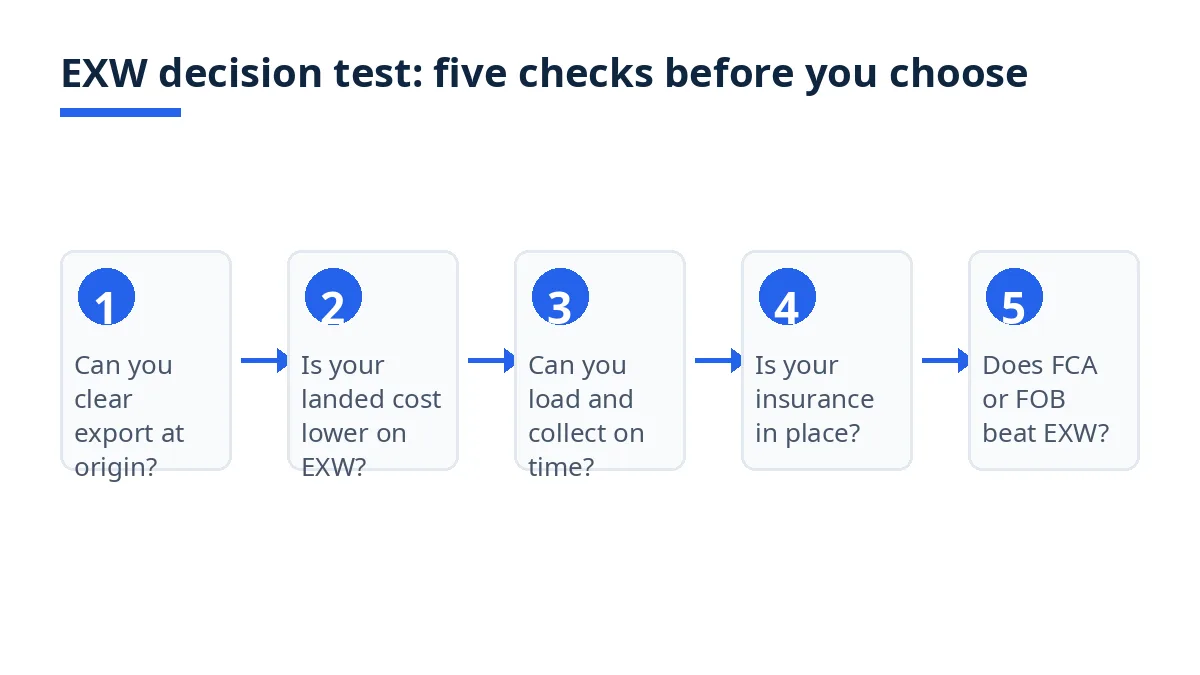
Run the five checks in the diagram before you compare prices. If any check fails, fix it or switch terms before you confirm the order.
Confirm the named place and the collection window in writing. State the exact factory or warehouse address, the date and time window for collection, and who to contact at the gate. Risk transfers when the goods are placed at your disposal at that place,1 so a vague place or an open-ended window creates disputes about when risk passed.
Agree who loads the goods. Under EXW the seller is not required to load the goods onto your collecting vehicle.1 If your truck arrives without loading labour or equipment, loading stalls. Write loading responsibility, labour and any loading charge into the contract.
Settle export clearance before the truck is booked. Under EXW, export clearance is the buyer's responsibility.1 A foreign buyer may not be able to file an export declaration in the seller's country, which is why the ICC recommends FCA instead of EXW for most cross-border transactions.1 Confirm in writing who files, and through which broker or agent, before you commit.
Book transport and insurance from the named place onward. You arrange inland transport to the port or airport, main carriage, and insurance. Insurance is your responsibility and is not automatic.1 Confirm cover starts at the named place, not at the port, so the origin leg is covered.
Clear import customs and arrange final delivery. You pay import duties and taxes at destination and arrange delivery to your warehouse. Keep the export and import document sets consistent, so the goods description, quantity and value match on both sides.
Costs, timelines and documents
What are the typical costs and timelines?
There is no typical EXW cost or timeline a guide can state as fact, because each shipment prices its own goods, route, mode and destination duties. What EXW does fix is who pays each line. The table below compares that split across the three terms buyers most often weigh against EXW. Under FCA, the seller clears export and delivers the goods to the carrier; under FOB, the seller clears export and loads the goods on board the vessel.2
Cost or task | EXW | FCA | FOB |
|---|---|---|---|
Goods and export packing | Buyer pays in price | Buyer pays in price | Buyer pays in price |
Loading at seller's premises | Buyer | Seller, when delivered to carrier | Seller |
Export clearance | Buyer | Seller | Seller |
Inland transport to port or airport | Buyer | Buyer, after handover to carrier | Seller to port, then on board |
Main carriage freight | Buyer | Buyer | Buyer |
Insurance | Buyer | Buyer | Buyer |
Import clearance, duties and taxes | Buyer | Buyer | Buyer |
Example figures, structure only: on an order with an EXW goods price of 8,000, a buyer might see loading and inland transport at 400, export clearance at 150, main carriage at 1,200 and insurance at 120, before destination duties and taxes. Those figures are illustrative, not quotes, and they show why an EXW price that looks 1,000 lower than an FOB price can still land higher once the buyer pays every origin line. Compare terms on the full landed cost, not on the goods price alone. See the landed cost guide for how to build that comparison line by line.
For timelines, ask each provider for separate dates for goods ready, collection, export clearance, departure, arrival, import clearance and delivery.
Which documents are needed?
For export clearance in Bangladesh, goods may not be loaded unless an export declaration, the Bill of Export or Shipping Bill, is submitted to Customs and approved.3 Enclosed documents include the export contract or purchase order where there is no export letter of credit, the commercial invoice, the packing list, the EXP form certified by an authorized dealer, and a certificate of origin issued by the Export Promotion Bureau (EPB) or a Chamber of Commerce and Industry.3 Under EXW, confirm who prepares and files each of these, because the filing party is not the seller by default. Your import set at destination normally includes the commercial invoice, packing list, transport document, certificate of origin where claimed, and any product certificates your market requires. Read the EXW documents checklist and the EXW risk transfer guide before you confirm.
Bangladesh-specific rules and tips
Settle the export filing question first. This is the single most common EXW problem on shipments from Bangladesh. Under EXW the buyer carries export clearance,1 yet a foreign buyer often cannot file the Bill of Export in its own name. Agree in writing whether the seller, your forwarder, or a licensed customs clearing and forwarding agent files, and who supplies the EXP form, invoice and packing list for that filing.3 If no party can file under EXW as written, switch to FCA, under which the seller clears export,2 rather than leaving the filing to chance.
Keep one legal name across every paper. The export declaration names the exporter and the foreign buyer,3 so the name on the trade licence, quotation, proforma invoice, EXP form and payment account should match. A name mismatch between the invoice and the Bill of Export is a common cause of clearance delay.
Confirm loading equipment and labour at the factory. Many Bangladeshi factories load by hand or with limited equipment. Under EXW, loading is the buyer's task,1 so confirm forklifts, labour, pallet requirements and any loading charge before the truck arrives. A truck waiting at the gate while loading is improvised costs demurrage and a missed sailing.
Ask for proof of export for tax and VAT records. Get copies of the export declaration, transport document and certificate of origin into your file after shipment.4
Use FCA when the seller has no export desk. Some smaller sellers have never filed an export declaration. That is not a reason to avoid them, but it is a reason to avoid EXW with them. FCA keeps the seller's price close to EXW while putting export clearance with the party that can actually file it.2
Mistakes and red flags
What are the most common mistakes?
Comparing an EXW price with an FOB price as if they were the same thing. The EXW price excludes loading, export clearance, inland transport, freight and insurance, while the FOB price includes export clearance and loading on board.2 Compare only full landed costs, built on the same goods, quantity and destination.
Leaving export clearance unassigned. The most expensive EXW mistake is signing the term without confirming who files the export declaration in the seller's country.1 When the buyer's forwarder cannot file, the shipment sits at the factory until the seller agrees to file, usually for a fee and on terms nobody agreed in advance.
Assuming the seller will load. Under EXW the seller is not required to load the goods onto your vehicle.1 A red flag is any quotation that says "EXW" without a loading line. Get loading responsibility in writing.
Leaving the origin leg uninsured. Insurance is the buyer's responsibility under EXW and is not automatic.1 Cover that starts only at the port leaves the factory-to-port leg, where damage and theft risk is real, uncovered. Confirm the cover start point in the policy, not only the premium.
Treating a profile or a badge as a guarantee. A supplier profile is a starting point for enquiries. Exportain verification is a document and photo review by staff, not a factory inspection, and a badge is not a guarantee of capacity, quality or delivery.5 6
Choosing EXW for a first order with a new seller. A first order is when collection, loading and document problems are most likely, so FCA or FOB fits better until the route, documents and loading routine are proven.
Checklist
Before you confirm EXW, every line should be answered in writing.
Named place, collection date and time window, and gate contact confirmed.
Loading responsibility, labour, equipment and any loading charge agreed.
Export filing party named: seller, forwarder or customs agent, with the broker instructed.
Export set agreed: contract or purchase order, commercial invoice, packing list, EXP form, certificate of origin, Bill of Export.3
Inland transport, main carriage and insurance booked, with cover starting at the named place.
Full landed cost built: EXW price plus every buyer-paid line, compared with FCA and FOB on the same basis.2
Import clearance, duties, taxes and final delivery arranged at destination.
Proof-of-export copies (export declaration, transport document, certificate of origin) to be sent after shipment.4
One Incoterm and one named place on the quotation, purchase order and invoice.
How Exportain helps
On Exportain, browse suppliers and post a request for quotation (RFQ) on the RFQ board stating EXW with the named place, so suppliers quote against the same term and place. Ask each reply to state its EXW price, its loading position, and whether it will file export clearance or expects your forwarder to file. When you accept a quotation, Exportain creates one order and issues one proforma invoice from the accepted terms.5 Read the badges for what they record: Exportain Verified means Exportain has checked identity, phone, email and business registration, and Export Verified means it has checked the Export Registration Certificate (ERC).6 Verification is a document review by staff, free, and never granted by membership plans.5 It is not a factory inspection,5 6 so collection, loading and inspection arrangements stay with you. See how to buy on Exportain7 and the EXW guide for the term itself, and the Incoterms guide for shipments from Bangladesh for the full set of terms.
FAQs
What should I know first about EXW?
EXW means the seller's job ends when the goods are placed at your disposal at the named place, usually the factory or warehouse, and risk transfers to you at that moment, before loading.1 You then pay for and carry the risk of loading, export clearance, transport, insurance, import clearance and delivery. EXW can be used for any mode of transport.4 Know first whether you can clear export at origin and load on time, because those two tasks decide whether EXW is workable at all.
What are the typical costs and timelines?
There are no typical figures, because each shipment prices its own goods, route, mode and destination duties. Under EXW you pay every line after the goods price: loading, export clearance, inland transport, freight, insurance, import clearance, duties and taxes.1 Build the full landed cost and compare it with FCA and FOB on the same goods and destination.2 For timelines, ask for separate dates for goods ready, collection, export clearance, departure, arrival, import clearance and delivery, and keep buffer around collection and clearance.
Which documents are needed?
The export set for Bangladesh is the Bill of Export, commercial invoice, packing list, EXP form certified by an authorized dealer, and certificate of origin issued by the EPB or a Chamber of Commerce and Industry, with the export contract or purchase order where there is no export letter of credit.3 Confirm who files the Bill of Export under EXW, since the seller does not file by default.1 Your import set normally includes the invoice, packing list, transport document, certificate of origin where claimed, and any product certificates your market requires.
What are the most common mistakes?
The most common mistakes are comparing an EXW price with an FOB price without adding the buyer-paid lines,2 leaving export clearance unassigned,1 assuming the seller will load,1 leaving the origin leg uninsured,1 and choosing EXW for a first order with a new seller. Each of these is fixed in writing before confirmation: loading responsibility, filing party, insurance start point and a full landed-cost comparison.
Next steps on Exportain
Browse suppliers, then post your requirement with the term, the named place and the collection window on the RFQ board so suppliers quote EXW on the same basis. Before you confirm, read how to import from Bangladesh and the EXW guide, and run the five checks in this guide against each quotation you receive.
Sources
- Ex Works (EXW) Incoterms 2026: Complete Guide for Freight Forwarders. GoFreight (accessed )
- EXW Meaning in Shipping | Ex Works Explained. FreightAmigo (accessed )
- Customs Clearance Procedures for Export. Bangladesh Customs, National Board of Revenue (accessed )
- Ex Works (EXW) Incoterm: Meaning, Benefits, Example, and Terms. Amazon Global Selling (accessed )
- Trust & Safety Center. Exportain (accessed )
- Supplier verification: Earn trust badges buyers can see. Exportain (accessed )
- How to source and buy from Bangladesh. Exportain (accessed )
About the author
Sourcing from Bangladesh?
Post a request for quotation and suppliers on Exportain can send you their quotes directly.
Post an RFQ


