7 Costly DPU Mistakes Importers Make (and How to Avoid Them)
DPU mistakes cluster around one act: unloading. This guide works through seven of them, place, equipment, notice, clearance, price, insurance and documents, with the fix to agree in writing before the goods leave Bangladesh.
Short answer
Under DPU (Delivered at Place Unloaded), Incoterms 2020, the seller must carry the goods to the named place, unload them, and place them at the buyer's disposal; risk and cost pass only then. The errors to fix first are naming a city instead of an unloading point, never checking that the seller can unload there, and budgeting the DPU price as the landed cost. Agree the place, point, equipment, notice, and buyer-side remainder in writing before booking.
On this page
Key takeaways
DPU delivery happens only when goods are unloaded at the named place and point and placed at the buyer's disposal; arrival with the load still on the vehicle is not delivery.
Name the unloading point, not just the place: bay or dock, address, access hours, and the edition, in the contract clause.
Check before booking that the seller can safely unload at that point with suitable equipment; if not, DPU is the wrong rule.
A DPU price excludes import clearance, duty and taxes, onward carriage, and any separately agreed insurance; price the remainder before budgeting.
DPU imposes no insurance obligation on either party; agree who insures which leg, including unloading, in writing.
A DPU price looks like the end of the story. The seller carries the goods to a named place, unloads them, and hands over the risk. The mistakes below happen in the gap between that sentence and the unloading bay: the place is named loosely, the unloading is assumed rather than agreed, and the costs after the bay are discovered late.
This guide lists the DPU common mistakes that cost importers money on shipments from Bangladesh, in the order they bite: from the contract wording, through the unloading itself, to the documents that prove it happened. Each mistake states what happens, why it costs money, and the fix to agree in writing before booking.
The unloading bay is the test
DPU stands for Delivered at Place Unloaded. Under Incoterms 2020, the seller undertakes to deliver the goods and transfer the risk of loss or damage at the designated place and point of destination, including unloading the goods from the arriving means of transport and making them available to the buyer.1 The seller arranges and pays for carriage to that point, completes export formalities and any transit procedures, and bears the risk throughout the journey; the buyer completes import formalities and arranges onward carriage beyond the named destination.1 DPU is the only Incoterms 2020 rule that requires the seller to unload the goods, and it can be used for any mode of transport.2
DPU replaced DAT (Delivered at Terminal) in Incoterms 2020 so delivery is no longer limited to a terminal: the parties may designate any agreed place.1 3 There are eleven Incoterms 2020 rules: seven work for any mode of transport and four, FAS, FOB, CFR and CIF, work for sea and inland waterway transport only; CPT is one of the any-mode rules.4
Before booking, answer three questions in writing. Where exactly will the goods come off the vehicle: which bay, dock, or gate, at which address, and during which access hours? With what labour and equipment, arranged by whom? And who is told, when, and what paper proves that the unloading happened? Every mistake below is one of those three questions left unanswered.
The DPU common mistakes, in the order they bite
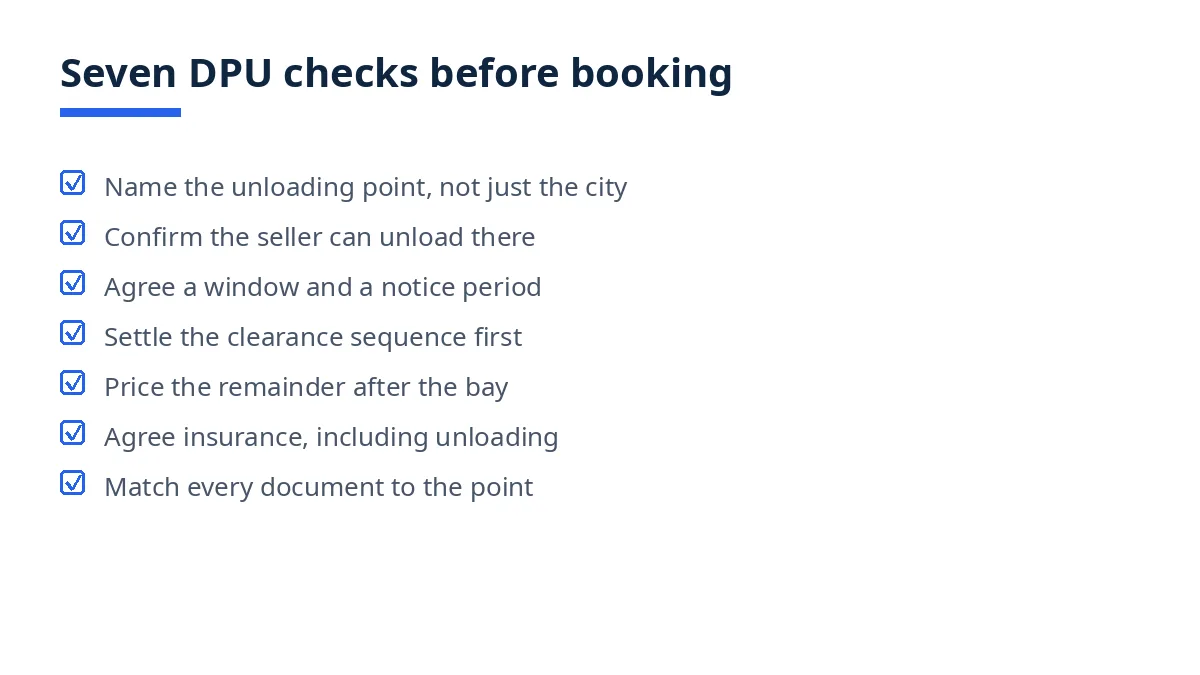
Run the seven checks in this order, from the clause to the document set. A failed check means fixing the wording, pricing the gap, or changing the rule before signing, not after the vehicle arrives.
1. What happens when the named place is only a city?
What happens. The contract reads "DPU Dallas" or "DPU Felixstowe" and nothing more. The seller chooses the cheapest accessible point inside that place, unloads there, and the delivery obligation is met. The buyer then pays for the onward move to the warehouse, the waiting time, and sometimes a second handling charge, none of which was in the budget.
Why it costs money. The place and point fix the moment of delivery and the transfer of risk, so a vague place leaves that moment undefined.5 The seller's duty is to deliver at the designated place and point of destination, unloaded and at the buyer's disposal.1 A city names neither. Carrier guidance is consistent on the remedy: state the exact warehouse bay, or use coordinates where no bay number exists, rather than a site name alone.2
Fix it before booking. Write the clause in full: "DPU [named place], [agreed point: bay, dock, or gate], [address], Incoterms 2020". Add the access hours and the name of the person who confirms the point before loading. If the point changes, amend the clause; do not rely on an email thread the carrier never sees.
2. What happens when nobody checks whether the seller can unload there?
What happens. The seller accepts DPU in good faith, the vehicle arrives, and there is no forklift rated for the pallet weights, no crane for an oversized case, or no access for the size of truck used. The unloading is refused or improvised, a carton is damaged during a lift the site was not set up for, and the vehicle waits while equipment is found.
Why it costs money. DPU is often chosen because the buyer lacks the equipment or expertise to unload safely.2 3 That logic only holds if the seller can unload safely at the agreed point. The seller should carefully assess whether safe unloading can be ensured there; if it cannot, DAP is the more appropriate rule, with unloading arranged by the buyer.1
Fix it before booking. Get written confirmation of the equipment type, the weight and size limits it handles, the vehicle sizes the point admits, and who supplies the labour. For heavy or oversized packing, confirm the lift plan, not just the equipment name. If the seller cannot confirm, agree DAP or a different point before signing rather than after arrival.
3. What happens when no unloading window or notice is agreed?
What happens. The vehicle arrives unannounced, or inside a window the buyer never confirmed. Nobody from the buyer's side is present, the goods are unloaded so the vehicle can leave, and the buyer first learns of damage or a short count hours later, when the proof is thin and the argument about when the damage happened has already started.
Why it costs money. The seller must inform the buyer in good time about the upcoming delivery so the buyer can make the necessary preparations.5 The buyer takes over the risk and costs once the seller has given notice enabling the buyer to collect the goods at the designated place and point.1 Notice is therefore not a courtesy: it is the step that lets the buyer be present, check the goods, and take over cleanly.
Fix it before booking. Agree a notice period in hours, a delivery window, and a named contact, and put the same window in the carrier instructions. Agree in writing who pays waiting and storage charges if the vehicle waits, and keep the signed receipt from the unloading as the record of what arrived, where, and in what condition.
4. What happens when unloaded is read as import-cleared?
What happens. The buyer plans collection for the day the goods are unloaded, only to find them held because import clearance had to happen first. In some importing countries, import clearance and customs clearance must be completed before unloading, and that clearance is the buyer's responsibility.5 The vehicle waits, the unloading slot is lost, or the goods are unloaded into customs control while the buyer bears the risk of goods it cannot yet collect.
Why it costs money. DPU is not DDP. The buyer handles import customs clearance, duties, VAT, and local taxes, and arranges onward carriage from the unloading point.2 Reading "unloaded" as "ready to use" collapses three separate steps, clearance, delivery, and onward movement, into one.
Fix it before booking. Ask the destination broker, before booking, whether clearance precedes unloading at the named place, and what documents and licences must be ready before arrival. Settle the duty and tax estimate and the broker instruction in advance, and agree the waiting charges for a clearance delay. The DPU price never covers this work, however the quotation is headed.
5. What happens when the DPU price is budgeted as the landed cost?
What happens. The budget carries one line, the DPU price, and the order is approved against it. Import duty and taxes, the broker's charges, onward carriage beyond the unloading point, and any separately agreed insurance premium then arrive as further lines. The shortfall is discovered after the goods are on the water, when renegotiating the price is no longer possible.
Why it costs money. A DPU price ends at the unloading point. Everything after it, import clearance, duty and taxes, and onward transport, sits with the buyer.1 2 Importers sometimes call the remainder hidden charges. Nothing is hidden: the charges sit outside the DPU price by the design of the rule, and they only surprise a buyer who budgeted the headline as the total. The DPU price guide explains the same split line by line.
Fix it before booking. Price every quotation to the same unloaded point, then build the remainder table: clearance and broker, duty and taxes on the broker's classification, onward carriage, and insurance. Replace each example figure in the next section with a broker, forwarder, or insurer figure for the actual order. Approve the landed total, not the DPU headline.
6. What happens when insurance is assumed, not agreed?
What happens. A carton is crushed during unloading, or a pallet is damaged on the final leg to the bay. The buyer claims against a policy that was never bought; the seller points out that no insurance obligation exists under DPU. The loss falls where the contract is silent.
Why it costs money. Except for CIF and CIP, no Incoterms 2020 rule obliges either party to take out insurance, and DPU is no exception.5 The seller bears the risk until the goods are unloaded and at the buyer's disposal, so any cover the seller buys should match that responsibility, including unloading where the policy covers it; the buyer should arrange protection for movement and exposure after delivery.2 The contrast with CIF shows what an obligation looks like: under CIF the seller must buy marine cargo insurance for the buyer's benefit and provide the policy or certificate so the buyer can claim directly, with minimum cover complying with Clause (C) of the Institute Cargo Clauses and an insured amount of at least 110% of the contract price.6 DPU contains no equivalent duty, so silence means no cover.
Fix it before booking. Agree in writing who insures, which leg, for what sum, and for which period, including the unloading act itself. Check the insured value, coverage period, exclusions, and deductible before shipping, and hold the certificate or policy reference before the goods move.2 If the seller insures to the bay, the buyer still needs cover from delivery onward.
7. What happens when the documents name a different unloading point?
What happens. The contract names Dock 7. The transport document names only the terminal, the invoice names the city, and the signed receipt, if one is taken, records a gate number nobody agreed. The carrier releases the goods at the point on its own document, the buyer disputes that delivery happened at the agreed point, and the proof of unloading describes a different place from the one in the contract.
Why it costs money. The seller must hand over to the buyer the documents entitling the buyer to take delivery of the goods.5 Transport documents should be marked with the DPU notation and the named place, and the seller notifies the buyer once the goods are placed at the buyer's disposal, unloaded.2 3 When the set disagrees, the document the carrier and the terminal actually follow wins in practice, whatever the contract says. The DPU documents guide covers the full paper set gate by gate; this mistake is only about consistency of the point across the set.
Fix it before booking. Use one data set: contract, commercial invoice, packing list, and transport document all carry the same "DPU [named place], [agreed point], Incoterms 2020" wording. Agree the proof of unloading before shipment, a signed receipt recording the point, date, and condition, and check the document copies against the clause as soon as they are issued, not on arrival.
What one order shows about the cost
Example figures. The figures below are illustrative arithmetic for one shipment of cotton towels from Chattogram to a distribution centre in Dallas, quoted DPU the centre, unloading at Dock 7, Incoterms 2020. They are not a quotation or a market price. No duty rate is stated: duty and taxes are an example lump sum only, and the broker must calculate both from the classification and the destination tariff.
Cost line | Example figure (USD) |
|---|---|
Goods, including export packing | 18,400 |
Export clearance and documents | 380 |
Carriage, Chattogram to the Dallas centre | 4,150 |
Unloading at Dock 7, labour and forklift hire | 240 |
DPU price to the centre, unloaded at Dock 7 | 23,170 |
Import clearance and broker | 230 |
Duty and taxes, example lump sum | 1,480 |
Onward transport beyond Dock 7 | 310 |
Buyer insurance premium, agreed separately | 175 |
Buyer-side total | 2,195 |
Landed total at the centre | 25,365 |
The arithmetic is 18,400 plus 380 plus 4,150 plus 240 equals 23,170, and 230 plus 1,480 plus 310 plus 175 equals 2,195, giving 25,365. A buyer that budgeted the DPU price as the landed cost would be 2,195 short before any inspection fee or bank charge.
Summary table: mistake, cost consequence, fix
Mistake | What it costs | Fix agreed in writing |
|---|---|---|
City named, no unloading point | Cheapest-point unloading, onward move, second handling | Full clause: place, point, address, edition, access hours |
Seller ability to unload never checked | Refused or improvised unloading, damage, waiting | Equipment, limits, access, and labour confirmed |
No window or notice agreed | Absent buyer, thin proof, disputed damage | Notice period, window, contact, waiting charges |
Unloaded read as import-cleared | Held goods, lost slot, risk without collection | Broker confirms clearance sequence before booking |
DPU price budgeted as landed cost | Duty, tax, broker, onward and insurance lines unbudgeted | Remainder table priced; landed total approved |
Insurance assumed, not agreed | No policy to claim from after unloading damage | Payer, leg, sum, period including unloading, certificate held |
Documents name a different point | Release at the wrong point, disputed delivery | One data set; signed receipt for point, date, condition |
What is the most common DPU mistake?
No survey ranks DPU mistakes, so no single mistake can be called the most frequent with evidence. The error that Incoterms guidance returns to most often is the named place: the place and point must be designated precisely, because they fix delivery and the transfer of risk.1 5 Start the check there, then work through equipment, notice, clearance, price, insurance, and documents in the order above.
How can I avoid DPU mistakes before I book?
Run the seven checks in order and write the answers into the contract, not into a message thread. Name the place and the unloading point with the edition. Confirm the seller can unload safely at that point with suitable equipment. Agree the notice period and window, the clearance sequence with the broker, and the buyer-side remainder with figures from the broker, forwarder, and insurer. Match the document set to the clause and hold the insurance certificate before the goods move.
Who is responsible when a DPU shipment goes wrong at the unloading point?
Responsibility follows the sequence. The seller bears the cost and risk of carriage and unloading, including loss or damage during unloading, until the goods are unloaded and placed at the buyer's disposal at the agreed place and point.1 2 The buyer bears the risk from delivery, and handles import clearance and onward carriage.1 Where the failure is a wrong rule choice, the contract wording decides the argument. The DPU risk transfer guide times each stage of that sequence in detail.
Where can I get help with a DPU quotation from Bangladesh?
Start with the quotation itself: ask the supplier to restate it as "DPU [named place], [agreed point], Incoterms 2020" with the unloading equipment, notice period, and document set stated, and compare every quotation priced to the same unloaded point. A destination broker confirms the clearance sequence and the duty and tax position, and an insurer confirms cover including unloading. For the wider rule choice, the Incoterms guide compares all eleven rules for shipments from Bangladesh.
Next steps on Exportain
Read the Incoterms guide to confirm DPU is the right rule, then check the DPU price guide against the quotation line by line. Post an RFQ stating the named place, the unloading point, and the Incoterm, and compare quotations priced to the same unloaded point, following the steps in the how-to-buy guide.
Sources
- DAP & DPU Incoterms 2020 explained: Key differences. ICC Academy, (accessed )
- DPU Incoterms (Delivered at Place Unloaded) Explained. iContainers (accessed )
- DPU Incoterm Explained: Unload Risks & Obligations 2026. FreightAmigo (accessed )
- Incoterms for Shipments From Bangladesh. Exportain (accessed )
- DPU (Delivered At Place Unloaded) | Incoterms 2020. Röhlig Logistics (accessed )
- CIF Meaning (Cost, Insurance & Freight). Exportain (accessed )
- Incoterms
- landed cost
- cargo insurance
- buyer guide
- importing from Bangladesh
- Bangladesh sourcing
- delivered at place
About the author
Sourcing from Bangladesh?
Post a request for quotation and suppliers on Exportain can send you their quotes directly.
Post an RFQ