DPU Risk Transfer: The Unloading Act That Moves the Loss
Definition
Under DPU (Delivered at Place Unloaded), Incoterms 2020, risk of loss or damage passes to the buyer only when the goods have been unloaded from the arriving vehicle and placed at the buyer's disposal at the named place or agreed point. The seller bears risk through carriage and unloading, including damage during unloading. The buyer bears risk after delivery, and must complete import clearance, pay duty and taxes, and arrange onward transport.
Published 7 min read
On this page
Key takeaways
Under DPU, risk passes only when goods are unloaded and placed at the buyer's disposal at the named place or agreed point; arrival with the load still on the vehicle is not delivery.
The seller bears risk through carriage and unloading, including damage caused during the unloading act, and must give the buyer notice to receive the goods.
The buyer bears risk from delivery onward, including damage found while goods wait for collection, and must complete import clearance and pay duty and taxes.
If the buyer fails to name the delivery point or to import-clear the goods, risk can pass from the agreed date or period for delivery, before unloading.
DPU imposes no insurance obligation on either side, so cover must be agreed for the leg each party's risk covers, including unloading on the seller's side.
A wet carton is noticed only after the last pallet is on the ground. DPU risk transfer turns on one act: unloading. This guide times that act for buyers in the United States, the United Kingdom, the European Union and the United Arab Emirates buying from Bangladesh on DPU terms.
Quick answer: unloaded and at your disposal
Under DPU (Delivered at Place Unloaded), Incoterms 2020, risk of loss or damage passes to the buyer only when the goods have been unloaded from the arriving vehicle and placed at the buyer's disposal at the named place or agreed point. Until then the seller bears the risk, including risk during unloading. After delivery, the buyer bears it, before collection.1 2
What the letters promise, and what they do not
DPU stands for Delivered at Place Unloaded. It is one of the eleven Incoterms 2020 rules, published by the ICC, and it replaced DAT (Delivered at Terminal) so the named place can be any agreed place.1 3 DPU is the only Incoterms 2020 rule that requires the seller to unload the goods at destination.4
The seller delivers the goods and transfers risk at the designated place and point, including unloading them and making them available to the buyer.1 The seller also pays for carriage, completes export clearance and transit formalities, and bears the risk throughout the journey.1 2 The buyer clears import, pays duty and taxes, and arranges onward transport.1
The letters do not promise insurance, delivery at the buyer's premises, or duty-paid arrival. DPU imposes no obligation to insure on either side.2 The named place need not be the buyer's premises.2 DPU works for any mode of transport.1 Four rules only, FAS, FOB, CFR and CIF, are for sea and inland waterway transport; the other seven, including DPU, work for any mode.5
DPU risk transfer, step by step: factory gate to the unloading bay
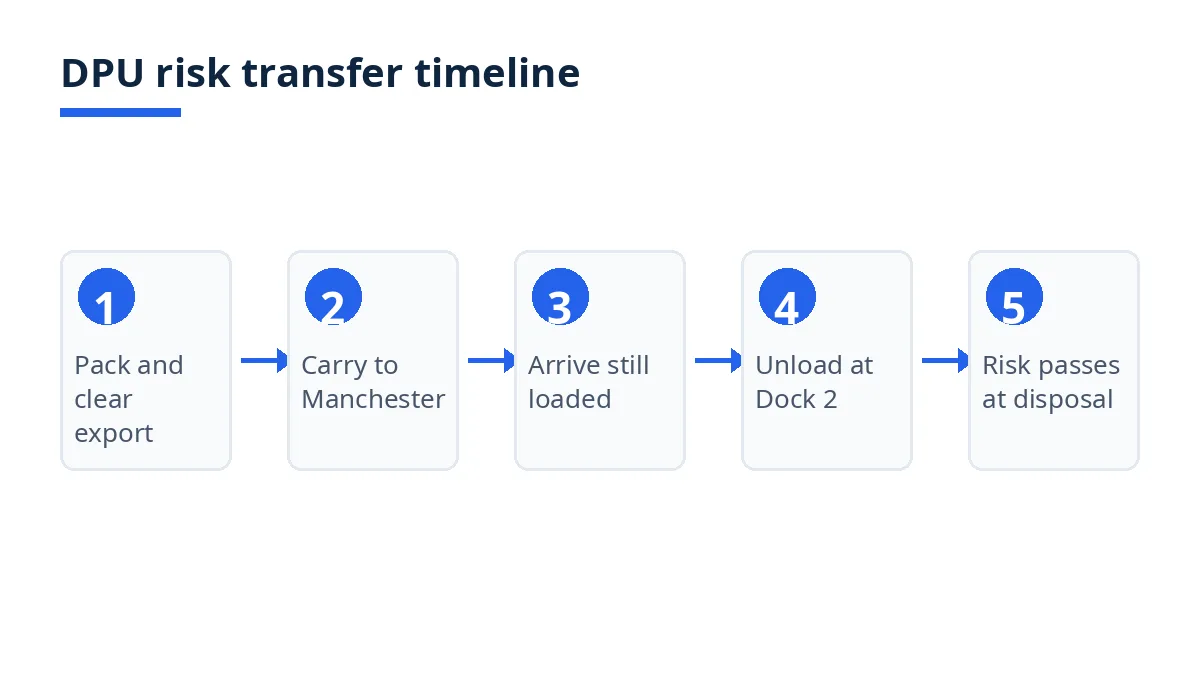
Risk stays with the seller through every leg, and moves once, at unloading.
Pack, check and clear for export. The seller packs the goods, pays checking costs, and carries out export clearance at its own risk and cost.2 For Bangladesh, goods must not be loaded for export unless an approved Bill of Export (Shipping Bill) has been submitted to Customs.6
Carry to the named place. The seller contracts and pays for carriage to the named place, or the agreed point within it, and bears the risk on the way.2
Arrive, still loaded. Arrival alone changes nothing: the goods are still on the vehicle, so delivery has not happened.
Unload. The seller unloads the goods. Damage during this act is the seller's, because delivery requires unloading.1 4
Place at your disposal and give notice. Delivery is complete when the unloaded goods are at your disposal and the seller has given notice.2 4 Risk is then yours.
Clear, collect and move on. You clear import, pay duty and taxes, collect the goods and arrange onward transport.1
The diagram marks the boundary at step five.
Risk and cost at each stage
The table separates risk from cost at each stage.
Stage | Risk | Cost |
|---|---|---|
Packing, checking, export clearance | Seller | Seller |
Carriage to the named place | Seller | Seller |
Arrival, goods still loaded | Seller | Seller |
Unloading | Seller | Seller, including unloading2 |
Unloaded, at your disposal | Buyer, from delivery2 | Buyer, from delivery2 |
Import clearance, onward transport | Buyer | Buyer |
Two exceptions move risk earlier than delivery. If the buyer fails to tell the seller where delivery is required, or fails to import-clear the goods, the buyer bears the risk from the agreed date or period for delivery.2
Notice works both ways: the seller must give notice the buyer needs to receive the goods, and the buyer must give the notice the contract requires.2 Insurance follows risk but the rule does not compel it.2 Cover, where bought, should run through unloading on the seller's side and start at delivery on the buyer's side.4
Three damage windows: one shipment, three answers
Example figures only, for one shipment of handwoven jute floor rugs from Chattogram to a Manchester warehouse, DPU the warehouse, unloading at Dock 2. They are not a quotation. The same shipment is tested at three moments.
Example figures: goods, including export packing, 8,240; export clearance and documents, 175; carriage, Chattogram to the Manchester warehouse, 1,690; unloading at Dock 2, 145; DPU price, unloaded at Dock 2, 10,250 (8,240 + 175 + 1,690 + 145). All figures in USD. No duty rate is stated: import clearance, duty and taxes stay with the buyer, outside the DPU price.1 2
Damage window | Example loss (USD) | Who bears it |
|---|---|---|
Water damage found in transit, before arrival | 1,240 | |
Forklift damage during unloading at Dock 2 | 380 | |
Damage after unloading, while rugs wait for collection | 265 | Buyer: delivery is complete once goods are at the buyer's disposal.2 4 |
The first two windows total 1,620 (1,240 + 380): damage on the seller's side of the line. Delay in collecting goods unloaded at Dock 2 does not keep risk with the seller.
DPU beside DAP, DDP and CIF: the unloading act is the difference
Ask where delivery happens, not who paid the freight.
Rule | Delivery and risk point | Unloading | Import clearance and duty |
|---|---|---|---|
DPU | After unloading, goods at the buyer's disposal | Seller | Buyer |
DAP | On arrival, ready for unloading | Buyer, unless the carriage contract includes it | Buyer |
DDP | On arrival, cleared for import, ready for unloading | Buyer, unless the carriage contract includes it | Seller |
CIF | On board the vessel at the port of shipment | Buyer, unless the freight contract includes it | Buyer |
Under DAP, the seller also pays carriage and bears transit risk to arrival, but delivery happens before unloading.1 Under DDP, the seller also clears import and pays duty and taxes, so a DPU price is not duty-paid.5 Under CIF, risk passes on board at origin, while the seller pays freight and minimum insurance to the destination port, so a CIF price ends at that port.7 Paying unloading under DAP or DDP does not move the risk point.4
Errors that put the loss on the wrong side
Naming a city instead of a point. "DPU Manchester" does not name Dock 2. Without an agreed point, the seller may select the point that suits its purpose.2 Name the bay in the contract.
Treating arrival as delivery. A vehicle at the gate with its load still on board has not delivered under DPU. Do not sign a clean receipt until unloading is finished.
Assuming the seller is insured. DPU imposes no insurance obligation on either party.2 Ask who bought cover, and whether unloading is inside the policy.
Assuming import clearance can wait until after unloading. Where the destination requires import clearance before unloading, the buyer must clear first.8 In that case DAP gives a clearer sequence.8
Agreeing DPU where the seller cannot unload safely. The seller should assess whether it can safely unload at the agreed place; if it cannot, DAP fits better.1
Ranking a DPU claim against a CIF headline. CIF risk passed on board at origin, so damage in transit is already the buyer's risk under CIF.7 The same damage under DPU is the seller's risk until unloading.
What is DPU?
DPU stands for Delivered at Place Unloaded. It is one of the eleven Incoterms 2020 rules, published by the ICC, and it replaced DAT so the named place can be any place, not only a terminal.1 3 The seller delivers unloaded, bears carriage and unloading cost and risk, and clears export. The buyer completes import clearance, pays duty and taxes, and arranges onward transport.1 2
How does DPU work in practice?
The seller packs, clears export, contracts carriage, and unloads at the agreed point, then places the goods at the buyer's disposal and gives notice.1 2 4 The buyer prepares import clearance in transit, takes delivery once the goods are unloaded, and moves them onward. Risk passes at unloading, not at departure, arrival, or collection.2
Is DPU used for shipments from Bangladesh?
Yes, where the seller arranges carriage and unloading and the buyer handles import clearance at destination. No separate Bangladesh rule changes the risk split: export clearance, including the approved Bill of Export before loading, stays with the seller, and import clearance and duty stay with the buyer.6
What are common mistakes with DPU?
Naming a city instead of a bay, treating arrival as delivery, assuming insurance or duty-paid arrival, leaving import clearance until after unloading where clearance must come first, agreeing DPU where the seller cannot unload safely, and ranking a DPU quotation against a CIF headline. Each mistake moves the loss to the wrong side of the unloading act.
Next steps on Exportain
Check the named place, unloading point and notice arrangements against the timeline above, and read the Incoterms guide for all eleven rules and the CIF guide for the port-based contrast. When the point is fixed, post an RFQ stating the DPU term and unloading point in full, and check how to buy. Exportain is a B2B marketplace where buyers find Bangladeshi suppliers. It is not a party to the contract for the goods.
Sources
- DAP & DPU Incoterms 2020 explained: Key differences. ICC Academy, (accessed )
- DPU Delivered at Place Unloaded [Updated 2025] | Incoterms. Trade Finance Global (accessed )
- Incoterms® 2020. International Chamber of Commerce (ICC) (accessed )
- DPU Incoterms (Delivered at Place Unloaded) Explained. iContainers (accessed )
- Incoterms for Shipments From Bangladesh. Exportain (accessed )
- Customs Clearance Procedures for Export. Bangladesh Customs, National Board of Revenue (accessed )
- CIF Meaning (Cost, Insurance & Freight). Exportain (accessed )
- DPU (Delivered At Place Unloaded) | Incoterms 2020. Röhlig Logistics (accessed )
Reviewed by Naim Islam
About the author
Sourcing from Bangladesh?
Post a request for quotation and suppliers on Exportain can send you their quotes directly.
Post an RFQ