DPU Documents Required: The Unloading-Gate Paper Check
The papers for a DPU shipment prove four handovers: export clearance, carriage, unloading and import clearance. This checklist checks each paper at the gate where it is needed, before the goods move on.
Short answer
Under DPU (Delivered at Place Unloaded), Incoterms 2020, the seller must provide the commercial invoice and any evidence of conformity the contract specifies, complete export clearance, and give the buyer the document needed to take over the goods once unloaded, including a signed receipt where that is the agreed proof. The buyer completes import clearance and pays duty and taxes. No insurance document is owed by either side, so any agreed cover is a separate paper.
On this page
Key takeaways
Under DPU the seller must unload the goods at the named place and point and give the buyer the document needed to take them over, including a signed receipt where that is the agreed proof; delivery is not complete on arrival alone.
The commercial invoice is the source document for the set: every later paper copies from it, so the set is checked against the invoice at each gate.
The transport document follows the mode used, and the carrier's possession and release papers, and the means of unloading, must be confirmed in writing before booking.
In Bangladesh, export clearance requires an approved Bill of Export with its enclosures before the goods are loaded; the certificate of origin and product permits depend on the destination and product.
DPU imposes no insurance obligation on either side, and import papers depend on the destination and mode, so the broker must confirm them in writing before departure.
A DPU delivery ends with a signature, not with a truck arriving. The vehicle can be at the right bay and the goods can be on the ground, yet the delivery stays unproven if nobody signs the receipt recording what was unloaded, where, and in what condition. Each paper in the shipment set proves one handover, and a missing paper leaves the handover it was meant to prove open to argument later.
This checklist covers the dpu documents required for buyers in the United States, the United Kingdom, the European Union and the United Arab Emirates buying from Bangladesh on DPU terms. It checks each paper at the gate where it is needed, so a missing paper is caught before the goods move past it.
Why one missing paper can hold an unloaded shipment
DPU stands for Delivered at Place Unloaded. Under DPU, Incoterms 2020, the seller delivers the goods unloaded at the named place and point, bears carriage and unloading cost and risk to that point, and completes export clearance and any transit formalities. The buyer completes import clearance, pays duty and taxes, and arranges onward transport beyond the named place.1 2 DPU is the only Incoterms 2020 rule that requires the seller to unload, and it works for any mode of transport, or a combination of modes.1 3 It replaced DAT (Delivered at Terminal) so the named place can be any agreed place, not only a terminal.4
Four rules, FAS, FOB, CFR and CIF, are for sea and inland waterway transport only, because delivery under those rules is defined by the vessel. The other seven, including DPU, work for any mode.5 The transport document therefore changes with the mode: a sea shipment and an air shipment do not carry the same document under the same rule. Papers also fix the sequence where import clearance must come before unloading: the seller cannot unload goods that have not been cleared, and the buyer cannot clear goods it has no papers for. If clearance delays unloading, agree in writing before shipment who bears the waiting and storage cost, rather than assuming the rule settles it.2 The Incoterms guide sets out all eleven rules.
Set the paper rules before anything is booked
Fix five points in writing before booking. First, write the term in full: "DPU (named place and unloading point), Incoterms 2020", with the full address and the bay, dock or yard area. A city name alone leaves the point open, and where the exact point is not specified the seller can select the point that suits its purpose, usually the cheapest option, such as a cargo terminal.2 The seller should also assess whether it can safely unload at the agreed point; if it cannot, DAP fits better.1
Second, agree the form of every document: paper or electronic. The seller must provide the goods and the commercial invoice as the contract requires, plus any other evidence of conformity the contract specifies, and any document may be in paper or electronic form as agreed in the contract, or as is customary where the contract says nothing.2 A port, a bank and a broker do not always accept the same form.
Third, agree notices: the seller must give the buyer any notice the buyer needs to receive the goods, and where the contract requires it the buyer must give notice of when, and at which point, delivery is required.2 Name the method, sender and timing for each notice. Fourth, agree how payment documents fit the term: a letter of credit calling for a bill of lading consigned to order can sit badly with a DPU delivery at the end of the transport chain.2 Get the bank's document requirements in writing before booking.
Fifth, name one checker on each side and appoint the broker before departure. The broker confirms, in writing, the destination papers for the exact goods, mode and destination, since the USA, the UK, the EU and the UAE do not ask for identical papers. State whether any insurance is agreed, who buys it and for which legs: DPU imposes no insurance obligation on either side, so no insurance document is owed unless the contract creates one.2 4
DPU documents required, gate by gate
Work through the gates in order. Do not let the goods pass a gate until every paper at that gate has been checked against the invoice. The diagram shows the four gates at a glance.
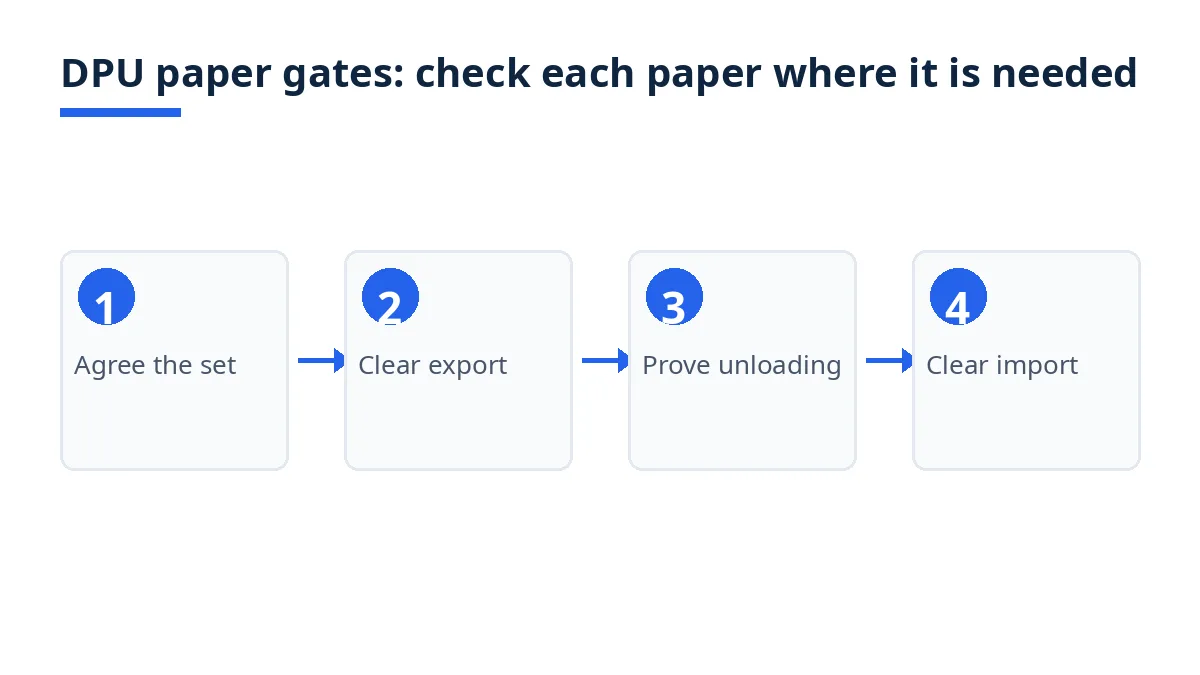
Gate 1: the contract and the export file
Commercial invoice, with evidence of conformity where the contract specifies it. The invoice is the source document for the whole set: seller and buyer, detailed goods description, quantity, unit and total price, the DPU term with the named place and unloading point, currency, and invoice number and date.2 6 Every later document copies from it, so every later error usually starts here. Where the contract specifies an analysis certificate or other evidence of conformity, obtain it as its own paper and check that it names the same goods and quantity.2
Bill of Export, EXP form and export enclosures. Goods must not be loaded or stuffed in containers or a ship for export unless a Bill of Export, also called a shipping bill, has been submitted to Customs in the prescribed format and approved by the Customs authority.7 Its enclosures for all export consignments are the export letter of credit or, where there is none, the export contract, purchase order or export guarantee approved by the negotiating bank; the signed invoice; the packing list; the EXP form certified by an Authorised Dealer bank; the certificate of origin; the VAT registration certificate; and the Taxpayer Identification Number.7 Ask for copies before loading, since approval must precede loading.
Certificate of origin and product permits, where required. Origin is proved by a certificate issued by the Export Promotion Bureau (EPB) or a chamber of commerce and industry, stating where the goods were manufactured or processed.7 6 Which form is needed depends on the destination authority, a preference arrangement or the payment terms: confirm it in writing through the broker, and obtain it before shipment. Product permits apply only where they apply: an Export Registration Certificate for jute, jute goods and tea, a consignment-wise export permit from the Bangladesh Tea Board for tea, a phytosanitary certificate for agricultural goods where the destination requires one, and a quality control certificate where one is obligatory for the product.7
Gate 2: packing, carriage and the transport document
Packing list, checked against the invoice and the packages. Use the list to verify each package: item quantities, package weights and dimensions, how the goods are packed, and the marks and numbers printed on the packages.7 6 Checking, packaging, weighing and counting for delivery are seller costs, and the seller must pack the goods to suit the transport unless the contract specifies the packaging or marking.2 Where wooden packing is used, ask the broker in writing whether a fumigation certificate confirming treatment to the ISPM 15 standard is required.6
Shipper's letter of instruction and the transport document for the mode used. Send the carrier a shipper's letter of instruction covering routing, handling and documentation requirements.6 The document the carrier issues then depends on the mode: sea uses a bill of lading, air uses an air waybill, road uses a CMR note, rail uses its equivalent, and a journey on two or more modes uses a multimodal document.6 The sea document combines three roles, receipt, contract of carriage and document of title; the air document is a receipt and contract only, is non-negotiable, and cannot transfer ownership.6 Confirm in writing who the carrier releases the goods to at each leg, and what the seller's carrier needs to take possession from the airline or shipping line and provide the means of unloading.2
Insurance paper, only where cover was agreed. No insurance document is owed under DPU. Only CIF and CIP oblige the seller to buy insurance for the buyer, at different levels of cover.4 Where cover was agreed, get the policy or certificate as a standalone document, verify who is insured, which goods and route it covers, the sum and currency, how a claim is made, and that the cover extends through unloading. Under CIF, by contrast, the seller must provide the insurance policy or certificate so the buyer can claim directly.8
Gate 3: arrival, notice and unloading
Arrival notice, in the agreed form and in time. The seller must give the buyer any notice the buyer needs to receive the goods.2 Agree the notice method before shipment, confirm the notify party can act on the carrier's arrival notice, and send the broker the invoice, packing list and transport document copy in transit, so import clearance is ready before the vehicle reaches the bay.
Unloading proof: the signed receipt or delivery document. At the seller's cost, the buyer must be given whatever document it needs to take over the goods, which may be as simple as a receipt for the buyer to sign; where the buyer must import-clear the goods, a copy of the transport document may be needed as evidence of the export and the shipment date.2 Providing proof that the goods have been delivered is also a seller cost.2 At unloading, check quantity and condition against the packing list before signing, record any visible damage on the receipt rather than signing it clean, and keep the signed receipt with the arrival notice. This paper is the DPU-specific proof: it shows the goods were unloaded at the agreed point, the act that completes delivery under DPU.1
Gate 4: import clearance and onward movement
Import declaration, licences and permits. Import formalities are the buyer's to carry out and pay for: licences, permits, security clearance and pre-shipment inspection where the destination requires them. The buyer must also assist the seller, at the seller's request, risk and cost, in obtaining documents needed for export formalities.2 Confirm the destination requirements before shipment, through the broker, and give the broker or forwarder written authority in good time where the destination requires it: in the USA a power of attorney may be required for a third party to act on customs clearance.6 If the buyer fails to tell the seller where delivery is required, or fails to import-clear the goods, the buyer bears the risk of loss or damage from the agreed date or period for delivery.2
Duty and tax payment evidence. The buyer pays the duties, taxes and other import clearance costs, and all costs relating to the goods from delivery onward.2 Keep the payment evidence in the shipment file with the import declaration. No duty rate is stated in this checklist: duty depends on the classification of the exact goods and the destination tariff, so the broker must confirm it before any figure is relied on.
Onward transport documents and a final consistency pass. Where the named place is not the final destination, arrange the onward carriage documents for the remaining leg: under DPU the buyer arranges onward transport beyond the named place.1 3 Then compare the finished set, line by line, with the invoice, and correct the set where a paper disagrees: the same names, goods description, quantities, weights, marks, places, values and currency on the invoice, packing list, transport document, certificate of origin and Bill of Export. Correct the source document first, reissue every document that copied the error, and check the set again.6
Where the paper set usually breaks
A clean receipt signed before the check. The buyer signs for goods still in the vehicle, or for cartons never counted, and the unloading proof says more than the buyer verified. Fix: count and inspect at the bay, record damage on the receipt, and sign only what was checked.2
The carrier cannot take possession or release the goods. The seller's carrier arrives without the paperwork the airline or shipping line requires to hand the goods over, or without the means to unload them at the destination.2 Fix: confirm the possession and release papers for each leg, and the unloading equipment, before booking.
Import clearance left until the vehicle is at the bay. The goods wait, the seller cannot unload, and the buyer may bear the risk while they sit uncleared.2 3 Fix: broker appointed, licences checked and documents sent in transit, before departure.
A city named where a bay was needed. "DPU Dubai" does not name the unloading point, and the seller may select the cheapest point that suits its purpose.2 Fix: full address, bay and access details in the contract and on every document.
One figure copied wrong. A weight, quantity or value that differs between the invoice and a later document creates a failure in every document that copied it.6 Fix: run item 11, fix at the source, and reissue every copy.
Summary table: paper, proof and gate
Copy this table into the shipment file. There is no separate file to download: this table is the template. Add the contract number, the named place and unloading point in full, the checker names and the check date for each line.
Paper | What it proves | Gate | If it is missing |
|---|---|---|---|
Commercial invoice, evidence of conformity if specified | Goods, value and term as contracted | Contract | Later documents copy an unchecked source |
Bill of Export, EXP form, enclosures | Export clearance approved before loading | Export | Goods cannot be loaded for export |
Certificate of origin, product permits | Origin and product permission for the destination | Export | Preference or entry refused at destination |
Packing list | Contents, weights, marks of each package | Carriage | Quantity and condition cannot be checked at unloading |
Shipper's letter of instruction, transport document | Carriage, routing and release of the goods | Carriage | Carrier cannot take possession or release the goods |
Insurance policy or certificate, if agreed | Cover for the agreed legs, through unloading | Carriage | Loss falls where no cover was bought |
Arrival notice | Buyer can receive the goods in time | Unloading | Vehicle arrives to an unready bay |
Signed unloading receipt | Goods unloaded at the agreed point | Unloading | Delivery under DPU is unproven |
Import declaration, licences, permits | Goods may enter and be cleared | Import | Goods wait uncleared and risk may be the buyer's |
Duty and tax payment evidence | Import costs settled | Import | Release is held until payment is shown |
Onward transport documents, consistency pass | Goods move on, and the set agrees | Import | Onward leg stalls, or one copied error voids the set |
When should this checklist be used?
Use it at four points: when the contract is agreed, when the goods are booked, at the loading gate when the export file is approved, and at the unloading gate when the receipt is signed. Run it again whenever the mode, the named place or the unloading point changes.
Who should complete it?
The seller's checker owns the export and carriage papers and the buyer's checker owns the import papers, and each checker reads the set against the invoice. Forwarders, brokers and inspectors can prepare individual papers, but they work from the contract, the booking details and written authority supplied by the responsible side, and the responsibility for each paper stays where the rule puts it.
What are the most common failures?
A clean receipt signed before the goods are checked, a carrier that cannot take possession or release the goods, import clearance left until the vehicle is at the bay, a city named instead of a bay, and one figure copied wrong across the set. Each is fixed at the gate where the paper is checked, before the goods move past it.
Can a third party do it?
Yes, for preparation and checking, not for responsibility. Forwarders handle carrier and clearance papers, brokers handle the import declaration and duty payment, insurers issue any agreed policy or certificate, and inspectors issue inspection certificates where the contract requires one. The named checker on the responsible side still verifies each paper, and preparing a document never moves responsibility for it to the third party.
Next steps on Exportain
Price the unloading line with the DPU price guide, read the Incoterms guide for all eleven rules, and check how to buy for the buying steps. When the named place, unloading point and document list are fixed, post a free RFQ on Exportain stating the DPU term, the unloading point and the document list in the requirement. Exportain is a B2B marketplace where buyers find Bangladeshi suppliers and post requests for quotation. It is not a party to the contract for the goods, and it does not inspect goods, book freight or clear customs.
Sources
- DAP & DPU Incoterms 2020 explained: Key differences. ICC Academy, (accessed )
- DPU Delivered at Place Unloaded [Updated 2025] | Incoterms. Trade Finance Global (accessed )
- DPU Shipping Terms: Duties, Costs and Customs. Eurosender (accessed )
- Incoterms® 2020. International Chamber of Commerce (ICC) (accessed )
- Incoterms for Shipments From Bangladesh. Exportain (accessed )
- International Shipping Guide: Essential Documents & Logistics. FreightAmigo (accessed )
- Customs Clearance Procedures for Export. Bangladesh Customs, National Board of Revenue (accessed )
- CIF Meaning (Cost, Insurance & Freight). Exportain (accessed )
About the author
Sourcing from Bangladesh?
Post a request for quotation and suppliers on Exportain can send you their quotes directly.
Post an RFQ