DDP Shipping From Bangladesh to UK: Costs, Steps and Timeline
DDP from Bangladesh to the UK, through a UK-entry lens: GB EORI and CDS clearance, postponed VAT accounting and duty deferment, costs, steps and documents.
Short answer
Under DDP, a Bangladeshi seller delivers goods to a named place in the UK, cleared for import, with duties and taxes paid, bearing risk until delivery. The deal stands or falls on the UK import setup: who imports the goods, through which broker, under which commodity code, and how duty and import VAT are paid or deferred. Confirm that setup, the code, and the VAT route in writing before accepting a DDP price.
On this page
Key takeaways
Under DDP, the seller delivers goods to the named UK place cleared for import, with duties and taxes paid, bearing risk until delivery.
A UK DDP deal stands or falls on the import setup: the named importer, the broker, a GB EORI number, and a CDS declaration.
Postponed VAT accounting and duty deferment are separate routes: the first handles import VAT for VAT-registered businesses, the second defers duty through a monthly Direct Debit backed by a guarantee or waiver.
Duty is priced only on a broker-confirmed commodity code, and the import VAT choice cannot be changed once the declaration is submitted.
Exportain verification is a document and photo review, not a factory inspection, and a badge is not a guarantee of capacity, quality or delivery.
A DDP price from Bangladesh to the UK looks simple: one price, goods delivered, no UK customs work to arrange. The work that decides whether that price holds sits on the UK side of the journey, not on the sea leg. Before goods leave Chattogram, the seller needs a workable UK import setup, a confirmed commodity code, and a written agreement on duty and import VAT at the UK border.
Under DDP, the seller delivers the goods to the named place in the destination country, cleared for import, with duties and taxes paid, and bears risk until delivery. The Incoterms 2020 rules allocate cost, risk and obligations for each rule, and DDP places the greatest obligation on the seller.1
Why this matters for buyers and sellers
For a UK buyer, DDP removes the need to appoint a UK broker, file a UK import declaration, or fund duty and import VAT at the border. That convenience is only as strong as the seller's UK setup: if the seller cannot stand behind a UK declaration, the shipment can stall at a UK port, incur storage charges, or turn into a different deal, with the buyer asked to import the goods instead.
For a Bangladeshi seller, DDP is a compliance commitment, not just a freight quote. The seller bears risk until delivery at the named place, and is responsible for declaration accuracy, classification, and payment of duties and taxes.2 A seller without a UK presence or partner must solve that gap before quoting.
Under EXW, the buyer collects the goods and handles almost everything from the seller's premises. Under DAP, the seller delivers to the named place but the buyer clears the goods and pays duty and import VAT. Under DDP, the seller does both. See the Incoterms guide for all 11 rules, and the EXW guide for the UK for the opposite end of that spectrum.
Term | Export clearance | Main carriage | UK import declaration | Duty and import VAT | Risk until |
|---|---|---|---|---|---|
EXW | Buyer | Buyer | Buyer | Buyer | Factory gate |
DAP | Seller | Seller | Buyer | Buyer | Named place, before unloading |
DDP | Seller | Seller | Seller | Seller | Named place, ready for unloading |
Step-by-step: how it works
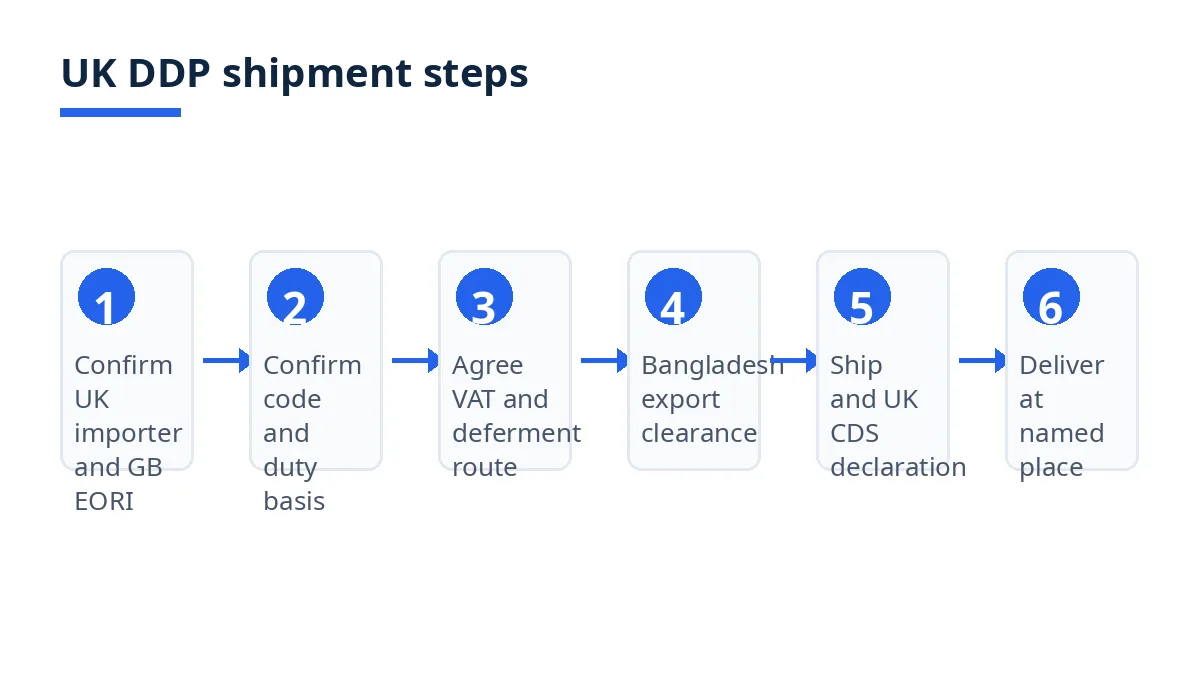
Confirm who will import the goods in the UK, in writing. Name the importer, the UK broker or agent, and the representation arrangement on the declaration. A provider guide on DDP states the practical choice: in most countries the seller must either be registered locally to act as importer of record, or appoint a qualified third-party provider, because that importer is legally responsible for declaration accuracy, classification, duty and tax payment, and post-entry compliance.2 GOV.UK guidance for a person without a UK establishment makes the same point: that person needs someone to deal with customs for them, who also completes the import declaration.3
Confirm the commodity code and duty position before pricing. GOV.UK's import steps require the code on the declaration, and state that it determines the duty rate and whether an import licence is needed.4 Do not price duty from a product description alone. Ask the broker to confirm the code against the UK tariff, and whether any duty reduction, licence, or marking rule applies.
Agree the VAT and duty payment route in writing, before the declaration. This is the step most DDP quotes skip. If the importer is UK VAT-registered and the goods are for business use, postponed VAT accounting lets it declare and recover import VAT on the same VAT Return, rather than paying it upfront and recovering it later.3 No approval is needed, but the VAT number must appear on the declaration.3 Where a supplier arranges import on the buyer's behalf, the parties must agree the VAT treatment, so written instructions can be given before the declaration, and the buyer must give the supplier its EORI number.3 Once submitted, the import VAT choice cannot be changed for that declaration.3
Agree duty deferment separately from VAT. A duty deferment account lets a regular importer delay most customs charges and make one payment a month through Direct Debit, instead of paying per consignment.5 It requires an approved guarantee or waiver.5 A VAT-registered business does not need one to delay import VAT, because it can account for import VAT on its VAT Return.5 Keep the routes apart: postponed VAT accounting handles import VAT, deferment handles duty and other deferred charges.
Complete Bangladesh export clearance. Goods may not be loaded for export unless an export declaration, the Bill of Export or Shipping Bill, is submitted to Customs and approved, naming the goods, value, exporter, foreign buyer and transport operator.6 The full export document set is listed in the documents section below.
Ship, then clear the goods in the UK through the Customs Declaration Service. GOV.UK states that a business needs an EORI number starting with GB to import into England, Wales or Scotland, and may need one starting with XI for Northern Ireland movements.7 The declaration carries the code, value, origin and payment route from steps 2 to 4. If goods are held, GOV.UK lists unpaid duty or VAT, missing licences, failed inspection, or a held-up combined shipment among the reasons, and states the importer will be told why.7
Deliver to the named place and reconcile the paper. Delivery is complete when the goods are at the named place, ready for unloading. Reconcile the VAT evidence after delivery: a border-paid importer uses the Import VAT Certificate (C79), while a postponed-accounting business uses its monthly postponed import VAT statement.3 Keep commercial invoices and customs paperwork, including the C79, as records.4
Costs, timelines and documents
What are the typical costs and timelines?
There is no typical DDP cost or transit time a guide can state as fact. Duty depends on the confirmed code, import VAT on the customs value and VAT treatment agreed, and freight on the route, volume and season. A DDP quote stating a duty rate before the code is confirmed should be treated as an estimate, and the contract should say so.
Example figures: one container of garments from Chattogram to a UK warehouse, as one DDP total: goods 18,000, freight and insurance 2,800, UK import duty 1,100, UK clearance and inland delivery 900, and import VAT handled as a cost in the example 3,700, for a DDP total of 26,500. These are example figures only, explaining the structure of a DDP price. They are not a quotation, duty rate, or freight rate, and every line must be replaced with broker-confirmed figures for the actual goods, code and route.
Test a DDP quote against landed cost, the full cost per good unit in the warehouse rather than the supplier price. See the landed cost guide for that calculation, and compare quotations with the DDP quotation guide before accepting a single total.
Example timeline, shown as a sequence rather than a promise: export documents and clearance 2 to 3 working days, sea transit from Chattogram to a UK port 28 to 35 days, UK clearance 1 to 3 working days once the declaration and payment route are ready, and inland delivery 1 to 2 working days. A wrong code, missing licence, or unconfirmed VAT route can extend UK clearance beyond that range, which is why steps 1 to 4 come before the goods move.
Which documents are needed?
For Bangladesh, the export set is the Bill of Export, commercial invoice, packing list, EXP form certified by an authorized dealer, and certificate of origin, with product-wise certification where required.6 For the UK, the broker needs the invoice, packing list, transport document, commodity code, origin information, licences for controlled goods, the GB EORI number, and, where postponed VAT accounting applies, the VAT number and written instruction to use it.3 Keep commercial invoices and customs paperwork, including the C79, as records.4
Bangladesh-specific rules and tips
Keep one legal name across every paper. The Bangladesh export declaration names the exporter and foreign buyer,6 so the name on the trade licence, quotation, proforma invoice and payment account should match the name the UK broker will declare. A mismatch is a common cause of queries.
Check product-wise documents early. Bangladesh Customs lists product-wise additional certification for some categories.6 A food or chemical shipment may need a certificate a general shipment does not, confirmed before sailing, not after the goods reach the UK.
Do not price a duty reduction until the broker confirms it. GOV.UK's import steps include finding out whether Customs Duty can be reduced,4 but a reduction depends on the code, origin, and proof of origin. A quote assuming a reduction without naming the code and proof is an estimate with a gap in it.
Treat a Northern Ireland delivery as a separate check. GOV.UK states that a business moving goods between Northern Ireland and non-EU countries, including Great Britain, may need an XI EORI number, and that declarations and tariffs are due when bringing goods into Northern Ireland from Great Britain or from outside the EU and UK.8 EU VAT rules continue to apply in Northern Ireland for goods under the Windsor Framework.8 Confirm that route with the broker before quoting a Great Britain price for a Northern Ireland delivery.
Mistakes and red flags
What are the most common mistakes?
Naming no importer. A quote that never states who will import the goods in the UK, or how that importer is registered and represented, is incomplete. Ask for the importer, broker, and representation arrangement in writing before the goods move.
Assuming import VAT is always recoverable. Postponed VAT accounting requires UK VAT registration, goods for business use, and the VAT number on the declaration.3 A seller that pays import VAT without a UK VAT registration to recover it on has no VAT Return to recover it through, and that cost stays inside the DDP price or becomes a dispute. A provider guide on DDP makes the same warning: VAT recovery is not always automatic.2
Leaving the VAT instruction until after the declaration. Postponed VAT accounting must be selected on the declaration, with written instructions given before it is made, and the choice cannot be changed once it is submitted.3 An arrangement that agrees the VAT route after clearance has already missed its chance to use it.
Confusing GB and XI EORI numbers. A GB EORI number covers imports into England, Wales and Scotland, while a Northern Ireland movement may need an XI number.7 Quoting a Great Britain price for a Northern Ireland delivery without a separate check is a red flag.
Pricing duty before the code is confirmed. The code determines the duty rate and any licence requirement.4 A duty figure quoted from a product name, without a code, is an estimate. Record the code on the quotation and purchase order.
Leaving the named place vague. "DDP UK" is not a named place. State the town, premises, and whether unloading is included.
Accepting a DDP price with no breakdown. A single total hides whether duty was estimated, whether import VAT was treated as recoverable, and whether inland delivery was included. Ask for the breakdown in the example format above, with each line labelled confirmed or estimated.
Checklist
Importer named, with broker or agent, in writing.
GB EORI confirmed for Great Britain, with an XI check for a Northern Ireland delivery.7
Commodity code confirmed against the UK tariff, with duty, licence and marking checks recorded.4
Duty and import VAT route agreed in writing: postponed VAT accounting, duty deferment, or payment at the border.3 5
Written VAT instruction given to the broker before the declaration is submitted.3
Named place stated in full, with inland delivery and unloading positions clear.
Bangladesh export set agreed: Bill of Export, invoice, packing list, EXP form, certificate of origin, plus any product-wise certificate.6
DDP price broken down by goods, freight and insurance, duty, clearance, inland delivery and import VAT, with estimates marked as estimates.
Delivery evidence agreed: C79 or postponed VAT statement, deferment statement, and delivery note.3
Contract wording checked against the DDP clause guide before signature.
How Exportain helps
On Exportain, browse suppliers and post a request for quotation (RFQ) on the RFQ board with the named UK place, the commodity code where known, and a request for a broken-down DDP price stating the importer, duty basis, and VAT route. Ask each reply to state which lines are confirmed and which are estimated. On acceptance, Exportain creates one order and issues one proforma invoice from the accepted terms.9
Read the badges for what they record. Exportain Verified means Exportain has checked identity, phone, email and business registration, and Export Verified means it has checked the Export Registration Certificate (ERC).9 Factory Verified means it has reviewed photos of the factory.9 Verification is a document and photo review by staff, free, and never granted by membership plans.9 10 It is not a factory inspection,9 10 so the UK import setup, code and VAT route stay with you and your broker to confirm.
FAQs
What should I know first about DDP?
DDP means the seller delivers goods to the named place in the UK, cleared for import, with duties and taxes paid, bearing risk until delivery.1 The first question is not the freight rate but the UK import setup: who will import the goods, through which broker, and how duty and import VAT will be paid.
What are the typical costs and timelines?
There are no typical DDP costs or timelines a guide can state as fact, because duty depends on the confirmed commodity code, import VAT depends on the customs value and VAT route, and freight depends on the route and season. Use the example figures in the costs section to test a quote's structure, then replace every line with broker-confirmed figures.
Which documents are needed?
The Bangladesh export set is the Bill of Export, commercial invoice, packing list, EXP form certified by an authorized dealer, and certificate of origin, plus any product-wise certificate.6 The UK side needs the invoice, packing list, transport document, commodity code, origin information, licences for controlled goods, the GB EORI number, and, where postponed VAT accounting applies, the VAT number and written instruction.3
What are the most common mistakes?
The most common mistakes are naming no UK importer, assuming import VAT is recoverable without UK VAT registration, leaving the postponed VAT accounting instruction until after the declaration, confusing GB and XI EORI numbers, pricing duty before the code is confirmed, and accepting a single DDP total with no breakdown.
Next steps on Exportain
Browse suppliers, then post your named UK place, commodity code and DDP breakdown request on the RFQ board so suppliers state their importer, duty basis and VAT route in writing. Before confirming, read the Incoterms guide to compare DDP with DAP and EXW.
Sources
- Incoterms® 2020. International Chamber of Commerce (ICC) (accessed )
- DDP Shipping (Delivered Duty Paid) Explained. TecEx (accessed )
- Check when you can account for import VAT on your VAT Return. GOV.UK (accessed )
- Import goods into the UK: step by step. GOV.UK (accessed )
- How to set up an account to defer duty payments when you import goods. GOV.UK (accessed )
- Customs Clearance Procedures for Export. Bangladesh Customs, National Board of Revenue (accessed )
- Get UK customs clearance when importing goods into the UK: step by step. GOV.UK (accessed )
- Trading and moving goods in and out of Northern Ireland. GOV.UK (accessed )
- Trust & Safety Center. Exportain (accessed )
- Supplier verification: Earn trust badges buyers can see. Exportain (accessed )
About the author
Sourcing from Bangladesh?
Post a request for quotation and suppliers on Exportain can send you their quotes directly.
Post an RFQ