EXW Shipping From Bangladesh to UK: Costs, Steps and Timeline
EXW shipping from Bangladesh to UK: the factory-gate price plus every buyer-side cost line, export filer, Felixstowe transit, GB EORI, and a buyer checklist.
Short answer
Under EXW, Incoterms 2020, a Bangladeshi seller places goods at the buyer's disposal at the named factory or warehouse, not loaded, and the buyer then arranges loading, export clearance, carriage, insurance, and United Kingdom import formalities, including a GB EORI for Great Britain and a broker-confirmed duty and import VAT check. Risk passes at disposal, so the factory-gate price must be compared only after adding every buyer-side line.
On this page
Key takeaways
Under EXW, Incoterms 2020, the seller's obligation ends when goods are placed at the buyer's disposal at the named place, not loaded on any collecting vehicle, and risk passes to the buyer at that moment.
The buyer arranges loading, export clearance, carriage, insurance, United Kingdom import formalities, and inland delivery, and must confirm the export filer in writing before agreeing the price, since the seller has no export-clearance duty under a bare EXW term.
An EXW price is a factory-gate figure only: compare quotations only after adding every buyer-side line, and treat duty as a broker-confirmed figure for the specific goods, never as a copied rate.
For Great Britain, the buyer needs a GB EORI number, while a move to or from Northern Ireland may need an XI EORI number; confirm the correct prefix for the actual destination before the declaration is filed.
Import VAT is kept outside the worked-example total as a separate broker-confirmed check; GOV.UK guidance states a VAT-registered buyer can select to account for import VAT on the VAT Return, with the VAT number entered in Data Element 3/40.
An EXW price from Bangladesh to the United Kingdom looks simple until the buyer asks who files the export papers, who loads the truck, and who stands at Felixstowe with an EORI number. Under EXW (Ex Works), Incoterms 2020, the seller's obligation ends when the goods are placed at the buyer's disposal at the named place, usually the seller's factory or warehouse, and the buyer then carries every later step.
EXW is the minimum-obligation rule for the seller and the maximum-obligation rule for the buyer. Delivery and risk transfer occur when the seller places the goods at the disposal of the buyer at the named place, not loaded on any collecting vehicle.1 The seller is not required to load the goods, to clear them for export, or to arrange carriage or insurance, unless the contract expressly adds one of those duties. The buyer arranges loading, export clearance, carriage, insurance, United Kingdom import formalities, and inland delivery, and bears the risk from the disposal moment onward. The ICC Academy notes that EXW may cause problems where goods are intended to be exported, and that FCA is preferred in that case.1 That warning is the reason this guide starts with the export filer and the United Kingdom entry file, rather than with the ocean leg alone.
Why this matters for buyers
An EXW quotation looks low because so much is left out of it. The buyer pays for loading at the seller's premises, inland transport to the origin port, export clearance and duties, origin terminal handling, ocean or air freight, cargo insurance, destination clearance and duties, and inland delivery.2 None of those lines is a seller cost under a bare EXW term. A buyer who compares an EXW price directly with an FOB or CIF price to the United Kingdom is comparing two different scopes, not two prices for the same service. The FOB seller clears the goods for export and loads them on board at Chattogram, while the CIF seller also pays freight and buys insurance to the destination port. The comparison only becomes fair once the buyer-side lines are added to the EXW figure, which is what the worked example below does.
The risk point matters as much as the price. Because risk passes when the goods are placed at the buyer's disposal, damage during loading at the factory, during inland transport to Chattogram, or during the ocean leg is the buyer's risk. Insurance bought by the buyer must therefore start at the factory gate, not at the port.
The United Kingdom entry point is the second reason an EXW shipment stalls. The buyer, or a broker acting for the buyer, must be ready at the United Kingdom end with the right EORI number and a broker-confirmed duty and import VAT position. GOV.UK's step guide states that a buyer needs an EORI number that starts with GB to import goods into England, Wales, or Scotland, and that a different prefix may be needed for moves to or from Northern Ireland.3
Step-by-step: how it works
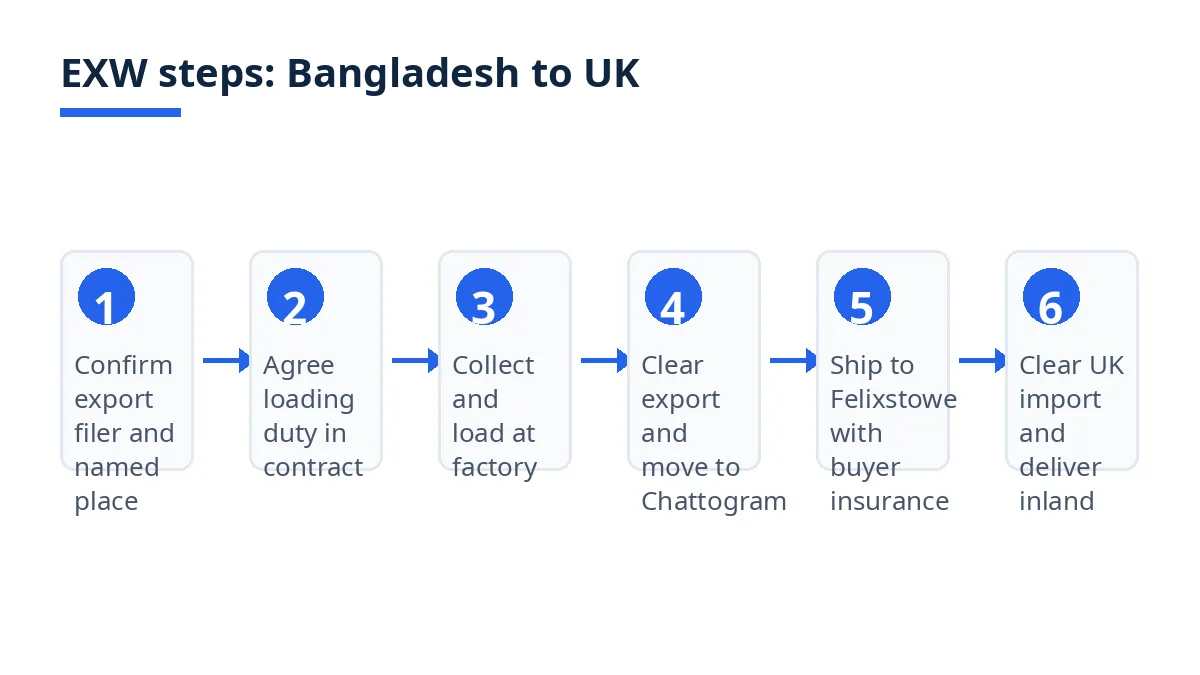
Work in this order.
Confirm the export filer and the named place in writing. Record the full factory or warehouse address, the collection window, the contact person, and the party who will file the export declaration. Under EXW, the buyer is responsible for export clearance unless the parties agree otherwise.4
Agree the term, the price, and the loading duty in the contract. Write "EXW [full named place], Incoterms 2020" with the goods, quantity, price, payment terms, and packing standard. State expressly who loads the goods, since the seller has no such duty under a bare EXW term.1
Appoint the United Kingdom broker and confirm the EORI position before collection. Give the broker the goods description and the destination, and ask the broker to confirm classification, the duty position, and the import VAT handling. Do not wait until the vessel sails.
Collect and load at the seller's premises. The buyer's carrier arrives in the agreed window, loads at the buyer's risk and expense, and checks quantity, marks, and packing against the invoice and packing list.4
Move the goods to Chattogram and complete export clearance. The buyer-side agent files the export declaration and hands the cargo to the carrier or terminal as the booking requires. Keep the export papers with the invoice and packing list.
Book the ocean leg and buy cargo insurance from the factory gate. The buyer contracts carriage from Chattogram to Felixstowe and buys cover that starts at the factory gate. Confirm the sailing, transshipment ports, and arrival window in writing.
Clear United Kingdom customs, settle the broker-confirmed duty and import VAT handling, and deliver inland to the warehouse on a forwarder-confirmed leg.
Costs, transit time and documents
Each line moves with the carrier, insurer, season, cargo, and contract, so the table below uses labeled example figures only, structured as the ex-works price plus buyer-side cost lines. It differs from the United States EXW example, which used a different factory-gate price and inland leg, and from the CIF and FOB United Kingdom examples, which start from a port price.
Buyer-side build-up | Example figure (USD) | Note |
|---|---|---|
Ex-works price of the goods | 10,750 | Example only, factory-gate price |
Loading at the seller's premises | 150 | Example only, buyer-side line |
Inland transport to Chattogram | 285 | Example only, buyer-side line |
Export clearance and agent charge | 240 | Example only, buyer-side line |
Ocean freight, Chattogram to Felixstowe | 1,980 | Example only, buyer-arranged |
Cargo insurance premium, buyer-bought | 130 | Example only, never a market rate |
Felixstowe port and terminal charges | 365 | Example only, buyer-side line |
Customs broker fee | 210 | Example only, buyer-side line |
Inland delivery to a Manchester warehouse | 420 | Example only, forwarder-confirmed leg only |
Subtotal of buyer-side lines in this example | 3,780 | Before duty and import VAT |
Total in this example | 14,530 | Ex-works price plus buyer-side lines, before duty |
Duty is left out of that total on purpose. Duty follows the classification of the specific goods and the United Kingdom tariff treatment the broker confirms for those goods, so no duty figure can be carried from one product to another. Ask the broker to confirm classification, the duty position, and any licence or certificate requirement for the goods before the vessel sails.3
Import VAT is also left out of that subtotal, and it must stay a separate buyer-side check. It is not part of the 3,780 figure, and no import VAT amount is built into the 14,530 total. If the broker confirms a base for the specific goods, treat import VAT as a separate line outside this example total, and confirm with the broker how it will be handled on the declaration for that shipment. For a VAT-registered buyer, GOV.UK guidance states that, when completing the import declaration, the buyer can select to account for import VAT on the VAT Return, that the choice cannot be changed once the declaration has been submitted, and that the VAT registration number is entered at header level in Data Element 3/40, with the VAT recorded against the EORI number.5
For transit time, read only dated guide estimates for the exact route and port pair, as planning figures, not as facts about a booked sailing. A route guide for Bangladesh to the United Kingdom, re-checked this session, gives 21 to 27 days for FCL shipments from Chittagong to Felixstowe, Southampton, or London Gateway on the Suez Canal route, with most cargo transshipping at Singapore, Colombo, Port Klang, or Tanjung Pelepas, and with LCL shipments at 25 to 33 days because of consolidation and deconsolidation time.6 The same guide notes that alternative routing via the Cape of Good Hope may add approximately 7 to 10 days during Suez Canal disruptions.6 Peak seasons and congestion at Chattogram can move a booked sailing away from a guide figure, so confirm the sailing in writing.6
Every item should match the others on names, quantities, weights, and marks:
Document | Job on this lane |
|---|---|
Commercial invoice | Seller, buyer, goods, value, origin |
Packing list | Carton, quantity, weight, marks |
Collection note | Proof of collection at the named place |
Export declaration papers | Buyer-side export clearance record |
Bill of lading | Carriage contract from Chattogram to Felixstowe |
Cargo insurance certificate or policy | Buyer-bought cover from the factory gate |
United Kingdom import declaration | Broker-filed entry, duty, and import VAT handling |
Delivery note | Inland delivery to the United Kingdom warehouse |
Bangladesh-specific rules and tips
Name the place with precision. "EXW Bangladesh" names no place at all, and "EXW Dhaka" still leaves the factory unidentified. Write the full street address of the factory or warehouse, the district, the collection window, and the contact who will release the goods. Each supplier needs its own named place and collection booking.
Settle the loading question before collection day. The seller has no duty to load under a bare EXW term, and the buyer's carrier must arrive with the labor and equipment the load requires.1 Confirm vehicle size, gate access, and loading hours.
Confirm the export filer as a named party. Ask the Bangladesh-side forwarder to confirm in writing that it will act on the export declaration for this shipment, and what documents it needs. If the forwarder cannot act, do not sign EXW and wait: agree FCA, under which the seller clears the goods for export, or agree in writing that the seller will handle export clearance as an added duty, with the charge stated.1
GB versus Northern Ireland — UK-only nuance: this paragraph covers only the United Kingdom entry. GOV.UK's import step guide states that a buyer needs an EORI number that starts with GB to import goods into England, Wales, or Scotland, and that a buyer moving goods to or from Northern Ireland may need one that starts with XI.3 Confirm which prefix applies before the declaration is filed.
Mistakes and red flags
The most common mistake is comparing an EXW price with an FOB or CIF price as if they covered the same scope. An EXW figure excludes the ocean leg, insurance, and both customs clearances, while an FOB figure includes export clearance and loading on board, and a CIF figure includes freight and seller-bought insurance to the destination port. Add the buyer-side lines first.
A second mistake is assuming the seller will load the goods. Under a bare EXW term, the seller places the goods at the buyer's disposal not loaded.1 A buyer who arrives without a loading plan pays waiting time or misses the collection window. Put the loading duty in the contract.
A third mistake is assuming the seller will clear the goods for export. Under EXW, the buyer handles export clearance, and the seller has no such duty unless the parties agree otherwise.4 A quotation that says nothing about export clearance has postponed the question to collection day.
A fourth mistake, specific to this lane, is engaging the United Kingdom broker only after the vessel arrives. By then the EORI, classification, and import VAT questions all need answers at once, while terminal charges are already running. Appoint the broker before collection.
Checklist
Named place in full, with factory address, collection window, and release contact
Export filer confirmed in writing, or FCA agreed instead
Loading duty stated in the contract, with vehicle, labor, and equipment confirmed
Packing standard and marks agreed, and marks checked at collection
Inland booking and cargo insurance both starting at the factory gate
Ocean booking confirmed in writing, with sailing, transshipment ports, and arrival window
United Kingdom broker appointed before collection, with EORI prefix confirmed
Classification, duty position, and import VAT handling confirmed by the broker
Bill of lading, insurance certificate, invoice, and packing list checked against each other
Inland delivery from Felixstowe booked on a forwarder-confirmed leg
How Exportain helps
Exportain connects international buyers with Bangladeshi suppliers, and an EXW purchase can be run through that channel in the same order as this guide. A buyer can request an EXW quotation that states the full named place, ask about collection windows and loading arrangements, and compare quotations by adding the buyer-side cost lines from the example table rather than comparing factory-gate figures alone. Keeping the quotation, the named place, and the document set in one thread makes it easier to spot a missing export filer, a wrong EORI prefix, or a mismatched mark before the goods leave the factory.
FAQs
What should I know first about EXW?
Know that the seller's obligation ends at the named place. Under EXW, Incoterms 2020, the seller places the goods at the buyer's disposal at the factory or warehouse, not loaded, and the buyer then arranges loading, export clearance, carriage, insurance, United Kingdom import formalities, and inland delivery.1 Price the whole chain before agreeing the factory-gate figure, and confirm the export filer first.
What are the typical costs and timelines?
There is no single total, because each line moves with the carrier, insurer, season, cargo, and contract. Use the worked example as a structure, not as a quotation: an ex-works price plus buyer-side lines for loading, inland transport, export clearance, ocean freight, buyer-bought insurance, Felixstowe port charges, broker fee, and inland delivery, with duty added only as a broker-confirmed figure and import VAT kept as a separate check outside the example total. For transit, use the dated guide figure for the exact port pair as a planning figure only, and confirm the booked sailing in writing.6
Which documents are needed?
The core set is the commercial invoice, packing list, collection note, export declaration papers, bill of lading, buyer-bought cargo insurance certificate or policy, and the United Kingdom import declaration papers. Every document should agree on seller and buyer names, goods description, quantity, weight, and marks. Collect the factory address and packing details from the Bangladesh side early.
What are the most common mistakes?
Comparing an EXW price with an FOB or CIF price without adding the buyer-side lines, assuming the seller will load the goods or clear them for export, leaving the named place vague, and engaging the United Kingdom broker only after the vessel arrives. The fix is contractual: write the named place in full, state the loading duty, name the export filer, confirm the EORI prefix, and add every buyer-side line before comparing quotations.
Next steps on Exportain
Read the EXW meaning guide: https://exportain.com/blog/exw-ex-works
Read the Incoterms guide for shipments from Bangladesh: https://exportain.com/blog/incoterms-for-shipments-from-bangladesh
Build the full landed total with the landed-cost guide: https://exportain.com/blog/landed-cost-imports-from-bangladesh
Sources
- Place of delivery & risk transfer in trade contracts. ICC Academy (accessed )
- Ex Works (EXW) Incoterms 2026: Complete Guide for Freight Forwarders. GoFreight (accessed )
- Get UK customs clearance when importing goods into the UK: step by step. GOV.UK (accessed )
- FCA & EXW Incoterms® 2020 explained: Key differences. ICC Academy (accessed )
- Check when you can account for import VAT on your VAT Return. GOV.UK (accessed )
- Shipping from Bangladesh to United Kingdom. GoCubic (accessed )
About the author
Sourcing from Bangladesh?
Post a request for quotation and suppliers on Exportain can send you their quotes directly.
Post an RFQ