How to Compare DDP Quotations From Bangladeshi Suppliers
A method to compare DDP quotes from multiple Bangladeshi suppliers on a like-for-like landed-cost basis, with a worked example in which the highest headline becomes the cheapest comparable total.
Short answer
A DDP quotation is only comparable when every supplier quotes to the same named place, with the same duty and tax treatment and the same import clearance arrangement. Itemise each headline price, add back every excluded destination charge, clearance fee, duty, tax, and inland leg, then rank the repriced comparable totals, not the headlines. The cheapest headline often loses once exclusions are added back.
On this page
Key takeaways
A DDP quote is comparable only when every supplier quotes to the same named place in full, with the same duty and tax treatment and the same import clearance arrangement.
Itemise each headline price, then add back every excluded destination charge, clearance fee, duty, tax, and inland leg before ranking any supplier.
In the worked example, the highest headline becomes the cheapest comparable total, because a clearance fee, an inland leg, and a duty and tax exclusion reverse the headline order.
Confirm the winning basis in writing before ordering: repriced total, named place, duty and tax treatment, clearance route, inland leg, and unloading position.
Two suppliers can both write DDP on a quotation and still be quoting two different deals. One price may end at a warehouse door with duties, taxes, clearance, and the final inland leg already paid. The other may stop short of one or more of those items, leaving the buyer to pay the balance after ordering. The headline figure alone cannot settle that difference.
This guide sets out a like-for-like method for DDP quotation comparison. It forces every quote onto the same basis before any total is ranked: the same named place, the same duty and tax treatment, the same answer on who bears import clearance, and the same quantity, specification, currency, and validity period. Only after repricing on that shared basis does the cheapest comparable total become visible. All money figures in the worked example are example figures, used to show the arithmetic, not prices a buyer should expect.
Why this matters for buyers and sellers
For a buyer, a DDP quotation promises a single landed figure. That promise only holds if the quotation states, in writing, what the figure covers at destination. A price that omits import clearance, a duty or tax item, a destination charge, or the inland leg is not a lower landed cost. It is an incomplete total that will grow once the missing items are billed.
For a seller, the same discipline protects the margin and the relationship. A seller who itemises what has been included, and names any item excluded, gives the buyer a figure that can be checked. Leaving those items unstated invites a dispute later, when the buyer discovers a charge it assumed was already paid.
Step-by-step: how it works
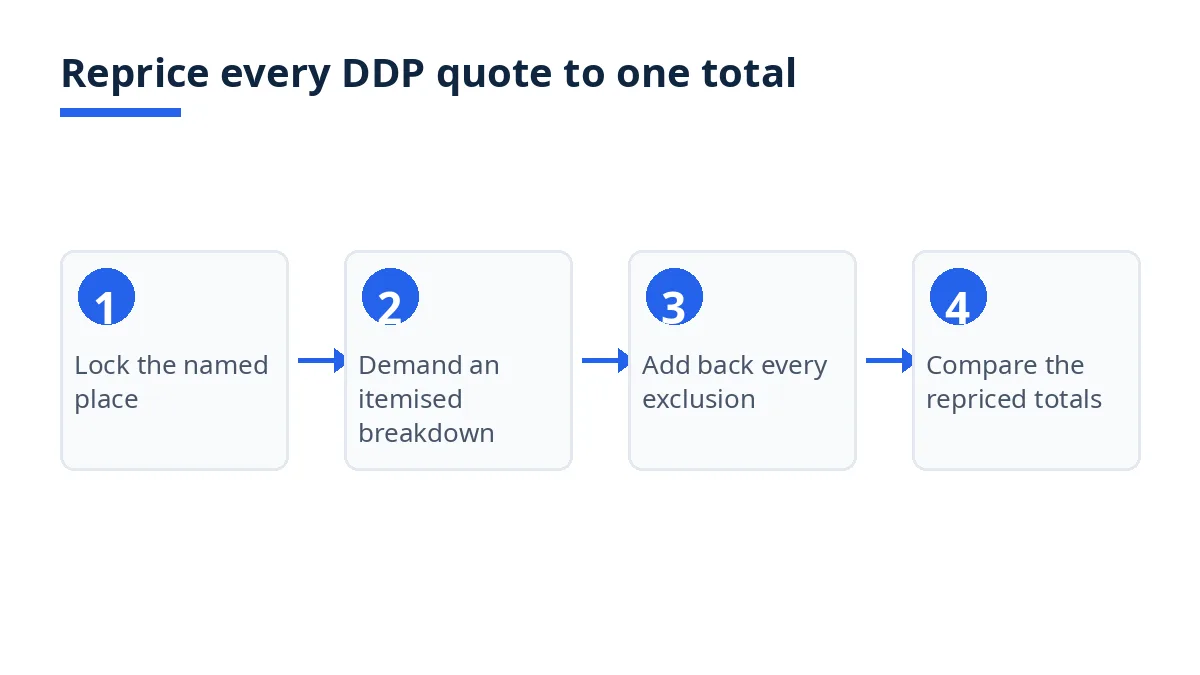
Work through the steps in order; do not rank any quotation until step four is complete.
1. Lock one named place for every supplier
Ask every supplier to quote DDP to the same named place, written in full: street address, building or warehouse name, and receiving dock or point within the site. Under the D terms, delivery and risk transfer occur at the named place of destination.1 A city name alone is not a comparable basis, because the inland leg, the delivery point, and the import entry can all differ within one city. If one supplier quotes to a port and another to a warehouse, reprice both to the warehouse before comparing them.
2. Demand an itemised breakdown
Ask each supplier to break the headline price into goods, export clearance and origin-side charges, main carriage, destination charges, import clearance and broker fees, duties and taxes, and the inland leg to the named place. Also ask whether unloading charges are included in the carriage contract or left to the buyer. Under DDP, the seller carries out all customs formalities, including export, import, and any transit formalities.1 The breakdown tests whether the quotation matches that allocation, or whether an item has quietly been left out.
3. Confirm the duty and tax treatment for the shipment
Ask each supplier, or its broker, to state in writing which duties and taxes are included, on what value they were calculated, and whether any tax is recoverable after import. Do not accept a general statement that duties are included. A duty figure built on a different classification, customs value, or tax treatment is not the same figure as a rival quote, even if both suppliers use the word included. Record the broker-confirmed treatment for the shipment in question, and treat it as applying to that shipment only, never as a general rate.
4. Reprice every quote to one comparable total
Build one table with one row per supplier and one column per cost item. Start from each headline price, add every excluded item that belongs in a complete DDP total to the named place, and remove any item outside that total. Keep currency, quantity, and specification identical across rows. Rank those comparable totals, not the headlines.
5. Check validity and confirm the winning basis in writing
Confirm that every quotation is valid on the same date, priced in the same currency, for the same quantity and specification, and for the same delivery window, with any difference repriced in writing. Before accepting, ask the chosen supplier to confirm the repriced total, the named place, the duty and tax treatment, the clearance arrangement, the inland leg, and the unloading position, in one written confirmation.
Costs, timelines and documents
A complete DDP comparison covers more than the goods price. Each item below belongs in the repriced total unless the quotation states, in writing, that it sits outside the agreed named place.
Goods, packing, marking, and checking for the agreed specification.
Export clearance and origin-side charges, and main carriage to the destination country.
Destination port or terminal charges, where the carriage contract does not already include them.
Import clearance and the broker fee for the import entry.
Import duties and taxes, on the broker-confirmed treatment for the shipment.
Inland carriage to the named place, and the unloading position, stated as included in the carriage contract or left to the buyer.
Timelines need the same treatment as costs. Ask each supplier for quotation validity, production or readiness time, transit time, and the expected arrival and clearance window, all measured from the same start point to the same named place.
For documents, ask each supplier to list what it will provide and what it expects from the buyer. A useful set normally includes the commercial invoice, the packing list, the transport document, and, where the destination treatment relies on it, proof of origin. The buyer may also need to assist the seller with documents or information the import authorities require, even though the seller remains responsible for import clearance.2 Confirm who provides each document, and that goods, quantity, and value agree across them.
DDP and DAP in one line each
DDP: the seller handles import clearance and pays import duties and taxes for delivery at the named place.
DAP: the buyer handles import clearance and pays import duties and taxes at the named place.
Worked example: three DDP quotes repriced to one total
All figures below are example figures only, for one example shipment: 1,200 stoneware dinner sets, quoted DDP to Keller and Sohn GmbH warehouse, Dock 3, 45 Hafenstrasse, Hamburg, Germany, Incoterms 2020. The duty and tax figure is the broker-confirmed treatment for this example shipment only, not a general rate for stoneware, Germany, or any other shipment.
Example item | Supplier A | Supplier B | Supplier C |
|---|---|---|---|
Headline DDP price (example figure) | USD 18,900 | USD 19,800 | USD 20,300 |
Import clearance and broker fee excluded from the headline | USD 1,150 | Included | Included |
Inland leg to Dock 3 excluded from the headline | USD 620 | Included | Included |
Duties and taxes excluded from the headline | Included | USD 2,340 | Included |
Comparable DDP total (example figure) | USD 20,670 | USD 22,140 | USD 20,300 |
On headlines, Supplier A looks cheapest, Supplier B sits in the middle, and Supplier C looks most expensive. On comparable totals, the order reverses at the top: Supplier C is cheapest at USD 20,300, Supplier A follows at USD 20,670, and Supplier B is most expensive at USD 22,140. Two exclusions decide that reversal. Supplier A loses its lead because clearance and the inland leg were outside its price, adding USD 1,770. Supplier B falls to last place because its duty and tax exclusion, at USD 2,340 on the broker-confirmed treatment for this example shipment, is larger than either rival's gap. Supplier C wins despite the highest headline, because its headline was already a complete total to Dock 3.
The lesson is not that the highest headline always wins. It is that no headline can be trusted until every exclusion has been added back. A buyer who had accepted Supplier A on price alone would have paid USD 370 more than Supplier C by the time the goods reached Dock 3, and a buyer who had accepted Supplier B would have paid USD 1,840 more.
Bangladesh-specific rules and tips
How a DDP quotation should be read is shaped by the Bangladesh side. The seller arranges export clearance and carriage from Bangladesh, and under DDP it also carries the destination import task, so a quotation silent on the destination side is incomplete even if the Bangladesh side is fully described.3 Ask the supplier to describe both sides in the same breakdown, not only the factory and port of shipment.
Four tips help buyers compare Bangladeshi DDP quotes on equal terms.
Fix the product definition first: send every supplier the same Harmonized System classification, specification, packing, and quantity. A duty figure built on a different classification is not comparable.
Ask how the supplier will complete import clearance at destination. A foreign seller can face difficulty carrying out import clearance in the destination country, and where local rules prevent the seller from completing import formalities, a different term may be more suitable.2 Ask who acts as importer of record, which broker will file the entry, and what the buyer must provide.
Keep origin and destination items on separate lines: origin charges, main carriage, destination charges, clearance, duties and taxes, and the inland leg. When lines are merged, an exclusion can hide in the merge.
Keep one currency and one validity window. Ask every supplier to quote in the same currency, or to state the conversion basis, and to hold the price to the same date.
Mistakes and red flags
Accepting a city as the named place. A quotation that says DDP Hamburg, with no warehouse, dock, or receiving point, leaves the inland leg and the delivery point open. Under DDP, the seller delivers at the named place of destination, ready for unloading from the arriving vehicle.2 Insist on the full place before ranking the quote.
Treating an excluded duty as a lower cost. A headline that excludes duties and taxes is unfinished, not cheaper. Ask for the broker-confirmed treatment for the shipment, add the figure to the total, and only then compare it with a quote that already includes duties and taxes.
Overlooking a separate clearance fee. If the breakdown shows no clearance or broker fee, ask whether the fee is included in the headline or billed separately. A fee billed separately belongs in the comparable total.
Missing the inland leg. A price that ends at a port or terminal is not a price to a warehouse. Ask whether the inland leg to the named place is included, and add it where it is not.
Leaving unloading unstated. Under DDP, the buyer unloads the goods from the arriving vehicle as part of taking delivery, and unloading charges fall to the buyer unless the carriage contract makes them the seller's.3 State the position in the confirmation, so neither side assumes the other pays.
Accepting a duty-paid promise with no clearance route. If the seller cannot name the broker, the importer-of-record arrangement, or the documents it needs from the buyer, the promise rests on an untested route. Ask for the route in writing before relying on the price.
Ranking headlines before repricing. A ranking made from headlines rewards the quotation with the most exclusions. Rank only comparable totals, and keep the repricing table as the record of how each total was reached.
Checklist
Named place written in full, identical across all suppliers.
Itemised breakdown: goods, export clearance, main carriage, destination charges, clearance fee, duties and taxes, inland leg.
Duty and tax treatment stated in writing, on the broker-confirmed basis for this shipment.
Clearance route named: broker, importer-of-record arrangement, buyer documents required.
Inland leg to the named place included or added to the comparable total.
Unloading position stated: included in the carriage contract or left to the buyer.
Same quantity, specification, packing, currency, and validity date across all quotes.
Comparable total calculated for each supplier; ranking made from those totals.
Winning basis confirmed in writing: total, named place, duty treatment, clearance route, inland leg, unloading.
How Exportain helps
Exportain lets a buyer post a request for quotation stating the quantity, specification, currency, and full named place of destination, asking each supplier to quote DDP on that same basis. Suppliers reply in the same thread, so the buyer can ask for an itemised breakdown, a stated duty and tax treatment, and a named clearance route, then build the repricing table, compare comparable totals, and confirm the winning basis in writing before accepting. One shared request removes the most common source of incomparable quotes: different suppliers answering different questions.
FAQs
What should I know first about DDP?
Know that a DDP quotation is only comparable when it names the same destination place, includes the same duty and tax treatment, and states who bears import clearance. Under DDP, the seller carries out all customs formalities, including export, import, and any transit formalities.1 Check those three points on every quotation before comparing prices.
What are the typical costs and timelines?
A complete DDP total covers the goods, export clearance, main carriage, destination charges, import clearance and broker fees, duties and taxes, and the inland leg to the named place, with the unloading position stated separately. No typical cost or timeline is stated here, because both depend on the goods, the route, and the destination treatment for the shipment. Ask each supplier for the same breakdown and timeline, measured to the same named place, and compare the written replies.
Which documents are needed?
Ask for the commercial invoice, the packing list, and the transport document, plus proof of origin where the destination treatment relies on it. Confirm who provides each document, and that goods, quantity, and value agree across them. The buyer may need to assist the seller with documents the import authorities require, even though the seller remains responsible for import clearance.2 Confirm the list in the written confirmation before ordering.
What are the most common mistakes?
The most common mistakes are ranking headlines before repricing, accepting a city instead of a full named place, treating an excluded duty or clearance fee as a saving, missing the inland leg, and comparing different quantities, specifications, currencies, or validity dates. Each has the same fix: reprice every quotation to one comparable total to the same named place, with the same duty and tax treatment.
Next steps on Exportain
Read the Incoterms guide for shipments from Bangladesh to place DDP among the other rules, and the CIF guide to see how a sea-only insured price differs from a duty-paid delivered price. When you are ready to buy, use the how-to-buy guide to post a request for quotation stating the full named place, quantity, and specification, so every supplier quotes DDP on the same basis.
Sources
- Incoterms® 2020 C rules vs D rules: Risk transfer explained. ICC Academy (accessed )
- DAP & DDP Incoterms 2020 explained: Key differences. ICC Academy (accessed )
- DDP & EXW Incoterms® 2020 explained: Key differences. ICC Academy (accessed )
About the author
Sourcing from Bangladesh?
Post a request for quotation and suppliers on Exportain can send you their quotes directly.
Post an RFQ