How to Write a DDP Clause in Your Sales Contract (Template Included)
A DDP clause that names the full duty-paid place, states Incoterms 2020, and puts import clearance, duties, and transit risk on the seller until delivery at destination, with a template and a Chattogram to Mississauga filled example.
Short answer
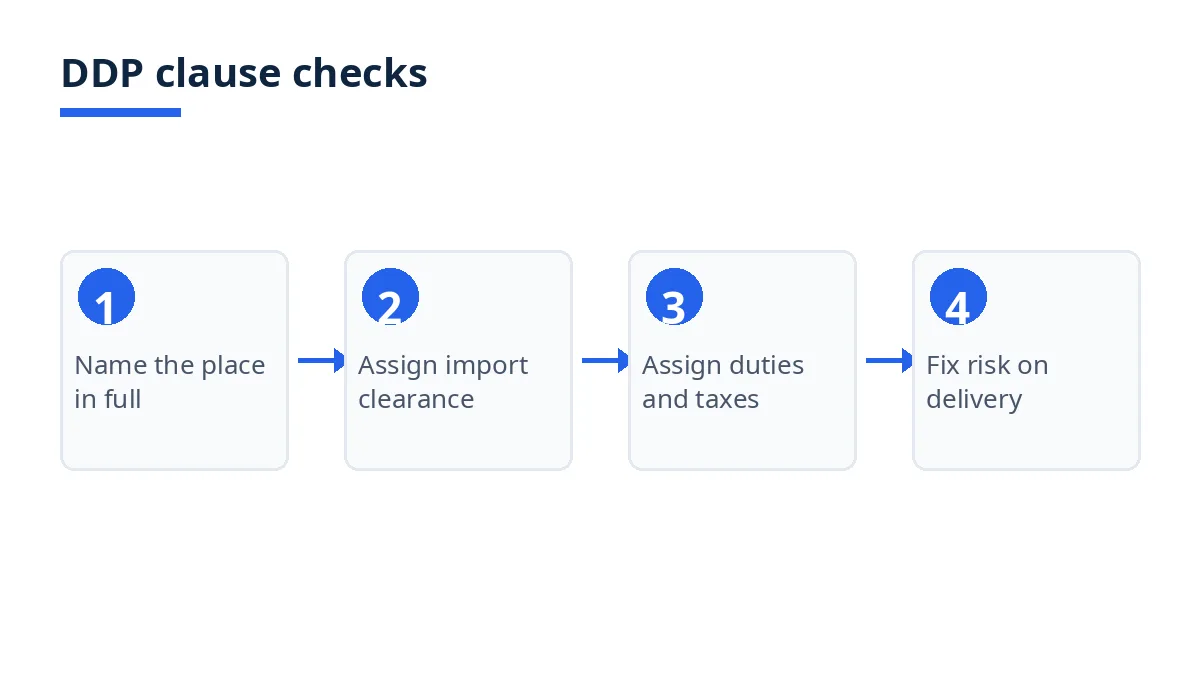
A DDP clause names the named place of destination in full, states Incoterms 2020, and fixes the split that defines DDP: the seller arranges and pays carriage to that place, completes import clearance, and pays all import duties and taxes, bearing risk until the goods are delivered at the named place, cleared for import and ready for unloading. The buyer unloads on taking delivery, and DDP imposes no insurance obligation on the seller unless agreed.
On this page
A DDP price looks like the simplest quote a buyer can accept: one price, goods delivered, nothing more to pay at the border. That simplicity is real for the buyer, and it is why the clause behind the price needs more care than any other delivery clause. Under DDP, the seller clears the goods for import, pays the duties and taxes, and carries the risk until delivery at the named place.
This article gives drafting guidance only and is not legal advice. Ask a lawyer to review the signed clause before the goods move.
What the document is for
The DDP clause is the delivery section inside a sales contract. DDP means Delivered Duty Paid. Under Incoterms 2020, DDP imposes maximum responsibility on the seller and minimal responsibility on the buyer: the seller delivers the goods and transfers risk at the agreed destination, which may be the buyer's premises, in what amounts to a door-to-door, all-inclusive delivery.1 The seller manages both export and import formalities, including any transit customs, and arranges transportation to fulfil delivery at the agreed destination.1
DDP works for any mode, including multimodal shipments.2
The contrast with the two neighbouring D terms is the whole point of choosing DDP. Under DAP, the buyer clears import and pays the duties and taxes. Under DPU, the seller unloads, and the buyer still clears import and pays the duties. Under DDP, and only under DDP, the seller clears import and pays the duties and taxes, and risk transfers only on delivery at the named place, cleared for import and ready for unloading.
The buyer still has one job at the end of the chain. Under DDP, the buyer's sole obligation is to unload the goods from the final vehicle at the agreed destination as part of taking delivery.1 The buyer must also assist the seller with documents or information the import authorities require, although the seller remains ultimately responsible for import clearance.1 If the seller does not want, or is prevented by local rules from managing, import clearance, then DAP is a more suitable rule.1
Required fields explained
Named place, in full. Write "DDP (named place of destination) Incoterms 2020". Give the full street address and the receiving point within it, such as a named dock.
Incoterms version. Write "Incoterms 2020" in full, beside the rule and the named place. Without the edition, the governing rules are not fixed.
Delivery and risk transfer. State in one sentence that delivery occurs, and risk passes, when the goods, cleared for import with duties and taxes paid, are placed at the buyer's disposal on the arriving vehicle at the named place, ready for unloading.
Import clearance. State that the seller will complete import clearance, act as the party responsible for the import entry where destination rules allow, and handle transit customs. Name the broker or agent. Under DDP, the seller carries out all customs formalities: export, import, and any transit.2
Duties and taxes. State that the seller will pay all import duties, taxes, and other charges payable on import, and list any charge expressly excluded, if any. Under DDP, an unnamed import charge is the seller's problem.
Main carriage. State that the seller will arrange and pay for carriage to the named place, including onward inland carriage, and what it excludes. In all D terms, the seller contracts and pays for transport up to the named place or port of destination.2
Unloading. State that the buyer unloads on taking delivery, and who pays unloading charges. Under DAP and DDP, the seller pays unloading charges only if the carriage contract stipulates that they are the seller's responsibility; otherwise they are the buyer's.2 Write the answer into the clause.
Insurance position. State that DDP imposes no insurance obligation on the seller. None of the D terms obliges the seller to arrange insurance for the buyer; arranging cover to protect the seller's own interest is the seller's decision.2 Then state any agreed cover: who buys it, for whose benefit, for what period, and who pays.
Arrival notice and proof of delivery. State how and when the seller will notify the buyer before and on arrival, and what document will prove delivery at the named place.
Delivery window and delay. State the arrival date or window, and what happens if import clearance is delayed, the goods are held by customs, or the buyer cannot take delivery on arrival. A customs delay is a seller delay under a silent clause.
Goods covered. Name the goods, quantity, marks, and order number, so the import entry, arrival notice, and proof of delivery match.
Template (table or downloadable)
Clause element | Wording to use | Fill in |
|---|---|---|
Delivery term | DDP (named place) Incoterms 2020. | Address, receiving point. |
Delivery event | Delivery on arrival, cleared, ready to unload. | One sentence. |
Risk transfer | Risk passes only on delivery at the named place. | Window. |
Import clearance | Seller completes export, transit, import clearance. | Broker. |
Duties and taxes | Seller pays import duties, taxes, charges. | Exclusions, if any. |
Main carriage | Seller arranges and pays carriage to the place. | Inland leg. |
Unloading | Buyer unloads on taking delivery. | Who pays charges. |
Insurance position | No obligation; agreed cover stated here. | Payer, period. |
Arrival notice | Seller notifies buyer before and on arrival. | Method, timing. |
Proof of delivery | Document proving duty-paid delivery. | Holder. |
Window and delay | Arrival window; customs delay effect. | Consequence. |
Beyond the named place | Onward carriage, charges beyond place. | Payer. |
Goods covered | Goods, quantity, marks, order. | Marks. |
Filled example
All names, figures, and dates below are examples only.
Example clause. Delivery is DDP Northgate Retail Inc Warehouse, Dock 2, 55 Industrial Parkway, Mississauga, Ontario, Canada, Incoterms 2020. Example Textiles Ltd will arrange and pay for carriage of 480 cartons of cotton bath towels, order number EX-9136, from Chattogram to that warehouse, will complete export, transit, and import clearance, and will pay all import duties and taxes. Delivery occurs, and risk passes, when the goods, cleared for import, are placed at the buyer's disposal on the arriving truck at Dock 2, ready for unloading, on or between 9 and 11 March. The buyer will unload at Dock 2 and arrange cover from delivery; the seller will cover its own transit risk. Onward carriage beyond the warehouse is for the buyer.
Example figures
Example figure | Amount |
|---|---|
Example contract price, DDP Mississauga | USD 51,200 |
Example duties and taxes included in that price | USD 6,400 |
Figures are examples only.
Common errors
Naming only a city. Delivery, risk, and the import entry all sit at the named place, so identify it precisely.1
Delivering on arrival without import clearance. A clause that leaves import clearance to the buyer describes DAP, not DDP. Under DDP, goods must arrive cleared for import, with duties and taxes paid.3
Delivering on handover to the carrier. That describes CPT or CIP, not DDP. Under DDP, risk stays with the seller until delivery at the named place.1
Assuming the buyer will clear import. Under DDP, the seller carries out all customs formalities, including import.2 If the seller cannot act for import in the destination country, discuss DAP before signing.1
Assuming the seller unloads. Under DDP, the buyer's sole obligation on taking delivery is to unload from the final vehicle.1
Leaving insurance silent. None of the D terms obliges the seller to arrange insurance for the buyer.2 Silence invites each party to assume the other is covered, while the seller still carries transit risk.
Leaving an import charge unnamed. Name any charge the seller will not pay as an exclusion.
Omitting the Incoterms version. Without "Incoterms 2020", the governing edition is not fixed.
Omitting the customs-delay rule. A hold at import customs is a seller problem under a silent clause. Agree the consequence, the notice, and the cost bearer in advance.
FAQs
Who issues this document?
No authority issues a DDP clause. It is a delivery section the buyer and seller draft and sign into their sales contract, using Incoterms 2020 DDP and the named place in full, with import clearance and duties assigned to the seller.
Which fields are mandatory?
The delivery term, edition, named place, delivery and risk sentence, clearance and duties assignments, carriage, unloading, insurance, arrival notice, and goods identification are all needed.
Can it be digital?
Yes. The clause is contract text, so it can sit in a signed contract in paper or digital form as the parties agree. Keep the clause, import entry, arrival notice, and proof of delivery together.
What errors cause delays?
A vague named place, a missing receiving point, a seller that cannot complete import clearance, an unnamed import charge, silent insurance, and a missing customs-delay rule cause the most delays.
Next steps on Exportain
Read the Incoterms guide for shipments from Bangladesh to compare DDP with the other ten rules, and the CIF guide to weigh a sea-only insured term against an any-mode duty-paid term. When you are ready to buy, post a free RFQ on Exportain stating the quantity, the named duty-paid place, and the Incoterm.
Sources
- DAP & DDP Incoterms 2020 explained: Key differences. ICC Academy (accessed )
- Incoterms® 2020 C rules vs D rules: Risk transfer explained. ICC Academy (accessed )
- DDP & EXW Incoterms® 2020 explained: Key differences. ICC Academy (accessed )
About the author
Sourcing from Bangladesh?
Post a request for quotation and suppliers on Exportain can send you their quotes directly.
Post an RFQ