

DAP for Air Freight: Rules, Alternatives and Examples
DAP works for air freight when the named place is written for an airport: the seller carries flight risk to the terminal, and the buyer clears import customs there. This guide sets out the air waybill, chargeable-weight costs and the alternatives.
Short answer
Yes. DAP (Delivered at Place), Incoterms 2020, can be used for air freight because it is an any-mode rule. The seller pays air carriage and export clearance and bears cost and risk until the goods arrive at the named place, usually a named airport cargo terminal, ready for unloading. The buyer unloads, clears import customs and pays duty and taxes. Name the terminal and handling agent in full, and check the air waybill consignee before booking.
On this page
Key takeaways
A DAP air shipment is delivered at the named place, ready for unloading, not when the aircraft lands; the named place is usually an airport cargo terminal.
DAP is an any-mode rule, so it fits air freight, while FAS, FOB, CFR and CIF are sea and inland waterway only.
The air waybill is non-negotiable and names the consignee directly; name the seller or its forwarder as consignee where the seller must move the goods onward after import clearance.
Chargeable weight is the greater of actual and volumetric weight at the IATA divisor of 6,000, and express services commonly use 5,000.
DAP imposes no insurance obligation on either side, so agree cover, its leg and its price in writing before booking.
The cartons are off the aircraft and sitting inside the destination airport cargo terminal. The flight has landed, the seller has paid for the air carriage, and the goods have not yet been delivered. Delivery under DAP happens only when the goods arrive at the named place, ready for unloading, and the named place on an air shipment is usually that terminal, not the runway and not the buyer's warehouse unless the contract says so.
This guide is for buyers importing from Bangladesh by air on DAP terms.
Can DAP be used for air freight?
Yes. DAP (Delivered at Place) is one of the any-mode Incoterms 2020 rules, so it can be used for air freight and for combinations of modes.1 The seller pays for transport and export clearance and bears all risk until the goods arrive at the named destination, ready for unloading.1 The buyer is responsible for import clearance, duties, taxes and unloading.1
The named place must be written for an airport journey. Name the airport, the cargo terminal or handling agent, and the delivery point, in the form "DAP (named place), Incoterms 2020". Only CIF and CIP oblige the seller to buy insurance for the buyer, at different levels of cover, so DAP carries no insurance duty for either side.2
What the named place means on an air journey
On an air shipment the journey breaks at the airport, because import clearance happens there.
Named place | Where delivery happens | What the buyer still does |
|---|---|---|
Airport cargo terminal | At the terminal, ready for unloading | Import clearance, unloading, onward trucking |
Forwarder depot near the airport | At the depot, after the airport-to-depot leg | Import clearance, unloading, onward trucking |
Buyer's warehouse | At the warehouse, after import clearance and the onward leg | Import clearance before the onward leg, unloading |
The first option is the usual DAP air-freight bargain. The seller's carriage ends at the airport, the buyer clears import customs while the goods are at the airport, and the seller's carrier then needs the paperwork to move the cargo onward.3 The third option is a door bargain, but the buyer must still clear import customs before the onward leg can run. A DAP airport price and a DAP warehouse price are not comparable.
Specify the precise unloading spot, and agree it between buyer and seller.3 Name the airport in full, the terminal, and the handling agent: a code alone, such as FRA, names an airport, not a delivery point inside it. Delivery happens before unloading: under DAP the seller does not unload, while under DPU the seller does.4
The air waybill on a DAP shipment
The air waybill (AWB) is the transport document for an air shipment. It is a non-negotiable document created by the carrier upon acceptance of the goods.5 It is a receipt, a contract of carriage, and delivery instructions for the consignee.5 Unlike a bill of lading, it does not confer title; it identifies the consignee directly.5
The AWB is issued when cargo is handed over. Check its fields against the commercial invoice and packing list before departure: a wrong weight, description or consignee name can hold the goods at the destination airport.
A Master AWB (MAWB) is issued by the airline, and a House AWB (HAWB) is issued by the forwarder for consolidated shipments, where several shipments travel under one MAWB.5 The AWB carries a unique 11-digit tracking number.5
The consignee entry needs care where the named place is beyond the airport. The buyer should not be the consignee on any air waybill where the seller has to arrange for its forwarder to take possession of the goods from the airline and arrange inland transport by truck.3 Name the seller, or the seller's forwarder, as consignee in that case, with the buyer named for notification.
DAP beside CPT, CIP, FCA and DPU for air freight
Seven rules work for any mode or modes of transport, while FAS, FOB, CFR and CIF work only for sea and inland waterway transport, because delivery under those rules is defined by the vessel.2 For air freight, use only the any-mode rules.2
Rule | Risk passes to the buyer | Carriage paid by | Insurance the seller must buy | Import clearance and duty |
|---|---|---|---|---|
DAP | On arrival at the named place, before unloading | Seller, to the named place | None required | Buyer |
CPT | When handed to the first carrier | Seller, to the named destination | None | Buyer |
CIP | When handed to the first carrier | Seller, to the named destination | Yes, wide cover | Buyer |
FCA | On delivery to the carrier nominated by the buyer | Buyer | None | Buyer |
DPU | After unloading at the named place | Seller, to the named place | None required | Buyer |
In the "C" rules the seller pays carriage to destination, but risk passes at origin, when the goods are handed to the carrier.2 Under CIP the seller must also buy wide cover, compliant with Institute Cargo Clauses (A), while under CIF, reserved for maritime trade, the default is Clause (C).4
Choose FCA when the buyer wants to choose the carrier, CPT or CIP when the buyer accepts risk from the first-carrier handover (CIP adds seller-bought wide cover), DAP when the seller must carry the flight risk to the named place, and DPU where the seller must also unload. Choose DDP only where the seller has a compliant import route, since DDP is the only rule where the seller clears import customs and pays duty.2 See the CIP air freight guide and the CPT air freight guide.
How a DAP air shipment runs, airport to named place
A DAP air shipment has six stages, and the airport break sits in the middle. The diagram below shows the stages in order.
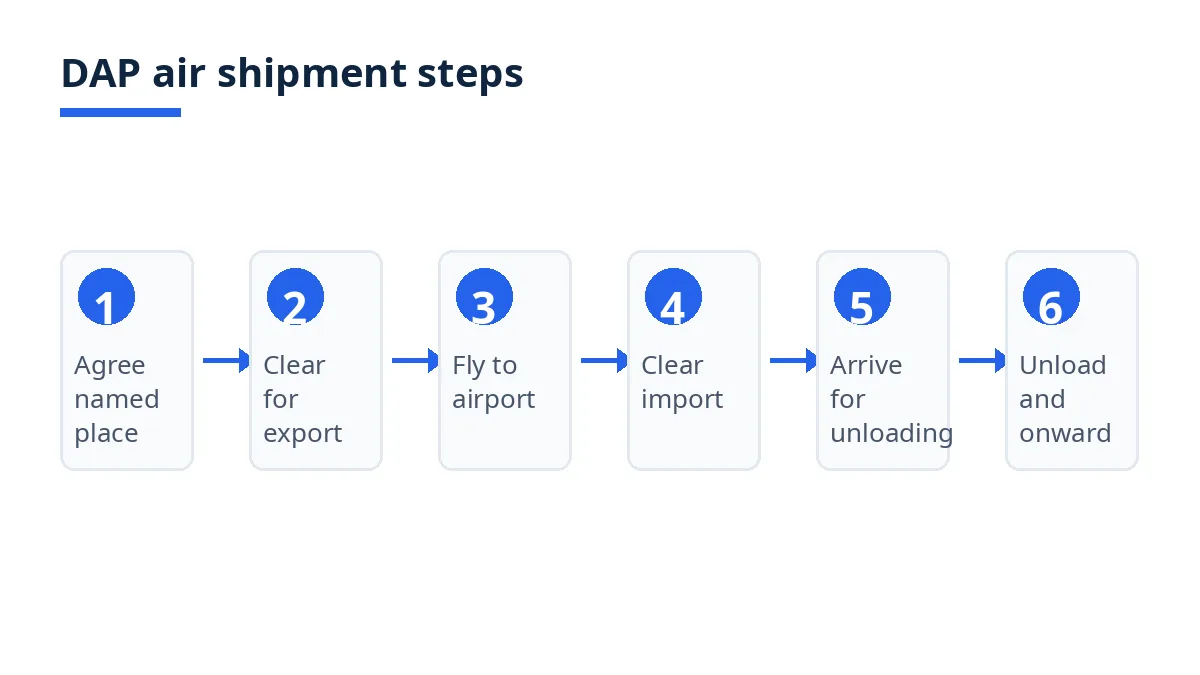
Agree the term, the named place and the AWB consignee in writing. Record the goods, quantity, packing, the named place in full with terminal and handling agent, the Incoterms 2020 edition, who unloads, who arranges insurance, and who is named as consignee on the AWB.
Prepare and clear the goods for export. The seller packs the goods and completes export clearance. For a shipment from Bangladesh, goods must not be loaded or stuffed for export unless a Bill of Export has been submitted to Customs and approved, with the export contract or letter of credit, invoice, packing list, EXP form, certificate of origin, VAT certificate and TIN enclosed.6
Hand over to the carrier and issue the AWB. The seller contracts carriage to the named place, pays the air freight, and hands the goods to the carrier or forwarder at the departure cargo terminal. The AWB is created upon acceptance, and the seller gives notice of arrival so the buyer can prepare import clearance and unloading.1
Fly to the destination airport. The seller bears the cost and risk of the flight. The buyer uses transit time for classification and a duty estimate.
Clear import customs at the airport. The buyer carries out import formalities and pays duty and taxes at the airport, then gives the seller's carrier the paperwork to move the cargo onward.3 If the buyer cannot clear promptly, the goods sit in customs control and the seller cannot deliver as contracted.3
Arrive at the named place, ready for unloading. The goods are placed at the buyer's disposal on the arriving means of transport, ready for unloading, and risk passes at that point.1 The buyer unloads, and arranges any onward transport beyond the named place.
What DAP air freight costs, and the chargeable-weight trap
A DAP air price is the goods plus export packing and clearance plus air carriage to the named place. The buyer still pays import clearance, duty, unloading and onward transport. Airlines charge on chargeable weight, not scale weight alone.
Chargeable weight is the greater of a shipment's actual weight and its volumetric weight.7 Volumetric weight converts the space cargo takes up into kilograms using the IATA standard divisor of 6,000: multiply length by width by height in centimetres and divide by 6,000.7 Some express couriers use their own divisor, commonly 5,000, so check the carrier's terms before quoting.7
Example figures only, for eight cartons of leather belts from Dhaka to a named airport cargo terminal, DAP the terminal, Incoterms 2020. Each carton is 60 × 40 × 40 cm and weighs 12 kg; volumetric weight is 16 kg per carton, so chargeable weight is 128 kg, the greater of 96 kg actual and 128 kg volumetric.7
Element | Example figure (USD) |
|---|---|
Goods, including export packing | 8,400 |
Export clearance and documents | 180 |
Air carriage, 128 kg at an example 10 per kg | 1,280 |
DAP price to the airport cargo terminal | 9,860 |
Buyer-side cost | Example figure (USD) |
|---|---|
Import clearance and broker | 220 |
Duty and taxes, example lump sum | 640 |
Unloading and terminal handling | 150 |
Onward trucking beyond the named place | 180 |
Buyer-side total | 1,190 |
Landed total at the warehouse | 11,050 |
The duty line is an example lump sum only; no duty rate is stated. Where a forwarder consolidates shipments under one Master AWB, each house document should still show its own chargeable weight.5 Compare with the DAP price guide and the landed cost guide.
Courier and express parcels: when DAP stops fitting
DAP can apply to a courier or express parcel, because it is an any-mode rule, but the fit is often poor. Express carriage commonly uses a divisor of 5,000 rather than 6,000.7
The larger problem is import clearance. A DAP express parcel still needs the buyer to clear import customs and pay duty and taxes at short notice, or it sits at the airport.3 Ask the carrier, in writing, what import service the quoted service includes and who pays duty.
Use DAP for an express parcel only where the buyer is ready to clear at the airport, or the named place is the buyer's door and the import step is agreed in advance. Do not use a sea-only rule for any courier shipment: FAS, FOB, CFR and CIF are for sea and inland waterway transport only.2
Mistakes that strand an air shipment at the airport
Naming only a city or an airport code as the named place. The named place fixes where the seller's carriage, cost and risk end, so it must name the terminal and handling agent, with the precise unloading spot agreed.3
Naming the buyer as AWB consignee where the seller must move the goods onward. The seller's forwarder needs to take possession of the goods from the airline and arrange inland transport, so the consignee entry must let it do so.3
Assuming the seller unloads at the airport. Under DAP the seller does not unload, and delivery happens before unloading.4 Book handling labour and equipment for the arrival window.
Assuming arrival at the airport is delivery when the named place is the warehouse. Under the D rules the place of delivery and the place of destination coincide.2 If the named place is the warehouse, the flight landing is not delivery.
Assuming insurance is included. DAP imposes no insurance obligation on either side, and only CIF and CIP oblige the seller to buy insurance for the buyer.2 Agree cover in writing, with the price shown separately.
Comparing a DAP airport price with a DAP door price on the headline alone. Price every quotation to the same point. The Incoterms guide sets all 11 rules side by side.
Leaving import clearance until the aircraft lands. The buyer clears import customs while the goods sit at the airport, and slow clearance can leave the goods in customs control with the seller unable to deliver.3 Brief the broker before departure.
Air-freight DAP checklist before booking
Named place in full: airport, cargo terminal, handling agent, precise unloading spot, in the form "DAP (named place), Incoterms 2020".
AWB consignee agreed: seller or seller's forwarder where the seller moves the goods onward, buyer only where the buyer collects at the terminal.
Export set agreed: Bill of Export approval, commercial invoice, packing list, EXP form, certificate of origin, VAT certificate and TIN, figures reconciled across every document.6
Insurance agreed in writing: who buys it, for which leg, at what price, shown as a separate line.
Chargeable weight checked: dimensions and scale weight for every carton, divisor confirmed, carriage line reworked on the greater figure.
Import readiness confirmed: broker briefed, classification and duty estimate in hand, arrival-notice method agreed, unloading booked.
Onward leg priced: where the named place is beyond the airport, the airport-to-warehouse leg, its paperwork and storage terms stated in the quotation.
What should I name as the place in a DAP air-freight contract?
Name the airport in full, the cargo terminal or handling agent, and the precise unloading spot, in the form "DAP (named place), Incoterms 2020". A city name or code alone does not fix the delivery point.3
Who clears import customs when DAP goods arrive by air?
The buyer clears import customs and pays duty and taxes.1 The seller carries out export clearance and any transit formalities, and has no obligation to clear the goods for import or pay import duty under DAP.3
Does DAP include air cargo insurance?
No insurance duty arises under DAP for either side. Only CIF and CIP oblige the seller to buy insurance for the buyer, at different levels, with CIP requiring the higher Clause (A) level.4
When should I use CPT or CIP instead of DAP for air freight?
Use CPT or CIP when the seller arranges air carriage and the buyer accepts risk from handover to the first carrier at the departure cargo terminal, rather than carrying the flight risk to the named place. Use CIP where seller-bought wide insurance cover is wanted, and CPT where the buyer holds its own cover from handover. Use DAP where the seller must carry the flight risk to the named airport place or warehouse and the buyer is ready to clear import customs at the airport.
Next steps on Exportain
Read the Incoterms guide and the DAP quotation guide before ranking air quotations, and work the landed cost guide with your broker's duty figure. When the named place and AWB consignee are fixed, post a free RFQ on Exportain, and check how to buy. Exportain is a B2B marketplace where buyers post RFQs, receive quotations and message suppliers. It is not a party to the contract for the goods, and it does not inspect goods, book freight or clear customs.
Sources
- DAP Incoterms 2026: Meaning, Seller vs Buyer Duties & Examples. Drip Capital, (accessed )
- Incoterms for Shipments From Bangladesh. Exportain (accessed )
- Incoterms DAP: Delivered at Place. Dia Tisa (accessed )
- Incoterms® 2020. International Chamber of Commerce (ICC) (accessed )
- Air Waybill (AWB) Guide: Importance in Air Freight. FreightAmigo (accessed )
- Customs Clearance Procedures for Export. Bangladesh Customs, National Board of Revenue (accessed )
- Chargeable Weight Calculator: Air & Sea. Freightos, (accessed )
About the author
Sourcing from Bangladesh?
Post a request for quotation and suppliers on Exportain can send you their quotes directly.
Post an RFQ


