

Can You Use CIP for Air Freight? Rules, Alternatives and Examples
CIP fits air freight because it is an any-mode rule, but the term only works when the handover terminal, destination airport and insurance wording are written for an air journey. This guide places delivery at the cargo terminal and compares CIP with CPT, FCA and the D terms.
Short answer
Yes, CIP can be used for air freight: it is one of the seven Incoterms 2020 rules for any mode of transport. The seller pays air carriage and Clause (A) insurance for at least 110 percent of the contract price to a named destination airport, but risk passes to the buyer when the goods are handed to the first carrier at the cargo terminal. Name the destination airport and handover terminal precisely, and hold the insurance certificate before handover.
On this page
Key takeaways
CIP is an any-mode Incoterms 2020 rule, so it can be used for air freight, while FAS, FOB, CFR and CIF are limited to sea and inland waterway transport.
Risk passes to the buyer at handover to the first carrier at the cargo terminal, not when the aircraft departs, while the seller pays carriage and insurance to the named destination airport.
The CIP seller must obtain Clause (A) or equivalent insurance for at least 110 percent of the contract price, and the buyer should hold the certificate before handover.
For air carriage, confirm whether the certificate relies on Clause (A), Institute Cargo Clauses (Air), or equivalent cover, and that cover runs from handover to the destination airport.
Use CPT when the buyer holds cargo cover, FCA when the buyer wants to choose the carrier and insurer, and a D term when the seller must carry the flight risk.
Yes, CIP works for air freight. Under CIP, the seller hands the goods to the first carrier, risk passes at that handover, and the seller still pays carriage and insurance to a named destination. For an air shipment, the handover happens at the cargo terminal, when the air carrier accepts the goods, not when the aircraft leaves the ground.
This guide answers the question at airport level: where delivery happens, what insurance wording to check, how CIP compares with the other air-freight terms, and three shipments where the choice changes the result.
Can CIP be used for air freight?
Yes. CIP is one of the seven Incoterms 2020 rules that can be used for any mode of transport, including air, road, rail, sea and multimodal journeys.1 2 The four remaining rules, FAS, FOB, CFR and CIF, are limited to sea and inland waterway transport, so they do not fit an air shipment in the way the ICC defines them.2
CIP stands for Carriage and Insurance Paid To. The seller delivers to the carrier at a named place of shipment, and risk passes at handover to the first carrier.1 The seller pays carriage to the named destination and obtains insurance for the buyer.1 3 The seller completes export clearance; the buyer handles import clearance, duty and onward transport.3
The named destination, the handover place and the insurance wording must all be written for an airport journey. A CIP term copied from a sea shipment, with a port as the destination and Clause (C) cover, does not become an air-freight term because the goods travel by air.
Where CIP delivery happens on an air journey
Delivery under CIP happens when the goods are handed over to the first carrier.1 On an air journey, the handover happens at the cargo terminal where the carrier accepts the goods. Departure is not the delivery point, the flight number is not the delivery point, and arrival is not the delivery point. Risk passes at acceptance, while the goods may still be sitting in the terminal.
That timing matters twice. The insurance period must already be running at handover, and the transport document must record the same handover. The air waybill is the transport document for air freight: a receipt for the goods, evidence of the contract of carriage, and a delivery instruction, and it is not a document of title.4 It is issued on acceptance and names the shipper, consignee, airports and goods.4
Name the handover place with airport precision. "CIP Frankfurt Airport, Incoterms 2020" names the destination, but the parties should also identify the delivery place, for example the cargo terminal at the airport of departure. Check that the air waybill, booking and contract describe the same handover.
CIP, CPT, FCA and D terms for air freight: choosing between them
The choice for an air shipment is between the any-mode terms: who pays the air freight, who insures, and who bears risk during the flight.
Term | Seller pays air freight | Seller must insure | Risk passes | Buyer control |
|---|---|---|---|---|
FCA | No | No | Handover to the carrier nominated by the buyer | Buyer chooses carrier and insurer |
CPT | Yes, to the named destination | No | Handover to the first carrier | Seller chooses carrier; buyer insures |
CIP | Yes, to the named destination | Yes, Clause (A) minimum | Handover to the first carrier | Seller chooses carrier and insurer |
DAP | Yes, to the named destination | No duty to insure | At the named destination, ready for unloading | Seller bears transit risk |
CPT shares the CIP delivery and risk points, but the CPT seller has no duty to insure.1 5 FCA differs in control: the buyer nominates the carrier and keeps control of the carrier and the insurer.6 DAP and DDP move the risk point to the destination, but neither term obliges the seller to insure, and DDP adds import clearance and duty.6
Use CIP when the buyer wants the seller to arrange both the flight and the insurance; CPT when the buyer holds cover and wants only the flight arranged; FCA when the buyer wants to choose the carrier and insurer; a D term when the buyer needs the seller to carry the flight risk. Compare all 11 rules in the Incoterms guide for shipments from Bangladesh.
What the seller must arrange: air carriage and insurance wording
Under CIP, the seller must obtain insurance complying with Institute Cargo Clauses (A), or equivalent cover, for at least 110 percent of the contract price, for the buyer, and must give the buyer the policy or certificate so the buyer can claim directly.1 3 A different level of cover may be expressly agreed in the contract.1 The CIF minimum is the narrower Clause (C), so a Clause (C) certificate does not meet the CIP minimum unless a lower level was expressly agreed.7 3
For an air leg, check the clause wording with the insurer. CIP cover is described as Institute Cargo Clauses (A) or (Air), and the (Air) wording addresses air carriage.6 Ask the broker in writing whether the certificate relies on Clause (A), on (Air), or on equivalent cover, and whether it covers the whole journey from handover to the named destination.
Before handover, check the cover level, insured amount, direct claim route, period of cover, and that the goods and flight details match the invoice, packing list and air waybill.
Example figures: USD 12,000 gives a minimum insured amount of USD 13,200 at 110 percent. The premium is separate, agreed with the insurer. Clause (A) cover is broad, not unlimited: exclusions include wilful misconduct, insufficient packaging, inherent vice, and delay, and a claim can fail on packing evidence or late notice.6 Agree the packing specification and hold the claim contact before handover.
When CIP fits air freight, and when it does not
CIP fits when the buyer values seller-arranged carriage and insurance more than control of the flight, and it fits multimodal journeys, where one any-mode term covers every leg.1 It does not fit when the buyer needs to choose the carrier or the insurer, because the seller contracts the carrier and buys the insurance,3 5 nor a buyer with a standing policy covering air shipments, unless the shipment is excluded from it. It does not fit a buyer who expects the seller to bear the flight risk: risk passes at handover, and insurance is the buyer's route to recovery.1 3 Such a buyer should test DAP.
Three shipments show the choice. Samples to a trade fair, no standing policy: test CIP first, with cover confirmed from handover. Urgent spare parts, standing policy, preferred carrier: test FCA first. Consolidated parcels: confirm which air waybill the buyer will hold and that the destination is the airport, not the forwarder's warehouse.
Step by step: a CIP air shipment from Dhaka to the destination airport
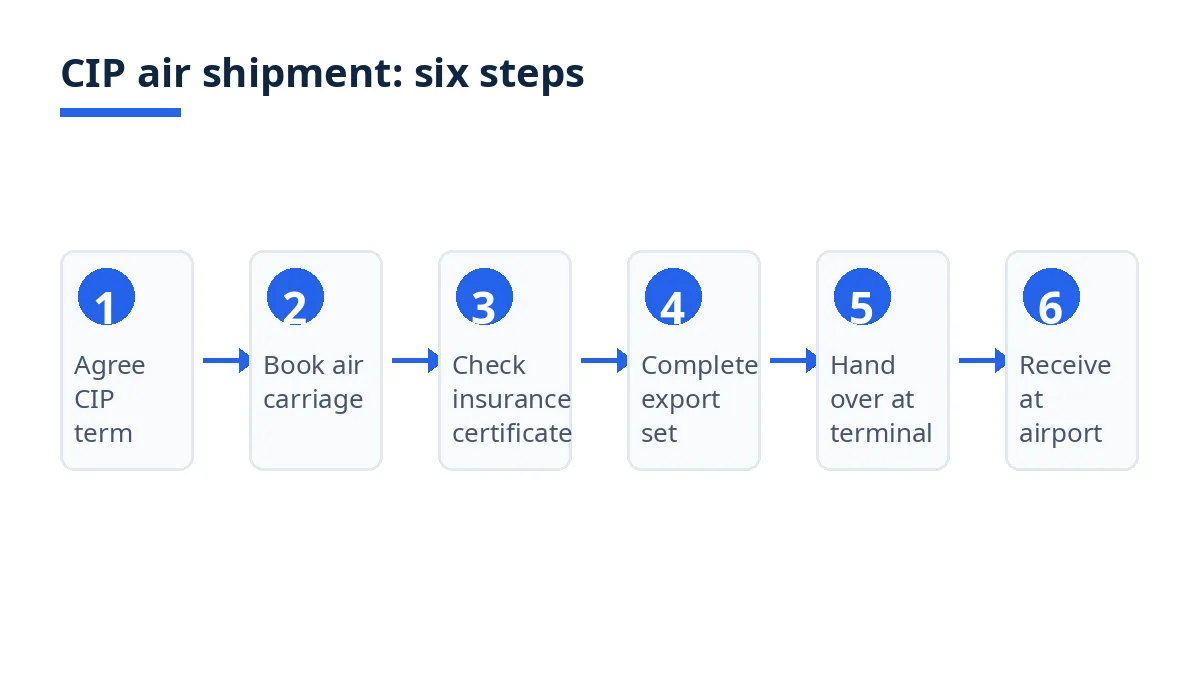
Agree the term. Write "CIP [named destination airport], Incoterms 2020", name the handover terminal, and state the insurance clause, insured value, and who pays onward transport.
Book the carriage. The seller contracts and pays for carriage and confirms the flight and expected arrival in writing.
Check the certificate. Hold the policy or certificate before handover and confirm cover runs from handover to at least the named destination.1 3
Complete the export set. For a Bangladesh shipment, an approved Bill of Export or Shipping Bill is required before goods are loaded or stuffed for export, with the contract or letter of credit, invoice, packing list, EXP form, certificate of origin, VAT and Taxpayer Identification Number documents enclosed.8
Hand over and record it. The seller hands the goods to the air carrier at the terminal, and the carrier issues the air waybill on acceptance.4 Keep the receipt, air waybill and delivery notice together.
Receive at the destination airport. Clear imports, pay duty, arrange onward carriage, and inspect before signing; remark damage and notify the carrier and insurer in writing.
The diagram below summarises the same sequence, from agreement to receipt at the destination airport.
Costs, documents and timing for a CIP air shipment
CIP fixes who pays, not how much. No CIP rule sets an air freight rate, a premium, a transit time or a document fee. Ask the seller to break the price into goods, air carriage, and insurance, for comparison with CPT plus own insurance on the same destination airport and cover. The CIP quotations guide works through the same split.
The illustration below shows the arithmetic only. Example figures.
Price line | CIP air quotation | CPT air quotation plus own insurance |
|---|---|---|
Goods | 12,000 | 12,000 |
Air carriage to the named destination airport | 1,400 | 1,400 |
Insurance | 150 | 210 (buyer policy) |
Total to the named destination airport, before destination costs | 13,550 | 13,610 |
In this illustration the CIP total is lower, but it proves nothing about the market. Compare the clause, insured amount, exclusions and insurer, and add the same destination costs to both columns.
Before the goods move, hold the invoice, packing list, air waybill details, and insurance certificate.1 4 8 CIP sets no transit time: agree the flight, cut-off, and sending date in writing. A certificate arriving after handover is a larger gap by air, because the goods may already be in the air.
Courier and express parcels: does CIP still apply?
CIP names a destination place, often an airport, while a courier or express parcel often travels door-to-door under the operator's own terms. Where the bargain is delivery to the buyer's door, test a D term first, as the CPT for air freight guide does for courier delivery. If CIP is used with a courier, state where seller-paid carriage and insurance end. For low-value samples, weigh the Clause (A) duty against the parcel value, remembering that a different level of cover may be expressly agreed.1 For high-value parcels, the certificate must describe the buyer's goods and let the buyer claim directly.1
Bangladesh notes: Dhaka airport handover and the export set
State both places: the cargo terminal where the seller hands the goods to the air carrier, and the destination airport to which carriage and insurance are paid.1 Do not write the destination as a country, or the handover as the flight departure. Confirm the export document set before handover: an approved Bill of Export or Shipping Bill is required before goods are loaded or stuffed for export.8
Mistakes and red flags
"CIP London" as the destination. Name the airport in full, not a country or a city.
Treating departure as delivery. Risk passes at handover at the cargo terminal.1
Writing FOB or CIF onto an air shipment. FAS, FOB, CFR and CIF are sea and inland waterway rules.2
Accepting Clause (C) cover. Clause (C) is the CIF minimum, not the CIP minimum.3
Cover starting on the flight date, or ending at a transit airport. Cover must run from handover to at least the named destination.1
Air waybill naming a different destination or consignee. Check it against the contract before the goods move.4
No claim contact, duplicate cover, or weak packing. Hold the claim contact before handover, check any standing policy, and agree the packing specification.6
Checklist: sign off a CIP air shipment
[ ] Term reads "CIP [named destination airport], Incoterms 2020".
[ ] Handover terminal named; booking shows the same point.
[ ] Insurance is Institute Cargo Clauses (A) or (Air), or equivalent, at least 110 percent, in a stated currency.
[ ] Insurance document, claim contact and notice period held before handover; cover runs from handover to the destination airport.
[ ] Price split shows goods, air carriage and insurance; destination costs added.
[ ] Air waybill matches the contract on shipper, consignee, airport and goods.
[ ] Standing-policy cover checked; import clearance, duty and onward transport allocated.
[ ] Flight, cut-off and document sending date agreed in writing; export set confirmed.8
How Exportain helps
Exportain is a marketplace where buyers can find Bangladeshi suppliers, post requests for quotation, receive quotations, message suppliers and place orders. Exportain is not a party to the contract for the goods, and it does not inspect goods, book freight or clear customs. Supplier badges are reviews of documents and photos, not factory inspections or guarantees, and membership never grants a badge.9
For a CIP air order, state the term, destination airport, Incoterms version, insurance clause and insured value, and handover terminal in the RFQ. An RFQ states the quantity and unit, the target price, the destination, the Incoterm, the required certifications and the deadline.10 The how to buy guide sets out the RFQ and ordering steps.
What should I know first about CIP for air freight?
Know the split: CIP fits any mode, including air, the seller pays carriage and insurance to the destination airport, but risk passes at handover to the first carrier at the cargo terminal.1 2 The seller must obtain Clause (A) insurance for at least 110 percent of the contract price.1 To keep risk with the seller through the flight, test a D term.
What are the typical costs and timelines for CIP air freight?
CIP sets no typical cost or timeline. The seller pays carriage and insurance to the destination airport; the buyer pays import clearance, duty and onward transport.3 Compare quotations only on the same destination airport, clause and insured amount, with the same destination-cost addition.
Which documents are needed for a CIP air shipment?
The buyer should hold the invoice, packing list, air waybill, and insurance certificate showing the clause, insured amount, insurer and claim contact.1 3 4 For Bangladesh exports, add the approved Bill of Export or Shipping Bill, the contract or letter of credit, the EXP form, and the certificate of origin, with VAT and Taxpayer Identification Number documents.8
What are the most common mistakes with CIP for air freight?
Naming a country instead of a destination airport, treating departure as delivery, writing FOB or CIF onto an air shipment, accepting Clause (C) cover or an unstated insured amount, and letting cover start on the flight date or end at a transit airport. Check the term, handover place, clause, amount and claim contact in writing before handover.
Next steps on Exportain
Start from the handover point, not the flight number. Compare the CPT for air freight guide and the CIF cost, insurance and freight guide on the same destination airport, then post a free RFQ stating the CIP term, destination airport, Incoterms 2020 version, and insurance clause and insured value required. Keep the agreed term and cover in the written contract, and hold the insurance document before handover.
Sources
- CPT & CIP Incoterms 2020 explained: Key differences. ICC Academy (accessed )
- Air Freight Incoterms: Use FCA, Not FOB. Ovrseas (accessed )
- CIP Incoterms (Carriage and Insurance Paid To) Explained. iContainers (accessed )
- Air Waybill (AWB) Guide: Importance in Air Freight. FreightAmigo (accessed )
- Incoterms 2020 CIP: Spotlight on Carriage and Insurance Paid To. Shipping Solutions (accessed )
- Master Guide to Incoterms 2020 for Air Cargo Shipments: Risk and Insurance. PolicyBazaar (accessed )
- Incoterms® 2020. International Chamber of Commerce (ICC) (accessed )
- Customs Clearance Procedures for Export. Bangladesh Customs, National Board of Revenue (accessed )
- Supplier verification: Earn trust badges buyers can see. Exportain (accessed )
- How to source and buy from Bangladesh. Exportain (accessed )
About the author
Sourcing from Bangladesh?
Post a request for quotation and suppliers on Exportain can send you their quotes directly.
Post an RFQ


