

Can You Use CPT for Air Freight? Rules, Alternatives and Examples
Whether CPT suits air cargo and courier shipments, how a CPT air shipment works from the Dhaka cargo terminal to the destination airport, and what to use instead when it does not fit.
Short answer
Yes, CPT can be used for air freight. CPT is one of the seven Incoterms 2020 rules for any mode of transport. The seller delivers the goods to the air carrier, pays the air freight to the destination airport, and completes export formalities, while risk passes to the buyer at handover to that carrier. The transport document is the air waybill, and the buyer arranges cargo insurance from the handover date, since CPT places no insurance duty on the seller.
On this page
Key takeaways
CPT can be used for air freight: it is one of the seven any-mode Incoterms 2020 rules, while FOB, CFR, and CIF are sea-only and do not apply to air.
Delivery happens at handover to the air carrier at the cargo terminal, not when the aircraft departs, and the air waybill is the transport document.
The seller pays air freight to the named destination airport. The buyer arranges insurance from the handover date and handles import clearance and onward transport.
Name the destination airport and the delivery point separately, and use FCA where the buyer arranges the flight, CIP for seller-arranged insurance, and DAP or DDP for door-to-door courier delivery.
CPT and air freight belong together more naturally than most Incoterms pairings. CPT is one of the seven Incoterms 2020 rules that apply to any mode of transport, and air freight is exactly the kind of movement those rules were written for: a handover at a cargo terminal, a flight, and a named destination airport. The pairing still fails when buyers treat it like a sea shipment, name the wrong place, or assume the freight bill carries insurance with it. This guide sets out how CPT works by air, what it costs, which document proves delivery, and when another term fits the air shipment better.
Can CPT be used for air freight? The short answer
Yes. CPT can be used for air freight. The International Chamber of Commerce (ICC) divides the 11 Incoterms 2020 rules into seven rules for any mode of transport, including CPT, and four rules for sea and inland waterway transport only.1 Air freight falls under the first group, so every air shipment must use one of those seven rules. FOB, CFR, and CIF are not proper options for air freight, because they are sea-only rules whose risk point, loading on board a vessel, never occurs at an airport.2
Under CPT for air, the seller delivers the goods to the air carrier, contracts and pays the air freight to the named destination airport, and completes export formalities, while risk passes to the buyer at handover to that carrier.3 The seller must notify the buyer that delivery has occurred, and the buyer arranges any cargo insurance from the handover date, since CPT places no insurance duty on the seller.3 The transport document is the air waybill, not a bill of lading.4 2
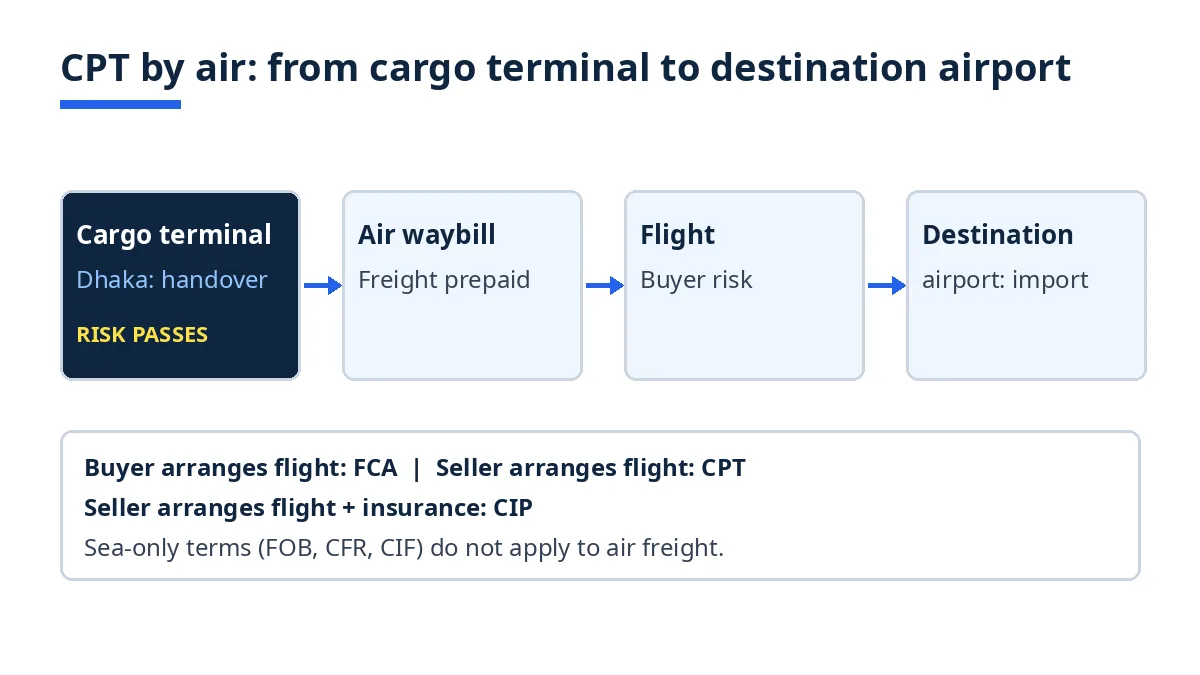
The choice between the air-freight terms turns on who arranges the flight and who insures the goods. Where the buyer arranges and pays for the air freight, FCA is the matching term. Where the seller arranges and pays for it, CPT or CIP applies, and CIP adds the seller insurance duty that CPT leaves out.2 Write the term with the named destination airport and the Incoterms 2020 version, and confirm the handover point with the forwarder before finalising the contract.2
How CPT air freight works, step by step
Agree the term, the airports, and the handover point. Write the contract as "CPT [named destination airport], Incoterms 2020", and add the place and point of delivery, for example delivery at the carrier's cargo terminal at Hazrat Shahjalal International Airport, Dhaka. The named destination airport is where the seller's freight duty ends. The delivery point is where risk passes, and the two are rarely the same airport.3 2
The seller prepares the goods for air carriage. Packing for air must protect the goods for handling at terminals and for the flight, and the seller completes export formalities at its own cost.3 Goods may not be loaded for export from Bangladesh until a Bill of Export has been submitted to Customs and approved, with the documents Customs lists for the consignment.5
The goods are handed to the air carrier. Delivery happens when the goods are handed to the carrier the seller contracted, at the carrier's terminal or warehouse, and it does not wait for the aircraft to be loaded.3 For air freight, that handover is typically at the cargo terminal at the export airport, where the seller hands the goods to the airline or to a freight forwarder acting as carrier.2
The air waybill is issued and the seller gives notice. The air waybill records the carrier, shipper, and consignee, the departure and destination airports, the goods description, the "Freight Prepaid" notation, and the carrier's signature and date.3 The seller notifies the buyer that delivery has occurred, with the information needed to receive the goods at the destination airport. The buyer uses that notice to put insurance in place from the handover date.3
The flight runs at the buyer's risk. The goods fly under a carriage contract the seller paid for, but loss or damage in transit is the buyer's risk from handover onward. Damage at a transshipment airport, or on the flight itself, falls on the buyer, and recovery depends on cover the buyer arranged.3 4
The buyer clears the goods and moves them onward. At the destination airport, the buyer completes import formalities, pays duty and taxes, and arranges and pays for transport beyond the named destination airport, which is usually a truck leg to the buyer's warehouse.3 The air waybill is a non-negotiable document, so the buyer collects the goods against the carrier's release procedures at the airport, not against a negotiable title document.2
The diagram below follows the air shipment from the Dhaka cargo terminal to the destination airport, with the risk point at handover.
Costs, timelines and documents for an air CPT shipment
Air freight is priced differently from sea freight, and a CPT air quotation should be read with that in mind. The seller's CPT price covers the goods, export packing and clearance, airport handling to the carrier, and the air carriage to the named destination airport. Ask the seller to show the air freight line separately, with the basis on which the carrier priced it, and confirm whether airport handling and destination terminal charges sit inside the price or fall to the buyer at arrival.3 4
Example figures only. Confirm freight, duty, and premium positions with a forwarder and a broker before ordering.
Element of the example CPT price | Example figure (USD) |
|---|---|
Goods and export packing | 6,400 |
Export clearance and airport handling | 500 |
Air carriage to the named destination airport | 1,850 |
Other export and carriage charges | 90 |
CPT contract price | 8,840 |
The example is an urgent consignment of knitwear, CPT London Heathrow Airport, with handover to the air carrier at the Dhaka cargo terminal. Cargo insurance is not in the price: the buyer arranges separate cover from the handover date, shown here as an example premium of USD 95 outside the CPT price. Duty, import clearance at Heathrow, and onward transport to the buyer's warehouse are also outside the price.3 4
Timelines for air CPT shipments are set by flight schedules and gateway cut-off times, not by the term. Ask the forwarder for the cut-off time at the departure cargo terminal, the flight schedule, and the date the air waybill will be available, and put the delivery date or period in the contract. A CPT air shipment that misses the cut-off waits for the next flight, and the contract should say who bears the cost of that wait.
The document set for an air CPT shipment is short, and each document has one job. The commercial invoice states the value and the CPT term. The packing list states the packages, weights, and marks. The air waybill proves handover to the carrier and carriage prepaid to the destination airport. The delivery notice fixes the risk date. The certificate of origin is obtained where the destination authority, a preference arrangement, or the letter of credit requires it, and the Bill of Export set covers export clearance.3 5 The buyer's insurance document and import set complete the file. No bill of lading is due, and no seller insurance document is due under CPT.3 4
Bangladesh air rules and tips: Dhaka airport handover
The handover point is the decision that matters most on a Bangladesh air shipment. Where the contract names the seller's warehouse as the delivery point, risk transfers when the goods are loaded onto the collecting vehicle at that warehouse, before they reach the airport. Where it names the cargo terminal, risk transfers at the terminal, when the goods are handed to the carrier.2 Both are valid CPT delivery points. They are not the same bargain, and the contract should say which one the parties agreed, rather than leaving it to be worked out after a loss.3
Confirm three things with the forwarder before the goods move. First, the exact terminal and counter where handover will happen, and the cut-off time for the flight booked. Second, that the air waybill will show the correct departure and destination airports, the correct consignee, and the "Freight Prepaid" notation to the named destination airport.3 Third, who acts on the arrival notice at the destination airport, and what release procedure the carrier requires there, since the air waybill is non-negotiable and the goods are not collected against a title document.2
Export clearance follows the same rule at the airport as at a sea port. Goods shall not be loaded for export unless an export declaration, the Bill of Export, has been submitted to Customs and approved, stating the goods, value, exporter, foreign buyer, and transport operator.5 Prepare the Bill of Export set before the goods go to the cargo terminal, so a missing enclosure does not miss the flight.
Mistakes and red flags
Writing FOB, CFR, or CIF on an air contract. These are sea-only rules. On an air shipment the risk transfer point they describe never occurs, the document they assume is a bill of lading rather than an air waybill, and a dispute over where risk passed will be settled from the rest of the contract rather than from the Incoterms rules.2
Naming a city instead of an airport. "CPT London" does not say which airport the freight is paid to, or where the buyer collects the goods. Name the destination airport, and the terminal where the goods will be available, in the contract and on the air waybill.3 2
Assuming the air waybill works like a bill of lading. It does not. The air waybill is a non-negotiable document that operates under different legal rules, and it does not transfer title to the goods in the way a negotiable bill of lading can.2 Check the carrier's release procedure at the destination airport before the flight, not after arrival.
Using CPT for door-to-door courier delivery. Where goods are handed to a courier for delivery to the buyer's address, the courier's door delivery rarely matches a CPT clause naming an airport as the destination. DAP or DDP usually record that bargain better, because they carry the seller's duty and risk to the named place. Use CPT where the seller contracts air carriage to a named airport and the buyer clears the goods there.4 2
Arranging insurance from the flight date. Delivery happens at handover to the carrier, not when the aircraft departs. Cover arranged from the flight date starts too late for damage in the cargo terminal after handover. Arrange it from the handover date, on the seller's delivery notice.3
Leaving the delivery point unnamed. If the delivery place is not agreed, the seller may choose it. Name the cargo terminal, or the seller's warehouse where that is the bargain, with the same care as the destination airport.3
Checklist: CPT air freight sign-off
The contract names the destination airport, the delivery point, and the cargo terminal, with "Incoterms 2020" stated.
The quotation shows the air freight line separately, with handling and destination charges confirmed.
The buyer has cargo cover from the handover date, or the term has been changed to CIP.
The Bill of Export set is complete before the goods go to the cargo terminal.
The air waybill details, consignee, and prepaid notation are checked against the contract.
The arrival notice and release procedure at the destination airport are confirmed.
Next steps on Exportain
Read the full rule in the Incoterms guide for shipments from Bangladesh, compare the sea-only counterpart in the CIF cost, insurance and freight guide, and work the buyer-side costs into your landed cost for imports from Bangladesh. The how to buy guide explains the buying steps on Exportain.
Post a free RFQ on Exportain and get quotes from Bangladeshi suppliers → https://exportain.com/rfqs
What should I know first about CPT?
CPT stands for Carriage Paid To. The seller delivers the goods to the first carrier, pays carriage to a named place of destination, and completes export formalities, while risk passes to the buyer at handover to that carrier. CPT works for any mode, including air, and the seller has no obligation to insure the goods.3
What are the typical costs and timelines?
The CPT price covers the goods, export packing and clearance, airport handling, and air carriage to the named destination airport. Insurance, import clearance, duty, and transport after the airport are buyer costs. Timelines depend on flight schedules and cargo terminal cut-off times, so confirm the schedule for the flight booked.3 4
Which documents are needed?
The seller provides the commercial invoice, packing list, air waybill, delivery notice, certificate of origin where required, and the Bill of Export set. The buyer provides the insurance document and the import set. No bill of lading and no seller insurance document are due on a CPT air shipment.3 5
What are the most common mistakes?
Using a sea-only term on an air shipment, naming a city instead of an airport, treating the air waybill like a bill of lading, using CPT for door-to-door courier delivery, arranging insurance only from the flight date, and leaving the delivery point unnamed. Each is fixed the same way: name the airport and the delivery point in the contract, use the air waybill for the mode, and arrange cover from handover.
Sources
- Incoterms® 2020. International Chamber of Commerce (ICC) (accessed )
- Air Freight Incoterms: Use FCA, Not FOB. Ovrseas (accessed )
- CPT & CIP Incoterms 2020 explained: Key differences. ICC Academy (accessed )
- CPT (Carriage Paid To) Meaning in Incoterms: Risk Transfer and Who Pays. GoFreight, (accessed )
- Customs Clearance Procedures for Export. Bangladesh Customs, National Board of Revenue (accessed )
About the author
Sourcing from Bangladesh?
Post a request for quotation and suppliers on Exportain can send you their quotes directly.
Post an RFQ


