CPT vs DPU: Key Differences, Costs and Which One to Choose
CPT pays the freight but hands the risk to you at origin; DPU keeps the seller responsible until the goods are unloaded at your warehouse. Compare the handover, the cost split and a worked jute shipment to Rotterdam.
Short answer
Under CPT the seller pays carriage to your named destination, but risk passes to you when the goods are handed to the first carrier in Bangladesh. Under DPU the seller pays the carriage, carries the risk to your named place and unloads the goods there. Import clearance, duty and taxes stay with you under both rules. Choose CPT for your own insurance and crew; choose DPU for one delivered-and-unloaded price.
On this page
Key takeaways
CPT and DPU both put the carriage on the seller; the split is the handover. Under CPT risk passes at the first carrier in Bangladesh, under DPU after unloading at your warehouse.
DPU is the only Incoterms 2020 rule that makes the seller unload; under the other ten rules, unloading at destination is the buyer's job unless the contract says otherwise.
Import clearance, duty and taxes stay with the buyer under both rules; DPU is not duty-paid.
Example figures price the same jute shipment at $19,408 under CPT and $19,518 under DPU; the $110 gap is the unloading margin alone.
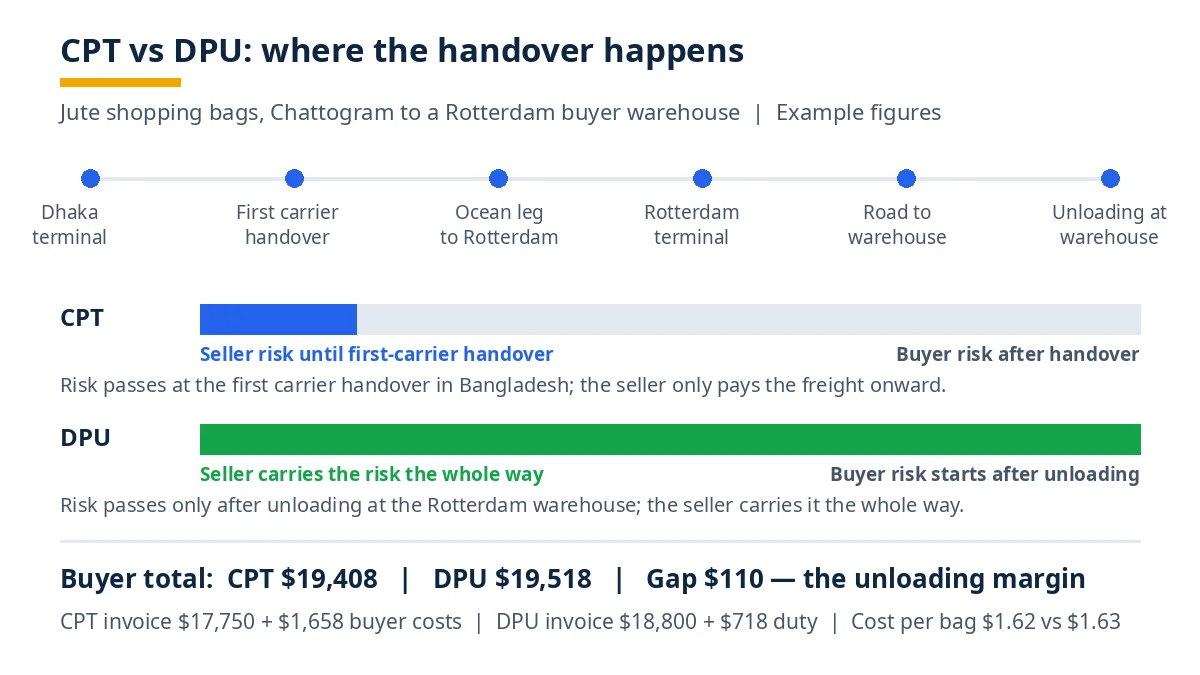
A buyer in Rotterdam orders 12,000 jute shopping bags and asks for two quotations: one on CPT Rotterdam and one on DPU at the buyer warehouse in Rotterdam. The goods, the vessel and the sailing are the same, yet the DPU price is higher. The difference is not the freight. Both terms put the carriage on the seller. The difference is the handover: under CPT the seller hands the goods to the first carrier in Bangladesh and the risk moves to the buyer at that moment, while under DPU the seller stays responsible until the bags are unloaded at the Rotterdam warehouse.
Two handovers, weeks apart
Follow one carton of jute bags from Dhaka to Rotterdam. A truck takes it to a terminal, the container sails from Chattogram, the vessel docks at Rotterdam, and a truck carries it to the buyer warehouse for unloading. Under CPT, delivery happens at the second step, when the goods are handed to the first carrier.1 Under DPU, delivery happens at the last step, when the goods have come off the arriving vehicle and are ready for the buyer at the named place.1
That gap is the whole comparison. What changes is who answers for the goods while they travel and who pays for the unloading. The 2020 edition of Incoterms divides its eleven rules by how delivery, cost and risk fall on each side.2
What CPT asks of each side
CPT expands to Carriage Paid To. The seller completes delivery, and the risk moves, when the goods are handed to the carrier the seller has booked, or when goods already delivered that way are procured.1 Delivery in that form carries no promise that the goods arrive at the named destination undamaged, in full, or at all — yet the carriage to that destination stays on the seller's account.1
CPT works with two places. Delivery takes place where the seller gives the goods to the first carrier and the risk changes hands. The destination named after the letters CPT is the point the seller's carriage must reach.2 The seller pays for export packing, export clearance, origin handling and the main carriage to that named destination; the buyer pays for insurance, import clearance, duties and anything after it.2
What DPU asks of each side
DPU stands for Delivered at Place Unloaded. Under DPU the seller delivers the goods, and transfers the risk, once the goods are off the arriving vehicle and ready for the buyer at the named place of destination.1 The seller bears all risks involved in bringing the goods to the named place and unloading them there.1
Among the eleven rules, DPU alone puts unloading at destination on the seller.1 The former Delivered at Terminal (DAT) was renamed Delivered at Place Unloaded (DPU) so the place can be any place, not just a terminal, and to mark the difference from Delivered at Place (DAP), under which the seller does not unload.3 The seller handles export formalities, carriage, unloading and the transport document, and notifies the buyer once the goods are unloaded.4 The seller must be able to organise unloading at the named place; if not, DAP should be used instead.1
The cost split, line by line
Cost line | Under CPT | Under DPU |
|---|---|---|
Goods, packing, inland carriage, export clearance | Seller | Seller |
Ocean freight, Chattogram to Rotterdam | Seller | Seller |
Cargo insurance | Buyer arranges its own cover | Seller usually insures its own risk |
Terminal handling at Rotterdam | Buyer | Seller |
Road carriage to the buyer warehouse | Buyer | Seller |
Unloading at the buyer warehouse | Buyer | Seller |
Import clearance, duty, VAT and taxes | Buyer | Buyer |
Onward carriage past the named place | Buyer | Buyer |
DPU is not a duty-paid term: only DDP puts import clearance and duty on the seller.4 Neither CPT nor DPU obliges any party to insure the goods.4
Worked example: jute shopping bags from Chattogram to Rotterdam
Example figures. A buyer in Rotterdam orders 12,000 jute shopping bags from a supplier in Dhaka, goods worth $15,600, shipped in one 40-foot container from Chattogram to Rotterdam, then by road to the buyer warehouse. The CPT named place is Rotterdam; the DPU named place is the buyer warehouse in Rotterdam. The figures are illustrative, and the duty rate is an example rate.
Cost line | Under CPT | Under DPU |
|---|---|---|
Goods, packing, inland carriage, export clearance | $15,600, in the seller price | $15,600, in the seller price |
Ocean freight, Chattogram to Rotterdam | $2,150, paid by the seller | $2,150, paid by the seller |
Cargo insurance | $190, paid by the buyer | $190, paid by the seller |
Terminal handling at Rotterdam | $260, paid by the buyer | $260, paid by the seller |
Road carriage to the warehouse | $340, paid by the buyer | $340, paid by the seller |
Unloading at the warehouse | $150, paid by the buyer | $260, paid by the seller |
Import duty, example 4% of $17,940 | $718, paid by the buyer | $718, paid by the buyer |
Total the buyer pays | $19,408 | $19,518 |
Cost per bag | $1.62 | $1.63 |
Under CPT the seller invoice is $17,750 plus a further $1,658 from the buyer. Under DPU the seller invoice is $18,800 and the buyer pays only the $718 duty. The totals differ by $110, and that gap is the unloading line alone: $260 under DPU against $150 under CPT.
Duty is an example 4% of $17,940: $717.60, rounded to $718. Our CPT vs DAP guide prices the same question with the goods still on the truck.
Insurance: no policy promised under either rule
Only two Incoterms rules impose an insurance duty on the seller: CIP and CIF. Under CPT and DPU, neither party is contractually required to buy cargo insurance.4 Under CPT the exposure is yours from the first carrier handover in Bangladesh, so buy cover that starts at that point. Under DPU the exposure is the seller's until the bags are unloaded at Rotterdam, so the seller usually arranges cover itself, even though the rule asks for no policy.4
CIP now asks for the higher level of cover, matching Institute Cargo Clauses (A) or equivalent terms, while CIF keeps Clause (C) as its default.3 Our CPT vs CIP guide turns on that single insurance line.
Import clearance at Rotterdam: still the buyer's job
Risk and unloading divide the two rules; the border does not. Under both, the seller completes export clearance in Bangladesh, while you file the import entry and pay the duty and taxes as importer of record.4
For imports into the European Union, the VAT rate depends on the member state and the goods. The VAT base usually begins with the customs value, then adds duties and qualifying incidental costs — freight and insurance up to the first destination, where they are not already counted.4 Confirm the customs value, classification and VAT rate with the destination customs broker.4 A clearance delay under DPU holds the goods while the seller still carries the risk; under CPT the risk, and the demurrage, are already yours.
The unloading question: the step that decides it
Unloading looks like a small line on the quotation, and it is the step that decides most CPT against DPU choices. Two questions settle it. First, who has the equipment. Jute bags in cartons need a forklift and a crew at the warehouse; a buyer with its own forklift and staff unloads for the direct rate, while a seller arranging a crew at a warehouse it has never worked in pays more and carries the risk of a delay. Second, who pays when it goes wrong: damage, a site not ready, or the wrong equipment fall on the seller under DPU and on the buyer under CPT.
Common DPU pitfalls: unloading delays when the site is not ready, damage from poor coordination or unsuitable equipment, a delivery place named without an address, and insurance gaps where each party assumes the other has cover.4 Name the exact warehouse bay, state the unloading gear and the time slot, and write down who insures the unloading step. Our DPU price guide breaks down what a DPU price contains.
Bangladesh points to settle before you sign
Customs lists the Export Registration Certificate and the BIN among its general export documents, alongside the LC or sales contract, the EXP form, invoice, packing list, transport document and certificate of origin.5 The EXP form is filed through the authorised dealer bank, and the exporter gives the bank the signed EXP copy and shipping documents within 14 days of shipment.5
Jute and jute goods exported from Bangladesh reached $883.69 million in FY2025-26, up 7.75 percent on the year before.5 Export money must reach Bangladesh within four months of shipment, although raw jute and jute goods can get up to 360 days under an irrevocable confirmed letter of credit.5 A 2026 guide to Bangladesh export rules lists EXW, FCA, FOB, FAS, CFR, CIF, CPT and CIP as the terms Bangladesh Bank allows when the contract or letter of credit names them, and DPU is not on that list.5 A seller quoting DPU under a letter of credit should confirm the wording with its bank before the credit is opened.
Decide with four questions
Can the seller unload where you named. If the seller has no crew, equipment or contacts at your warehouse, DPU is not a real offer. Choose CPT, or ask for DAP.1
Who should carry the voyage risk. Choose DPU if you want the seller to answer for the goods until they are set down at your warehouse. Choose CPT if you hold your own cargo policy and prefer to claim on it.2
Who unloads cheaper. Price the unloading both ways: in the worked example the seller's unloading cost $110 more than the buyer's own crew, but the gap can run the other way.
Can you clear import at Rotterdam. Both rules leave import clearance, duty and taxes with you. If you cannot clear import at all, ask for DDP instead.4
Our FOB vs DPU guide looks at the same unloading question from the term where the buyer books and pays the freight.
Questions buyers ask about CPT and DPU
Is DPU always more expensive than CPT?
Not by a fixed amount: in the worked example the buyer totals differ by only $110, the unloading margin.
Does the seller insure the goods under DPU?
No rule obliges either side to insure under DPU.4 The seller usually buys its own cover, because the transit risk stays with it until unloading is done.
Can I use CPT for a container handed to a terminal?
Yes. Delivery under CPT is the handover to the first carrier at the terminal, while sea-only rules name a delivery point on board the vessel.2
What should the DPU named place say?
The full warehouse address, including the bay or dock where unloading happens, not the city alone: under DPU the named place is where the goods are unloaded, so a vague place leaves the delivery point open to dispute.1
Next steps on Exportain
Get both quotations for the same order, and ask each seller to itemise handling, road freight and unloading in writing. Then post an RFQ stating the rule, the place, the edition and how unloading is arranged, and search Bangladeshi suppliers for makers who quote both terms. Our Incoterms guide explains all eleven rules together.
Sources
- Trade Terms Definitions. DHL (accessed )
- CPT (Carriage Paid To) Meaning in Incoterms: Risk Transfer and Who Pays. GoFreight, (accessed )
- Incoterms® 2020. International Chamber of Commerce (ICC) (accessed )
- DPU Incoterms (Delivered at Place Unloaded) Explained. iContainers (accessed )
- Start an Export Business in Bangladesh (2026 Guide). Entrepreneurs.bd (accessed )
About the author
Sourcing from Bangladesh?
Post a request for quotation and suppliers on Exportain can send you their quotes directly.
Post an RFQ