

30-Piece MOQ Suppliers: Practical Guide
How to work with 30-piece MOQ suppliers in Bangladesh: confirm the MOQ basis, compare total landed cost, approve a sample in writing, and protect a trial order with staged terms and inspection.
Short answer
30-piece MOQ suppliers accept a first order of 30 pieces, usually per style, so buyers can test quality, sizing and sell-through before a larger run. Confirm what the 30 counts against, compare total landed cost rather than unit price alone, approve a sample in writing, agree inspection and staged payment terms, and record every term on the proforma invoice before production starts.
On this page
Key takeaways
An MOQ of 30 pieces can be counted per order, per style, per color or per size, so confirm the basis in writing before you compare quotes.
Small orders cost more per unit because fixed setup costs are spread over fewer pieces, so compare total landed cost rather than unit price alone.
Approve a sample in writing and record price, lead time, payment schedule and delivery term on the proforma invoice before production starts.
Bangladesh Customs requires an approved Bill of Export with documents including the contract or purchase order, commercial invoice, packing list, EXP form and certificate of origin.
Finding 30-piece moq suppliers is often the first real test for a new importer. You have a product idea, a small budget for a trial order, and a long list of factories whose minimum is far larger than you can sell. This guide explains how low-MOQ sourcing works in Bangladesh, how to read an MOQ offer, how to negotiate without damaging the relationship, and how to place a small first order that protects you if anything goes wrong. It is for buyers in the United States, the United Kingdom, the European Union and the United Arab Emirates.
A minimum order quantity, or MOQ, is the smallest number of units a supplier is willing to sell in one order, and suppliers set it to cover production costs and operate efficiently.1 The basis matters: an MOQ can be stated per style, per color, per size set, or per total order, and those are very different commitments. Thirty pieces per style across mixed sizes is far more flexible than 30 pieces of every color and size. Before you compare two offers, confirm you are comparing the same basis. The explainer on MOQ and minimum order quantity covers the term in full.
Why this matters for buyers and sellers
For buyers, low-MOQ suppliers lower the cost of learning. A first order shows whether the fabric feels right, sizing matches your market, printing survives washing, and the supplier ships what was agreed. Testing those questions on 30 pieces is far cheaper than on a full production run. A small order also validates demand: list a small batch, watch real sell-through, and reorder with evidence instead of a guess.
For sellers in Bangladesh, a small first order is often the start of a longer account rather than a one-off favor. Suppliers who handle small orders professionally, with a clear specification, an honest lead time and consistent quality, are better placed to win the repeat business that follows. Behavior on a small order is also a useful predictor of behavior on a large one.
Ready-made garment exports from Bangladesh grew 6.1 percent year on year to $10.58 billion in July to September 2026, with the European Union taking 46.36 percent, the United States 20.99 percent and the United Kingdom 12.21 percent, according to Export Promotion Bureau data reported by The Business Standard.2 Within that trade, smaller and mid-sized units, buying houses and trading suppliers are often structured for flexible quantities in a way a large production line is not, which is why a 30-piece trial order can work here.
Step-by-step: how it works
The process below turns a vague idea into a written, checkable order, with a document or confirmation kept in one order file at each step.
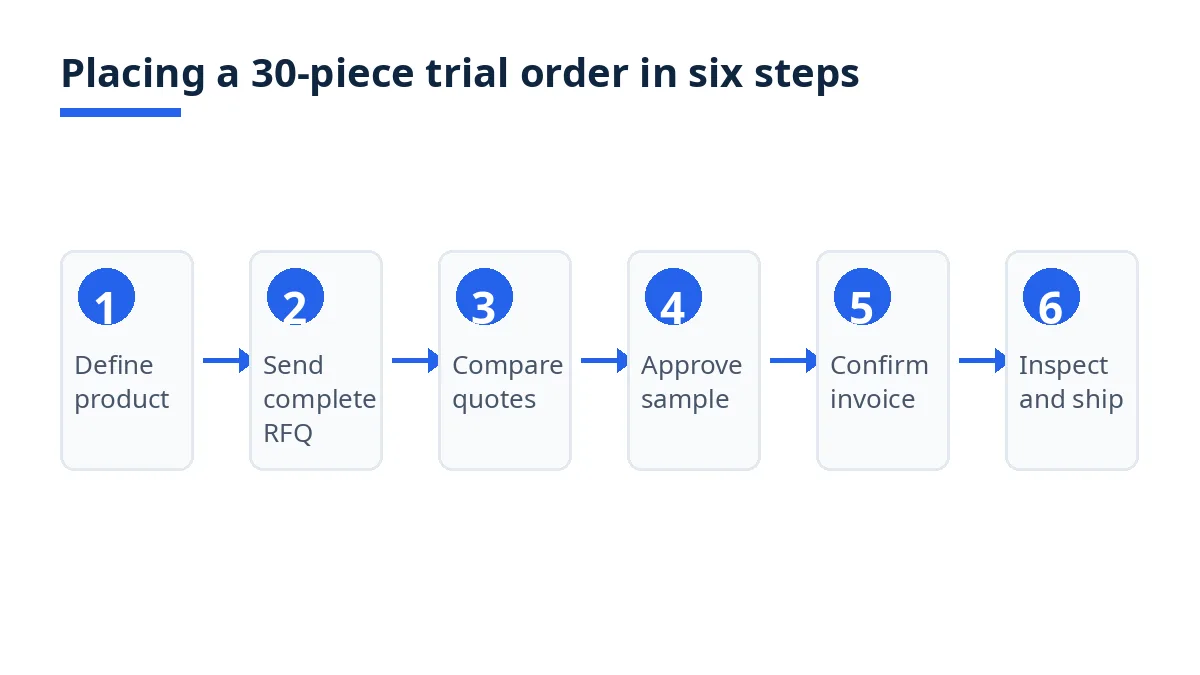
Step 1: Define the product before you search
Write down the product, material, sizes, colors, customization (print, embroidery, labels, packaging) and target quantity. Suppliers cannot quote a meaningful MOQ or price against a vague description, and customization is the most common reason a low MOQ disappears: a plain stock item may be available in small quantities while the same item with your print and labels is not.
Step 2: Shortlist suppliers who work at this scale
Look for suppliers whose listings, range and stated MOQ match small orders, rather than asking a high-volume factory to make an exception. A polite refusal from a large factory is information, not rejection. Note each candidate's range and MOQ basis before you contact them.
Step 3: Send a complete RFQ
A request for quotation (RFQ) should state the specification, quantity per size and color, customization, destination, packaging, and what you need quoted: unit price, sample cost, production time and shipping options. A structured RFQ signals a serious buyer, which matters when a supplier decides whether a small order is worth the setup time. The guide on how to write an RFQ lists the fields a complete inquiry needs. A short template:
Product: [name and material]. Sizes and colors: [breakdown]. Quantity: 30 pieces in total, split as [breakdown]. Customization: [print, labels or none]. Packaging: [requirement]. Destination: [port or city, country]. Please quote: unit price at 30 pieces and at your next quantity break, sample cost and sample lead time, production lead time after approval, and delivery terms.
Step 4: Compare quotes on the same basis
Build a table with one row per supplier: MOQ basis, unit price, sample cost, lead time, delivery terms, and inclusions such as labels, packaging and inspection access. The cheapest-looking quote often excludes something another quote includes. Ask each supplier to state inclusions and exclusions in writing.
Step 5: Order and approve a sample
Even at 30 pieces, approve a physical sample, or at minimum recent production photos and a detailed specification sheet, before production. The approved sample becomes your quality reference if there is a dispute. Record the approval in writing, and note any later change, because a late change can alter price and timing.
Step 6: Confirm everything in a proforma invoice
The proforma invoice should restate the product, quantities, prices, lead time, payment schedule and delivery terms. If a term is not written there, it is not agreed. Check that the business name and payment details match the supplier you verified, and query any difference before you pay.
Step 7: Inspect and ship
Agree how quality will be checked before the balance is paid: your own visit, a third-party inspection, or photo and video evidence against the approved sample. Then confirm the shipping method and documents before dispatch. See pre-shipment inspection for what a final check covers.
Costs, timelines and documents
What does a 30-piece order actually cost?
Small orders carry proportionally higher costs. Every production run involves fixed costs such as labor, machinery setup and raw materials, and an MOQ ensures the supplier covers those costs without losing money on a small order.1 Setup work takes roughly the same effort for a small run as for a larger one, so those costs are spread over fewer pieces. Expect a higher unit price at 30 pieces than at production volumes, and sample and courier costs to be a visible share of the total. Judge suppliers on total landed cost: product, sampling, freight, destination duties and taxes, and any inspection cost. The guide to landed cost for imports from Bangladesh shows how to build that total.
Cost element | What to confirm in writing |
|---|---|
Product and materials | Material, weight or grade, substitutes allowed |
Customization | Print, embroidery, labels and packaging included or excluded |
Sampling and courier | Charge per sample, who pays for dispatch |
Production | Unit price at 30 pieces and at the next quantity break |
Inspection | Who inspects, to which standard, and who pays for re-inspection |
Freight and delivery term | Named place or port, legs covered |
Import duty and taxes | Duty checked with your broker before pricing |
For scale only, consider this comparison. Example figures: one supplier quotes $6.40 per piece for 30 polo shirts EXW, another $6.95 per piece FOB. Adding inland transport, export handling and loading of $0.50 per piece to the EXW quote gives a like-for-like FOB cost of $6.90 per piece, so the real gap is $0.05 per piece, not $0.55. The decision then rests on fabric and construction, not on a gap that never existed.
Delivery terms decide who pays for which leg, so quotations on different terms are not comparable until you adjust them. The ICC Incoterms rules are eleven three-letter trade terms that clarify the tasks, costs and risks involved in delivering goods from sellers to buyers, and Incoterms 2020 entered into force on 1 January 2020.3 Name the term and place in the proforma invoice, for example FOB Chattogram.
Negotiation works best when it trades something rather than only asking for less. Buyers can accept a higher unit price for a smaller order, offer a longer-term commitment, or combine items into one order to reach a workable run size.1 Ask what would make 30 pieces workable, and put the answer in writing.
How long does a trial order take?
Separate the stages and get each confirmed in writing: sampling, main production after approval, quality check, and transit. Never plan a launch date around a single combined estimate. Build in buffer, because small orders are often scheduled between larger runs.
Which documents are needed?
The documents for a small order are the same family as for any export order. Bangladesh Customs states that goods may not be loaded for export unless a Bill of Export has been submitted and approved, and that its enclosed documents for all export consignments are the export letter of credit or, where there is none, the export contract or purchase order, a commercial invoice, a packing list, an EXP form certified by an Authorized Dealer, a certificate of origin issued by the Export Promotion Bureau or a Chamber of Commerce and Industry, a VAT registration certificate, and the exporter's Taxpayer Identification Number.4 Product categories can need additional certification. Keep every document in one folder per order. See export documents from Bangladesh.
Bangladesh-specific rules and tips
First, state whether quoted prices include local handling and delivery to the port or courier, and which delivery term applies. Second, agree the size standard in writing: conventions differ between the US, UK, EU and Gulf markets, and a measurement chart removes the ambiguity. Third, discuss reorder terms during the first order, so you know the price and MOQ for the second run before you need it. Fourth, keep communication in one thread with written confirmations. Finally, verify the supplier's business identity before paying: a listing, trade license details and references are reasonable requests at any order size.
Plan for the destination, not only the factory. In the European Union, Regulation (EU) No 1007/2011 of 27 September 2011 sets the rules on textile fibre names and the related labelling and marking of fibre composition.5 Requirements also differ in the United States, the United Kingdom and the United Arab Emirates, especially for children's clothing. Confirm the exact label wording before labels are printed: a well-made garment with the wrong fibre label is not saleable in that market.
Mistakes and red flags
The most common mistake is negotiating only on unit price. A slightly higher price from a supplier who communicates clearly and ships on time is cheaper in total than a bargain that arrives wrong. The second mistake is skipping the sample because the order is only 30 pieces: the sample is your only physical proof of what the run will look like. Third is paying in full in advance to an unchecked supplier; staged payments linked to milestones are the usual protection. Fourth is leaving the MOQ basis ambiguous and discovering at packing that 30 pieces meant 30 per color.
Red flags justify walking away: a supplier who will not put the specification, price and lead time in writing; prices that change after the proforma invoice without a stated reason; refusal of any pre-shipment quality evidence; pressure to pay quickly before documents are shared; and payment details that do not match the business identity you were given. Any one of these on a trial order predicts larger problems at scale.
Checklist
Before you pay a deposit on a 30-piece order, confirm each item:
Specification, materials and customization written down and acknowledged.
MOQ basis confirmed in writing: per style, color, size or total order.
Quantity breakdown by size and color agreed.
Unit price, sample cost and inclusions stated on the proforma invoice.
Sample approved, or a photo and video evidence standard agreed.
Lead time and shipping method confirmed in writing.
Payment schedule agreed, with no full prepayment to an unchecked supplier.
Pre-shipment check method agreed, judged against the approved sample.
Documents confirmed: contract or purchase order, invoice, packing list, certificate of origin if needed, transport document.
Reorder price and MOQ discussed.
For the final check, agree the sampling method in advance. ISO 2859-1 is the international standard for sampling procedures for inspection by attributes, and it uses the acceptance quality limit (AQL) to determine sample sizes and acceptance and rejection thresholds for a lot.6 See AQL.
How Exportain helps
Exportain is a B2B export marketplace where buyers find Bangladeshi suppliers, post RFQs and compare quotations in one written thread. Post one RFQ describing your product, quantity and destination, and receive quotes from suppliers whose stated range fits that scale. Supplier profiles show which document and photo checks Exportain has recorded. Those checks are reviews of documents and photos, not factory inspections, and they do not replace your own checks, sample approval or inspection. Exportain is not a party to your contract for goods, and it does not inspect goods, book freight or clear customs. The how to buy guide sets out the buyer journey.
FAQs
What should I know first about MOQ?
Know what the number is counted against. An MOQ of 30 pieces can mean 30 per order, per style, per color or per size, and each produces a very different total commitment and cost. The MOQ covers the supplier's setup work and minimum material purchases, which is why fully customized products rarely carry the lowest MOQs and plain or stock-based items are the easiest route into small orders.
What are the typical costs and timelines?
Costs depend on the product, materials and customization, so no honest guide can quote a universal figure. Expect a higher unit price than at volume, plus sample and courier costs that are proportionally significant on a small order. Compare total landed cost, including freight and destination duties and taxes. Timelines split into sampling, production, checking and transit: ask the supplier to confirm each stage in writing and add buffer.
Which documents are needed?
At minimum, a contract or purchase order, a proforma invoice before payment, and at shipment a commercial invoice and packing list, with a certificate of origin and an EXP form on the Bangladesh export side, plus a bill of lading for sea freight or an air waybill for air freight.4 Product-specific test reports or labelling evidence may also be required. Confirm the full list with your supplier and, for a first import, with your customs broker before the goods ship.
What are the most common mistakes?
The mistakes behind most failed trial orders are comparing quotes that are not on the same MOQ basis or do not include the same items, skipping the sample, paying in full in advance to an unchecked supplier, and leaving specifications and quality checks unwritten. A complete RFQ, an approved sample, staged written terms and a pre-shipment check avoid each of them.
Next steps on Exportain
Browse Bangladeshi suppliers by category and note the suppliers whose stated MOQ matches a 30-piece trial, then read the how to buy guide. When your specification is ready, post an RFQ so suppliers quote against the same requirements, and keep the replies, sample approval and proforma invoice in one order file.
Sources
- MOQ Meaning: Minimum Order Quantity Guide. AGR Inventory (accessed )
- RMG exports grow 6.1% in Q1. The Business Standard, (accessed )
- Incoterms® rules. International Chamber of Commerce (ICC) (accessed )
- Customs Clearance Procedures for Export. Bangladesh Customs, National Board of Revenue (accessed )
- Regulation (EU) No 1007/2011 on textile fibre names and related labelling and marking of the fibre composition of textile products. European Union, (accessed )
- ISO 2859-1:2026 - Sampling procedures for inspection by attributes — Part 1: Sampling schemes indexed by acceptance quality limit (AQL) for lot-by-lot inspection. International Organization for Standardization (accessed )
About the author
Sourcing from Bangladesh?
Post a request for quotation and suppliers on Exportain can send you their quotes directly.
Post an RFQ


