How to Find WRAP Certified Factories in Bangladesh
WRAP certifies facilities, not products: the 12 Principles, the March 2026 move from Platinum, Gold and Silver levels to an annual Certification of Compliance, and how to check a certificate and facility listing for a Bangladesh factory before you order.
Short answer
WRAP certifies a single production facility, not a product, against its 12 Principles covering lawful, humane and ethical manufacturing. Ask for the full certificate for the exact facility, check its issue and expiry dates and the WRAP facility listing entry, and read the corrective-action position. Under the current system a passing facility receives an annual Certification of Compliance; Platinum, Gold and Silver levels appear only on certificates issued before March 1, 2026.
On this page
Key takeaways
WRAP certifies a single production facility, not a product, against 12 Principles covering lawful, humane and ethical manufacturing, including labor practice, health and safety, environment, customs compliance, and security.
Under the current system a passing facility receives an annual Certification of Compliance. Platinum, Gold and Silver levels appear only on certificates issued before March 1, 2026, and must be read within their printed validity.
Verification means checking the full certificate for the exact facility, its issue and expiry dates, the monitoring firm, and the WRAP facility listing entry, not accepting a logo or cropped certificate.
Certification is granted only after all corrective actions have been implemented and verified, and certified facilities are subject to unannounced post-certification assessments during the certification period.
Exportain supplier verification is a document and photo review, not a factory inspection, and a badge is not a guarantee of capacity, quality, or delivery.
A supplier sends a certificate headed "Gold" and dated 2024, and calls the factory WRAP certified. A second supplier sends a certificate with no level at all, dated 2026, and makes the same claim. Both can be genuine, and neither answers the real question: is this exact factory certified today, for this order?
WRAP stands for Worldwide Responsible Accredited Production. It certifies facilities, not products. A facility is audited against WRAP's 12 Principles, based on international workplace standards, local laws, and workplace regulations, including the spirit of International Labour Organization conventions and United Nations and OECD guidance.1 The principles cover human resources management, health and safety, environmental practices, and legal compliance, including customs and security standards.1 A WRAP certificate says something about how a named facility operates. It does not certify a fiber, a fabric, a dye, a finished garment, or a shipment.
That facility scope sets WRAP apart from the neighboring guides here: the BSCI / amfori guide covers a member-driven audit program producing a rating and a report, not a facility certificate; the GOTS guide covers a whole-chain organic standard; the OCS guide covers organic content and chain of custody; the GRS guide covers recycled content; and the OEKO-TEX Standard 100 guide covers substance testing of a finished article.
The 12 Principles, in plain terms
As listed by WRAP monitoring firms, the 12 Principles are:2 (1) compliance with laws and workplace regulations; (2) prohibition of forced labor; (3) prohibition of child labor; (4) prohibition of harassment or abuse; (5) compensation and benefits as required by law; (6) hours of work as limited by law; (7) prohibition of discrimination; (8) health and safety; (9) freedom of association and collective bargaining; (10) environment; (11) customs compliance; (12) security.
Principle 3 references International Labour Organization Convention 138 on minimum age, and Principle 5 references Convention 95 on protection of wages.1 Principle 12 is benchmarked against the United States Customs Trade Partnership Against Terrorism program.1 Certification is granted only after all corrective actions have been implemented and verified.3
Certification levels and validity: read the date first
Older guides and supplier documents go out of date here. WRAP's current explanation, published in March 2026, states: "WRAP certifications last for one year, which reflects the idea that social compliance is an ongoing process, not a one-time check."4 A monitoring firm states the change behind that wording: WRAP no longer offers certification levels as of March 1, 2026, and a passing facility receives an annual Certification of Compliance.5 A letter presenting levels as current may describe the older system, not the current one.
Older certificates did carry levels:5 2 6
Level | Validity under the former system | What it meant |
|---|---|---|
Platinum | 2 years | Full compliance across three consecutive audits, with no corrective actions. |
Gold | 1 year | Standard level: full compliance at the time of audit. |
Silver | 6 months | Substantial compliance, with minor non-compliances still to close; no more than three consecutive Silver certificates. |
Read a certificate in this order: facility name and address, issue and expiry dates, then, only for a pre-March 2026 certificate, the level. A Gold certificate that expired in 2025 is not evidence for a 2026 order, and a current certificate with no level is not weaker than an old Gold certificate. Certified facilities are subject to random, unannounced Post-Certification Assessments.4 Zero-tolerance issues are subject to remediation, with expiry or suspension as a last resort.3
Why this matters for buyers and sellers
For a buyer, the risk is ordering on a workplace claim never tested at the site that will make the goods. A sample can show fabric, stitching, and print, but not wage records, working-hours records, grievance handling, fire exits, chemical storage, or customs record keeping. A WRAP audit tests those areas through document review, site observation, and worker interviews. For a seller, one certificate can serve several buyers who accept WRAP, which is also why the document is copied, cropped, and overstated.
A WRAP certificate does not prove product quality, on-time delivery, production capacity, or building structural safety, nor that a fabric is organic, recycled, or free of a restricted substance. It does not cover a subcontractor never in scope, a second unit at a different address, or a parent company. Certifications can only be granted to individual production units, and holding companies, brands, and retailers are not eligible to apply directly.5
Step-by-step: how it works
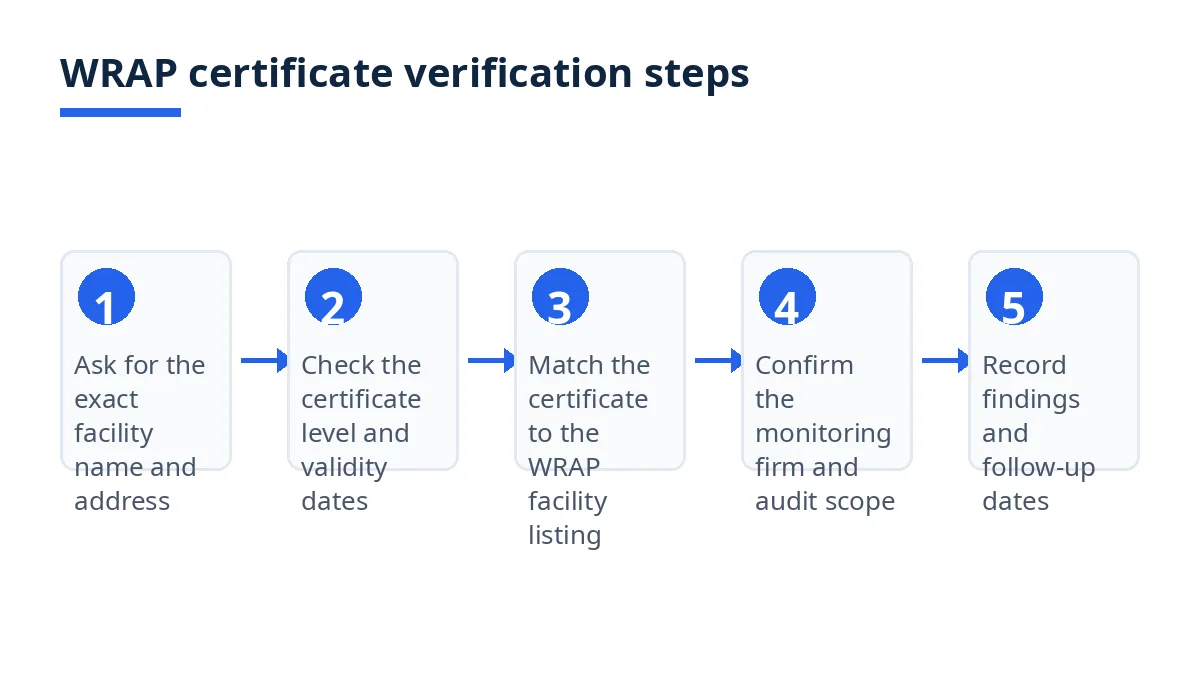
The route runs through application, self-assessment, audit by an accredited monitoring firm, WRAP review, and a certification decision. WRAP states that a facility starts by submitting an application, then chooses an approved monitoring firm to conduct a full audit covering working conditions, management systems, and adherence to the principles across all work shifts.4 Many facilities complete an optional Pre-Audit Self-Assessment first.4 After the audit, the monitoring firm sends a report to WRAP, and final decisions are made with oversight from WRAP staff and its independent review board.4
1. Name the exact facility first
Ask for the legal name, site address, and production unit name as they appear on the certificate. A certificate for a head office or sister unit does not cover the unit making your order.
2. Confirm the monitoring firm and the audit scope
Facility compliance is examined through audits by third-party monitoring firms accredited by WRAP, whose auditors must meet accreditation requirements and attend refresher training every two years.7 A report from an unaccredited firm is not a WRAP audit.
3. Read the full certificate, not the logo
Record the facility name and address, the monitoring firm, the issue and expiry dates, and, for a pre-March 2026 certificate, the level. A certificate expiring mid-production needs a renewal position in writing before you confirm the order.
4. Check the facility listing
WRAP's facilities page states that buyers can verify a given factory's certification there.7 Use that listing as a cross-check, not a substitute for the certificate. If the listing and the certificate disagree on name, address, or dates, ask the monitoring firm or WRAP to resolve the mismatch first.
5. Ask about corrective actions and post-certification checks
Certification is granted only after all corrective actions have been implemented and verified.3 4 Ask what findings were raised, what was corrected, whether any finding remains open, and whether a post-certification assessment has taken place.
6. Check subcontractors and the cascade
WRAP states that participating facilities commit to passing along the expectation of compliance to their contractors and suppliers.1 Ask which processes are subcontracted, and whether those sites are WRAP certified or covered by the audited scope.
Costs, timelines and documents
There is no single standard WRAP fee or timeline that a guide can state as a market rate, because cost and duration depend on the facility, its size, its readiness, and the monitoring firm it chooses. Treat any fee or timeline a factory or agent quotes as a quote for a specific facility and scope. WRAP's own pages opened for this guide do not publish a standard fee schedule.
One monitoring firm describes the procedure as an application and registration fee, a self-assessment demonstrating implementation for at least three months, selection of an accredited monitoring firm, and an audit that must be passed within six months of the registration fee payment to avoid re-registering.6 The same firm lists the registration fee as US$1,195.6 Confirm that figure before relying on it: it is dated, and separate from the audit fee. A second monitoring firm states that its audit report goes to WRAP within 10 days, followed by WRAP review and board approval.8
Request this set for each order: the full WRAP certificate for the exact facility, with name, address, monitoring firm, dates, and level only for a pre-March 2026 certificate; the facility listing entry checked against the certificate;7 a summary of findings and corrective actions, with evidence that every action was implemented and verified;3 4 the monitoring firm's accreditation status;7 and written positions on subcontracted processes and on any post-certification assessment or zero-tolerance issue.3 4
Example figures, illustrative only: a certificate running January to December can cover production in that window, but an order cut the following January needs a renewed certificate first. A pre-March 2026 Gold or Platinum certificate needs the same check at expiry.
Bangladesh-specific rules and tips
There is no separate Bangladesh version of WRAP. Principle 1 requires compliance with the laws and workplace regulations of the country of operation.2 What is specific to Bangladesh is how production is organized.
First, check the unit, not the group. Garment groups commonly operate several units at different addresses, sometimes under similar names. A certificate for one unit does not cover another. Match the certificate unit to the purchase order unit.
Second, check the subcontracting chain. Cutting, sewing, dyeing, printing, embroidery, and washing are frequently split across sites. WRAP's expectation that a facility passes compliance expectations to its contractors gives you the right question, not the answer.1 Ask for the subcontractor list, and whether each site is in scope or holds its own certificate.
Third, do not read a WRAP certificate as a building safety approval, a fire safety certificate, or an environmental permit. It is not a structural engineering inspection.
Fourth, plan for language and shift coverage. WRAP states that the audit evaluates adherence across all work shifts.4 Confirm that the audit covered the shifts that will produce your order, and that interviews used languages the workforce speaks.
Mistakes and red flags
Calling a facility certificate a product certification
A WRAP certificate tests workplace practice at a facility, not fiber content, recycled content, chemical safety, or product quality. If a supplier offers it as proof of those material claims, ask for the separate evidence.
Accepting a logo, a cropped certificate, or a screenshot
A logo can be copied, and a cropped page can hide the facility name, the dates, or the scope. On a product, WRAP requires the "MADE IN A CERTIFIED FACILITY" version without implying a product quality claim.3 Ask for the full certificate and the listing entry.
Accepting a level as if it were current
A Platinum, Gold, or Silver level on a certificate dated after March 1, 2026, does not match the current system, under which WRAP issues an annual Certification of Compliance.5 A level on an older certificate is meaningful only within its printed validity.
Accepting evidence for a different facility
A certificate for one unit, a head office, or a parent company does not cover a different unit.5 If the letterhead address and the certificate address differ, ask which address produced the goods, in writing.
Accepting an expired certificate
A certificate that expired before production, or that expires mid-production without a renewal position, is an open gap. WRAP's current certificates last one year.4 Record the expiry date in your order file, and set a reminder before it passes.
Treating a self-assessment as an audit
The Pre-Audit Self-Assessment helps a facility prepare.4 It is optional, and it is not an audit. A self-assessment or readiness report does not carry WRAP certification.
Treating a certificate as permanent
A certificate is a dated position for one facility and one period. It does not guarantee quality, delivery, capacity, or building safety, and it can be lost through decertification.3
Ignoring the corrective-action and zero-tolerance position
A certificate issued after corrective actions were verified is stronger evidence than one presented with no findings at all.3 4 A zero-tolerance issue without a remediation position is a pause signal: pause the order until the monitoring firm or WRAP confirms the position in writing.
Checklist
Before you confirm, answer every line.
Exact facility: legal name, site address, production unit, matched to the purchase order.
Full certificate on file, with dates and, for a pre-March 2026 certificate, its level.
Facility listing entry checked against the certificate.7
Validity checked: current annual certificate covering production; older levels read only within printed validity.4 5
Monitoring firm confirmed as WRAP accredited.7
Findings and corrective actions on file, with evidence of implementation and verification.3 4
Post-certification assessment position in writing, where one has taken place.4
Zero-tolerance position in writing, with remediation status, where one exists.3
Scope checked: subcontracted processes named, each in scope or separately certified.
Material, substance, quality, and building safety claims checked separately.
How Exportain helps
Exportain supplier verification is a document and photo review, not a factory inspection, and it is not a check against any government database.9 A badge is not a guarantee of capacity, quality, or delivery.9 Verification is free, staff review every submission, and membership plans never grant a trust badge.9 It does not replace the WRAP certificate or the corrective-action file for the exact facility.
Post a free RFQ on Exportain and state the WRAP position you need: exact facility, certificate dates, monitoring firm, corrective-action summary, and subcontracting scope. Ask each reply to attach the full certificate, not a logo. Read Seller Verification and Trust Center. The certification services category currently states "No services published in this category yet", so treat it as a category reference only, not as a listing of certifiers or auditors.
FAQs
What should I know first about WRAP?
Know first that WRAP certifies facilities, not products, against 12 Principles covering lawful, humane, and ethical manufacturing.1 A certificate names one production facility and, under the current system, is an annual Certification of Compliance rather than a leveled certificate.4 5
What are the typical costs and timelines?
There is no standard WRAP fee or timeline published on WRAP's own pages opened for this guide, so treat any figure as a quote for a specific facility and scope. One monitoring firm lists a US$1,195 registration fee, with implementation demonstrated for at least three months, then the audit passed within six months of payment.6 A second monitoring firm states that its audit report goes to WRAP within 10 days, followed by review and board approval.8
Which documents are needed?
You need the full WRAP certificate for the exact facility; the facility listing entry checked against the certificate; a summary of findings and corrective actions, with evidence of implementation and verification; the monitoring firm's accreditation status; and written positions on subcontracted processes and on any post-certification assessment or zero-tolerance issue.3 4 7
What are the most common mistakes?
The most common mistakes are calling a facility certificate a product certification, accepting a logo or cropped certificate, treating a retired level as current, accepting evidence for a different facility, accepting an expired certificate, treating a self-assessment as an audit, treating a certificate as permanent, and ignoring the corrective-action and zero-tolerance position.1 3 4 5
Next steps on Exportain
Post a free RFQ on Exportain at RFQs, stating the exact facility, certificate dates, monitoring firm, and subcontracting scope. Read Seller Verification and Trust Center, then ask each reply for the full WRAP certificate, not a logo.
Sources
- 12 Principles. Worldwide Responsible Accredited Production (WRAP) (accessed )
- Worldwide Responsible Accredited Production (WRAP). TÜV SÜD (accessed )
- Certification Explained. Worldwide Responsible Accredited Production (WRAP) (accessed )
- WRAP Certification: Building Responsible, Ethical, and Sustainable Workplaces. Worldwide Responsible Accredited Production (WRAP) (accessed )
- WRAP Certification | Social Audit. Bureau Veritas (accessed )
- Sustainability audit on suppliers - WRAP audit. RINA (accessed )
- Facilities and monitors. Worldwide Responsible Accredited Production (WRAP) (accessed )
- WRAP Certification by Intertek. Intertek (accessed )
- Trust & Safety Center. Exportain (accessed )
About the author
Sourcing from Bangladesh?
Post a request for quotation and suppliers on Exportain can send you their quotes directly.
Post an RFQ