How to Find GRS (Global Recycled Standard) Certified Factories in Bangladesh
A GRS claim stands on two documents, not a logo: a scope certificate for the factory and a transaction certificate for the shipment. This guide shows how to read both, apply the 20% and 50% recycled content thresholds, and check pre-consumer and post-consumer claims before you order.
Short answer
A GRS certified factory is one whose scope certificate, issued by an accredited certification body, covers the recycled material and processing steps in your order, and whose shipment is covered by a transaction certificate. Check the recycled content percentage against the 20% certification threshold and the 50% labelling threshold, confirm every site in the route is certified, and ask the issuing certifier about any mismatch.
On this page
Key takeaways
A GRS claim needs two documents, not a logo: a scope certificate for the factory and a transaction certificate for the shipment.
GRS requires at least 20% recycled content by mass, and at least 50% for a consumer-facing GRS logo; 20% to below 50% is certified for business-to-business trade only.
Only pre-consumer and post-consumer materials count as recycled content, and ordinary production rework is excluded from the pre-consumer definition.
Every site in the route must be certified, and the certified quantity claimed out cannot exceed the certified quantity that came in.
An Exportain badge is a document and photo review, not a factory inspection, and it cannot stand in for a scope certificate or a transaction certificate.
A factory can call its fabric recycled and still not support a Global Recycled Standard claim for your order. The claim stands only when two documents line up: a scope certificate for the factory, and a transaction certificate for the shipment. This guide shows how to read both, apply the recycled content thresholds, and spot where a recycled claim breaks down.
The Global Recycled Standard (GRS) is a full product standard to verify and track recycled raw materials through the supply chain. It also includes processing criteria to prevent the use of potentially hazardous chemicals, and verifies positive social and environmental production at the facilities. The GRS uses the chain of custody requirements of the Content Claim Standard (CCS).1 That chain is the point: the recycled material must be traceable from its source to your finished product.
Two thresholds decide what a product can claim. GRS requires a 20% minimum recycled content percentage, with additional social and environmental requirements related to processing and chemical use.2 For consumer-facing labelling, the bar is higher: for GRS certified products, the recycled content must be at or above 50%, while GRS (no label) covers 20% to below 50% certified content.3 A product at 30% recycled content can therefore be GRS certified for business-to-business trade, but it cannot carry the GRS logo for consumers.
Why this matters for buyers and sellers
For a buyer, the risk is paying a recycled premium for goods whose recycled content cannot be proved at retail. A quotation that says "recycled polyester" does not say how much of the product is recycled, whether the input is pre-consumer or post-consumer, or whether the sewing factory is inside the certified chain.
For a seller, the same documents protect work already done: a factory still loses the sale when a subcontractor is uncertified, when input TCs do not cover the quantity claimed, or when the label claim exceeds the recycled percentage. GRS is not a test on a finished garment: it answers the recycled content question, with social, environmental and chemical requirements for certified processing sites.1 3
Recycled content is measured by mass. Textile Exchange defines recycled content as the proportion, by mass, of recycled material in products or packaging, and states that only pre-consumer and post-consumer materials shall be considered as recycled content.4 Ask for the percentage by mass for your exact product, not for a fabric range, a yarn, or a different style from the same factory.
Step-by-step: how it works
Work through the six checks in order. A pass on one check does not cover a failure on another.
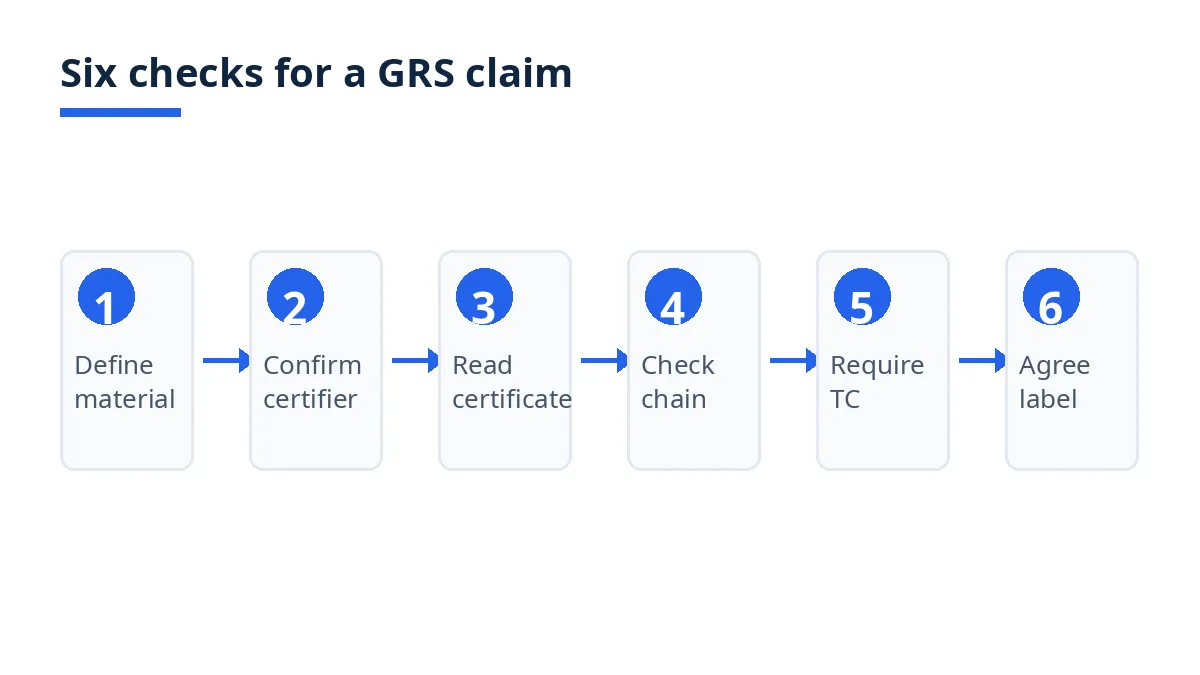
1. Define the recycled material, the source type and the percentage you need
State the material, source type and percentage in your enquiry before you ask for a price. GRS and the Recycled Claim Standard (RCS) both require third-party certification of recycled input, pre-consumer or post-consumer, with a chain of custody from source to final product.2 Pre-consumer material is material diverted from the waste stream during the manufacturing process, while post-consumer material is material generated by households or by commercial, industrial and institutional facilities in their role as end users of a product that can no longer be used for its intended purpose.5 Typical examples are fabric cutting waste on the pre-consumer side and used clothing and used plastic bottles on the post-consumer side.5
One exclusion catches buyers out. Reutilization of materials such as rework, regrind or scrap generated in a process and capable of being reclaimed within the same process that generated it is excluded from the pre-consumer definition.5 Ask the supplier to confirm that ordinary production rework is not counted as recycled content in your order.
2. Confirm the certifier is licensed for GRS
Certification to Textile Exchange standards is carried out by independent certification bodies, accredited by an authorized body and licensed by Textile Exchange.6 Check the issuing body against the published list, and confirm its GRS accreditation covers the country and stages your order needs.
3. Read the scope certificate line by line
Ask for a copy of the scope certificate, and read it for the legal name, site address, product and process categories, standard version and validity dates. Check that every step in your route appears on a scope certificate held by the company doing that step.
Current GRS certificates cite Version 4.0, and Textile Exchange states that GRS shall not appear on valid scope certificates after March 31, 2029.7 For a multi-year programme, ask the certifier what successor arrangement applies.
4. Check the chain, not just the factory
The CCS is the chain of custody for all Textile Exchange standards, and it makes sure the identity of the claimed material is maintained from feedstock to its final product.2 Certified materials are identified, separated and verified as they move through production, with documented verification and transaction records at each stage.3 Ask the supplier to show the input transaction certificates behind your order, and compare quantities: the certified quantity claimed out cannot exceed the certified quantity that came in, allowing for production loss the supplier can explain.
A factory can hold a valid scope certificate and still claim more than its input documents support. The scope certificate proves the company is certified, not that a particular shipment is certified.
5. Require a transaction certificate for the shipment
Require a transaction certificate (TC), issued by the supplier's certification body, and write that requirement into the purchase order with a timing term agreed before shipment. Read the TC against the purchase order, the invoice and the packing list for supplier, product, material, percentage, source type where stated, and quantity. If the TC names a different buyer, product or quantity, treat the shipment as unverified until the issuing certifier confirms it.
6. Agree the label claim before artwork is printed
Apply the thresholds to your exact percentage, and agree the wording before labels are printed.
Recycled content by mass | What it supports |
|---|---|
Below 20% | Not GRS certified; do not use a GRS claim |
20% to below 50% | GRS certified for business-to-business trade; GRS (no label) — no consumer-facing GRS logo |
50% or more | GRS certified, and eligible for consumer-facing GRS labelling |
For GRS certified products, the recycled content must be at or above 50% for product-related claims on final products intended for consumer sale, and claims can only be made by organizations that hold a valid scope certificate.3 A hangtag that shows the logo on a 30% product is a labelling error even when the factory is genuinely certified.
Example figures: a jacket at 60% recycled polyester by mass clears the 50% line for a consumer-facing claim, while a T-shirt blend at 30% recycled cotton is GRS certified for business-to-business trade only. The examples apply the thresholds only.
Costs, timelines and documents
There is no typical GRS certification cost a guide can state for a buyer, because certification is paid by the certified entity to its certification body, and the price depends on that entity's sites, processes and product range. Ask the factory for its own certifier quote if you are asking an uncertified factory to become certified. For a buyer, the cost question is narrower: does the factory already hold a current scope certificate, and does the TC for your shipment carry any charge the supplier passes on in the quotation.
Textile Exchange certifications require annual audits to maintain certification, and a scope certificate is issued only after audit, corrective actions and a technical review and certification decision.3 No standard processing timeline is published for a buyer to rely on, so treat any timeline in a quotation as that certifier's estimate. Write your own dates for scope validity, input TCs and the shipment TC into the purchase order.
Hold one file per order, with the same legal name on every document.
Document | What to check on it |
|---|---|
Scope certificate | Legal name, site, product and process categories, standard version, validity dates, issuing body |
Input transaction certificates | Material, source type, percentage, quantity, seller and buyer names |
Shipment transaction certificate | Product, material, percentage, quantity, buyer name, matching the purchase order and packing list |
Label artwork | Claim wording matched to the percentage band above, approved before printing |
Purchase order clause | Scope certificate and TC required, TC timing agreed, label claim stated in writing |
Bangladesh-specific rules and tips
Bangladesh routes are often split across specialist units, and GRS accreditation refers to certification bodies that conduct GRS certification for all stages in the supply chain.6 Do not accept one certificate from the garment maker as cover for recycling, spinning or dyeing done elsewhere. Ask for each unit's certificate by name, and check the process categories against the work your order needs.
Association membership is not certification. The Bangladesh Knitwear Manufacturers and Exporters Association (BKMEA), an apex trade body for the knitwear sector, was established in 1996 and currently represents approximately 2,540 knitwear member factories.8 Membership does not certify a factory under GRS and does not replace a scope certificate or a transaction certificate.
Three habits reduce failed checks in Bangladesh orders. Confirm the full route in writing before sampling, state the source type on the enquiry, and agree the TC timing in the purchase order rather than after shipment.
Mistakes and red flags
The most common mistake is accepting a logo as proof. A logo on a website header, a catalogue page or a social post is not a scope certificate, and a scope certificate alone is not proof for a shipment. The shipment proof is the transaction certificate.
Other mistakes follow the same pattern. A yarn certificate does not cover a finished garment sewn elsewhere. A consumer logo on a 30% product fails the labelling band even when the factory is certified. A claim that counts ordinary rework as recycled content fails the pre-consumer definition.5 A claim for "recycled" with no standard named cannot be checked against any threshold.
GRS and RCS are also confused with each other. RCS requires at least 5% recycled input with no processing requirements, while GRS requires 20% and adds social, environmental and chemical requirements for processing.2 A supplier holding only RCS certification cannot support a GRS claim.
Further red flags are a scanned logo alone, a certificate with the entity name or site cropped out, a certifier absent from the published list, a scope certificate expired before production, a group certificate applied to a different site, and a TC quantity smaller than the shipped quantity. A certified polybag does not certify the garment inside it, so a packaging claim must identify the packaging as the certified product.
Checklist
[ ] Recycled material, source type and percentage by mass stated in the enquiry.
[ ] Certifier confirmed on Textile Exchange's published list, licensed for GRS.
[ ] Scope certificate received, covering the order's name, site, products, processes and validity dates.
[ ] Every site in the route identified, with its own scope certificate, and input TCs supporting the claimed percentage and quantity.
[ ] Pre-consumer or post-consumer source stated, with ordinary rework excluded.
[ ] Shipment transaction certificate required in the purchase order, with timing agreed before shipment.
[ ] TC checked against the purchase order, invoice and packing list.
[ ] Label claim matched to the band: 50% or more for a consumer-facing logo, 20% to below 50% for business-to-business trade only.
[ ] Any mismatch sent to the issuing certification body before shipment release.
[ ] Membership, badges and factory tours read separately from certification, never as a substitute for it.
How Exportain helps
On Exportain, browse suppliers and post a request for quotation on the RFQ board with the recycled material, source type, percentage by mass you need, and the requirement that the supplier provide a scope certificate and a transaction certificate for the shipment. Ask each reply to name its certification body and list every site in the route.
Read the badges on a profile for what they record. Exportain Verified means Exportain has checked identity, phone, email and business registration, Export Verified means it has checked the Export Registration Certificate, and Factory Verified means it has reviewed photos of the manufacturer's factory.9 Verification is a document review by Exportain's team, not a factory inspection, and a badge is not a guarantee of production capacity, product quality or delivery.9 10 That review does not certify a factory under GRS, so the scope certificate and the TC still have to be checked through Textile Exchange and the issuing certification body.
For contrast, the GOTS guide covers organic fibre percentages and label grades, and the OEKO-TEX Standard 100 guide covers finished-article substance testing. See how supplier verification works on Exportain for the full badge list.
FAQs
What should I know first about GRS (Global Recycled Standard)?
GRS is a full product standard to verify and track recycled raw materials through the supply chain, using the chain of custody requirements of the Content Claim Standard, with processing criteria for chemicals and social and environmental production.1 A product needs at least 20% recycled content by mass to be GRS certified, and at least 50% for consumer-facing GRS labelling.2 3 Only pre-consumer and post-consumer materials count as recycled content.4
What are the typical costs and timelines?
There is no typical cost a buyer can apply to an order, because certification is paid by the certified entity to its certification body and depends on its sites, processes and product range. Textile Exchange certifications require annual audits to maintain certification.3 No standard processing timeline is published for a buyer to rely on, so treat any timeline in a quotation as the certifier's estimate.
Which documents are needed?
The documents are the scope certificate for each site in the route, the input TCs behind the order, the TC for the shipment, and label artwork matched to the percentage band.2 3 The scope certificate proves the company is certified; the TC proves the shipment is certified.
What are the most common mistakes?
The most common mistakes are accepting a logo as proof, accepting a scope certificate as shipment proof, printing a consumer logo below 50% recycled content, counting rework as pre-consumer content, accepting an RCS certificate for a GRS claim, and reading a badge or membership as certification.2 3 5 9
Next steps on Exportain
Browse suppliers, then post your recycled material, source type and required percentage on the RFQ board and ask each reply for its scope certificate, certification body, and transaction certificate terms. If your buyer also asks about organic fibre, read the GOTS guide before combining claims on one label.
Sources
- What is the Global Recycled Standard (GRS)?. Textile Exchange (accessed )
- Global Recycled Standard (GRS) and Recycled Claim Standard (RCS) Certification. Intertek (accessed )
- Textiles Exchange Suite of Services. SCS Global Services (accessed )
- Terms and Definitions for Textile Exchange Standards and Related Documents. Textile Exchange (accessed )
- Textile Exchange Textile Presentation: Definitions of reclaimed, recycled, pre-consumer and post-consumer material. Textile Exchange (accessed )
- Certification Bodies. Textile Exchange (accessed )
- Standard-Specific Details for Assurance Systems (TE-TXL-POL-204-V1.0). Textile Exchange (accessed )
- BKMEA at a Glance. BKMEA (accessed )
- Trust & Safety Center. Exportain (accessed )
- Supplier verification: Earn trust badges buyers can see. Exportain (accessed )
About the author
Sourcing from Bangladesh?
Post a request for quotation and suppliers on Exportain can send you their quotes directly.
Post an RFQ