How to Find GOTS Certified Factories in Bangladesh
How to find a GOTS certified factory in Bangladesh: check the scope certificate, the label grade and the transaction certificate, and confirm any mismatch with the issuing certifier.
Short answer
A GOTS certified factory is one whose scope certificate, issued by an approved certification body, covers the products and processing steps in your order, and whose shipment is covered by a transaction certificate. Check the factory in the GOTS public database, read the scope certificate and label grade, and confirm any mismatch with the issuing certifier.
On this page
Key takeaways
A GOTS claim needs two documents, not a logo: a scope certificate for the factory and a transaction certificate for the shipment.
Every company in the production route must be certified, including subcontractors such as dyehouses, or the final product cannot carry the label.
The label grade follows fibre content: 95% or more certified organic fibre for organic, and 70% to 94% for made with (x%) organic materials.
GOTS uses physical segregation and volume reconciliation, not a mass-balance allocation, so ask how the factory keeps GOTS goods separate from conventional goods.
An Exportain badge is a document and photo review, not a factory inspection, and it cannot stand in for a scope certificate or a transaction certificate.
A factory can be described as GOTS certified only when a named, approved certifier has certified that factory for the work it will do on your order, and when the shipment itself is covered by a transaction certificate. This guide shows how to check both documents, how to read the label grade, and where a claim usually breaks down. GOTS is the Global Organic Textile Standard, Version 7.0, released in March 2023 and effective from 1 March 2024.1
GOTS starts where organic farming ends. It covers fibre processing, wet processing, manufacturing and trading, and requires every company in a labelled product's route to be certified by an approved independent certification body.2 A fabric or yarn certificate held by a different company does not make the finished garment certified.
Why this matters for buyers and sellers
For a buyer, the risk is paying an organic premium for goods that cannot carry the claim at retail. GOTS labelling must show the logo, the correct label grade, a reference to the certification body, and the certification number of the certified entity.3 A product offered without that labelling, but with other references to GOTS, may not indicate certification of the final product.4 For a seller, the same rule protects work already done: a factory holding a scope certificate still loses the sale when a subcontractor in the route is uncertified, or when the shipment has no transaction certificate.
Two label grades decide what can be printed on the product. A product with at least 95% certified organic fibres, excluding accessories, carries the "organic" grade, and a product with at least 70% carries the "made with (x%) organic materials" grade, with the percentage stated.4 3 The in-conversion grades work the same way, at 95% or more and at 70% to 94%.3 A product needs a minimum of 70% certified organic fibre material to be certified at all, and it may not contain conventional fibres of the same organic raw material.4
Label grade | Certified organic fibre content |
|---|---|
Organic | 95% or more, excluding accessories |
Organic in-conversion | 95% or more in-conversion fibres |
Made with (x%) organic materials | 70% to 94%, percentage stated |
Made with (x%) organic in-conversion materials | 70% to 94% in-conversion fibres, percentage stated |
GOTS is not an organic cotton standard, and it does not certify raw cotton itself: organic raw fibres must be certified by an accepted external organic certification before they enter the GOTS chain of custody.3 Phrases such as "GOTS cotton" and "made with GOTS-certified fabric" are not correct claims when only one component is certified, and fabric sewn in an uncertified facility breaks the chain of custody, so the final product is not considered certified.3
Step-by-step: how it works
A pass on one check does not cover a failure on another.
1. Search the public database
Start with the GOTS public database, which lists GOTS certified entities along the whole supply chain, with their location, fields of operation and certified products, searchable by individual parameters.5 Entries are updated frequently by approved certification bodies, and if information is missing, the database page directs the reader to the certification body directly.5 Compare the listed name and location with the company that sent the quotation. A database entry is a starting point, not proof itself: GOTS states that database entries cannot be used as definitive verification, and that the scope certificate copy on the company database entry is the appropriate proof.4
2. Confirm the certifier is approved, and note its scopes
Certification must come from a GOTS approved certification body. The approved list is published by Global Standards, with each body's approved scopes and countries of operation.6 Scope 1 covers mechanical processing and manufacturing, Scope 2 covers wet processing and finishing, Scope 3 covers trading, and Scope 4 covers approval of textile auxiliary agents, or chemical inputs, for the positive list.7 A dyehouse needs Scope 2 coverage, a garment maker needs Scope 1, and a trader needs Scope 3.
3. Read the scope certificate line by line
Ask the supplier for an electronic copy of its scope certificate, issued by a GOTS approved certifier.4 The scope certificate, also called a Certificate of Compliance, authorises a processor or manufacturer to accept orders for GOTS compliant work within its certified scope, and authorises a certified trader to trade in GOTS textile products within its scope.4 Read it for the exact legal name, the issuing certifier, the listed products and steps, and the validity dates. Then check that every step in your route appears on a scope certificate held by the company doing that step, and request the missing company's certificate if one step is absent.
4. Read the label grade against your fibre content
Compare the fibre content in your tech pack with the grade the supplier proposes to print. A blend at 80% certified organic cotton cannot carry the "organic" grade, because that grade needs 95% or more.4 3 It can carry "made with 80% organic materials" if the rest of the chain is certified and the other fibres are permitted. Also check the no-blending rule: the product may not contain conventional fibres of the same organic raw material, so conventional cotton cannot sit beside organic cotton in the same GOTS product.4 Ask the supplier to state the grade in writing on the quotation, so the purchase order and the label agree.
5. Require a transaction certificate for the shipment
The scope certificate proves that a company is certified. It does not prove that a particular shipment is certified.4 For that, request a transaction certificate (TC), issued by the supplier's GOTS certifier, which lists the specific products and shipment details, including the buyer's name and address.4 GOTS advises buyers that they may make TC issuance for each purchase a contractual condition.4 Put that condition in the purchase order, with a named date: TC required before shipment release, or as part of the post-shipment compliance file. If a TC is in doubt, ask the entity's certifier to verify its validity.4
6. Confirm with the certifier when anything does not match
If the database entry, the scope certificate and the TC do not agree, stop and ask the issuing certifier. GOTS states that certification status may be confirmed by contacting the issuing approved certifier, and that the same route applies to a TC.4 Use contact details from the approved certifier list rather than an address printed on a document you already doubt. A mismatch in name, product, quantity or validity date is a reason to pause the order, not a detail to clear after shipment.
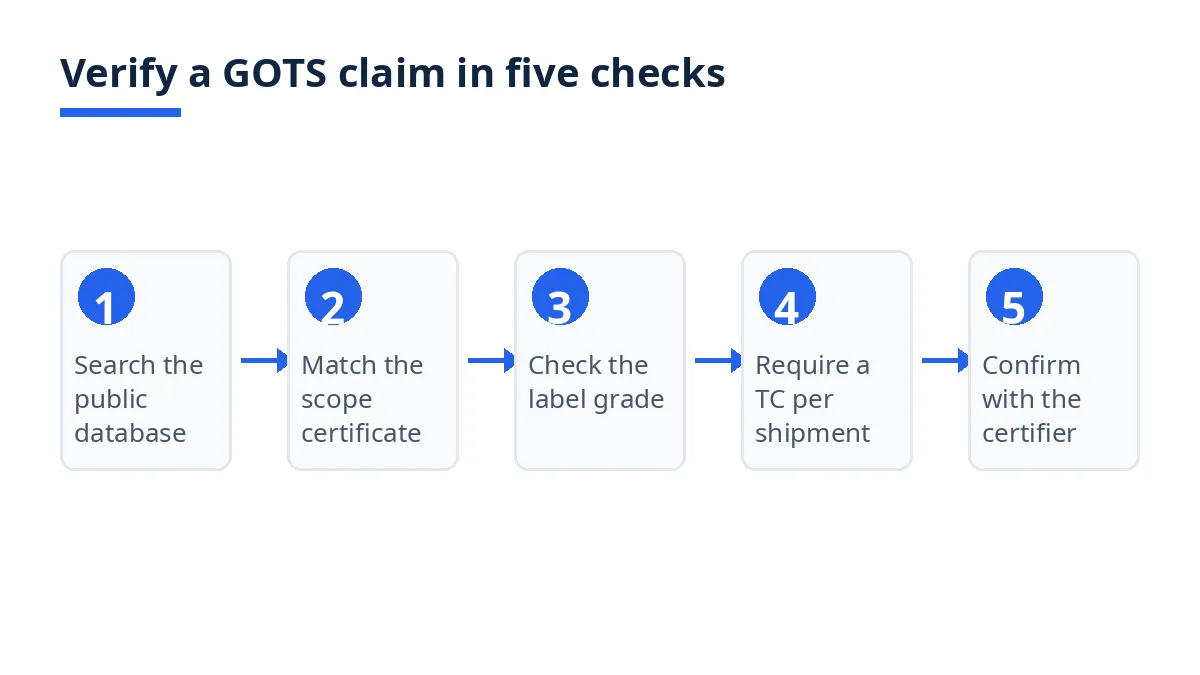
The five checks in order:
Costs, timelines and documents
Certification costs depend on the number of locations, the size and type of the entity, and the range of products under the scope of certification.4 As a rough estimation, entities with one facility can expect an annual certification cost ranging between 1,200 and 3,000 euro, and approved certification bodies will give an individual estimate on the data the applicant provides.4 In addition, each certified entity must pay an annual fee for GOTS of 180 euro for each facility inspected, collected by the approved certifier and transferred to GOTS.4
Buyers should not read those figures as the price of their order: the certification cost is paid by the certified entity to its certifier. A buyer who asks for a GOTS order from an uncertified factory should expect the factory to need its own certification first, with its own application, inspection, review and decision. GOTS gives no standard processing timeline in its published questions, so any timeline in a quotation is that certifier's estimate, not a GOTS promise.
Bangladesh-specific rules and tips
Bangladesh routes are often split across specialist units: a garment maker, a separate dyehouse and a separate fabric supplier, each needing its own scope certificate. Do not accept a single certificate from the garment maker as cover for dyeing done elsewhere. Ask for the dyehouse certificate by name, and check its scope against the wet processing your order needs.
Association membership is not certification. The Bangladesh Knitwear Manufacturers and Exporters Association describes itself as an apex trade body for the knitwear sector, established in 1996, representing approximately 2,540 knitwear member factories.8 Membership of BKMEA, or of any trade association, does not certify a factory under GOTS or replace a scope certificate. Use association directories to find candidates, then run the GOTS checks on each one separately.
Three habits reduce failed checks. First, confirm the subcontracting route in writing before sampling, because a route that moves after sampling can move the order to an uncertified unit. Second, ask whether the supplier's certifier has a local representative that can answer a query.4 Third, agree the TC timing in the purchase order rather than after shipment.
GOTS uses physical segregation and volume reconciliation to protect product integrity across processing and trading stages, rather than a mass-balance allocation in which certified and non-certified material are mixed and the certified share is assigned on paper.2 Ask how the factory keeps GOTS goods separate from conventional goods, and whether its records reconcile inputs with outputs for the order.
Mistakes and red flags
The most common mistake is accepting a logo as proof. A logo on a website header, a catalogue page or a social post is not a scope certificate, and GOTS signs must appear only in direct association with certified products or certification-related content.3 A second mistake is accepting a certificate for the wrong step: a yarn certificate for a finished garment, or a fabric certificate for a garment sewn elsewhere. GOTS states that label use is not permitted when certification is valid only for intermediate products such as yarn or fabric, and that the whole value chain and the final product must be certified first.4
Other red flags follow the same pattern: a scanned logo alone, a certificate with the entity name cropped out, a certifier absent from the approved list, or a grade that does not match the fibre content, for example "organic" on a 70% blend. A TC that arrives late, names a different buyer, or covers a different quantity should be treated as unverified until the issuing certifier confirms it. A "GOTS cotton" claim should be corrected at once, because GOTS certifies processing of goods made with organic fibres, not the raw cotton itself.3
Checklist
[ ] Supplier found in the GOTS public database, name and location matching the quotation.
[ ] Certifier confirmed on the approved list, with scope coverage for each step in the route.
[ ] Scope certificate received, with products, steps and validity dates covering the order.
[ ] Every subcontractor identified, with its own scope certificate where it performs a GOTS step.
[ ] Label grade checked: 95% or more for "organic", 70% to 94% for "made with (x%) organic materials".
[ ] No conventional fibre of the same organic raw material in the blend.
[ ] Label artwork shows the logo, grade, certifier reference and certification number.
[ ] Transaction certificate required in the purchase order, with timing agreed before shipment.
[ ] TC checked against the order, invoice and packing list for entity, product, quantity and fibre content.
[ ] Any mismatch sent to the issuing certifier before shipment release.
How Exportain helps
On Exportain, browse suppliers and post a request for quotation on the RFQ board with the product, the fibre content, the label grade you need, and the requirement that the supplier provide a scope certificate and a transaction certificate for the shipment. Ask each reply to name its certifier and to list every subcontractor in the route.
Read the badges on a profile for what they record. Exportain Verified means Exportain has checked identity, phone, email and business registration, Export Verified means it has checked the Export Registration Certificate, Factory Verified means it has reviewed photos of the manufacturer's factory, and Trading Company Verified means it has reviewed photos of the trading company's office or warehouse.9 Verification is free, never granted by membership plans, and is a document and photo review, not a factory inspection.9 10 That review does not certify a factory under GOTS, so the scope certificate and the TC still have to be checked through GOTS and the issuing certifier.
For help finding a certifier, the certification services category lists certification bodies for standards such as GOTS, OEKO-TEX, ISO 9001, BSCI and Sedex, although the category page notes that no services are published in that category yet. For a different check, the OEKO-TEX Standard 100 guide covers a label that tests the finished article for harmful substances, a different question from the organic chain-of-custody question GOTS answers.
FAQs
What should I know first about GOTS?
GOTS is a processing standard for textiles made with organic fibres, not a test on a finished garment and not a raw cotton standard. A product needs at least 70% certified organic fibre to be certified at all, 95% or more for the "organic" grade, and 70% to 94% for the "made with (x%) organic materials" grade.4 3 Every company in the route must be certified before the final product can carry the label.2
What are the typical costs and timelines?
There is no typical cost a buyer can apply to an order, because certification is paid by the certified entity to its certifier. GOTS gives a rough estimation of 1,200 to 3,000 euro per year for a single-facility entity, plus a 180 euro annual fee per inspected facility.4 GOTS publishes no standard processing timeline, so treat any timeline in a quotation as the certifier's estimate.
Which documents are needed?
The documents are the scope certificate for each company in the route, the transaction certificate for the shipment, the label artwork showing the logo, grade, certifier and certification number, and the fibre and input records behind the order.4 3 The scope certificate proves the company is certified; the TC proves the shipment is certified.
What are the most common mistakes?
The most common mistakes are accepting a logo as proof, accepting a certificate for the wrong step in the chain, printing a grade that does not match the fibre content, and treating a marketplace badge as a certification.4 3 9 A further mistake is using "GOTS cotton" as a claim, since GOTS certifies processing, not the raw fibre itself.3
Next steps on Exportain
Browse suppliers, then post your product, fibre content and required label grade on the RFQ board and ask each reply for its scope certificate, its certifier, and its transaction certificate terms. Before you confirm an order, check the certification services category as a starting point for approved certifiers, and read the OEKO-TEX Standard 100 guide if your buyer also asks for finished-article substance testing.
Sources
- Global Organic Textile Standard (GOTS) Version 7.0. Global Standard gGmbH (accessed )
- GOTS – How the system works. Global Standards, (accessed )
- GOTS Labelling. Global Organic Textile Standard (GOTS) (accessed )
- Frequently Asked Questions on GOTS Certification. Global Organic Textile Standard (accessed )
- Certified Suppliers Database. Global Standards (accessed )
- Approved Certification Bodies. Global Standards (accessed )
- GOTS Organic Textile Standard Certification Services. USB Certification (accessed )
- BKMEA at a Glance. BKMEA (accessed )
- Trust & Safety Center. Exportain (accessed )
- Supplier verification: Earn trust badges buyers can see. Exportain (accessed )
About the author
Sourcing from Bangladesh?
Post a request for quotation and suppliers on Exportain can send you their quotes directly.
Post an RFQ