How to Find OEKO-TEX Standard 100 Certified Factories in Bangladesh
No logo proves an OEKO-TEX Standard 100 claim: how to run the Label Check, read certificate scope and product class, and confirm a Bangladesh factory certificate covers your order.
Short answer
OEKO-TEX Standard 100 certifies that every component of a textile article, from fabric and threads to dyes, finishes and zips, has been tested for harmful substances under the product class for its end use. To find a certified factory in Bangladesh, ask for the certificate and label number, run the OEKO-TEX Label Check, and confirm that the holder, scope, class and validity cover your article.
On this page
Key takeaways
Standard 100 is awarded only when every component of an article, including threads, linings, dyes, finishes, prints and accessories, meets the criteria without exception.
The product class must match the end use: Class I for babies up to three years, Class II for direct skin contact, Class III for limited skin contact, and Class IV for furnishing materials.
Run the Label Check with the label number exactly as printed, case-sensitive, without the institute name, and match the holder, scope and class to your order.
Certificates are valid for one year, so confirm validity covers your production window and ask for the renewed certificate if expiry falls inside it.
A marketplace badge is a document and photo review, not a factory inspection, and it is not a substitute for a Standard 100 certificate.
A supplier can print the words OEKO-TEX Standard 100 on a quotation, a hangtag or a website, and that print alone proves nothing. The claim is only useful when you can trace it to a certificate, read what it covers, and confirm that it is still valid. This guide shows how to do that check for factories in Bangladesh, before you place an order.
OEKO-TEX Standard 100 is an independent testing and certification system for textile raw materials, semi-finished products and finished products at all stages of processing, as well as their accessories, confirming that products have been tested for harmful substances in accordance with scientific criteria.1 Laboratory tests cover substances prohibited or restricted by law, known chemicals of health concern, and other substances that pose a potential health risk, and the criteria and limit values depend on the product type and materials and, above all, on its intended use.1
The certificate and label are only awarded if all components of an item meet the required criteria without exception. For a finished garment, that includes the outer fabric, sewing threads, lining, dyes, finishes and prints, and non-textile accessories such as buttons, rivets or zips.1 A product may not be labelled with Standard 100 if only individual components meet the requirements, for example only the zips or only the lining of a jacket.1 That rule is why a component claim and a finished-product claim differ, and why the scope matters more than the logo.
The stricter the skin contact and the more sensitive the skin, the stricter the requirements, so Standard 100 divides products into four product classes.1
Product class | Covers | Bangladesh example |
|---|---|---|
Class I | Textiles and materials for babies and young children up to three years of age | Baby rompers, infant bedding |
Class II | Textiles and materials whose surface comes into direct contact with the skin | T-shirts, underwear, bed linen, towels, shirts |
Class III | Textiles and materials whose surface comes into direct contact with the skin only to a limited extent | Jackets, coats, outdoor textiles |
Class IV | Furnishing materials for decorative purposes | Table linen, curtains, upholstery fabrics |
Standard 100 on its own does not certify organic fibre origin. OEKO-TEX has a separate ORGANIC COTTON standard, with its own chain of custody from ginning through processing, for cotton verified as organic.2 It also does not audit production conditions: OEKO-TEX STeP assesses responsible production conditions, and MADE IN GREEN combines Standard 100 with STeP.1 For an organic or working-conditions claim, ask for the certificate for that claim, not the Standard 100 certificate.
Why this matters for buyers and sellers
For a buyer, the value of a Standard 100 claim is that it can be checked before money moves. A certificate number, a scope and a validity date give you three facts to confirm, rather than a logo to take on trust. For a seller, the system is modular: certification is possible at every stage of the value chain, and raw materials already certified to Standard 100 are recognised at later stages, reducing testing effort for the finished item.1 Each stage can hold its own certificate, so the buyer must still check the one covering the finished article being ordered.
Consider an example order, not a real factory case. A buyer orders baby rompers and accepts a Class II T-shirt certificate from the same factory group, on the grounds that both are cotton garments. That certificate does not cover the rompers, and it does not meet the Class I requirements for babies and young children up to three years of age.1 The order fails the check even though a genuine certificate exists. Match the class to the article you are actually buying, every time.
Step-by-step: how it works
The verification workflow has one public tool at its centre; the rest is careful reading of the certificate against your order.
Shortlist by article, not by logo. Use the OEKO-TEX Buying Guide, a free, global online directory of certified products, manufacturers and brands, to find candidates for your product type.1 A directory listing is a starting point, not a substitute for checking the certificate for your order.
Ask for the certificate document and the label number. Ask for the full certificate, not a screenshot of a logo or a hangtag photograph alone. The label number is the key to the public check.
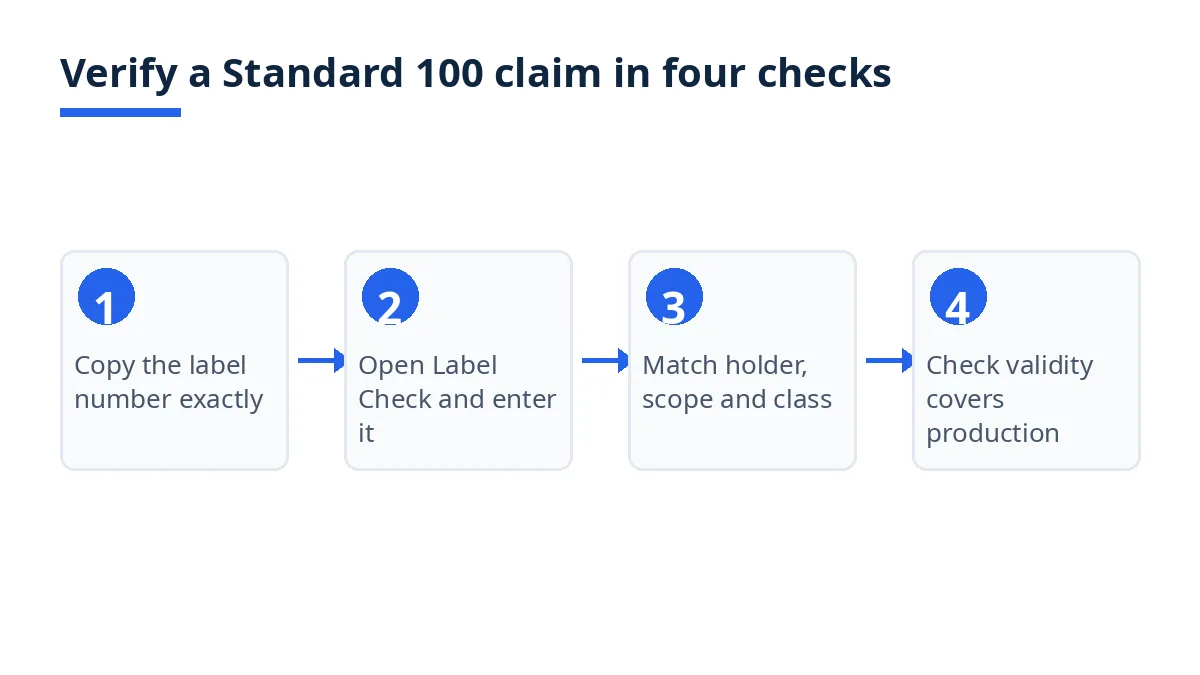
Run the Label Check with the number exactly as printed. OEKO-TEX provides a Label Check tool3 for verifying certification validity by entering the label number.2 Enter it with case-sensitive characters, special characters and blank spaces, and do not include the name of the testing institute.2 If the product is advertised as certified, the packaging or the product itself should feature the label with the unique product ID.2
Match the holder to the company you are buying from. Compare the holder name on the Label Check result and the certificate with the legal name of the quoting company. If the names differ, ask in writing how the quoting company is covered, and do not proceed on a verbal explanation.
Read the scope line by line. Confirm that the certified articles listed cover your article type, components and finish. A certificate for woven fabric does not automatically cover a knitted garment, and a certificate for one article does not cover a different article from the same factory. If a print, coating or zip you care about is not in the scope, ask for the certificate that covers it.
Check the class against the end use. Confirm that the product class matches the skin contact of your article, using the four-class table above.1 A lower class than your end use requires is a mismatch, even when the certificate is genuine and current.
Check validity across your production window. OEKO-TEX certificates are valid for one year, and materials covered by a certificate are retested in partner laboratories for renewal.2 An "under review" status means renewal is in progress, with samples reviewed and tested for the next one-year term.2 Confirm that the certificate covers the period when your goods are produced, and ask for the renewed certificate if expiry falls inside that window. Keep the Label Check result and the certificate copy with the purchase order.
Costs, timelines and documents
What are the typical costs and timelines?
There is no single fee a guide can state for Standard 100 certification, because the cost structure has two parts and both vary. The costs generally consist of an annual licence fee and laboratory testing costs, which depend on the material and complexity of the product, such as fibres, yarns, dyed or finished fabrics, ready-to-wear garments and accessories, and the criteria for its intended use.1 A seller seeking certification therefore needs a quote based on its own application, not a figure from a guide.
For timing, once the application and samples are received and all queries resolved, the process usually takes up to four weeks, depending on sample complexity.1 To keep a certificate continuous, the renewal application should be submitted three months before expiry.1 For a buyer, the practical question is whether the supplier's current certificate covers your production window, and whether a renewal is already in progress.
Which documents are needed?
The buyer-side document set is short. Ask for the certificate document itself, the label number for the Label Check, and written confirmation that the scope and product class cover your article. Certification itself starts with an application form and representative production samples for laboratory testing, and passing samples are summarised in a detailed test report.1 After a successful inspection, the company must confirm in writing that series production complies with the tested samples and demonstrate a quality assurance system that holds that quality through the validity period.1 You do not need the test report to run the Label Check, but asking whether series production matches the tested samples is reasonable for a large order or a baby article.
Write the certificate number, product class and scope reference into the purchase order.
Bangladesh-specific rules and tips
Association membership is sometimes presented alongside certification claims. Keep the two checks separate. The Bangladesh Knitwear Manufacturers and Exporters Association (BKMEA), established in 1996, is the apex trade body for the knitwear sector and represents approximately 2,540 knitwear member factories.4 BKMEA membership signals a knitwear business, and it also addresses environmental and labour standard issues in its member factories.4 Membership does not certify any article under Standard 100, and a Standard 100 certificate does not prove BKMEA membership. Confirm membership with the association itself, and certification through the Label Check.
Three habits reduce errors. First, keep one legal name across the quotation, the certificate holder name, the purchase order and the payment account, and investigate any mismatch before production. Second, when production is split across sites, ask which site the certificate covers, in writing. Third, do not accept a factory tour, a sample garment with a sewn-in label, or a buyer reference as a substitute for the Label Check. Each can be genuine and still leave the certificate question unanswered. See the sustainable knitwear guide for how certification claims sit alongside other sustainability claims for knitwear from Bangladesh.
Mistakes and red flags
What are the most common mistakes?
Trusting a logo without a label number. A logo can be copied onto a hangtag. Without a label number, the claim cannot be run through the Label Check, and an unverifiable claim should be treated as no claim until the number is produced.2
Accepting a component certificate for a finished article. A certificate covering fabric, thread or zips alone does not entitle the finished garment to the label.1 Read the scope for the finished article, including prints, finishes and accessories.
Accepting the wrong product class. A Class III certificate for outerwear does not support a Class II claim for a T-shirt, and a Class II certificate does not support a Class I claim for baby articles.1 The class must match the end use, not the factory.
Ignoring expiry and renewal status. A certificate valid for one year can lapse during a long production run.2 Check the validity dates, note an "under review" renewal status, and ask for the renewed certificate before shipment if expiry falls inside the window.2
Accepting another company's certificate. If the holder name does not match the quoting company, the certificate belongs to someone else until coverage is shown in writing. A group name or a shared building does not transfer certification.
Reading a marketplace badge as a product certification. On Exportain, verification is a document and photo review by staff, not a factory inspection, and a badge is not a guarantee of capacity, quality or delivery.5 A badge and a Standard 100 certificate answer different questions.
Skipping the written record. A Label Check remembered loosely cannot be repeated by a colleague or a retailer months later. Save the result, the certificate copy and the scope confirmation with the order.
Checklist
Before you confirm an order that relies on a Standard 100 claim, every line should be answered in writing.
Certificate document received, not only a logo or hangtag photograph.
Label number entered in the Label Check exactly as printed, case-sensitive, without the institute name.2
Holder name matches the quoting company, or coverage is shown in writing.
Scope covers your article type, components, prints, finishes and accessories.1
Product class matches the end use: Class I for babies up to three years, Class II for direct skin contact, Class III for limited contact, Class IV for furnishing materials.1
Validity covers the production window, or renewal is confirmed in writing.2
Certificate number, class and scope reference written into the purchase order.
Membership claims, if any, confirmed with the association separately.4
Renewed certificate attached to the order file if renewal happens during production.
Marketplace badges read for what they record, not as product certification.5
How Exportain helps
On Exportain, browse suppliers and post your article specification, product class and certificate requirement on the RFQ board, so replies can be compared on the same article and class. Ask each reply for the certificate document and label number, then run the Label Check yourself before accepting a quotation.
Read the badges for what they record. Exportain Verified means Exportain has checked identity, phone, email and business registration, and Export Verified means it has checked the Export Registration Certificate (ERC).5 Factory Verified means it has reviewed photos of the manufacturer's factory.5 Verification is a document and photo review by staff, free, never granted by membership plans, and not a factory inspection.5 6 See how supplier verification works on Exportain for the full badge list.
FAQs
What should I know first about OEKO-TEX Standard 100?
Standard 100 is an independent testing and certification system for textile products at all stages of processing, confirming that products have been tested for harmful substances.1 The label is only awarded when all components of an item meet the criteria without exception, including threads, linings, dyes, finishes, prints and accessories such as buttons and zips.1 Products fall into four classes by skin contact, from Class I for babies up to three years to Class IV for furnishing materials.1 On its own, it does not certify organic fibre origin or audit production conditions.1 2
What are the typical costs and timelines?
Certification costs generally consist of an annual licence fee plus laboratory testing costs, which depend on the material and complexity of the product, so a single typical fee cannot be stated.1 Once the application and samples are received and queries resolved, the process usually takes up to four weeks depending on sample complexity.1 Certificates are valid for one year, with renewal applications recommended three months before expiry.1 2
Which documents are needed?
A buyer needs the certificate document, the label number for the Label Check, and written confirmation that the scope and product class cover the ordered article. Certification itself uses an application form and representative production samples, with passing samples summarised in a test report, and the company confirming in writing that series production matches the tested samples.1 Write the certificate number, class and scope reference into the purchase order, and keep the Label Check result with it.
What are the most common mistakes?
The most common mistakes are trusting a logo without a label number, accepting a component certificate for a finished article, accepting the wrong product class, ignoring expiry or renewal status, and accepting another company's certificate.1 2 A further mistake is reading a marketplace badge as product certification: Exportain verification is a document and photo review, not a factory inspection.5
Next steps on Exportain
Browse suppliers, then post your article, product class and certificate requirement on the RFQ board so suppliers reply against the same specification. You can also browse the certification-body services category.
Sources
- OEKO-TEX STANDARD 100 for textiles tested for harmful substances. Hohenstein (accessed )
- FAQ. OEKO-TEX (accessed )
- OEKO-TEX Label Check. OEKO-TEX (accessed )
- BKMEA at a Glance. BKMEA (accessed )
- Trust & Safety Center. Exportain (accessed )
- Supplier verification: Earn trust badges buyers can see. Exportain (accessed )
- supplier verification
- buyer guide
- Bangladesh sourcing
- bangladesh garments
- OEKO-TEX Standard 100
- Factory certification
About the author
Sourcing from Bangladesh?
Post a request for quotation and suppliers on Exportain can send you their quotes directly.
Post an RFQ