How to Find BSCI / amfori Certified Factories in Bangladesh
BSCI / amfori is a social-compliance audit, not a product certificate: the Code of Conduct principles, the A to E audit ratings, zero-tolerance findings, and how to check audit evidence for a Bangladesh factory site before you order.
Short answer
A BSCI / amfori audited factory is a site audited against the amfori BSCI Code of Conduct and given an A to E rating, not a factory holding a product certificate. Ask for the audit report or platform summary for the exact site, check the rating, audit date and validity, the Performance Areas with findings, and any follow-up audit, and confirm the zero-tolerance position before you order.

On this page
Key takeaways
Amfori BSCI is a social-compliance audit program, not a product certification: a site is audited against the Code of Conduct and given an A to E rating, not a material or product certificate.
Ratings run from A (Very Good) to E (Unacceptable) across 13 Performance Areas, with A or B valid for two years and C, D, or E valid for a maximum of 12 months, with a follow-up audit between two and 12 months.
There is no public factory directory for BSCI ratings, so verification means asking for the platform report or summary for the exact site and reading the rating, date, scope, and findings.
Zero-tolerance findings, such as bonded and forced labor, trigger a rapid alert within 24 hours and need a remediation position with verified follow-up before a buyer treats the finding as closed.
Exportain supplier verification is a document and photo review, not a factory inspection, and a badge is not a guarantee of capacity, quality, or delivery.
A supplier sends a one-page summary with a letter grade, no site address, and no audit date, and calls the factory BSCI certified. That page is where most BSCI mistakes start.
Start with the correction. Amfori BSCI is a social-compliance audit program, not a product certification. A factory site is audited against the amfori BSCI Code of Conduct, and the audit produces a rating and a report. It does not certify a product, a material, or a shipment. The process is a verification: it evaluates the extent to which an organization meets the Code, and the output is a report on the amfori Sustainability Platform to share with linked buyers.1
There is no public directory for searching a factory name and reading its BSCI rating. Amfori states that it cannot publish data from audit reports, for legal reasons around proprietary and personal information, while it does publish a list of current members.2 Verification therefore runs through evidence, not lookup: ask the supplier for platform evidence for the exact site, or work through a linked member who can view the report.
Why this matters for buyers and sellers
For a buyer, the risk is ordering on a social claim never tested at the site that will make the goods. A sample can show fabric, stitching, and print. It cannot show working hours, wage records, grievance handling, or safety practice. An audit tests those areas through interviews, document review, and site observation, and records the result by Performance Area. For a seller, one audit shared through the platform can serve several linked buyers.
Keep BSCI in its own lane. The GOTS guide covers a whole-chain organic textile standard, the OCS guide covers organic content and chain of custody, the OEKO-TEX Standard 100 guide covers substance testing of a finished article, and the GRS guide covers recycled content. A BSCI audit answers none of those questions.
The overall rating is generated from ratings across 13 Performance Areas, and auditors do not know it until submission.3
Rating | Meaning | Result |
|---|---|---|
A | Very Good | At least seven areas rated A, no area rated C, D, or E. No follow-up audit needed. |
B | Good | At most three areas rated C, no area rated D or E. No follow-up audit needed. |
C | Acceptable | At most two areas rated D, no area rated E. Remediation plan due within 60 days; follow-up envisaged. |
D | Insufficient | At most six areas rated E. Remediation plan due within 60 days; follow-up envisaged. |
E | Unacceptable | At least seven areas rated E. Remediation plan due within 60 days; follow-up envisaged. |
Validity follows the rating: A or B audits are valid for two years. C, D, or E audits are valid for a maximum of 12 months, provided two full audits never span more than two years. For C, D, or E, a follow-up audit is required between two and 12 months later; if missed, a full audit is required instead.3
The Code rests on five core values, cooperation, empowerment, code observance, protection of vulnerable persons, and transparency, through 13 principles: social management system and cascade effect, workers involvement and protection, freedom of association and collective bargaining, no discrimination, violence or harassment, fair remuneration, decent working hours, occupational health and safety, no child labor, special protection for young workers, no precarious employment, no bonded, forced labor or human trafficking, protection of the environment, and ethical business behavior.4 The Code draws on International Labour Organization conventions and the UN Guiding Principles on Business and Human Rights.4
Step-by-step: how it works
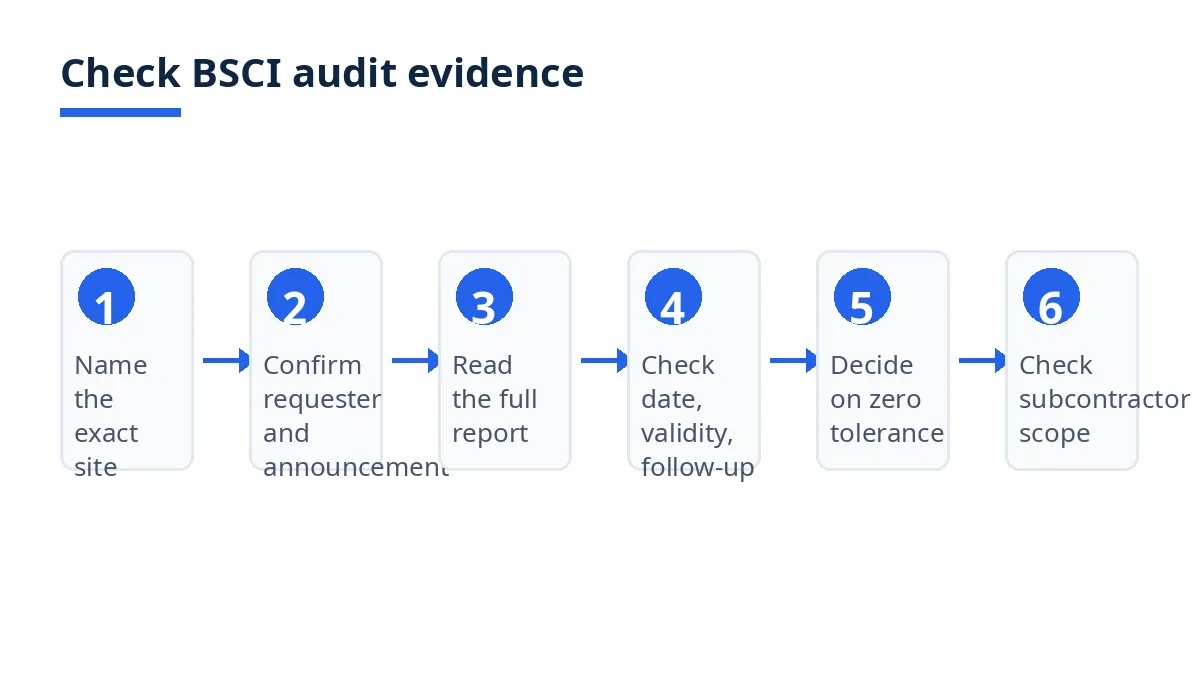
1. Name the exact site first
For a one-site audit, the scope usually corresponds to one legal entity at one location.3 Ask for the legal name, site address, and production unit name as it appears in the report. A company cannot transfer one unit's rating to another unit. A narrow one-site exception requires proven physical and workforce separation, and the audited unit clearly named in the platform.3
2. Confirm who requested the audit and how it was announced
Only suppliers working with an amfori BSCI member can be audited under the Code, and the member decides which supplier is audited and when, and can specify an auditing company.5 Only the Responsibility holder can request and schedule an audit, through the platform only.3
Announcement types are fully announced, semi-announced, and unannounced. Semi-announced is the default: the producer knows an audit will take place but not the date.3
Since July 2, 2025, a business partner linked to at least one amfori member can also directly request monitoring for its own site, provided no linked member has already initiated it, linked members do not cancel within five days, and the partner pays directly.6 The evidence is still the platform report for the exact site.
3. Read the full report, not the letter
An on-site audit begins with an opening meeting, then confidential interviews, review of employment contracts and working time and payroll records, comparison with actual conditions, a site tour, and documentation on the platform. It usually takes one to three days, and the report is available within two weeks.5
Auditors cross-check worker interviews, documents, and site observations.3 Each question is answered YES, NO, or PARTIALLY.3 Crucial questions in child labor, bonded labor, and occupational health and safety have the greatest impact on the area rating.3 Read the area ratings, not only the overall letter.
4. Check the date, the validity, and the follow-up position
A rating without a date is incomplete.3 For a C, D, or E result, ask for the remediation plan and follow-up date. Follow-up audits focus only on areas that need new evidence.3 At least two months should pass before a follow-up where new records are needed, particularly for remuneration and working hours.3
5. Treat zero-tolerance findings as a separate decision
Zero-tolerance behavior refers to human rights violations and business behavior that may endanger audit independence, distinguished from regular findings. When severe violations such as bonded and forced labor are detected, the auditor triggers a rapid alert within 24 hours, amfori and linked members are notified, and the aim is collaborative remediation.2
Do not average a zero-tolerance finding away with strong scores elsewhere. Ask what was found, what action was taken, what the plan covers, and whether a follow-up audit has verified the change. If the supplier cannot answer, pause the order until the linked member or auditing company confirms the position in writing.
6. Check subcontractors and the cascade
Members commit to operate under the Code, and suppliers must ensure their subcontractors also comply with it.5 The first Performance Area, social management system and cascade effect, covers whether the site spreads the Code through its supply chain.3 4 Ask which processes are subcontracted and whether those sites fall inside the scope. A rating for a cutting and sewing unit does not cover a dyeing or printing subcontractor never in scope.
Costs, timelines and documents
Amfori does not prescribe who pays for an audit or how much it costs. Every auditing company defines its own service rate, while amfori sets the minimum audit length.3 Treat any fee quoted as a quote for a specific site, worker count, and scope, not as a market rate.3
Use this sequence for planning. The member or Responsibility holder requests the audit through the platform, the supplier signs the Code and Terms of Implementation and completes a self-assessment.5 The on-site audit runs for one to three days, the report is available within two weeks, a plan is due within 60 days for a C, D, or E result, and a follow-up audit falls between two and 12 months later, inside a two-year cycle.3 5 A producer should have been in business for at least three months before an audit.3
Request this set for each order:
Audit report or platform summary for the exact site: name, address, date, overall and area ratings.
Remediation plan for any C, D, or E result, with follow-up date and result.
Auditing company name and announcement type.
Scope note: one site or unit, and subcontracted processes inside or outside scope.
Written zero-tolerance statement and remediation status, where one exists.
Example rating cases, illustrative only, not named factories: a site rated A needs no follow-up audit, with its next full audit at the two-year cycle end. A site rated C with findings in working hours and occupational health and safety must produce a plan within 60 days, faces a follow-up audit between two and 12 months later, and holds a result valid for a maximum of 12 months. A site with a zero-tolerance alert cannot be cleared by a marketing letter; it needs remediation work and a verified follow-up position.
Bangladesh-specific rules and tips
There is no separate Bangladesh version of the Code.
First, do not read a BSCI rating as a building safety approval. Amfori states that an auditor is not expected to conduct building integrity inspections beyond the mandate of a social auditor, although the auditor reports a general description of the premises.2 Agree building or fire safety checks separately.
Second, check the unit, not the group. The one-site exception turns on physical and workforce separation.3 Ask for the unit name, address, and confirmation that no workforce exchange links it to an unaudited unit.
Third, use the Bangladesh footprint as context, not as proof. As of April 2023, amfori reported 718 members sourcing from Bangladesh and 1,781 business partners registered in Bangladesh, with 77 percent in textile, apparel, and luxury goods.2 That does not prove any single factory is audited.
Fourth, plan for language and workforce data. The auditing company establishes workforce languages and gender ratio and hires translators as needed.5 3 For a large factory, confirm duration and interview sample fit the site size.
Mistakes and red flags
What are the most common mistakes?
Calling the audit a product certification. A BSCI audit tests workplace practice at a site. It does not test fiber content, recycled content, or chemical safety. If a supplier offers a BSCI letter as proof of organic, recycled, or substance-tested material, ask for the separate material evidence.
Accepting a logo, a cropped summary, or a screenshot. A logo can be copied, and a cropped page can hide the site, date, or area findings. Ask for the full report or platform summary, and check name, address, date, rating, and findings against your order.
Accepting company evidence for a different site. A rating for one unit, a head office, or a parent company does not cover a different unit. Check the scope note and unit name.3
Accepting an expired result. An A or B result older than two years, or a C, D, or E result older than 12 months, is out of validity. A missed follow-up deadline means a full audit is required instead.3
Treating a self-assessment as an audit. Voluntary tools, including the self-assessment questionnaire, do not result in a rating and do not affect the audit cycle.3
Treating a good rating as permanent. A rating is a dated snapshot for one site and one scope. It does not guarantee quality, delivery, capacity, or building safety.
Ignoring the remediation and follow-up position. A C, D, or E rating without a plan within 60 days and a follow-up date is an open finding. A zero-tolerance alert without a remediation position is a pause signal.2
Checklist
Before you confirm, answer every line in writing.
Exact site: legal name, site address, production unit.
Requester confirmed: Responsibility holder, or self-requested route for a linked partner since July 2025.
Full report or platform summary on file, not a logo or cropped page.
Rating, area ratings, audit date, announcement type recorded.
Validity checked: A or B within two years, C, D, or E within 12 months.
Remediation plan on file for any C, D, or E result, due within 60 days, follow-up date set.
Zero-tolerance position in writing, with alert, remediation, verified follow-up.
Scope checked: subcontracted processes named, inside or outside scope.
Material, substance, quality, building safety claims checked separately.
How Exportain helps
Exportain supplier verification is a document and photo review, not a factory inspection, and it is not a check against any government database. A badge is not a guarantee of capacity, quality, or delivery.7 Verification is free, staff review every submission, and membership plans never grant a trust badge.8
Post a free RFQ on Exportain and state the BSCI position you need: exact site, rating, date, area findings, remediation and follow-up position, and scope for subcontracted processes. Ask each reply to attach the audit report or platform summary for that site, rather than a logo. Read how verification works at Seller Verification and Trust Center. The certification services category currently states "No services published in this category yet", so treat that page as a category reference only, not as a listing of certifiers or auditors.
FAQs
What should I know first about BSCI / amfori?
Know first that BSCI / amfori is a social-compliance audit program, not a product certification. A site is audited against the Code, given an A to E rating across 13 Performance Areas, and reported on the amfori platform.1 3 There is no public factory directory.2
What are the typical costs and timelines?
There is no standard cost, because amfori does not prescribe who pays or how much an audit costs, and each auditing company sets its own rate.3 For timelines, plan on a request three or four months in advance, an on-site audit of one to three days, a report within two weeks, a plan within 60 days for a C, D, or E result, a follow-up audit between two and 12 months, and a full audit at the two-year cycle end.3 5
Which documents are needed?
You need the audit report or platform summary for the exact site, showing name, address, date, overall and area ratings, and scope; the remediation plan and follow-up result for any C, D, or E result; the auditing company name and announcement type; and a written zero-tolerance position where an alert exists.3 5 2
What are the most common mistakes?
The most common mistakes are calling the audit a product certification, accepting a logo or cropped summary, accepting evidence for a different site, accepting an expired rating, treating a self-assessment as an audit, and ignoring the remediation and follow-up position.1 3 2 Each is avoidable by reading the full platform report for the exact site.
Next steps on Exportain
Post a free RFQ on Exportain at RFQs, stating the site, rating, date, and follow-up position you need. Read Seller Verification and Trust Center, then ask each reply for the full report or platform summary for the exact site.
Sources
- amfori BSCI Verification – Responsible Supply Chain Management. TÜV NORD (accessed )
- amfori response to Human Rights Watch on BSCI monitoring, zero tolerance and Bangladesh. amfori (accessed )
- amfori BSCI System Manual Part II. amfori (accessed )
- What Is the BSCI Code of Conduct? Everything You Need to Know. QIMA (accessed )
- The 6 Steps of an Amfori BSCI Supply Chain Audit. TÜV Rheinland (accessed )
- Amfori BSCI audit. TÜV Rheinland (accessed )
- Trust & Safety Center. Exportain (accessed )
- Supplier verification: Earn trust badges buyers can see. Exportain (accessed )
About the author
Sourcing from Bangladesh?
Post a request for quotation and suppliers on Exportain can send you their quotes directly.
Post an RFQ