How to Find OCS (Organic Content Standard) Certified Factories in Bangladesh
OCS verifies organic content only: the OCS 100 and Blended thresholds, the scope and transaction certificate checks, and the mistakes that break an organic claim on a Bangladesh order.
Short answer
An OCS certified factory is one whose scope certificate, issued by a licensed certification body, covers the products and processes in your order, and whose shipments carry a matching transaction certificate. OCS verifies organic content only, not processing, social, or environmental criteria, so check the label grade, the full chain of holders, and both certificates before you order.
On this page
Key takeaways
OCS verifies organic material content and its chain of custody only; it does not cover processing chemicals, environmental performance, or social criteria.
OCS 100 requires at least 95% certified organic material, while OCS Blended covers at least 5% and less than 95%; a no-label category covers in-conversion material that cannot be labeled.
Every holder from the first post-harvest processor to the final business-to-business seller must be certified, including subcontractors for dyeing, printing, and sewing.
A scope certificate proves a holder is certified, while a transaction certificate for the shipment proves the goods in it are certified; both must match the purchase order and invoice.
Exportain supplier verification is a document and photo review, not a factory inspection, and a badge is not a guarantee of capacity, quality, or delivery.
A factory that shows you an OCS document has not necessarily shown you what you think it has. The Organic Content Standard (OCS) answers one narrow question: how much of the material in a product is verified organic material, and can that amount be traced through each holder in the chain. It does not answer how the factory treats workers, handles wastewater, or which chemicals it uses. That distinction is where most OCS mistakes begin.
The standard, developed by Textile Exchange, focuses exclusively on tracing organic content through the supply chain. Unlike GOTS, it imposes no chemical restrictions or social audits; it verifies the presence and quantity of organic matter in a final product and traces raw materials from origin to final product.1 If your buyer also needs processing, environmental, or social criteria checked, OCS alone will not cover them.
Why this matters for buyers and sellers
For a buyer, the risk is paying an organic price for material that cannot be traced. A garment looks identical whether its cotton came from a certified organic farm or a conventional one, and neither a sewn-in label nor a factory tour can settle the question. Only the paper chain can: the scope certificate showing a holder is certified, and the transaction certificate tying a shipment to certified material. For a seller, the risk runs the other way: a factory that buys certified yarn but sends it for dyeing or sewing at an uncertified subcontractor can lose the claim.
OCS is a content claim, not a product quality claim: it says nothing about hand feel, color fastness, or durability, and does not replace sample approval, fabric testing, or finished-goods inspection. It sits beside, not instead of, neighboring checks: the GOTS guide covers a whole-chain organic textile standard with processing criteria, while the OEKO-TEX Standard 100 guide covers substance testing of a finished article.
Label grade | Certified organic content required | What it can be used for |
|---|---|---|
OCS 100 | At least 95% certified organic material | Almost entirely certified organic material |
OCS Blended | At least 5% and less than 95% certified organic material | Mixed product with certified organic material alongside other fibers |
OCS (no label) | At least 5% in-conversion material | Business-to-business tracking only; not eligible for labeling |
Textile Exchange lists OCS 100 at 95% or more and OCS Blended from 5% up to less than 95%, with a separate no-label category for in-conversion material at 5% or more.2 A certification body states the same split plainly: OCS 100 needs a 95% minimum of certified organic fiber, and OCS Blended covers products mixed with a 5% minimum.3 A T-shirt at 96% organic cotton and 4% elastane can sit in OCS 100 territory, while the same shirt at 60% organic cotton is an OCS Blended product, even if its organic cotton is genuine. The label must follow the percentage. Note too that 10% in-conversion cotton plus 90% organic cotton takes the OCS Blended category, per a Textile Exchange example.2 If your buyer wants only fully organic material, say so in writing; a Blended label does not promise it.
Step-by-step: how it works
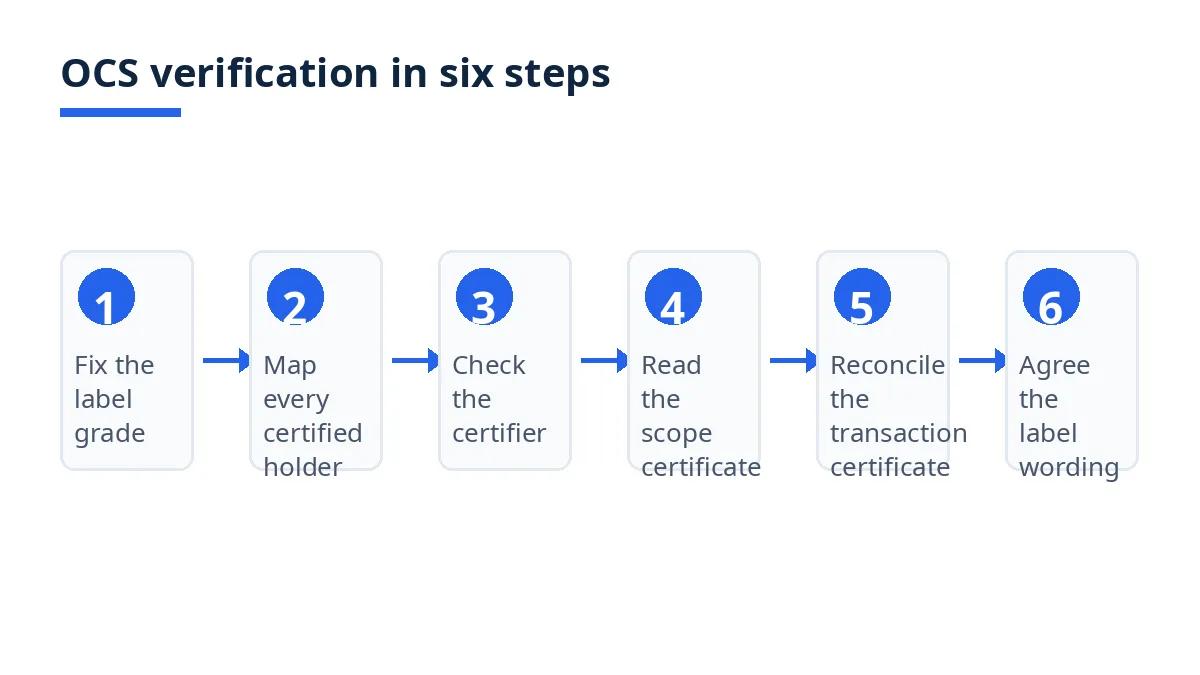
1. Fix the label grade before sampling
Write the grade into your tech pack and request for quotation: OCS 100, OCS Blended, or no consumer label. State the material, percentage required, and whether in-conversion material is acceptable. A factory cannot choose the grade after fabric is bought, because the grade follows the material actually purchased and tracked.
2. Map every holder from first processor to final seller
OCS requires all organizations in a supply chain to be certified from post-harvest processing sites through to the seller in the final business-to-business transaction; the retailer does not need to be certified.4 First post-harvest sites can include ginning for cotton, retting for bast fibers, boiling and washing cocoons for silk, and scouring for wools.4 Ask the factory to list every holder, including subcontractors for spinning, dyeing, printing, and sewing. If any holder is uncertified for the product and process you need, the chain breaks there.
3. Check that the certification body is licensed for OCS
Certification is carried out by independent certification bodies, accredited by an authorized accreditation body and licensed by Textile Exchange.5 Open the Textile Exchange certification bodies list and confirm the body on the certificate is listed for OCS and for the holder's country.5 A certificate from an unlicensed body is unproven until that body confirms it; a website logo is no substitute.
4. Read the scope certificate line by line
A scope certificate proves a holder is certified; it does not prove any particular shipment is certified. Read the holder's legal name, site address, product categories, process categories, claims category, and validity dates against your order. A garment-manufacturing certificate does not cover dyeing at a different site, and a parent company certificate does not cover a subsidiary factory unless that site is listed. The holder must hold a valid scope certificate at production for its products to be considered certified.4 If it expired before production or covers a different category, ask the certification body to confirm before you proceed.
5. Reconcile the transaction certificate for the shipment
Transaction certificates document each time OCS product changes ownership; the seller applies for one with the certification body, and the consignee should check that the packaging, invoice, bill of lading, and transaction certificate agree on receipt.4 Check seller name, buyer name, product description, composition, and quantity against the purchase order and invoice. A certificate naming a different seller, product, or larger quantity is a mismatch to resolve, and where its quantity is smaller than the shipment, only the certificated quantity carries the claim.
6. Agree the label wording before artwork is printed
Agree only label wording matching the claims category on the scope and transaction certificates. OCS 100 and OCS Blended carry different logos, and a no-label product cannot be labeled at all.2 Confirm wording, percentage where required, and certification body reference before artwork is printed, since reprinting after production is slow and costly. If your buyer also requires a GOTS or OEKO-TEX claim on the same garment, agree each separately; one certificate never supports another standard's label.
Costs, timelines and documents
No standard fee or timeline applies to OCS certification, so this section gives structure rather than figures. Any number a factory or agent quotes is a quote for a specific scope, not a market rate; ask what it includes before comparing it with another quote.
A quote is shaped by sites to be audited, products and processes in scope, transaction certificates likely to be needed, and whether any holder still needs certification before production. A single-site order is a different audit task from a multi-site order with subcontracted dyeing and several shipments. A certification body describes its process as application review, then a detailed proposal covering services, estimated timelines, and budget, with the audit scheduled once the proposal is signed.1 Plan on that sequence: application, proposal, audit, certificate, then transaction certificates per shipment.
Timelines follow the same logic: no audit until scope is agreed, and no transaction certificate behind a shipment that moved without a valid scope certificate. Build certification into your calendar at sampling, not after bulk fabric is booked. Certification is renewed annually, so last year's certificate may no longer be valid; always check current validity dates.4
Request for each order: the scope certificate for every holder, with product and process categories visible; the certification body listing showing the body is licensed for OCS; the transaction certificate for each shipment, matched to purchase order and invoice; the input documents behind it; and the agreed label artwork, showing claims category and certification body reference. Keep the full set on file: if a buyer later asks how the claim was checked, the file is your answer.
Bangladesh-specific rules and tips
There is no separate Bangladesh version of OCS. It applies globally, to sites in the supply chain of products not intended for consumption as food or feed, and covers products with at least 5% organically grown material, excluding accessories and trimmings.1 What is specific to Bangladesh is how production is organized, and that creates the checks that matter most.
First, confirm which site a certificate covers: a group may hold one for one factory while your order is sewn at another site, and a trading company may hold a trading certificate while manufacturing sits elsewhere. Match its site address to the site that will make your goods. Second, keep one legal name across quotation, scope certificate holder name, purchase order, transaction certificate, and payment account, and investigate any mismatch before production. Third, when a factory subcontracts dyeing, printing, or embroidery, ask whether that subcontractor is certified for the process, and if not, how the claim will be preserved. A vague answer at sampling becomes a failed claim at shipment.
Association membership is a separate check from certification. The Bangladesh Knitwear Manufacturers and Exporters Association (BKMEA), the apex trade body for the knitwear sector, was established in 1996 and represents approximately 2,540 knitwear member factories.6 Membership signals a knitwear business; it does not certify any product under OCS, and an OCS certificate does not prove membership. Confirm membership with the association, and certification through the certification body.
Two habits help on Bangladesh orders: ask for transaction certificate terms in the quotation, including who applies, when it will be issued, and what happens if a shipment date moves past scope validity; and put the certified site for each process in writing in the purchase order, so a later site change is a decision you approve rather than a change you discover after shipment.
Mistakes and red flags
What are the most common mistakes?
The most common mistake is treating a scope certificate as proof for a shipment: only a transaction certificate for that shipment shows its goods are certified. The second is treating OCS as whole-factory approval: it certifies material content and chain of custody, not chemicals, water treatment, or labor practices. The third is reading a percentage loosely: 60% organic cotton is not an OCS 100 product, and labeling it as though it were 100% organic misstates the claim even when the organic cotton is genuine.
Other mistakes read a document for more than it says: a cropped certificate hides categories, site, and validity dates; a certificate in a different legal name assumes a group relationship that may not exist; a logo file assumes a current certificate; and a transaction certificate mismatching the invoice assumes a match the documents do not support. Each can be checked in minutes, and each becomes expensive once goods have shipped.
Pause on any factory that will not share the full scope certificate, a certificate past its validity dates, a certification body absent from the Textile Exchange list for OCS, a transaction certificate from a different body without explanation, or a label grade mismatching the tech pack percentage. None proves wrongdoing alone, but each leaves the claim unproven until the certification body confirms holder, scope, and dates.
Checklist
Label grade fixed in writing, with in-conversion material accepted or excluded
Every holder mapped, from first processor to final business-to-business seller, including subcontractors
Certification body confirmed on the Textile Exchange list for OCS and each holder's country
Scope certificate read in full: legal name, site, product and process categories, claims category, validity dates
Transaction certificate requested for each shipment, with applicant and timing agreed in the quotation
Transaction certificate reconciled to purchase order and invoice: seller, buyer, product, composition, quantity
Label wording and logo agreed before artwork, matching the claims category
Certified site for each process written into the purchase order
Full document set filed with the purchase order
How Exportain helps
Exportain can help you find suppliers and structure the conversation, but it does not certify factories and does not replace the checks in this guide. Supplier verification is a document review by Exportain staff, not a factory inspection, and not a check against any government database.7 Verification is free, each check is reviewed by staff, approved checks earn trust badges, and membership plans never grant a trust badge.8 A badge is not a guarantee of capacity, quality, or delivery.7 Shortlist suppliers and post a detailed request on Exportain, then run the scope and transaction certificate checks yourself, or through the certification body, before confirming.
FAQs
What should I know first about OCS (Organic Content Standard)?
Know first that OCS verifies organic material content and its chain of custody, and nothing else. It applies to non-food products with 5% to 100% organic material, requires certification from post-harvest processing to the final business-to-business seller, and uses two label grades: OCS 100 for at least 95%, and OCS Blended for 5% to less than 95%.1 2 4 Remember the two-document rule: a scope certificate proves the holder is certified, and a transaction certificate proves the shipment is certified.
What are the typical costs and timelines?
There is no published standard cost or timeline for OCS certification, so treat every figure as a quote for a specific scope. Costs and timelines depend on sites, products and processes in scope, and transaction certificates needed, and a certification body sets them out in a proposal after reviewing the application.1 Plan certification at sampling stage, check validity at production and shipment, and remember certification is renewed annually.4
Which documents are needed?
You need the scope certificate for every holder, the Textile Exchange listing confirming the certification body is licensed for OCS, the transaction certificate for each shipment, the input documents behind it, and the agreed label artwork. The scope certificate must be valid at production, and the transaction certificate must match the purchase order and invoice on seller, buyer, product, composition, and quantity.4 5 Keep the full set with the purchase order.
What are the most common mistakes?
The most common mistakes are treating a scope certificate as shipment proof, treating OCS as approval of a factory's chemicals or labor practices, and labeling a blended product as though it were 100% organic. Others are accepting a cropped certificate, a certificate in a different legal name, or a transaction certificate mismatching the invoice. Each is avoidable by reading the full documents and confirming any mismatch with the certification body before shipment.
Next steps on Exportain
Browse suppliers, then post your material, required percentage, and label grade on the RFQ board and ask each reply for its scope certificate, certification body, and transaction certificate terms. The certification services category currently shows no services published in that category yet, so use it only as a category reference, not as a listing of certifiers, and run the checks in this guide before confirming any order.
Sources
- OCS – Organic Content Standard. Control Union (accessed )
- Standard-Specific Details for Assurance Systems (TE-TXL-POL-204-V1.0). Textile Exchange (accessed )
- Organic textile certification (OCS). Ecocert (accessed )
- Organic Content Standard Questions and Answers. Textile Exchange (accessed )
- Certification Bodies. Textile Exchange (accessed )
- BKMEA at a Glance. BKMEA (accessed )
- Trust & Safety Center. Exportain (accessed )
- Supplier verification: Earn trust badges buyers can see. Exportain (accessed )
About the author
Sourcing from Bangladesh?
Post a request for quotation and suppliers on Exportain can send you their quotes directly.
Post an RFQ