Wholesale Live Eels From Bangladesh: Prices, MOQ and Reliable Suppliers
Wholesale live eels from Bangladesh, bought by grade line: per-line MOQ, box counts, tiers, assortment balancing, live-transport terms and mortality allowances, with the documents and supplier checks for a repeat programme.
Short answer
Wholesale live eels from Bangladesh are bought as grade lines, not as one total weight. Each line needs its own size band, per-line minimum, box count and live-arrival term, flown on a rhythm the market can sell through. Compare suppliers only on the same lines, the same box counts and the same delivery term, and run a trial flight on the planned split before locking a programme.
On this page
Key takeaways
Wholesale live eels are bought as grade lines, each with its own size band, per-line minimum, box count and live-arrival term, not as one total weight.
Trial, regular and programme tiers differ in minimums, notice periods and holding reservation, and a lower programme price must name the term that changed.
Assortment shares should follow sell-through per line, with an anchor line for volume and a capped premium line for margin.
Mortality must be counted live, weak and dead per line at arrival, with the inspection window, evidence and settlement method agreed before dispatch.
Exportain verification is a document and photo review, not a factory inspection, and a badge is not a guarantee of capacity, quality or delivery.
A wholesale live eel programme from Bangladesh is a set of grade lines run on a flight rhythm, not one large shipment repeated. Each line has its own size band, minimum, box count and arrival count, and the programme only pays when every line sells through before the next flight lands. Ordering by total weight alone finds the fault too late: one line falls short of its minimum and is dropped or surcharged, while another arrives in a quantity the market cannot sell before holding losses rise.
Live eels fall under HS subheading 030192, live eels of Anguilla species.1 That fixes the customs description, not the commercial structure, which is set line by line before the first flight. Live fish transport is a stress problem first: fish in a small volume of water face handling stress, oxygen demand rising with temperature, density and time since feeding, and ammonia that starving before packing helps to slow.2
Why this matters for buyers and sellers
For a buyer, the channel decides working capital and waste together. Live eels cannot be held like frozen stock, so a shipment larger than the selling window becomes holding cost and post-arrival loss, while one smaller than the flight minimum becomes a high freight cost per kilogram. The balance is struck per grade line, because large, medium and small grades sell at different speeds and prices. A shipment balanced only by total weight can leave the large grade unsold while the medium grade runs out.
For a seller, the channel decides whether holding capacity can be committed. Holding, grading and packing run against a flight departure, and each line must reach its own minimum before packing starts. A seller accepting a mixed order without line minimums must either hold eels longer while waiting for one line to fill, which weakens them, or pack short on that line, breaking the agreed split.
Step-by-step: how it works
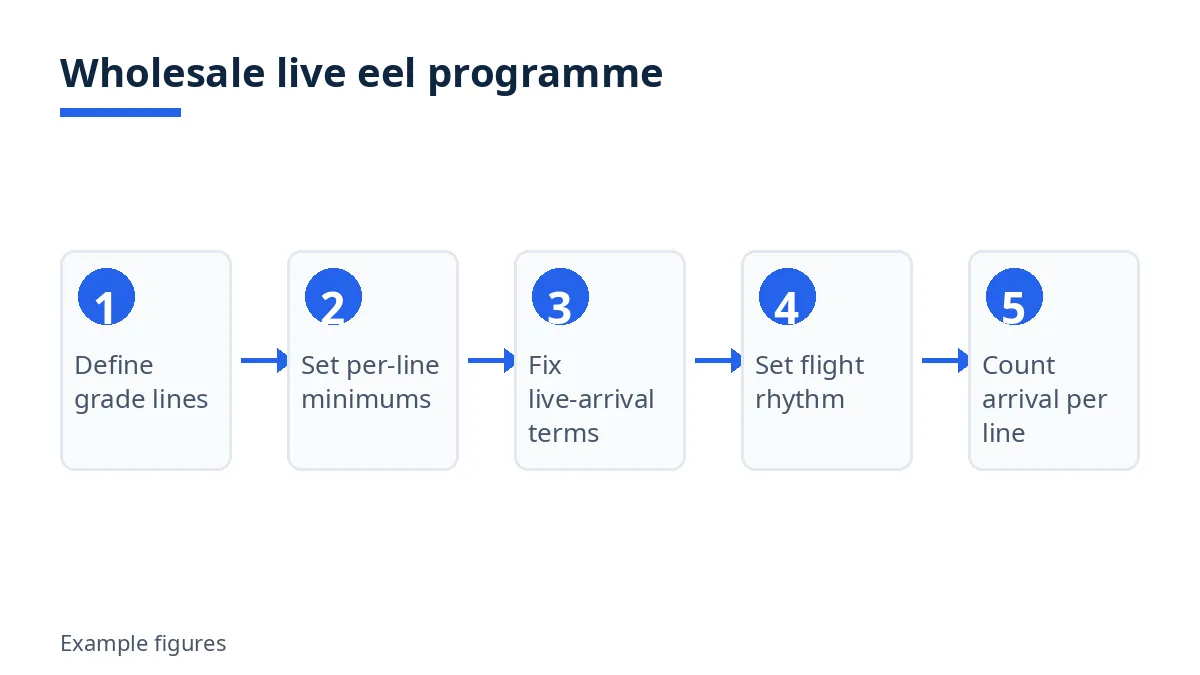
Define the grade lines. Write each line separately: species with its scientific name, size band, measurement method, tolerance at the band edges, and customer group. A line is a product with its own price, not a description of a mixed box.
Ask for a minimum per line. Record the minimum, box size and kilograms per box for each line. A shipment total clearing the supplier minimum can still fail on one line.
Choose a tier and state what it changes. Trial, regular and programme tiers differ in minimums, notice periods and holding reservation. Do not let a tier label replace its written terms.
Balance the assortment before you price it. Assign each flight share by sell-through speed, not availability alone. The anchor line carries volume, the premium line carries margin at a slower speed, and the everyday line carries frequency.
Fix the live-transport terms per line. State the packing method, maximum transit time, live-arrival share, inspection window, evidence for a mortality claim, and whether settlement is a credit, a replacement or a price adjustment.
Set the replenishment rhythm against flight days. Agree flight weekdays, the order confirmation deadline before departure, and how the order changes if one line is short that week.
Run a trial on the wholesale split. Place the trial in the same line split as the planned repeat order, not as a single premium line. A premium-only trial proves nothing about the lines carrying most of the volume.
Count arrival per line and reset the rhythm. Record live, weak and dead counts per line at arrival, compare them with the agreed term, and adjust the next quantity per line before the next flight.
Wholesale tiers and what each tier changes
Tier | What is fixed | What changes for the buyer |
|---|---|---|
Trial | One or two flights on the planned split | Tests the split and arrival count; no holding reservation |
Regular | Weekly or fortnightly flights, standing quantities | Quantities move only within an agreed band; short lines follow a written rule |
Programme | Standing holding reservation for agreed lines | Notice period for changes; a lower price must name the term that changed |
Per-line quantities by eel size and grade
Example figures: the table below shows structure only. It is not a typical MOQ, price or lead time for live eels from Bangladesh, and no line in it should be quoted as a market figure.
Grade line | Size band in the example | Example per-line minimum | Example box count |
|---|---|---|---|
Large table grade | 500 g and above per eel | 100 kg per flight | 10 kg per box, 10 boxes |
Medium restaurant grade | 300 g to below 500 g per eel | 150 kg per flight | 10 kg per box, 15 boxes |
Small everyday grade | Below 300 g per eel | 100 kg per flight | 10 kg per box, 10 boxes |
In this example the shipment totals 350 kg, yet no line can be judged from that total. If the large line delivers only 60 kg, it fails its own minimum even though the other lines are full, and the written short-line rule decides the response: hold the flight, substitute within an agreed band, or drop the line and reprice the freight.
Costs, timelines and documents
What should I know first about live eels?
Know the lines, flight rhythm and arrival term before discussing price. The Department of Fisheries e-certification system covers licences, health certificates, additional certificates set to the importing country's requirements, sample collection, inspection, test reports and certificate issuance, connected to customs.3 A quotation naming no species, grade bands, packing method or arrival term cannot be compared with one that does, whatever its price.
What are the typical costs and timelines?
There are no typical costs or timelines a guide can state as fact, because each supplier prices its own holding, grading, packing, freight and delivery term for your lines. The Incoterms 2020 rules provide 11 rules with a clear allocation of cost, risk and obligations,4 so compare quotations only on the same rule and named place. Use the structure below to compare like with like; every figure in it is an example, not a market price.
Cost or time element | What to ask for | Example figures |
|---|---|---|
Eel price per line | Price per kilogram, per line, on one delivery term4 | Example figures: large grade higher per kilogram than small grade, by a stated gap |
Packing and boxes | Box count per line, kilograms per box | Example figures: 10 kg per box, 35 boxes per flight |
Freight | Air freight per kilogram or per flight, same term4 | Example figures: freight quoted per flight |
Mortality allowance | Live-arrival share per line, settlement method | Example figures: 95 live per 100 at arrival, settled as credit |
Timeline stages | Holding, fasting, grading, packing, flight, clearance | Example figures: order confirmed 5 days before flight, arrival counted within 6 hours of landing |
Ask for holding, grading, packing, flight and clearance dates as separate lines, not a single delivery week. Transport planning should cover vehicle and equipment, route and weather, duration, and emergency procedures,5 and fish should not be loaded until documentation is complete.5
Which documents are needed?
For export clearance in Bangladesh, goods may not be loaded unless an export declaration, the Bill of Export or Shipping Bill, is submitted to Customs and approved.6 Enclosed documents include the export contract or purchase order where there is no export letter of credit, the commercial invoice, the packing list, the EXP form certified by an authorized dealer, and a certificate of origin issued by the EPB or a Chamber of Commerce and Industry.6 For live eels, confirm the exact certificate for your market with the supplier and your import authority, because the Department of Fisheries system issues additional health certificates set to the importing country's requirements.3 The transport log should record the consignment, transport plan, route, water exchanges, expected arrival and receiver contacts, and be available to the dispatcher, receiver and aquatic animal health service on request.5
Bangladesh-specific rules and tips
Use the e-certification route for your market's certificate. The Department of Fisheries e-certification system covers licences, health certificates and additional certificates set to the importing country's requirements, with sample collection, inspection, test reports and certificate issuance, directly connected to customs.3 Ask the supplier to name the certificate type and issuing office in writing.
Keep one legal name across every paper. The export declaration names the exporter and the foreign buyer,6 so the name on the trade licence, quotation, proforma invoice and payment account should match. A mismatch with the exporter name on the Bill of Export is a clearance delay, and for live cargo also a mortality risk.
Confirm destination-market rules per species and per market. Rules for live aquatic animals are species- and market-specific, so never assume approval for one market or species covers another. Ask your import authority for the current requirement for the exact species and grade, and put it, with its certificate name, into the purchase order.
Plan packing around water, not boxes alone. Water quality, including oxygen, carbon dioxide and ammonia levels, pH, temperature and salinity, should be appropriate for the species and transport method, with monitoring equipment where the journey requires it.5 Ask for the packing specification per line: water volume, biomass, temperature range, fasting period and maximum transit time.
Mistakes and red flags
What are the most common mistakes?
Ordering by total weight only. The binding minimum is per line. An order can clear the shipment total and still fail on one grade, which then carries a surcharge, substitution or removal that changes the assortment.
Comparing prices on different lines or terms. A lower price on a mixed grade, a different box size or a different delivery term is a different offer. Compare only replies to the same lines, box counts and Incoterm.4
Counting mortality against the shipment total. Mortality counted only in total hides which line failed. Count live, weak and dead per line at arrival, within the agreed inspection window, with the evidence the contract requires.
Accepting a tier label without its terms. A trial, regular or programme label means nothing until the quotation states the per-line minimum, notice period, holding reservation and short-line rule behind it.
Treating a profile or a badge as a capacity check. A badge records a document and photo review, not a factory inspection, and it is not a guarantee of capacity, quality or delivery.7
Red flags include a quotation naming only eel with no species, no box counts per line, an arrival term counting only dead animals with no window for weak animals, a packing specification copied across grades, and a certificate with no issuing office or market attached. Any one of these is a reason to pause and ask for the missing line in writing.
Checklist
Before you confirm a wholesale programme, every line should be answered in writing.
Species and source water named on the quotation, invoice and packing list, with HS 030192 on the customs description.1
Grade lines defined by size band, measurement method, tolerance and customer group.
Minimum, box size and kilograms per box confirmed per line, not per shipment.
Tier selected with its minimum, notice period, holding reservation and short-line rule in writing.
Assortment shares set per line from sell-through, with the anchor line identified.
Packing specification per line: water volume, biomass, temperature, fasting period, maximum transit time.2 5
Live-arrival share, inspection window, evidence and settlement method agreed per line.
Flight days, order confirmation deadline and short-line procedure agreed.
Export set agreed: Bill of Export, invoice, packing list, EXP form, certificate of origin, market health certificate.3 6
Quotations compared on the same lines, box counts and Incoterm.4
Trial flight run on the planned split, with arrival counted per line before the programme is locked.
How Exportain helps
On Exportain, browse suppliers and post a request for quotation (RFQ) on the RFQ board with your grade lines, box counts, flight rhythm and live-arrival term, so suppliers quote against the same structure. Ask each reply for its per-line minimum and short-line rule, on one delivery term.4 When you accept a quotation, Exportain creates one order and issues one proforma invoice from the accepted terms.7
Read the badges for what they record. Exportain Verified means Exportain has checked identity, phone, email and business registration, and Export Verified means it has checked the Export Registration Certificate (ERC).7 Factory Verified means it has reviewed photos of the manufacturer factory, while Trading Company Verified means it has reviewed photos of the trading company office or warehouse.7 Verification is a document and photo review by staff, not a factory inspection, and membership plans never grant a trust badge.8 A badge is not a guarantee of capacity, quality or delivery,7 so the trial flight and per-line arrival count remain your controls. See how supplier verification works on Exportain, the live eels quality control checklist and the HS code for live eels guide.
FAQs
What should I know first about live eels?
Start with the structure, not the price: grade lines, box counts, flight rhythm and per-line arrival term, plus the species and certificate your market requires. Live eels are classified under HS 030192,1 and the Department of Fisheries system issues certificates set to the importing country's requirements.3
What are the typical costs and timelines?
No typical cost or timeline can be stated, because holding, grading, packing, freight and the delivery term differ by supplier and line. Compare quotations on the same lines and Incoterm,4 ask for each timeline stage as a separate date, and treat guide-table figures as examples.
Which documents are needed?
The order documents are the line specification, quotation and purchase order, with the per-line minimum, box counts and arrival term on both. The export set is the Bill of Export, invoice, packing list, EXP form certified by an authorized dealer, and certificate of origin issued by the EPB or a Chamber of Commerce and Industry,6 plus the market-specific health certificate.3
What are the most common mistakes?
The most common mistakes are ordering by total weight, comparing prices on different grades or terms,4 counting mortality only in total, accepting a tier label without its terms, and reading a badge as a guarantee.7 Put the lines, rhythm and arrival term in writing before the first flight.
Next steps on Exportain
Browse suppliers, then post your grade lines, box counts and live-arrival term on the RFQ board so suppliers quote on the same structure. Before you confirm, read how supplier verification works on Exportain and the MOQ definition guide.
Sources
- Classification Detail — HS Code 030192, live eels (Anguilla spp.). United Nations Statistics Division (accessed )
- Training Manual on Marine Finfish Netcage Culture in Singapore — Live fish transportation. Food and Agriculture Organization (FAO) (accessed )
- Bangladesh rolls out online certification system to simplify fish and seafood trade. International Collective in Support of Fishworkers (ICSF) (accessed )
- Incoterms® 2020. International Chamber of Commerce (ICC) (accessed )
- Welfare of Farmed Fish During Transport. World Organisation for Animal Health (accessed )
- Customs Clearance Procedures for Export. Bangladesh Customs, National Board of Revenue (accessed )
- Trust & Safety Center. Exportain (accessed )
- Supplier verification: Earn trust badges buyers can see. Exportain (accessed )
About the author
Sourcing from Bangladesh?
Post a request for quotation and suppliers on Exportain can send you their quotes directly.
Post an RFQ