Wholesale Hoodies and Sweatshirts From Bangladesh: Prices, MOQ and Reliable Suppliers
Source wholesale hoodies and sweatshirts from Bangladesh: specification, factory checks, MOQ, price drivers, HS 6110 duty and quality control for buyers.
Short answer
To source wholesale hoodies and sweatshirts from Bangladesh, write a specification covering fabric blend, type and GSM, hood and pocket construction, print placements and sizing, then shortlist knitwear factories and compare quotes on that identical specification. Verify the supplier's documents and fleece capability, agree the MOQ split by colour, approve a pre-production sample in production fabric, classify the garments under heading 6110, and inspect packed goods before shipment.
On this page
Key takeaways
Hoodies and sweatshirts are knitted garments that classify under HS heading 6110, split by fibre into 6110.20 for cotton and 6110.30 for man-made fibres.
BGMEA reports around 4,500 member factories, around 40 percent of them knitwear and sweater manufacturers, accounting for more than 95 percent of sweater exports.
There is no single typical price, MOQ or lead time: price is driven by fabric type, blend and GSM, print or embroidery, construction, per-colour quantity and compliance.
The UK tariff lists a 12.00 percent third country duty on the main 6110 cotton and man-made fibre lines, while EU entries from Bangladesh can be duty-free under Everything But Arms when origin is proved.
Approve a pre-production sample in production fabric, wash and re-measure it, and inspect packed goods against a sealed counter-sample under an ISO 2859-1 AQL plan agreed in advance.
Buying wholesale hoodies and sweatshirts from Bangladesh is a knitwear purchase, and it rewards the same discipline as any fleece program: a precise specification, quotes compared on identical fabric, a supplier checked on documents and capability, samples approved in production fabric, and an inspection agreed before bulk starts. This guide is for brands, retailers, importers and sourcing agents in the United States, the United Kingdom, the European Union and the United Arab Emirates. It covers scope, factory checks, minimum order quantity (MOQ), price drivers and classification under heading 6110.
Wholesale hoodies and sweatshirts in Bangladesh: scope, fabrics and fits
A hoodie is a sweatshirt with a hood: the shared base garment is a knitted pullover with long sleeves, a ribbed hem and cuffs, a crew neckline on the sweatshirt, and a hood, drawcord and kangaroo pocket on the hooded version. Both are sewn from knitted fabric, most often fleece with a brushed inner face, French terry with a looped inner face, or a lighter jersey.
State the fibre blend, fabric type and weight in grams per square metre (GSM), with a tolerance: a heavier fleece costs more because each piece consumes more yarn, and the same GSM in a different blend is not the same fabric. State the hood lining, drawcord, pocket shape, rib quality and stitch density, because a quote that omits a lined hood describes a different garment. State each print or embroidery placement, approve it on a strike-off in production fabric, and state the fit block, measurement chart and size ratio per colour.
Why this matters for buyers and sellers
Hoodies and sweatshirts sit inside one of the deepest knitwear supply bases in world trade. The Bangladesh Garment Manufacturers and Exporters Association (BGMEA) represents the readymade garment industry across the woven, knitwear and sweater sub-sectors, and reports around 4,500 member factories, of which around 40 percent are knitwear and sweater manufacturers, with member factories accounting for more than 95 percent of sweater exports and around half of light knitwear exports.1 The work is narrowing that pool to factories whose regular range is this garment.
The order flow behind the pool is current. Export Promotion Bureau (EPB) data reported for the first quarter of fiscal 2026-27, July to September, put ready-made garment exports at US$10,578.56 million, with knitwear at US$5,963.76 million, up 6.88 percent year on year.2 The European Union remained the largest destination bloc, taking US$4,904.02 million of apparel in the quarter, a 46.36 percent share.2 For sellers, the lesson is direct: buyers judge a quotation on the fabric it assumes and the documents behind the company, not on unit price alone.
Step-by-step: how it works
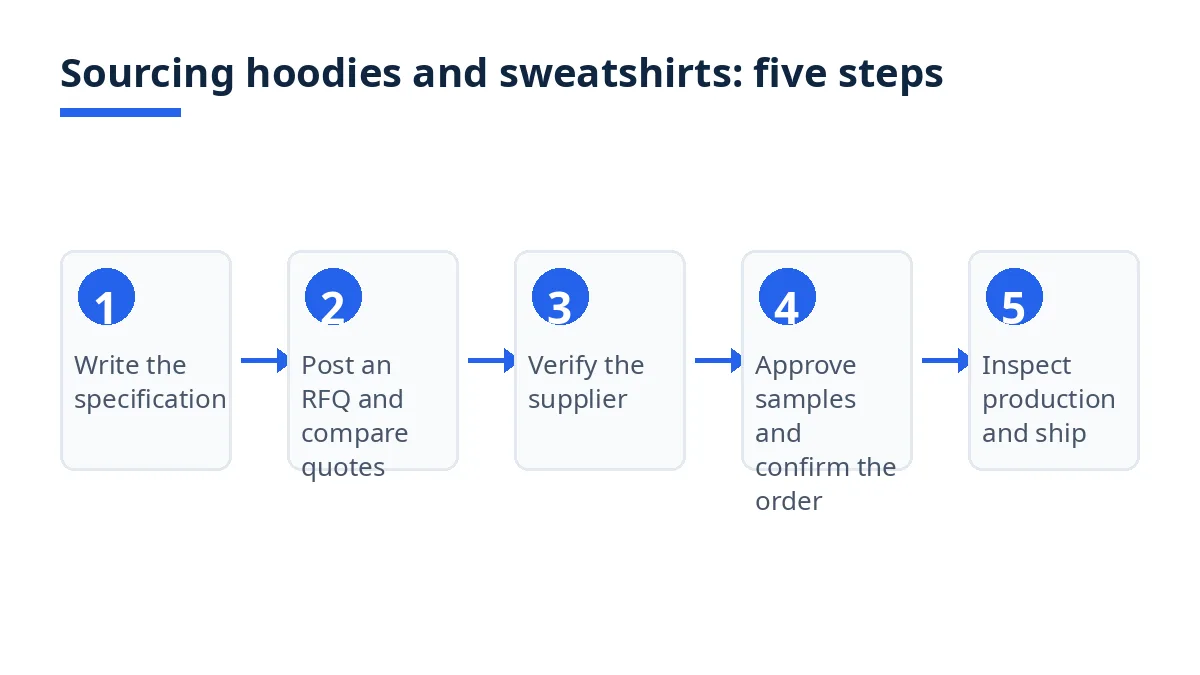
Write the specification. Cover fabric blend, fabric type and GSM with tolerance, hood and pocket construction, print placements, colours, size chart and ratio, labels and packing. Send the identical version to every supplier, because every comparison depends on it.
Post an RFQ and compare quotes. Post the specification as an RFQ (request for quotation) and ask each factory to state the fabric behind its price, what it includes, its validity and the packing assumed. Read the guide to finding suppliers in Bangladesh alongside the shortlist, and treat a quote far below the rest as a specification difference until proved otherwise.
Verify the supplier. Check trade licence, export registration and association membership, with company name, address and bank account name matching across documents. BGMEA membership is one cross-check, since the association covers the knitwear and sweater sub-sectors.1 Then check capability: fleece lines, dyeing and print in-house or bought in, and monthly capacity. The page on how supplier verification works on Exportain explains what document and photo reviews cover.
Approve samples and confirm the order. Work in stages: fit sample, strike-off, then a pre-production sample in production fabric. Wash it and re-measure it, because fleece can shrink unevenly. Approve it in writing, keep a sealed counter-sample, and confirm price basis, MOQ split, delivery term, payment terms, inspection plan and shipment date on the pro forma invoice.
Inspect production and ship. Inspect fabric on arrival where shade is critical, check an inline sample during sewing, and run a final random inspection of packed goods against the approved sample. The hoodies and sweatshirts quality control checklist sets out the garment checks.
Costs, timelines and documents
What drives the price of hoodies and sweatshirts?
There is no market price list for this garment, because the price is built per specification:
Price driver | How it moves the unit price |
|---|---|
Fabric type, blend and GSM | Fleece costs more than French terry at the same weight; heavier GSM uses more yarn |
Print or embroidery | Costed per placement, colour and stitch count; a second placement is a second operation |
Construction | Lined hoods, flatlock seams and reinforced pockets add material and time |
Order size per style and colour | Dyeing and changeover costs spread over fewer pieces at small quantities |
Compliance and testing | Audits, fibre tests and certified-fibre paperwork are real costs |
Every number below is an example figure for illustration, not a quote, a market price or a confirmed rate.
Example figures: 5,000 cotton fleece hoodies with one chest print, FOB Chattogram.
Cost element | Example figures (per unit) |
|---|---|
Fabric, including cutting waste | $4.90 |
Trims: drawcord, eyelets, rib, labels | $0.55 |
Chest print, one placement | $0.60 |
Cutting and sewing | $1.85 |
Finishing, inspection and packing | $0.45 |
Factory overhead and margin | $0.85 |
Total example FOB price | $9.20 |
Negotiate on specification before price: a lower price obtained by dropping the GSM or removing a print placement produces a different garment. Change a visible item openly instead, and record it in the tech pack.
How does MOQ work for hoodies and sweatshirts?
There is no single typical MOQ for hoodies and sweatshirts from Bangladesh. The minimum is set per style and usually per colour, because fleece is dyed in batches: a stock fabric can carry a lower minimum than a custom-dyed colour, where the dye batch sets the floor. Ask how the minimum splits by colour and size ratio, in writing. The minimum order quantity definition explains how minimums are built, and the knitwear sourcing guide covers the wider category.
How long does an order take, and which documents are needed?
Production time and transit time are separate, and neither has a single typical figure. Production runs from approval of the pre-production sample and the deposit. Sea freight takes weeks rather than days, varying by port and routing, so plan from your forwarder's sailing schedule. The delivery term decides who pays for each stage: the Incoterms 2020 rules define the place of delivery, the transfer of risk and the allocation of costs, and specify who pays tariffs on export and import.3 Under EXW, the buyer must pay all tariffs and handle all customs duties, while the seller only makes the goods available.3 Under FOB and CIF alike, the seller is responsible for export clearance only, and the buyer handles import duties and clearance.3
Classification sets the duty line. Knitted hoodies and sweatshirts sit in Chapter 61, which applies only to made up knitted or crocheted articles, under heading 6110, jerseys, pullovers, cardigans, waistcoats and similar articles, knitted or crocheted.4 The heading splits by fibre: 6110.20 covers cotton and 6110.30 covers man-made fibres.4 The UK tariff lists a third country duty of 12.00 percent on the main cotton and man-made fibre lines.4 In the European Union, Bangladesh, as a least developed country, benefits from the Everything But Arms arrangement, which grants duty-free, quota-free access for all exports except arms and ammunition, and Bangladesh is the largest beneficiary under it.5 Claiming it depends on origin rules and proof of origin, so confirm both with your broker before pricing. For the United States and the United Arab Emirates, this guide states no rate: read the rate beside your confirmed code in the official tariff for the entry date. See the HS code for hoodies and sweatshirts guide for the detail.
The standard clearance set is the commercial invoice, packing list, bill of lading or air waybill, and proof of origin where a preference is claimed. Descriptions, quantities and weights must agree across every document, because mismatches delay customs. Agree fibre wording and origin marking at sampling stage. Quality is agreed before production: ISO 2859-1 is the standard for sampling procedures for inspection by attributes, and it uses the acceptance quality limit (AQL) to determine sample sizes and acceptance and rejection thresholds for a lot, where AQL is the maximum average percentage of defective items considered acceptable during random sampling.6 Set the AQL per defect class and the remedy for a failed inspection in the order confirmation.
Bangladesh-specific rules and tips
Check the association and export documents together. Trade licence, export registration and BGMEA or BKMEA membership should name the same company, at the same address, as the bank account you pay. BGMEA covers the woven, knitwear and sweater sub-sectors,1 so membership is a meaningful cross-check, but never a substitute for your own review.
Price the EU preference, do not assume it. The European Commission records that the EU's imports from Bangladesh are dominated by textiles, at almost 94 percent of total imports from Bangladesh in 2025,5 and that 91 percent of Bangladesh's exports to the EU enter duty- and quota-free under Everything But Arms.5 Your shipment still needs to meet the origin rules and carry the correct proof of origin, so build the saving into your landed cost only when your broker has confirmed both for your shipment.
Manage shade as a production risk. Fleece is dyed in batches, and one order can span more than one dye lot. Keep shade lots separate through cutting, approve a shade band at sampling, and check shade across cartons at final inspection.
Build disruption into the calendar. Export performance reporting for the quarter noted an energy crisis raising production costs and pressuring factory operations.2 Hold a buffer between the ex-factory date and your selling season, and agree in writing what happens if the shipment date moves.
Keep payments inside the documents. Pay the company account named in the trade documents, never a personal account, and verify any change of bank details through a separate channel. For a first order, a live video walk-through of the fleece lines is a proportionate step before the deposit.
Mistakes and red flags
Comparing quotes on different fabrics. Two prices are comparable only when blend, fabric type, GSM, construction and print are identical. Ask each factory to state the fabric behind its price first.
Approving print or embroidery from artwork alone. A placement centred on a PDF can sit high, low or puckered on fleece. The strike-off in production fabric is the control.
Skipping the wash test. Shrinkage that differs between length and width twists the garment and moves every measurement. Wash and re-measure the pre-production sample.
Treating MOQ as one number. A minimum per style can hide a higher minimum per colour or per custom-dyed fabric. Get the split in writing.
Accepting a changed bank account by email. A request to pay a new account, a different company name or a personal account is a stop signal. Verify through a separate channel against the trade documents.
Leaving duty out of the comparison. A cheaper FOB quote can lose once duty, freight and clearance are added. The heading 6110 lines carry a 12.00 percent third country duty in the UK tariff,4 while an EU entry can be duty-free under Everything But Arms when origin is proved.5
Checklist
Write the specification: blend, fabric type, GSM and tolerance, hood construction, print placements, colours, size chart and ratio, labels and packing.
Classify each style under heading 6110 by fibre, and confirm duty, preference eligibility and labelling rules for your destination with your broker.
Shortlist knitwear factories whose regular range is hoodies or fleece pullovers, and request quotes on the identical specification.
Verify the supplier: trade licence, export registration, association membership, fleece capability, and bank details that match across documents.
Approve samples in stages: fit sample, strike-off, then a pre-production sample in production fabric, washed and re-measured, with a counter-sample kept.
Confirm the order in writing: price basis, MOQ split by colour, delivery term, payment terms, AQL plan, packing and shipment date.
Inspect fabric and shade lots, check an inline sample, and run a final random inspection of packed goods against the approved sample.
Ship with a document set that agrees across invoice, packing list and bill of lading, and reconcile the landed cost.
How Exportain helps
Exportain is a B2B marketplace where buyers can browse Bangladeshi suppliers, post an RFQ and compare quotations before they order. Supplier profiles carry document and photo review badges: those badges are reviews of documents and photos, not factory inspections, certifications or guarantees. Exportain is not a party to the contract for goods, and it does not inspect goods, book freight or clear customs. State the fabric, GSM, construction and quantity in your RFQ, and run the verification steps in this guide alongside any badge.
FAQs
What should I know first about hoodies and sweatshirts?
Know the garment as a specification before you ask for a price: blend, fabric type and GSM, hood construction, print placements, and the size chart. Hoodies and sweatshirts are knitted garments that classify under heading 6110 by fibre,4 so the blend sets both the price build and the duty line.
What are the typical costs and timelines?
There is no single typical cost or timeline. The unit price is built from fabric, trims, print or embroidery, sewing, finishing and margin for your exact specification, and the example build in this guide, labelled Example figures, shows the shape of that calculation. Production runs from sample approval, and sea transit takes weeks rather than days. Confirm both in writing.
Which documents are needed?
For clearance: the commercial invoice, packing list and bill of lading or air waybill, plus proof of origin where you claim a preference such as Everything But Arms in the EU.5 On the supplier side, check the trade licence and export registration before you order.
What are the most common mistakes?
Comparing quotes written against different fabrics, approving print from artwork instead of a strike-off in production fabric, skipping the wash and shrinkage check, accepting an MOQ without its per-colour split, and paying an account that does not match the trade documents. Each is cheaper to prevent early than to settle after the bulk is sewn.
Next steps on Exportain
Browse Bangladeshi suppliers whose regular range covers fleece knitwear, read how supplier verification works on Exportain before you shortlist, and post a free RFQ at Exportain RFQs with the fabric, GSM, construction and quantity stated.
Sources
- BGMEA at a glance. Bangladesh Garment Manufacturers and Exporters Association (BGMEA) (accessed )
- RMG exports rise 6.10pc to US$10.58b in July-Sept of FY27. The Financial Express, (accessed )
- Should tariffs be part of Incoterms® training?. ICC Academy (accessed )
- Jerseys, pullovers, cardigans, waistcoats and similar articles, knitted or crocheted - Northern Ireland Online Tariff. GOV.UK, UK Trade Tariff (accessed )
- EU trade relations with Bangladesh. European Commission, (accessed )
- ISO 2859-1:2026 - Sampling procedures for inspection by attributes — Part 1: Sampling schemes indexed by acceptance quality limit (AQL) for lot-by-lot inspection. International Organization for Standardization (accessed )
- MOQ
- knitwear
- quality control
- buyer guide
- importing from Bangladesh
- Bangladesh sourcing
- Hoodies and sweatshirts
About the author
Sourcing from Bangladesh?
Post a request for quotation and suppliers on Exportain can send you their quotes directly.
Post an RFQ