Quality Control Checklist for Hoodies and Sweatshirts From Bangladesh
A numbered, printable QC checklist for hoodies and sweatshirts from Bangladesh: measurements, hood, pocket and cuff checks, common defects, destination label and drawstring rules, and packing checks before shipment.
Short answer
A hoodies and sweatshirts quality control checklist is a numbered pre-shipment check of an order against the approved sample, tech pack and purchase order. It covers quantity, fabric and shade, measurements including the hood, drawcords, pockets, ribbed cuffs and hems, workmanship, labels, functional checks and packing, with each defect classified as critical, major or minor and compared with the agreed acceptance limits before the lot is released.
On this page
Key takeaways
Inspect against the approved sample, tech pack and purchase order, never from memory: hood, drawcords, pockets and ribbed cuffs are the hoodie-specific failure points.
Agree the inspection level, AQL values and defect classes in writing before sampling, and record actual measurements against tolerance for every size.
Check destination rules before labels are printed: fiber and care labeling in the EU and the US, and drawstring limits for children's upper outerwear in the US.
Draw the final sample from packed cartons, and correct, re-inspect and record any failure before the lot is released.
Use this hoodies and sweatshirts quality control checklist before an order from Bangladesh leaves the factory. It turns the approved specification for style, measurements, fabric, colors, hood and cuff details, print and packing into pass-or-fail checks an inspector can complete size by size and carton by carton.
Hoodies and sweatshirts fail for reasons a plain T-shirt does not: a hood that sits unevenly, a kangaroo pocket sewn off-center, or ribbed cuffs that lose recovery. Each fault is visible during a structured inspection, provided the inspector works from the approved sample and purchase order.
Why this checklist matters
A hoodie order is produced in several sizes and often several colors, with more components than most knitwear: a hood, drawcords, eyelets, ribbed cuffs and hem, and often a kangaroo pocket, print or embroidery. Small errors multiply quickly. One incorrect measurement point can affect an entire size, and one unapproved fabric lot can create shade differences across a color.
A written checklist creates a shared standard, so buyer, factory and inspector judge the same points against the same references. It catches problems while they can still be corrected, and leaves a dated record linked to the purchase order.
Sampling needs an agreed basis. ISO 2859-1 is the international standard for sampling procedures for inspection by attributes, indexed by the acceptance quality limit (AQL) for lot-by-lot inspection.1 It uses the AQL to determine sample sizes and acceptance and rejection thresholds, so record the inspection level and the AQL for each defect class in the order documents.1 See AQL.
Before you start
Do not start until the references are in the room. Gather:
The purchase order: style, colors, sizes, quantities, destination and packing instructions.
The approved pre-production sample and any later approved sample.
The tech pack: measurement chart with tolerances, fabric composition and weight, stitch details, hood construction, and print artwork.
Approved color references, such as lab dips or a standard swatch for each color.
Measuring tools: a flexible tape, a ruler, and a flat, well-lit table.
The agreed acceptance standard, including the AQL level and defect limits.
A camera for defect and packing photographs.
Confirm the quantity presented. Goods should be complete, or at the stage agreed with the inspector, and cartons accessible so samples can be drawn from across the order, not only from top cartons. Part-finished goods cannot be reported as a final result. See pre-shipment inspection.
The full checklist
Work in order, tick each point and photograph anything that fails.
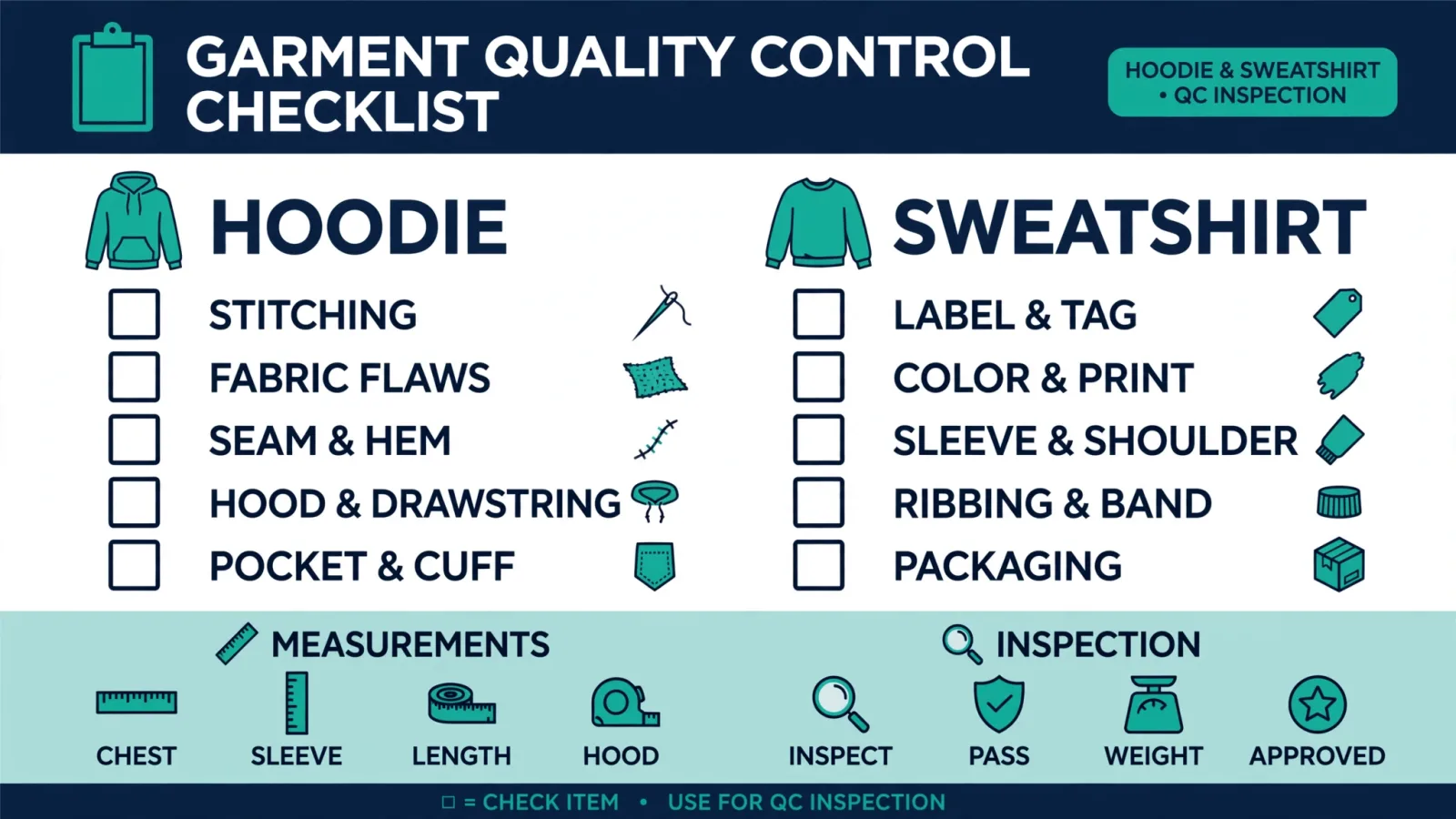
A. Quantity and style verification
Style number, description and colors match the purchase order.
Quantity per size and color matches the order, allowing only variations approved in writing.
The product matches the approved sample for fabric hand feel, construction, trims and finish.
B. Fabric and color
Fabric composition and appearance match the approved swatch. Where a fleece back is specified, check it for even raising, holes, stains or knitting faults.
The color of body fabric, hood lining, ribbing, cuffs and drawcords matches the approved reference under consistent, neutral light, in every color.
Print or embroidery, where used, matches the approved artwork for design, colors, size and placement.
C. Measurements
Measure sampled pieces flat, without stretching, at every chart point: chest, body length, shoulder, sleeve, neck, hem and hood.
Record each measurement against the size and its tolerance. Flag any point outside tolerance and measure further pieces in that size.
Check that sides are symmetrical, the hood sits centered, and measurements are consistent across colors.
D. Hood, pocket, cuffs and workmanship
The hood is evenly attached, lies symmetrically, and any lining matches the specification.
Drawcords, where fitted, are the correct length, material and color, evenly finished at both ends, and eyelets are secure.
Kangaroo or side pockets, where fitted, are centered, level and securely bar-tacked at the openings.
Ribbed cuffs and hem sit flat, are evenly attached and return to shape after gentle stretching.
Seams are complete, even and secure, with no skipped or broken stitches, open seams or untrimmed threads. Hems do not twist.
No stains, oil marks, dirt, holes, snags, needle damage or shiny pressing marks appear on sampled pieces.
Labels are correct and legible: size label matches the actual size, care and fiber-content label matches the ordered fabric and destination requirements, and any required origin label is present. Zips and snaps, where specified, are secure.
E. Simple functional checks
Gently pull the main seams to confirm they do not open or crack.
Operate any zip through its full length several times. It should close evenly without catching the fabric.
Check print fastness on a sample only as agreed with the buyer, and record the method.
Stack folded pieces of the same size. Obvious length or width differences should be re-measured, not ignored.
F. Pressing, folding and packing
Pieces are clean, pressed without scorch or shine, and folded to the specified dimensions.
Individual packing matches the instruction, with correct size identification and any inserts or hangtags attached.
The size and color ratio in each carton matches the packing list, and carton markings show style, color, sizes and quantities.
Cartons are sound, correctly closed and suitable for the transport method, and the total count matches the packing list.
Draw a final sample from packed cartons, not only loose pieces, and recheck style, size, label and packing before signing.
Classify every defect as critical, major or minor, and compare totals with the agreed acceptance limits.
Two checks depend on destination rules. In the European Union, Regulation (EU) No 1007/2011 covers textile fiber names and the related labeling of fiber composition.2 In the United States, federal law requires most textile products to carry a label listing fiber content, country of origin and the identity of the manufacturer or another responsible business, and the Care Labeling Rule requires care instructions.3 The Consumer Product Safety Commission states that drawstrings are not allowed at the hood and neck of children's upper outerwear in sizes 2T to 12, and that waist and bottom drawstrings in sizes 2T to 16 must meet set requirements, including a limit of three inches beyond the channel when the garment is fully expanded.4 A children's hoodie with a hood drawstring for that market is a critical defect: hold the lot.
Common failures and how to fix them
Measurement drift. One size moves outside tolerance because a pattern, cutting or sewing setting has shifted. Isolate that size, measure a larger sample, and rework or replace the pieces.
Shade variation. Pieces in the same color differ, or body fabric, hood lining and ribbing do not match, usually because fabric lots were mixed. Sort suspect cartons, separate the lots and replace mismatched pieces.
Hood and pocket faults. An off-center hood, uneven drawcords or a crooked pocket are construction faults. Re-sew or replace affected pieces, correct the sewing guide, then re-inspect.
Cuff and hem recovery failure. Ribbing that stays stretched after gentle pulling points to the rib fabric or its attachment. Replace affected pieces and check the rib against the approved sample.
Print faults. Compare misplaced, crooked, cracked or wrongly colored prints with the approved artwork. Faulty prints cannot usually be repaired invisibly, so replace the pieces.
Stitching and finishing defects. Open seams, skipped stitches, loose threads and uneven hems can often be repaired. Restitch, trim, re-press, then re-inspect.
Stains and soiling. Clean only by a buyer-approved, fabric-safe method, then re-inspect. Pieces that cannot be cleaned should be replaced.
Wrong labels or packing ratio. A correct garment with a wrong label is still a failed product. Relabel or repack affected cartons, then draw a fresh sample to verify.
Summary table for the inspection record
Section | What is checked | Result to record |
|---|---|---|
Quantity and style | Quantities per size and color against the order | Counts found and any variance |
Fabric and color | Fabric, fleece back, shade and print against approved references | Pass or fail per color, with photographs |
Measurements | Every chart point on sampled pieces, per size, including the hood | Actual measurements against tolerance |
Hood, pocket and workmanship | Hood, drawcords, pockets, cuffs, seams, stains, labels | Defects counted as critical, major or minor |
Functional checks | Seam strength, zip operation and agreed print checks | Method used and result |
Packing | Folding, individual packing, ratio and carton marks | Carton sample result and total cartons |
Buyers still setting up the order can start with how to import hoodies and sweatshirts from Bangladesh, and compare the cotton T-shirts quality control checklist for styles without a hood.
How Exportain helps
Exportain is a marketplace where buyers find Bangladeshi knitwear suppliers, post requests for quotation and compare replies in one place. Share your tech pack and approved requirements with suppliers, and arrange an independent inspection through inspection services before shipment. Profile verification information records document and photo checks. Those checks are not factory inspections and do not replace your own sample approval, purchase order or inspection. Exportain is not a party to your contract for goods, and it does not inspect goods, book freight or clear customs.
FAQs
When should this checklist be used?
Use it at the pre-shipment stage, when production is complete and packing is finished or at the stage agreed with the inspector, so loose pieces and packed cartons can both be checked. Parts of it can also be used in process during production, giving the factory time to correct a drift before packing.
Who should complete it?
A competent inspector working from the buyer's approved sample, tech pack and purchase order should complete it: the buyer's own representative, an independent provider, or a factory quality manager, provided the acceptance standard was agreed in advance and findings are recorded with measurements and photographs.
What are the most common failures?
The most frequent failures are measurements outside tolerance, shade variation, off-center hoods and pockets, cuffs and hems that lose recovery, print faults, stitching defects, stains, and packing errors including wrong size ratios and incorrect labels. Most can be corrected and re-inspected before shipment if found in time.
Can a third party do it?
Yes. A third-party provider can complete this checklist at the factory on the buyer's behalf, using the buyer's approved references and agreed acceptance standard, and report measurements, defect counts and photographs directly to the buyer. Confirm the sample size, acceptance limits and carton sampling in advance.
Next steps on Exportain
Browse suppliers by knitwear category and read the how to buy guide to set up the order documents this checklist depends on. When your tech pack and packing instructions are ready, post an RFQ so suppliers quote against the same specification, and build the final inspection into the purchase order.
Sources
- ISO 2859-1:2026 - Sampling procedures for inspection by attributes — Part 1: Sampling schemes indexed by acceptance quality limit (AQL) for lot-by-lot inspection. International Organization for Standardization (accessed )
- Regulation (EU) No 1007/2011 on textile fibre names and related labelling and marking of the fibre composition of textile products. European Union, (accessed )
- Textile, Wool, Fur, Apparel and Leather Matters. Federal Trade Commission (accessed )
- Drawstring Bulletin: Drawstrings on Children's Upper Outerwear. U.S. Consumer Product Safety Commission (accessed )
About the author
Sourcing from Bangladesh?
Post a request for quotation and suppliers on Exportain can send you their quotes directly.
Post an RFQ