Sustainable Pharmaceuticals & Medical Supplies From Bangladesh: Certifications and Green Factories
Pharmaceutical export receipts were USD 215.7 million in FY2024-25 on Bangladesh Bank data, but no official series separates claim-bearing production. This pillar guide covers how buyers verify DGDA licences, GMP, environmental clearance, effluent and waste records, and green claims.
Short answer
Sustainable pharmaceuticals from Bangladesh means evidence a buyer can check: a current DGDA manufacturing licence and GMP status for the site, product registration for the exact medicine, a current Environmental Clearance Certificate with working effluent treatment, documented pharmaceutical waste handling, and destination-market proof such as an EudraGMDP entry, FDA registration and listing, or WHO prequalification listing for the specific product.
On this page
Key takeaways
Bangladesh Bank recorded pharmaceutical product export receipts of USD 215.7 million in fiscal year 2024-25, up 14.6 percent, on its banking-channel receipts series; no official series separates claim-bearing production, so the verifiable unit is the plant, licence and batch.
The DGDA is the sole responsible authority for medicines, vaccines, biologics, medical devices and in-vitro diagnostics in Bangladesh: ask for the site manufacturing licence and the product registration or marketing authorization by number, with GMP verified after inspection.
Under the Environment Conservation Rules 2023, sites are classified Green, Yellow, Orange or Red and need an Environmental Clearance Certificate before trial production; Orange and Red certificates are valid for one year, so currency is checkable at every order.
Destination proof differs by market: EU GMP status is checkable in the public EudraGMDP database, US FDA establishment registration and drug listing do not indicate product approval, and WHO prequalification lists the exact API or finished product, not the company.
ISO 14001 certifies an environmental management system for a named site and scope, not a product or an effluent result; a green factory claim is verified item by item from metered energy and water records, discharge test reports and waste transfer records.
Sustainable pharmaceuticals and medical supplies from Bangladesh is not a product category with its own label. It is a way of buying medicines, active pharmaceutical ingredients (APIs) and medical supplies: every environmental or quality claim is tied to a named regulator, licence or standard, a current certificate whose scope covers the site and the product in your order, a batch file that follows the consignment, and effluent and waste records you can read rather than a brochure you are asked to trust. This pillar guide is for importers, distributors, tender buyers and sourcing agents in the United States, the United Kingdom, the European Union and the United Arab Emirates who want that evidence file. The companion pillar on the pharmaceuticals industry in Bangladesh covers the industry's capacity, clusters and export structure in full; this guide deals only with the sustainability layer: environmental compliance, good manufacturing practice (GMP) and quality systems as buyer-verifiable evidence, effluent and waste handling duties, and how to verify each claim through documents and registries.
Market overview with latest data
Keep the market picture brief and read each series by its publisher, because the sustainability file sits at site and product level, not in the national total. Bangladesh Bank's Annual Export Receipts for fiscal year 2024-25 records export receipts for pharmaceutical products of USD 215.7 million, up 14.6 percent on the preceding year.1 Those are receipts recorded through the banking channel, and Bangladesh Bank itself notes that its figures differ from the shipment-based series published by the Export Promotion Bureau (EPB) and the Bangladesh Bureau of Statistics because valuation, timing and coverage differ.1 No official series separates claim-bearing or environmentally certified production from that total, and no official body publishes a market share for sustainable pharmaceuticals. The verifiable unit is the individual plant, licence and batch.
The regulator behind every claim in this guide is the Directorate General of Drug Administration (DGDA). In its own guideline for quality assurance of locally sourced medical products, the DGDA describes itself as the sole responsible authority for the regulation of medicines, vaccines, biologics, medical devices and in-vitro diagnostics in Bangladesh, with key roles in licensing premises, regulatory inspection, registration and marketing authorization, laboratory testing, post-marketing surveillance and pharmacovigilance.2 A claim that cannot be traced back to a DGDA licence, a destination-market regulator or a named scheme owner has no standing in your file.
One structural feature of the Bangladesh offer is time-limited. Under the WTO TRIPS Agreement, the general transition period for least developed countries has been extended to 1 July 2034, and the mailbox and exclusive marketing rights obligations are waived for least developed country members until 1 January 2033.3 The TRIPS Council decided on 6 November 2015 that least developed countries would not have to protect pharmaceutical patents and test data until 1 January 2033.4 That transition explains part of the generic range Bangladeshi plants can lawfully make at home. It is not a quality claim and says nothing about whether a specific product may be sold in your market: patent status is a product-by-product legal question for the destination country.
Main products and production clusters
Pharmaceuticals and medical supplies are classified across several chapters of the Harmonized System, because the system follows the product, not the claim.5 Sustainability status does not change the heading: the claim lives in the compliance file, not the tariff line. The chapters you will use most often are:
HS chapter | What it covers | The sustainability question to settle in writing |
|---|---|---|
29 | Organic chemicals, the chapter that carries many active pharmaceutical ingredients | Which site made the API, under what GMP evidence, and how are its solvent and effluent streams handled |
30 | Pharmaceutical products, including medicaments in dosage form and retail packings | Does the product registration, GMP certificate scope and batch file cover this exact product, strength and pack |
90 | Optical, medical and surgical instruments and appliances, the chapter that carries much of the medical supplies range | Which site assembled or packed the item, and what quality system and waste route sits behind it |
Agree the six-digit subheading with your supplier and broker for each product before you order, because the heading decides the duty line and which product rules customs applies at destination.5
The product families carry different evidence. Finished formulations are dosage forms such as tablets, capsules, elixirs, injections and suppositories, and the claim sits with the formulation site: its DGDA manufacturing licence, GMP status and batch records.2 APIs are made on chemical production sites, where the environmental questions are sharpest: solvents, process effluent and hazardous waste are generated at this stage, so the effluent and waste file matters as much as the GMP file. Medical supplies sit between the two: assembly and packing sites carry lighter process loads, but sterility, packaging waste and product registration still need documents, and the DGDA regulates medical devices within the same mandate.2
The one purpose-built production cluster is the API Industrial Park at Bausia, Gazaria, in Munshiganj. Project documents describe 200 acres developed into 42 plots for API production, with an Initial Environmental Examination approved by the Department of Environment (DoE) covering a common effluent treatment plant (CETP) and solid waste disposal management.6 Clustering API producers behind shared effluent infrastructure is the park's environmental logic. Treat the park documents as a starting point, not as evidence about any tenant: a plot allocation is not an operating plant, so check unit by unit which site is built, DGDA-licensed and running, what its own environmental clearance says, and whether its effluent actually goes to the common plant. Formulation and medical supplies production is site-by-site, and each plant carries its own licence and clearance file.
How to find and verify suppliers
Find suppliers through more than one channel so you can cross-check what a plant tells you. Start with the DGDA licence position for any plant you consider, add the pharmaceuticals industry in Bangladesh pillar and Bangladesh export data for context, then work Bangladeshi suppliers listings by product. With each candidate, separate three questions suppliers often merge: is this product registered and lawful for my market, is this site licensed and GMP-compliant for this product, and is the environmental claim on this site evidenced. Each has a different document behind it.
Verification for a sustainability claim is a document exercise. Ask for, and read, the following before you discuss price in detail:
The DGDA manufacturing licence for the exact site address, and the registration or marketing authorization for the exact product, strength and dosage form. In the DGDA's own sourcing guideline, the product must be made at a site with a valid DGDA-issued manufacturing licence, and GMP compliance must have been verified after inspection by the DGDA, the WHO prequalification team or a stringent regulatory authority.2
The GMP evidence for the site: which authority inspected it, against which GMP standard, on what date, and for which dosage forms. A certificate for one site, line or dosage form does not cover another.
The environmental file: the site's category under the Environment Conservation Rules 2023, its current Environmental Clearance Certificate and renewal date, and the effluent treatment arrangements behind it, including CETP membership where the site sits in the API park.6 7
The batch file for a recent comparable consignment: the certificate of analysis (CoA) for the batch actually supplied, the stability data behind the shelf life, and the API source validation. The DGDA sourcing guideline states a preference for API suppliers that are WHO-prequalified or hold a certificate of suitability to the monographs of the European Pharmacopoeia (CEP) or a US FDA-submitted drug master file.2
The API source itself: named API manufacturer and site, not a trader's assurance, because the API site's environmental and GMP file is part of your product's file.
A traceability test on one batch: the supplier identifies the API lot, the production record and the carton range that batch went into, while you time it.
The claims file: every environmental or quality statement in the offer, each matched to its certificate, registry entry, test report or metered record, with expiry dates.
On Exportain, read badges for what they are. Supplier profiles carry document and photo review badges: the badge records that documents and photos were reviewed by Exportain staff, verification is free, and membership never grants a badge.8 A badge is not a factory inspection, a GMP certificate, an environmental clearance or a guarantee. Exportain is a B2B marketplace and is not a party to the contract for goods; it does not inspect goods, book freight or clear customs.8 Use the badge as a first filter, then run the checks above yourself or through an inspection firm you appoint.
Two red flags end a conversation early: a supplier that markets US FDA establishment registration as FDA approval of its products, and a plant that describes itself as a green factory but cannot produce a current Environmental Clearance Certificate and effluent test reports for its own site.
MOQ, pricing and lead times
There is no industry-wide MOQ, standard price or standard lead time for pharmaceuticals or medical supplies from Bangladesh, and no official body publishes one. All three are quoted per plant, per product and per order, against a registered specification. Sustainability and compliance requirements move all three, and the movement should be visible in the quote rather than absorbed into one higher price.
MOQ. The minimum is set by the production stage and the regulatory file behind the order. A formulation order carries the batch size of the line and the registered pack configuration; a new-market order adds artwork, registration and stability work that a plant will not start below a commercial volume. An API order carries the reactor campaign minimum of the producing site. State your target quantity per product, strength, pack size and market, and ask which parts of the quoted minimum are production minimums and which are regulatory or packaging minimums.
Pricing. Your unit price is built from API and excipient cost, conversion, packaging, quality control testing, stability and documentation work, and export costs to the agreed Incoterm point. The sustainability file adds identifiable lines: audit and certification fees spread across volume, effluent treatment and hazardous waste handling, CETP charges where they apply, added testing, and upgraded packaging where your market or claim requires it. Ask for those lines itemised: a compliance premium that cannot be itemised cannot be checked at renewal, and a quote that drops the evidence lines is usually dropping the evidence.
Example figures. For illustration only: 500,000 film-coated tablets in blister packs, quoted by two suppliers at FOB Chattogram. Supplier A quotes USD 0.021 per tablet itemised as API and conversion USD 0.014, blister and carton USD 0.003, quality control and stability work USD 0.0015, effluent and waste compliance USD 0.001 and export costs USD 0.0015. Supplier B quotes USD 0.0184 with no itemisation. The totals are USD 10,500 and USD 9,200. The example shows the method, not a market price: the buyer asks Supplier B for the same itemisation, and for the effluent and waste line in particular, before treating the USD 1,300 gap as a saving.
Lead times. A lead time is a chain: API procurement, which for imported API depends on the API supplier's own lead time and import clearance, production scheduling, quality control release, packaging, documentation, inspection and booking, then transit. Compliance adds two links: any audit, certificate renewal or destination-market registration step your order depends on must complete before shipment, and temperature-sensitive products add validated packing and cold chain booking. Ask for the stages separately and agree what starts the clock, normally written order confirmation plus approved artwork and, where the market requires it, confirmed registration.
Quality, certifications and compliance
Quality in this category is decided by three layers: the Bangladesh licence layer, the destination market's regulatory layer, and your own specification and testing. Sustainability evidence sits inside those layers, not beside them. No single certificate covers all three, none is required for every product in every market, and a certificate proves only what its scope says: that site, those activities or products, that standard, until that expiry date.
The Bangladesh licence layer: the DGDA. Before any sustainability question, the plant and the product must be lawful at origin. The DGDA licenses premises, inspects establishments, registers products and issues marketing authorizations, and runs laboratory testing, post-marketing surveillance and pharmacovigilance.2 A marketing authorization is the legal document the DGDA issues authorizing the marketing or free distribution of a medical product in Bangladesh after evaluation of safety, efficacy and quality.2 Ask for both documents by number. Neither is an environmental claim, and neither substitutes for the destination market's own authorization.
GMP: what it actually certifies. Good manufacturing practice is the part of a quality management system that ensures products are consistently produced and controlled to the quality standards appropriate to their intended use and as required by the marketing authorization.9 WHO states that GMP is aimed primarily at diminishing the risks inherent in pharmaceutical production, grouped into cross-contamination and mix-ups, and false labelling, and that manufacturers must not place patients at risk through inadequate safety, quality or efficacy.9 Read a GMP claim in those terms: an inspectorate found the site's system compliant for the inspected scope on the inspection dates. GMP is not an environmental certification and not a product-by-product approval, and one authority's GMP certificate does not automatically satisfy another market's inspectorate.
WHO prequalification: a product listing, not a company badge. Any manufacturer of APIs or finished pharmaceutical products (FPPs) can express interest in having a product evaluated, provided the product is eligible and appears in the relevant Invitation to Manufacturers to Submit an Expression of Interest for Evaluation.10 WHO reviews the submitted information, may request more, and inspection of the manufacturing site, and of any contract research organization that ran a related study, may also be necessary; a product already approved by a stringent regulatory authority may go through abbreviated assessment.10 Once an API, FPP or quality control laboratory has met the requirements, it is added to the relevant WHO list.10 Verify a claim on that list, for the exact product, strength, dosage form and site: prequalification of one product does not prequalify the plant's other products, and it is not an environmental assessment.
The EU route: authorization, EudraLex and a public database. In the EU, the manufacture or import of medicinal products is subject to manufacturing or import authorization, the authorization holder must comply with the principles and guidelines of GMP, and active substances must have been manufactured in compliance with GMP; EudraLex Volume 4 contains the guidance for interpreting those GMP principles and guidelines.11 Any manufacturer of medicines intended for the EU market must comply with EU GMP no matter where in the world it is located, and importers are responsible for ensuring that the third-country manufacturer they import from complies with GMP.12 APIs imported into the EU also need, for each consignment, a confirmation by the competent authority of the producing country that the API conforms to GMP standards equivalent to those in the EU, unless a waiver applies.12 The verification route is public: EudraGMDP is a publicly accessible EU database containing manufacturing and import authorizations, registration of active substance manufacturers, GMP certificates and non-compliance statements, and after an inspection the competent authority enters a GMP certificate or a non-compliance statement in it.12 Search your supplier's site in EudraGMDP, read the certificate scope and inspection date, and check that no non-compliance statement stands against the site.
The US route: CGMP, and registration is not approval. The US Food and Drug Administration (FDA) monitors drug manufacturers' compliance with its Current Good Manufacturing Practice (CGMP) regulations, which contain minimum requirements for the methods, facilities and controls used in manufacturing, processing and packing a drug product, in 21 CFR Part 210 for drugs generally and Part 211 for finished pharmaceuticals.13 The approval process for new and generic drug marketing applications includes a review of the manufacturer's compliance with CGMP.13 Separately, drug manufacturers must register their establishments with FDA and list each drug manufactured at the establishment for commercial distribution, updating the listing twice a year.14 FDA states the limit in its own words: registering an establishment and listing drugs with FDA does not indicate the products are approved or that FDA has verified the information provided.14 Verify a US claim in two parts: the establishment's current registration and drug listing in FDA's published records, and the product's own marketing status, which registration never establishes.
Environmental compliance: clearance, effluent and waste. The environmental layer at origin is a legal duty, not a voluntary claim. Under the Environment Conservation Rules 2023, industrial units and projects are classified as Green, Yellow, Orange or Red based on their activities, pollution and potential harm to the environment and health, and location clearance and then an Environmental Clearance Certificate must be obtained before a new unit is set up, with no trial production allowed without the Environmental Clearance Certificate.7 For Orange and Red category units, the certificates are valid for one year and renewable at one-year intervals, so a current certificate is a dated document you can ask for at every order.7 For API production in the Gazaria park, the project file route runs through an Initial Environmental Examination and the common effluent treatment plant arrangements approved for the park.6 At plant level, ask for the records that show the system working, not only the certificate that shows it exists: effluent treatment plant operating logs, discharge test reports against the conditions in the clearance, CETP receipts where the common plant is used, and the hazardous waste route for rejected stock, expired material, solvents and laboratory waste, with contractor names and transfer records.
WHO's health-care waste guidance shows why the waste route needs documents. Of the waste generated by health-care activities, about 85 percent is general, non-hazardous waste and the remaining 15 percent is hazardous material; pharmaceutical and cytotoxic waste, meaning pharmaceuticals that are expired or no longer needed and items contaminated by or containing pharmaceuticals, is a named hazardous category.15 WHO also records that unsafe storage, treatment and disposal of pharmaceutical waste can spread antimicrobial resistance, and that waste minimization should be a priority.15 Those figures describe health-care activities globally, not a Bangladeshi plant's own waste split; your supplier's split is in its waste inventory and transfer records, which is why you ask for them.
Environmental management certification: ISO 14001. ISO describes ISO 14001 as the internationally recognized standard for environmental management systems: a framework for an organization to design and implement an environmental management system and continually improve its environmental performance, covering resource usage and waste management through to monitoring environmental performance.16 Certification is by third-party certification bodies, and ISO instructs organizations to use the full designation, for example certified to ISO 14001 followed by the edition year; certified organizations usually undergo surveillance audits annually, with a recertification audit every three years.16 Read the claim at that scope: the certificate attests that the named organization at the named site runs a management system meeting the standard. It does not certify a product, set or measure an effluent limit for your consignment, or replace the Environmental Clearance Certificate or GMP. Verify it through the certificate number and issuing certification body, and check that the site address and scope match the plant making your order.
Green claims and green factory claims. In the EU, Directive (EU) 2024/825 on empowering consumers for the green transition bans generic environmental claims such as eco-friendly or carbon neutral unless they are substantiated, requires sustainability labels to be based on a certification scheme or established by public authorities and verified by an independent third party, and bans suggesting a benefit applies to the entire product or business when it relates only to a specific part.17 Apply the same discipline in any market. There is no pharmaceutical-specific green-factory certificate a buyer can check for a Bangladeshi plant, so verify each claim one item at a time: metered energy and water use per batch or per tonne, fuel and solvent recovery records, effluent discharge results, and waste transfer records. Ask for the metered record, not the brochure.
Your own quality system. Write the specification so a laboratory can measure it: product, strength and dosage form, the pharmacopoeial or in-house specification and its compendial references, API source, pack format and materials, batch coding, and shelf life, with the remaining shelf life required on arrival stated as a number. The DGDA sourcing guideline works the same way for public procurement: the CoA must be for the same batch intended to be supplied, stability studies must cover the full proposed shelf life in the proposed container, and the remaining shelf life should be at least 75 percent of the total shelf life before shipping.2 Approve a pre-production sample and the final artwork, including every claim, in writing, and test goods from the actual production batch.
Shipping, Incoterms and duties
Pharmaceuticals and medical supplies normally leave by sea from Chattogram, with urgent and small temperature-sensitive consignments moving by air from Dhaka. The sustainability variables in shipping are concrete: the cold chain record for temperature-sensitive products, packaging protection against humidity, and carton dimensions that decide cube use in the container. Agree the temperature set point, data logger placement and maximum transit time in the purchase order for cold chain lines, and confirm carton dimensions and moisture protection in the specification before the Incoterm is chosen.
Incoterms® 2020 is the current edition of the ICC rules, in force since 1 January 2020: eleven three-letter trade terms that clarify the tasks, costs and risks involved in the delivery of goods from sellers to buyers, recognised as the global standard for interpreting the most common terms in foreign trade.18 The four rules you will meet most often on orders in this category work as follows:
Rule | Who arranges and pays main freight | Where risk passes to the buyer | Practical note for this category |
|---|---|---|---|
EXW (Ex Works) | Buyer | At the seller's premises | Buyer carries export clearance workload; rarely suitable for a first order |
FOB (Free On Board) | Buyer | When goods are on board the vessel at the named loading port | The common Bangladesh term; name the port, for example FOB Chattogram, Incoterms® 2020 |
CIF (Cost, Insurance and Freight) | Seller, plus minimum insurance | When goods are on board at the loading port | Seller's freight is convenient, but risk still passes at loading, not at arrival, and shelf life and cold chain run from production and loading |
DAP (Delivered at Place) | Seller | At the named destination place, ready for unloading | Buyer still clears import and pays duty unless the contract says otherwise |
Always write the rule with its named place and edition, for example "FOB Chattogram, Incoterms® 2020". Exportain does not book freight or clear customs, so the freight forwarder and customs broker are separate appointments to name in the order paperwork.8
Duties are decided by the heading, the origin of the goods and the destination's preference scheme, in that order. As a least developed country, Bangladesh benefits from the Everything But Arms (EBA) arrangement under the EU's Generalised Scheme of Preferences, which grants duty-free, quota-free access to the EU for all products except arms and ammunition, and 91 percent of Bangladesh's exports to the EU enter duty- and quota-free.19 Bangladesh is the largest EBA beneficiary, with EUR 19 billion in exports benefitting from these preferences in 2024 at a 96 percent utilisation rate.19 Products that meet the EBA rules of origin and ship with the required proof of origin therefore enter the EU without customs duty while Bangladesh holds that status. Two cautions apply. First, preference is a property of the consignment, not the country: if the origin evidence fails, the standard third-country duty for the heading applies. Second, EBA status waives duty only: EU GMP, manufacturing authorization and marketing authorization requirements apply in full to medicines.11 12 For the United States, the United Kingdom and the UAE, read the duty beside your confirmed six-digit code in the destination tariff for the entry date; this guide states no rate for them, because rates vary by heading.
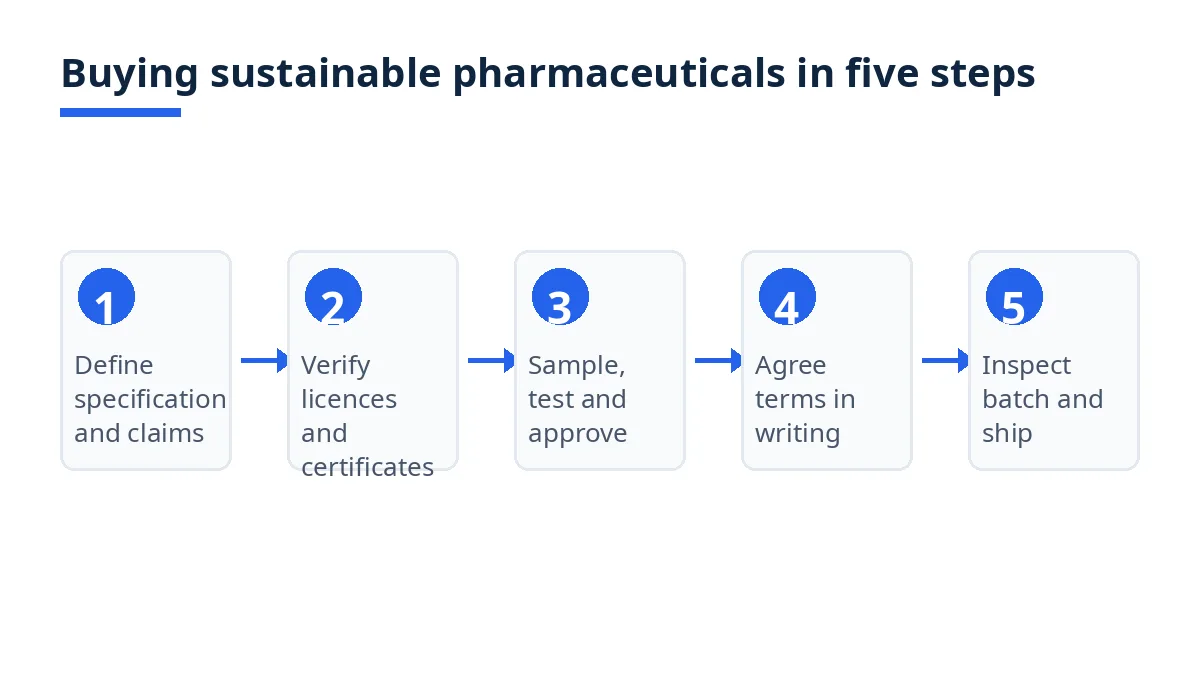
Step-by-step buying process
Define the specification and the claims. Write the product before you shop for it: HS subheading, product, strength and dosage form, pharmacopoeial specification, API source requirement, pack format, minimum remaining shelf life on arrival, the exact claims and the named licence, standard or registry behind each one, target quantity, and destination market.
Shortlist and verify suppliers. Confirm the site and its DGDA licence, then run the GMP scope, environmental clearance, batch file and one-batch traceability checks above, including the destination-market registry check for your market.2 7 12
Sample, test and approve the pack. Test production-representative goods against the specification, and approve a counter-sample and the destination label and artwork proof, including every claim, in writing.14 17
Agree commercial terms in writing. Fix MOQ per product and pack, itemised unit price with validity period and compliance lines shown separately, the Incoterm with named place, staged lead time, payment terms and inspection point, all in the purchase order.18
Produce, inspect and ship. Monitor API procurement and the production batch first, inspect and test finished goods against the counter-sample, assemble the batch, clearance and waste records for the shipped lots, then ship with the origin evidence your duty position depends on.15 19
Related guides
Read the pharmaceuticals industry in Bangladesh pillar for the industry's capacity, clusters and export data behind this sustainability layer, how to import from Bangladesh for the general import sequence, and Bangladesh export data for category scale. The guide to Incoterms for shipments from Bangladesh works through the delivery terms in more detail, and the guide on how to import medical scrubs from Bangladesh covers a neighbouring medical supplies category.
FAQs
Is Bangladesh a good place to source pharmaceuticals & medical supplies?
Bangladesh is a credible sourcing option for generic formulations, APIs and medical supplies where the licence, registration and evidence file are managed actively. Bangladesh Bank recorded pharmaceutical product export receipts of USD 215.7 million in fiscal year 2024-25, up 14.6 percent, on its banking-channel receipts series.1 The DGDA licenses plants and registers products at origin,2 and the WTO pharmaceutical transition for least developed countries runs to 1 January 2033.4 No official series separates claim-bearing production from the total, so the sustainable supply base is the set of plants whose licences, certificates, registries and records you have checked.
What is the typical MOQ?
There is no published typical MOQ for pharmaceuticals or medical supplies from Bangladesh, and no official body sets one. Each plant quotes its MOQ from its production and regulatory position: a batch and line minimum per formulation, a reactor campaign minimum per API, or a pack printing minimum per market and artwork. A claim-bearing or new-market order adds registration, stability and audit steps, so ask for the production minimum and the regulatory minimum separately.
How long is the lead time?
There is no standard lead time: yours is the sum of API procurement, production scheduling, quality control release, packaging, documentation, inspection, booking and transit. Two stages carry dated constraints: the API must be available and released, not just ordered, and any certificate renewal or registration step your claim depends on must be current at shipment, which matters where an Environmental Clearance Certificate for an Orange or Red category site is valid for one year.7 Ask for the stages separately and agree in writing what starts the clock.
Which certifications matter?
The certifications and approvals that matter are the ones your destination law, your channel and your product claims require for the exact product and site; none is a general badge. The origin floor is the DGDA site manufacturing licence and the product registration or marketing authorization.2 On top of that floor: GMP evidence for the site, meaning consistent production and control to the standard appropriate to the product's intended use and marketing authorization,9 checked for the EU in the public EudraGMDP database,12 and for the United States through CGMP compliance plus establishment registration and drug listing, which FDA states does not indicate product approval.13 14 A tender claim may need WHO prequalification for the exact product, ending in a listing on the relevant WHO list.10 An environmental claim needs the site's current Environmental Clearance Certificate,7 and, where ISO 14001 is claimed, a third-party certificate whose site and scope match your plant.16
Next steps on Exportain
Browse Bangladeshi suppliers by pharmaceutical or medical supplies product, use Exportain trade intelligence to check the market picture behind this guide, and post a free RFQ at Exportain RFQs with your specification, the claims you need evidenced, target quantity and destination market so suppliers in this category can quote against the same written brief.
Sources
- Annual Export Receipts of Goods and Services 2024-25. Bangladesh Bank (accessed )
- Guideline for quality assurance of locally sourced medical products for public health priority disease. Directorate General of Drug Administration (DGDA), (accessed )
- Intellectual property (TRIPS) and pharmaceuticals - technical note. World Trade Organization (accessed )
- WTO: agreement on intellectual property rights relating to trade and pharmaceutical patents. European Commission, EUR-Lex (accessed )
- Harmonized System. World Customs Organization (accessed )
- Initial Environmental Examination (IEE): The ACME Laboratories Ltd. (API Unit), API Industrial Park, Bausia, Gazaria, Munshiganj. IDCOL (accessed )
- Bangladesh Environment Conservation Act 1995 and Environment Conservation Rules 2023. Jural Acuity (accessed )
- Supplier verification: Earn trust badges buyers can see. Exportain (accessed )
- Guidelines: Production - WHO good manufacturing practices. World Health Organization (accessed )
- How does medicines prequalification work?. World Health Organization (accessed )
- Good Manufacturing and Distribution Practices. European Commission (accessed )
- Good manufacturing practice. European Medicines Agency (accessed )
- Current Good Manufacturing Practice (CGMP) Regulations. U.S. Food and Drug Administration (accessed )
- Electronic Drug Registration and Listing System (eDRLS). U.S. Food and Drug Administration (accessed )
- Health-care waste (fact sheet). World Health Organization, (accessed )
- ISO 14001:2026 - Environmental management systems. International Organization for Standardization (accessed )
- Directive (EU) 2024/825 – Empowering Consumers for the Green Transition. Department of Enterprise, Trade and Employment, Ireland (accessed )
- Incoterms® rules. International Chamber of Commerce (ICC) (accessed )
- EU trade relations with Bangladesh. European Commission, (accessed )
- Incoterms
- quality control
- Bangladesh Export Data
- Category Pillars
- Supplier Sourcing
- Pharmaceuticals Bangladesh
About the author
Sourcing from Bangladesh?
Post a request for quotation and suppliers on Exportain can send you their quotes directly.
Post an RFQ