The Pharmaceuticals & Medical Supplies Industry in Bangladesh: Capacity, Clusters and Key Players
Pharmaceutical exports were USD 238.5 million in FY2025-26 on the EPB shipment series. This pillar guide covers products, clusters, DGDA licensing, GMP, supplier checks, MOQ, pricing, Incoterms and duties.
Short answer
The pharmaceuticals industry in Bangladesh makes finished generic medicines, active pharmaceutical ingredients and medical supplies inside Chapter 30 for export. Pharmaceutical exports were USD 238.5 million in fiscal year 2025-26 on the EPB shipment series. Buyers source it by confirming the DGDA licence and site, the destination registration, the API source and the batch file, then agreeing MOQ, price, Incoterm and lead time per product.
On this page
Key takeaways
Pharmaceutical exports were USD 238.5 million in fiscal year 2025-26 on the EPB fiscal-year shipment series, up 12 percent from USD 213.2 million in FY2024-25, with Sri Lanka the top destination that year.
Bangladesh Bank records a different figure for the same year, USD 215.7 million in pharmaceutical export receipts for 2024-25, because receipts are recorded when proceeds are received; the Bank itself notes valuation, timing and coverage differences from EPB data.
Three exporters accounted for nearly half of pharmaceutical exports in the last fiscal year on EPB data, while the API layer behind finished medicines is still largely imported and the Gazaria API Park had only two producers started by June 2026.
There is no industry-wide MOQ, price or lead time for pharmaceuticals from Bangladesh; all three are quoted per manufacturer, per product and per destination registration file, with drug registration described by industry executives at two to five years.
At origin the operative file is the DGDA licence and product registration; the manufacturing reference is WHO GMP, aimed at cross-contamination, mix-ups and false labelling; at destination your own marketing authorisation applies in full.
The pharmaceuticals industry in Bangladesh supplies finished generic medicines, active pharmaceutical ingredients (APIs) and a narrower range of medical supplies to domestic patients first and to export markets second. This pillar guide is for importers, distributors, hospital and pharmacy procurement teams, and sourcing agents in the United States, the United Kingdom, the European Union and the United Arab Emirates weighing Bangladesh as an origin. It covers the latest export data and how to read it, products and clusters, supplier checks, MOQ, pricing and lead times, quality and compliance, shipping, Incoterms and duties, and a step-by-step buying process. Pharmaceuticals are regulated goods: a low price means nothing until the product, the manufacturer and the destination file are all in order.
Market overview with latest data
Start with the export value, and with the series it belongs to. Bangladesh exported USD 238.5 million worth of pharmaceutical products in fiscal year 2025-26, up 12 percent from USD 213.2 million in fiscal year 2024-25, on the Export Promotion Bureau (EPB) fiscal-year shipment series reported by The Business Standard.1 The same report puts the sector at 0.5 percent of Bangladesh total merchandise exports of USD 48 billion in FY2025-26.1 Sri Lanka remained the top destination in FY2025-26, with pharmaceutical products making up 40.1 percent of the USD 76.4 million worth of goods Bangladesh exported to Sri Lanka that year, on the same EPB-sourced reporting.1 Read those figures as one EPB set for FY2025-26, and read the years below in their own sets.
The year before was slower on the same EPB basis. Pharmaceutical exports reached USD 213 million in fiscal year 2024-25, just 4 percent higher than USD 205 million in fiscal year 2023-24, in EPB figures reported by The Daily Star.2 That reporting puts the destination count at 166 nations, up from around 140 countries seven years earlier, with new destinations in Central Asia among the additions.2 A destination count is not a market-access count: a product counts as exported once a shipment is recorded, while lawful sale in that country depends on a product registration held for that market. Keep the EPB destination count and your own registration position as two separate facts.
The longer EPB run, as analysed by The Financial Express from EPB data, shows how this level was reached. Bangladesh earned USD 44.2 million from pharmaceutical exports in FY2010-11; earnings reached USD 188.78 million in FY2021-22, fell 7 percent to USD 175.42 million in FY2022-23, then rose to USD 205.48 million in FY2023-24 with growth of 17.14 percent, the first year above USD 200 million on that analysis.3 The same analysis records USD 213.16 million for FY2024-25, the precise figure behind the rounded USD 213 million in the Daily Star report, and USD 194.63 million for July to April of FY2025-26, up 9.7 percent on the corresponding period, before the full-year USD 238.5 million figure was reported.3 1 There was one dip in that run, in FY2022-23.3
A second official series measures something different. Bangladesh Bank records export receipts, meaning earnings reported through the banking channel when proceeds are received, and its Annual Export Receipts for 2024-25 puts pharmaceutical products at USD 215.7 million in 2024-25, up 14.6 percent on the year, inside total goods receipts of USD 43,559.3 million.4 That is not the same as the EPB USD 213.16 million shipment figure for the same fiscal year, and neither is an error. Bangladesh Bank states that its receipts data and data based on customs returns compiled by the Bangladesh Bureau of Statistics and the EPB are likely to differ because of differences in valuation, timing and coverage, since a shipment and the receipt of its proceeds can fall on different dates.4 Cite the EPB series for shipments, the Bangladesh Bank series for proceeds received, and never average the two.
Concentration is the third feature. Three companies accounted for nearly half of total pharmaceutical exports in the last fiscal year on the EPB data reported by The Financial Express, and the next tier is a short list rather than a long tail.3 This guide does not name or rank exporters, because a ranking changes by year and is not a quality finding. A small number of exporters carries a large share of recorded volume, a much larger number of licensed manufacturers serves mainly the domestic market, and export capability must be established company by company and product by product. The same reporting, citing industry association data, records around 1,200 pharmaceutical products receiving export registration over the past two years and shipments to more than 150 countries.3 Treat that count as an industry association figure, separate from the 166-nation count in the Daily Star report for FY2024-25: different sources and reference periods, not merged here.2 3
The constraint behind the growth is raw material supply. Finished medicines are formulated in Bangladesh, but their active ingredients are still largely imported. The Active Pharmaceutical Ingredient (API) Park at Gazaria in Munshiganj was allocated to manufacturers more than fifteen years after the project began; plots have been allocated and several manufacturers have begun building there, yet as reported in June 2026 only two companies had started producing raw materials there, two others had begun preliminary work, and land allocated to 23 companies remained vacant.3 Industry participants in the same reporting put the annual cost of imported APIs at at least Tk 100 billion.3 The Bangladesh API and Intermediaries Manufacturers Association position reported there is that local firms have developed more than 40 APIs over the past eight years and could meet 30 percent to 40 percent of domestic API demand with stronger support, an association estimate of potential, not a measure of current supply.3 Ask every supplier which API source sits behind your product and what happens to price and lead time if it is interrupted.
Main products and production clusters
Pharmaceutical products sit mainly in Chapter 30 of the Harmonized System, and the chapter notes decide what belongs there. The notes exclude, among other goods, foods and beverages other than nutritional preparations for intravenous administration, preparations of headings 3303 to 3307 even if they have therapeutic or prophylactic properties, and diagnostic reagents of heading 3822.5 Heading 3006 applies only to a listed set of goods, including sterile suture materials, sterile absorbable haemostatics, opacifying preparations for X-ray examinations, dental cements, first-aid boxes and kits, and gel preparations for use in human or veterinary medicine as a lubricant for parts of the body for surgical operations or physical examinations.5 Agree the six-digit subheading with your supplier and broker before you order, because the heading drives the duty line and the regulatory file customs expects.
HS heading | What it covers | Typical buying use |
|---|---|---|
3002 | Blood, antisera, vaccines and similar immunological products as defined in the chapter notes | Vaccines and immunological products, with the strictest cold-chain and authorisation checks |
3003 | Medicaments of mixed constituents, not put up in measured doses or retail packings | Bulk medicaments for further packing under a separate authorisation |
3004 | Medicaments put up in measured doses or retail packings | Finished, packaged generic medicines most export buyers source |
3005 | Wadding, gauze, bandages and similar articles for medical, surgical, dental or veterinary purposes | Dressings and bandages, the medical-supplies end of this category |
3006 | Pharmaceutical goods specified in the chapter notes, including sterile suture materials, dental cements and first-aid kits | Surgical and dental supplies inside Chapter 30 |
The product offer follows that structure. The volume offer is finished generic medicaments under heading 3004: tablets, capsules, liquids, inhalers, infusions and other dosage forms made for a named market, in that market packaging and language, against that market registration. Bulk medicaments under 3003 serve a licensed packer or manufacturer at destination working under its own authorisation. Vaccines and immunological products under 3002 are a specialist trade with their own authorisation, batch-release and cold-chain requirements. APIs are the input layer: largely imported at present, with local production centred on the Gazaria park project and individual company plants.3 Dressings under 3005 and the listed goods under 3006 sit inside the pharmaceutical chapter, while a wider medical device is a different regulatory object: the Directorate General of Drug Administration (DGDA) is the national regulatory authority for all kinds of medicines, medical devices, vaccines and other biological products, as the World Health Organization (WHO) country office records.6 A finished-medicines maker is not, by that fact alone, a device source.
Production clusters should be described by function, not by a borrowed map. The documented cluster in the sources opened for this guide is the API layer: the API Industrial Park at Gazaria, Munshiganj, where plots were allocated and only a small number of producers had started output by June 2026.3 Finished-dosage formulation is the second layer, carried on by manufacturers licensed through the DGDA system, whose export production is concentrated in the small group carrying nearly half of recorded export value.3 6 Packing, testing and release form the third layer. When a supplier makes a cluster claim, ask which layers it operates itself, which sit with another company, and where each physically happens.
Key players, described structurally, fall into three groups. The first is the regulator: the DGDA, whose licensing and registration decisions decide what may be made and exported.6 The second is the exporting manufacturer group behind the EPB figures, including the three companies that together account for nearly half of exports.3 The third is the API and intermediates layer, whose output still covers only part of domestic API demand.3 Start in the second group, verify against the first, and price the third into every long programme.
How to find and verify suppliers
Find pharmaceutical suppliers through more than one channel, because in this category the cost of a wrong first choice is measured in registration time, not just in price. Start with Bangladesh export data for category scale, add Exportain trade intelligence for market context, then work Bangladeshi suppliers listings by product type and ask each candidate the same opening questions: which exact products, in which dosage form and strength, are registered for export, to which destinations they are currently shipped, and which destination registrations the company itself holds rather than a partner.
Verification for medicines is a document exercise with a regulatory spine. Ask for, and read, the following before you discuss price in detail:
Manufacturing licence in the company own name for the site that will make your product, read against the DGDA role as national regulatory authority.6
Product registration for the exact product, strength and dosage form, for Bangladesh and, separately, for your destination.
Export history: anonymised shipment summaries showing heading, destination, volume and recency, checked against the EPB picture.1
The API source for your product and its country of manufacture.3
Batch documentation from a recent comparable run: certificate of analysis, stability summary and release process.
Site evidence: which lines exist at the named site, which stages are subcontracted, and which laboratory performs release testing.
On Exportain, read badges for what they are. Supplier profiles carry document and photo review badges: the badge records that documents and photos were reviewed by Exportain staff, verification is free, and membership never grants a badge.7 A badge is not a factory inspection, a medicines licence or a guarantee, and Exportain is not a party to the contract for goods; it does not inspect goods, hold authorisations, book freight or clear customs. Use the badge as a first filter, then run the checks above yourself or through an adviser you appoint.
Two red flags end a conversation early. The first is a supplier offering a medicine for a regulated destination without asking who holds the marketing authorisation there. The second is a supplier that cannot state the API source and site of manufacture for the quoted product. A claim to supply any molecule, in any pack, to any market, on request, is a claim to have solved a file the industry itself builds product by product.3
MOQ, pricing and lead times
There is no industry-wide MOQ, standard price or standard lead time for pharmaceuticals and medical supplies from Bangladesh, and no official body publishes one. All three are set per manufacturer, per product and per destination file. What follows is how each is built, so quotes can be compared on equal terms.
MOQ. For finished medicines, MOQ is set by the batch, not by the carton. A tablet order carries a batch-size minimum per product, strength and pack; a liquid or infusion order carries line and filling minimums; a dressing order carries cutting, sterilisation and packing minimums per size. Destination-language cartons, leaflets and labels are product-specific, and a short run still pays a full print setup per variant. State your target quantity per product, strength and pack, and ask for the MOQ on the same basis.
Pricing. Your unit price is built from API cost, excipients, packaging including destination-language print, batch testing and release, stability and registration-batch costs where they apply, and export costs to the Incoterm point. API cost is the volatile element, because the API layer is largely imported and priced in foreign currency.3 Compare quotes only at the same Incoterm, pack specification and registration basis, and ask each manufacturer to state the API source, batch size and price-validity period in writing.
Example figures. For illustration only: a buyer specifies 100,000 retail packs of a finished generic tablet product, in one strength and one destination-language pack, FOB Chattogram. Supplier A quotes USD 1.10 per pack itemised as API and formulation USD 0.72, packaging and print USD 0.18, testing and release USD 0.08 and packing and export costs USD 0.12. Supplier B quotes USD 0.94 per pack with no itemisation. The totals are USD 110,000 from Supplier A and USD 94,000 from Supplier B. The example shows the method, not a market price: the buyer asks Supplier B for the same itemisation before treating the USD 16,000 gap as a saving, because an unitemised gap on a medicine is usually a different batch basis, API source or testing file.
Lead times. A pharmaceutical lead time is a chain with a regulatory link inside it: API procurement, formulation, packing in destination livery, batch testing and release, export documentation, booking, and transit. In front of it sits registration, on a different clock. An industry executive cited in the Daily Star reporting put drug registration timelines at two to five years, an executive description of how long destination registration can take, not a promised timeline for any one product.2 Separate the two clocks: registration decides when you may lawfully sell the product, and production decides how long a batch takes once registration, artwork and API are in place. Ask for production stages separately, with API procurement stated on its own, and agree what starts the clock.
Quality, certifications and compliance
Quality is decided by four layers: the Bangladesh licence to manufacture, the destination authorisation to sell, the GMP system the batch was made under, and your own specification and testing. No single certificate covers all four.
Bangladesh licensing and the DGDA. The DGDA is the national regulatory authority in Bangladesh for all kinds of medicines, medical devices, vaccines and other biological products, and WHO supports it through benchmarking and institutional development work.6 The manufacturer licence, product registration and export documentation all trace back to that authority, and each should name the same manufacturer, site and product. A mismatch between the licence, the certificate of analysis and the export invoice is a file defect that should stop a shipment until it is resolved.
GMP in WHO terms. Good manufacturing practice is that part of a quality management system which ensures that products are consistently produced and controlled to the quality standards appropriate to their intended use and as required by the marketing authorisation, in the WHO definition.8 WHO frames GMP as aimed primarily at diminishing the risks inherent in pharmaceutical production, grouped as cross-contamination and mix-ups, and false labelling, and states that manufacturers must not place patients at risk due to inadequate safety, quality or efficacy.8 Production covers all operations from receipt of materials through processing, packaging and repackaging, labelling and relabelling, to completion of the finished product.8 Ask a supplier to describe its GMP system in those terms: how materials are received and released, how cross-contamination is controlled on shared lines, how labelling is reconciled per batch, and how deviations are closed. A batch record and a deviation log answer those questions; a framed certificate does not.
Destination authorisation and product law. A Bangladesh export licence does not authorise sale in your market. Each destination applies its own marketing authorisation, labelling, pharmacovigilance and import rules to the exact product, and its own device route for medical devices.6 Write the destination file into the specification: authorisation holder, registration number where issued, approved name, strength and pack, labelling, certificate requirements, and shelf life required on arrival. Test production-representative batches, not showroom samples, through an accredited laboratory.
Patents and the TRIPS position. Bangladesh generics capacity developed inside a specific legal window. WTO members decided in the TRIPS Council on 6 November 2015 to extend, until January 2033, the period during which key TRIPS provisions do not apply to pharmaceutical products in least developed countries, so LDCs can choose whether or not to protect pharmaceutical patents and clinical trial data before 2033, with related waivers on mailbox and exclusive marketing rights running to the same date.9 That flexibility concerns obligations in LDCs; it does not remove patent, data or authorisation requirements at destination. For any product still under patent or data protection at destination, take destination intellectual property advice before you order.
Your own quality system. Write the specification so an inspector and a laboratory can both work from it: product name, strength and dosage form, API source, pack size and materials, labelling artwork version, batch size, certificates required per batch, inspection and sampling point before cartons are sealed, and the shelf-life-on-arrival rule. Approve artwork and a pre-production pack sample in writing, because a label error is a compliance failure, not a print defect, under the false-labelling risk WHO places at the centre of GMP.8
Shipping, Incoterms and duties
Medicines and medical supplies leave Bangladesh by air and by sea, and the choice is driven by the product file before freight price. Temperature-sensitive products, products with a short remaining shelf life on arrival, and small urgent consignments point toward air freight with a validated packing and temperature-monitoring arrangement in the order. Stable products in volume, and bulky low-value supplies such as dressings, point toward sea freight from Chattogram, with carton dimensions, gross weight and any storage condition in the shipping specification. In both modes, agree who holds the storage-condition record in transit, where it is handed over, and what happens if it shows an excursion.
Incoterms 2020 is the current edition of the ICC rules, in force since 1 January 2020. The rules are eleven three-letter trade terms that clarify the tasks, costs and risks in the delivery of goods from sellers to buyers, and they are recognised as the global standard for interpreting the most common terms in foreign trade.10 The four rules you will meet most often on pharmaceutical orders work as follows, in your own words:
Rule | Who pays main freight | Where risk passes | Practical note |
|---|---|---|---|
EXW (Ex Works) | Buyer | At the seller premises | Buyer carries export clearance; rarely suitable for a first regulated order |
FOB (Free On Board) | Buyer | On board the vessel at the named loading port | Common sea-freight term; name the port, for example FOB Chattogram, Incoterms 2020 |
CIF (Cost, Insurance and Freight) | Seller, plus minimum insurance | On board at the loading port | Risk still passes at loading, and minimum insurance may not match a temperature-sensitive cargo |
DAP (Delivered at Place) | Seller | At the named destination, ready for unloading | Buyer still clears import and holds the authorisation position |
Always write the rule with its named place and edition, for example "FOB Chattogram, Incoterms 2020". For air shipments use a rule written for any mode of transport, and state the airport as the named place. Exportain does not book freight, hold authorisations or clear customs, so the forwarder, broker and authorisation holder are separate appointments in the order paperwork.7
Duties are decided by the heading, the origin of the goods and the destination preference scheme, in that order, and for medicines the duty question sits behind the authorisation question: a zero duty rate does not admit a product that lacks a destination registration. As a least developed country, Bangladesh benefits from the Everything But Arms (EBA) arrangement under the EU Generalised Scheme of Preferences, which grants duty-free, quota-free access to the EU for exports of all products except arms and ammunition; Bangladesh is the largest beneficiary under the arrangement, with EUR 19 billion in exports benefitting from these preferences in 2024 at a 96 percent utilisation rate, and 91 percent of Bangladesh exports to the EU enter duty- and quota-free.11 A Chapter 30 consignment that meets the EBA rules of origin and ships with the required proof of origin therefore enters the EU without customs duty while Bangladesh holds that status. Preference is a property of the consignment, not the country: if the origin evidence fails, the standard third-country duty applies, and a programme running beyond a change in LDC status should price that duty as a sensitivity. For the United States, the United Kingdom and the UAE, read the duty beside your confirmed six-digit code in the destination tariff; this guide states no rate for them, because rates vary by heading and product.
The buying process below pulls these threads together.
Step-by-step buying process
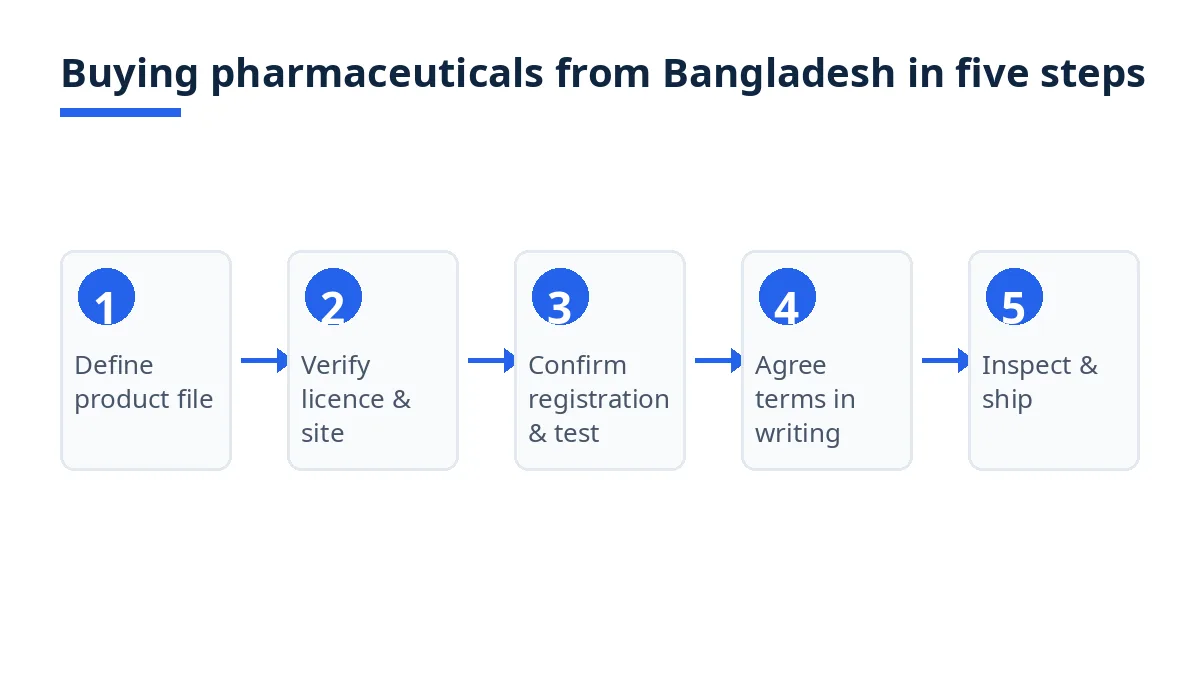
Define the product and the destination file. HS heading, product, strength and dosage form or supply specification, pack, destination, authorisation holder and registration position, labelling language, shelf-life rule and target quantity.
Shortlist and verify suppliers. Confirm the licence and site through the DGDA file, then run the verification checks, including API source and batch documentation.6 7
Confirm registration and test. Establish who registers the product at destination and on what timeline, test production-representative goods, and approve artwork and a pre-production pack in writing.2 8
Agree commercial terms in writing. MOQ, itemised price with validity and API basis, Incoterm with named place, staged lead time, payment terms, inspection point and transit storage record, all in the purchase order.10
Produce, inspect and ship. Monitor API arrival and batch release first, inspect against the approved pack and specification, then ship with the certificates, batch documents and origin evidence your positions depend on.8 11
Related guides
Read how to import from Bangladesh for the general import sequence behind the pharmaceutical steps above, Bangladesh export data for the category data in a wider export context, and Incoterms for shipments from Bangladesh for the delivery terms in more detail.
FAQs
Is Bangladesh a good place to source pharmaceuticals & medical supplies?
Bangladesh is a credible sourcing option for finished generic medicines and for the medical supplies inside Chapter 30 where the destination registration, the manufacturer licence and the batch file are managed actively. The country exported USD 238.5 million of pharmaceutical products in FY2025-26 on the EPB shipment series, up 12 percent on the year, and three exporters accounted for nearly half of exports in the preceding fiscal year on EPB data, so export capability is real but concentrated.1 3 The constraints to price in are imported API dependence and a two-to-five-year registration horizon described by industry executives for new destination files.3 2 Source product by product and market by market, not on the country label.
What is the typical MOQ?
There is no published typical MOQ for pharmaceuticals or medical supplies from Bangladesh, and no official body sets one. Each manufacturer quotes its MOQ from its production basis: a batch-size minimum per product, strength and pack for a finished medicine, a filling minimum for a liquid or infusion line, or a cutting, sterilisation and packing minimum per size for a dressing or suture line. Destination-language print and registration variants form part of the minimum, because each variant carries its own print setup.
How long is the lead time?
There are two lead times, and they should never be merged into one number. The registration lead time decides when a product may be sold at destination, and an industry executive description puts drug registration at two to five years.2 The production lead time for a registered product is the sum of its stages: API procurement, formulation, packing in destination livery, batch testing and release, export documentation, booking and transit, with API procurement the stage most exposed to import supply.3 Ask for the production stages separately and agree in writing what starts the clock.
Which certifications matter?
The requirements that matter are the ones your destination market and your product file require. At origin, the operative file is the DGDA manufacturing licence and product registration, with the DGDA as national regulatory authority for medicines, medical devices, vaccines and other biological products.6 For the manufacturing system, the reference definition is WHO GMP: products consistently produced and controlled to the quality standards appropriate to their intended use and as required by the marketing authorisation, aimed at diminishing cross-contamination, mix-ups and false labelling.8 At destination, your own market marketing authorisation, labelling and pharmacovigilance or device requirements apply in full, and buyer audits sit on top of that legal file rather than replacing it.
Next steps on Exportain
Browse Bangladeshi suppliers by pharmaceutical product type, use Exportain trade intelligence to check the market picture behind this guide, and post a free RFQ at Exportain RFQs with your product, strength or supply specification, pack, target quantity and destination market so suppliers can quote against the same written brief.
Sources
- Sri Lanka stays Bangladesh's top pharma export market in FY26. The Business Standard, (accessed )
- Pharma exports more than double in seven years. The Daily Star, (accessed )
- Medicine exports eye first-ever $250mn mark as earnings climb. The Financial Express, (accessed )
- Annual Export Receipts of Goods and Services 2024-25. Bangladesh Bank (accessed )
- Harmonized System: Chapter 30 Pharmaceutical products notes. World Customs Organization (accessed )
- Strengthening National Regulatory Authority. World Health Organization (accessed )
- Supplier verification: Earn trust badges buyers can see. Exportain (accessed )
- Guidelines: Production - WHO good manufacturing practices. World Health Organization (accessed )
- WTO members agree to extend drug patent exemption for poorest members. World Trade Organization, (accessed )
- Incoterms® rules. International Chamber of Commerce (ICC) (accessed )
- EU trade relations with Bangladesh. European Commission, (accessed )
About the author
Sourcing from Bangladesh?
Post a request for quotation and suppliers on Exportain can send you their quotes directly.
Post an RFQ