Sustainable Furniture & Home Decor From Bangladesh: Certifications and Green Factories
Furniture exports were USD 45.53 million in FY2024-25 on EPB data. This pillar covers certified timber, FSC and PEFC proof, EU deforestation duties, green factory checks, MOQ and lead times.
Short answer
Sustainable furniture from Bangladesh is furniture whose timber and board can be evidenced: imported certified material under chain of custody, since domestic timber is not FSC-certified, plus an EU deforestation file for EU orders. Exports were USD 45.53 million in FY2024-25. Buyers verify the certificate scope, material file and claim wording per consignment.
On this page
Key takeaways
Furniture exports were USD 45.53 million in fiscal year 2024-25 on the EPB fiscal-year series, down from USD 110.36 million in FY2021-22; the EPB headline does not split certified from uncertified shipments.
Bangladesh timber is not FSC-certified on a 2022 BIDA report, so certified export furniture rests on imported certified timber or board held under the factory's own chain of custody.
For EU wood furniture, Regulation (EU) 2023/1115 requires traceability to the plot of harvest, a 31 December 2020 deforestation cut-off and operator due diligence from 30 December 2026.
There is no industry-wide MOQ, price or lead time for furniture; all three are quoted per factory and per model against a written specification and a named Incoterm.
Around 25 companies currently export furniture on the BFIOA chairman's count, out of over 40,000 enterprises nationwide; verify certificate scope and export history factory by factory.
Sustainable furniture and home decor from Bangladesh means furniture whose timber, board, finishes and factory process can be evidenced, not only described: traceable wood under a chain of custody that survives an audit, and, for the European Union, a deforestation due diligence file reaching back to the plot of harvest. This pillar guide is for importers, retailers, hospitality buyers and sourcing agents in the United States, the United Kingdom, the European Union and the United Arab Emirates. It uses the same Export Promotion Bureau (EPB) export series as the sibling furniture industry pillar, keeps association figures separate from that series, and covers products and clusters, supplier checks, MOQ, pricing, certifications, shipping, Incoterms and duties.
Market overview with latest data
Furniture in Bangladesh is a large domestic industry and a small export industry, and certified export production is a subset of the export part. The domestic market is estimated at Tk 300 billion, with the sector employing around 2.5 million people, according to industry sources.1 Against that base, export earnings fell slightly by 0.37 percent in fiscal year 2024-25 to USD 45.53 million, down from USD 45.70 million in FY2023-24, according to the latest data from the Export Promotion Bureau (EPB).1 These are EPB fiscal-year figures, running from July to June. Keep them separate from calendar-year series and from association shipment figures, which use different coverage and are not interchangeable with the EPB series.
The recent EPB series, the same series used in the furniture industry pillar, reads as follows. Exports stood at USD 110.36 million in FY2021-22, then fell to USD 52.65 million in FY2022-23, a fall of more than 50 percent in a single year, then to USD 45.70 million in FY2023-24 and USD 45.53 million in FY2024-25.1 2 The first seven months of FY2024-25 showed a partial rebound inside that flat year: USD 26.67 million in July to January, a 13.65 percent increase on the same period a year earlier, according to the EPB.2 The government then declared furniture the Product of the Year.2 Neither figure describes the sustainable segment on its own, because the EPB headline does not split certified from uncertified shipments.
Industry insiders attribute the wider downtrend in part to lower competitiveness, lack of proper certifications and inadequate country branding, alongside rising production costs and trade complications with markets such as India.1 Certification is therefore not a decoration on this category: on this reporting, it is one of the named gaps between the peak year and the present one.
Two forward figures circulate, on different bases, and neither is an EPB outturn. The EPB vice-chairman said the sector could generate around USD 3 billion by 2030 with adequate policy support, including a bonded warehouse facility.2 Separately, the Bangladesh Furniture Industry Owners Association (BFIOA) side targets USD 500 million within five years, linked to a planned temporary duty-free bond facility for partial exporters.3 Treat both as stated ambitions with conditions attached, and plan against the recorded USD 45.53 million.
The structural point behind every sustainability claim here is import dependence. Most raw materials and accessories are brought from abroad, with import duties on some items as high as 90 percent, and total duties, taxes and VAT on some inputs, including hardware, lacquer and fabrics, reported at more than 100 percent.1 3 The timber story of a Bangladeshi piece often begins outside Bangladesh, in an imported certified board or timber consignment, so the chain of custody you audit is an import chain as much as a factory chain.
Main products and production clusters
Furniture and home decor sit mainly in Chapter 94 of the Harmonized System, which covers furniture, bedding, mattresses, mattress supports, cushions and similar stuffed furnishings, lamps and lighting fittings, illuminated signs and prefabricated buildings.4 The headings a furniture buyer uses most often are:
HS heading | What it covers | Typical Bangladesh products |
|---|---|---|
9401 | Seats, other than those of heading 9402, whether or not convertible into beds, and parts thereof | Chairs, sofas, office seating and seat parts in wood, metal and upholstery |
9402 | Medical, surgical, dental or veterinary furniture, and barbers' chairs and similar chairs, and parts | Hospital beds, examination tables and salon chairs |
9403 | Other furniture and parts thereof, not elsewhere specified in Chapter 94 | Wooden bedroom, kitchen and office furniture, tables, cabinets and parts |
9404 | Mattress supports and articles of bedding, including mattresses, quilts, cushions and pillows, fitted with springs or stuffed | Mattresses, cushions and padded bedding and decor lines |
9405 | Lamps and lighting fittings, illuminated signs and name-plates, and parts | Home decor lighting and illuminated signage |
9406 | Prefabricated buildings | Prefabricated structures and building units |
Agree the six-digit subheading with your supplier and broker before you order, because the heading decides the duty line, the product rules and, for EU wood products, the deforestation due diligence file.4 5
The sustainable offer follows the material, not the heading alone. Lines divide into solid wood, engineered board, metal and plastic furniture, and upholstered seating, plus decor under 9404 and 9405. The evidence differs by line: a solid wood piece turns on species, country of harvest and chain of custody; a board piece on the panel maker and its certified content; an upholstered piece adds fabric, foam and finish chemistry. A certificate covering one line does not automatically cover the next line on the same floor.
One timber fact shapes the category. A 2022 Bangladesh Investment Development Authority (BIDA) report, reported by The Business Standard, pointed out that Bangladesh's timber is not FSC-certified, forcing exporters to import certified wood for export-oriented furniture production, and that the country needs a traceable, sustainably managed forestry system.3 That does not bar an FSC claim on Bangladeshi furniture. It means the certified input behind an export piece is, on that reporting, imported certified timber or board held under the factory's own chain of custody. Your audit starts at the import invoice and the supplier's certificate, not at a Bangladeshi forest.
Production clusters are urban, and the base is wide and mostly domestic. Prominent Dhaka clusters include Badda, Mirpur and Sutrapur, several large firms sit in Gazipur and Savar, and larger firms concentrate in cities that include Chattogram, Dhaka and Sylhet.6 Around 70,000 entrepreneurs are involved, with over 40,000 enterprises operating nationwide and employing about 2.5 million people, on figures reported with BFIOA data.3 The exporter association has 22 members and the BFIOA over 500 registered members.1 Around 25 companies currently export furniture, according to the BFIOA chairman.3
Key players are the exporting brands, because they hold the references and imported-material lines a buyer can check. HATIL leads, now available in the USA, Canada, the UAE, Saudi Arabia, India and Bhutan; other exporters include Otobi, Regal Furniture, Navana and Akhtar Furnishers.3 EPB reporting also names Partex and HI-TECH, shipping primarily to China, India, Nepal, the United States, the European Union and Canada.1 Start with the exporting brands, then test each candidate on heading, destination and certificate scope.
How to find and verify suppliers
Find suppliers through more than one channel so you can cross-check what a factory tells you. Start with the two associations above, add Bangladesh export data and Exportain trade intelligence for context, then work Bangladeshi suppliers listings by product and read the sibling furniture industry in Bangladesh pillar. Given that only around 25 companies currently export on the BFIOA chairman's count, a long list of claimed exporters is itself a reason to check harder.3
For a sustainable order, verification has two layers: the normal export checks, and the claim checks. Ask for, and read, the following before you discuss price in detail:
Trade licence and export registration in the company's own name, plus association membership where claimed, checked against the exporter association's 22-member picture.1
Export history: anonymised bills of lading or shipment summaries for your target market, showing heading, volume and recency, because most of the country's roughly 40,000 furniture companies serve the domestic market only.3
The certificate itself, where a certified claim is made: certificate number, issuing body, the sites and product groups in its scope, and expiry date. Check the number in the scheme's own certificate search before you repeat the claim.
The timber and board file: species by common and scientific name, country of harvest, import documents for certified material, and how certified and uncertified stock are identified and kept apart.7
The green factory evidence behind any green claim: what it covers, and the audit, building or utility record that supports it. A claim with no named scope is marketing copy, not evidence.
Test reports and finish samples for the exact construction, including moisture content, finish adhesion and load testing for seating.
Factory profile evidence: cutting, machining, finishing and packing capacity per day, and whether upholstery or finishing is in-house or subcontracted, because a subcontracted stage sits outside the certificate scope unless named in it.
On Exportain, read badges for what they are. Supplier profiles carry document and photo review badges: verification is free, Exportain staff review every submission, and approved checks earn badges shown on the company page, product listings and quotations; it is a document and photo review, not a factory inspection, and membership plans never grant a badge.8 A badge is not a forest certification, an environmental audit or a guarantee. Exportain is a B2B marketplace and is not a party to the contract for goods; it does not inspect goods, book freight or clear customs. Use the badge as a first filter, then run the checks above yourself or through an inspection firm you appoint.
Two red flags end a conversation early: a supplier that uses a certification logo in a quotation but cannot produce a certificate whose scope names its own site and your product group, and a supplier that describes domestic timber as certified when the BIDA reporting records that domestic timber is not FSC-certified and exporters import certified wood for export production.3 In both cases the claim runs ahead of the paper.
MOQ, pricing and lead times
There is no industry-wide MOQ, standard price or standard lead time for furniture from Bangladesh, and no official body publishes one. All three are quoted per factory, per model and per order, against a written specification. What follows is how each is built, and what the sustainable specification adds.
MOQ. The minimum is set by the production stage and, on a certified order, by the certified material batch: a panel minimum per board type and thickness, an imported certified timber parcel per model, or a finishing minimum per finish and colour. State your target quantity per model, per finish and per packing format, and ask the factory to quote its MOQ on the same basis, including the material batch behind it.
Pricing. Your unit price is built from timber or board, hardware, lacquer and finish, fabric and foam where they apply, labour and machining, packing, and export costs to the agreed Incoterm point. Two cost facts sit inside that build: most raw materials are imported, with duties on some items as high as 90 percent and total duties, taxes and VAT on some inputs reported at more than 100 percent, and a certified input is a specific imported consignment with its own price and paperwork, not a generic material line.1 3 Ask each factory to itemise the certified material, its claim and its price validity period in writing.
Example figures. For illustration only: a specification for 200 wooden side tables in imported certified board and timber is quoted by two suppliers at FOB Chattogram. Supplier A quotes USD 84 per table itemised as certified board and timber USD 38, hardware and finish USD 14, making USD 22 and packing and export costs USD 10, with the chain of custody claim stated. Supplier B quotes USD 76 per table with no itemisation and no claim stated. The totals are USD 16,800 from Supplier A and USD 15,200 from Supplier B. The example shows the method, not a market price: the buyer asks Supplier B for the same itemisation and the certificate behind the material before treating the USD 1,600 gap as a saving, because an unitemised gap on a certified specification is usually uncertified material, a thinner board or a cheaper finish.
Lead times. A lead time is a chain, not a single number: certified material import and clearance, machining, finishing, upholstery where it applies, inspection and booking, then transit. The first stage is the one a domestic order does not carry, because the certified timber or board is imported for export production.3 Ask for the stages separately, with the material stage stated on its own and its start point defined, normally written order confirmation plus approved sample and confirmed material booking.
Quality, certifications and compliance
Quality and sustainability are decided by three layers: destination product and environmental law, the voluntary scheme your claim rests on, and your own specification and testing. Keep them separate in the purchase file: a pass in one layer is not a pass in the others.
FSC chain of custody. Chain of custody certification is how the Forest Stewardship Council (FSC) verifies that forest-based materials produced according to its standards are credibly used along the product's path from the forest to becoming finished goods, and the FSC label on a finished product signals that the materials used during production have met the chain of custody requirements at every step, from sourcing to distribution.7 To qualify, an organisation must run a management system under which its forest-based materials are FSC-certified, including reclaimed materials, certified material is identified and tracked during manufacturing and distribution, and records of certified production, purchase and sales are kept; it must also meet FSC core labour requirements, including no child or forced labour, no discrimination, and freedom of association.7 Certification is issued by a third-party FSC-accredited body after an assessment, with annual audits.7 A factory-level certificate does not certify a consignment whose sales documents carry no claim.
PEFC chain of custody. The Programme for the Endorsement of Forest Certification (PEFC) runs a parallel route: a voluntary, market-based instrument implemented through sustainable forest management certification and chain of custody certification.9 PEFC chain of custody certification is open worldwide to companies that manufacture, process, trade or sell forest-based products, and provides independent verified assurance that the certified forest-based material in a product originates from sustainably managed forests.9 FSC and PEFC are different schemes with different standards, certificates and labels. Do not accept one scheme's paperwork as evidence for the other scheme's claim.
EU deforestation due diligence. For wood furniture placed on the EU market, Regulation (EU) 2023/1115 sits above both voluntary schemes. It sets binding rules for EU operators, downstream operators and traders making available wood and certain derived products, which include furniture, on the EU market or exporting them from the EU.5 Operators must trace products back to the plot of land where they were produced and declare that they have exercised due diligence, and only products produced on land not subject to deforestation or forest degradation after 31 December 2020 can be placed on the EU market.5 As amended, operators that are not micro- or small enterprises must comply from 30 December 2026, and micro- and small enterprises from 30 June 2027, and penalties include fines of at least 4 percent of an operator's annual EU turnover.5 Your supplier file for an EU wood order therefore needs species, country of production and harvest geolocation evidence in a form your EU operator can use. A voluntary certificate can support that file; it does not replace the operator's due diligence duty.
Green factories. Treat green factory as a claim that needs a scope. The furniture reporting in this guide names the practices industry experts point to for export competitiveness: eco-friendly manufacturing, waste recycling and green certification, alongside modern machinery, automation and adherence to international production standards.3 Ask a factory making a green claim to name which practice it operates, for which building or line, and what record supports it, such as a building certificate in its own name, energy and water records, a waste transfer record or a chemical inventory. Do not transfer a green building count from another Bangladesh sector to furniture: a total published for garment factories states nothing about a furniture plant.
Your own quality system. Write the specification so an inspector can measure it: species and board type with its certified claim, dimensions and tolerances, moisture content, joint and finish requirements, load and stability testing for seating, hardware, and packing with pieces per unit. Approve a pre-production sample and a counter-sample made from the production material batch where the claim matters, set the inspection point before cartons are closed, and test production-representative goods, not showroom samples.
Shipping, Incoterms and duties
Furniture normally leaves by sea from Chattogram, the country's main seaport. It is bulky relative to weight, and flat-packed board furniture, assembled solid wood and upholstered seating price freight very differently, so confirm carton dimensions, pieces per carton and gross weight in the specification. On certified orders, add the document set to the packing check: the sales documents carrying the chain of custody claim travel with the consignment file, and for EU wood orders the harvest evidence behind the due diligence statement must be complete before shipment.7 5
Incoterms 2020, in force since 1 January 2020, is the current edition of the ICC rules: eleven three-letter terms that clarify the tasks, costs and risks in the delivery of goods, recognised as the global standard for interpreting the most common terms in foreign trade.10 The four rules you will meet most often work as follows:
Rule | Who arranges and pays main freight | Where risk passes to the buyer | Practical note for furniture goods |
|---|---|---|---|
EXW (Ex Works) | Buyer | At the seller's premises | Buyer carries export clearance workload; rarely suitable for a first order |
FOB (Free On Board) | Buyer | When goods are on board the vessel at the named loading port | The common Bangladesh furniture term; name the port, for example FOB Chattogram, Incoterms 2020 |
CIF (Cost, Insurance and Freight) | Seller, plus minimum insurance | When goods are on board at the loading port | Seller's freight is convenient, but risk still passes at loading, not at arrival |
DAP (Delivered at Place) | Seller | At the named destination place, ready for unloading | Buyer still clears import and pays duty unless the contract says otherwise |
Always write the rule with its named place and edition, for example "FOB Chattogram, Incoterms 2020". Exportain does not book freight or clear customs.8
Duties are decided by the heading, the origin of the goods and the destination's preference scheme, in that order. As a least developed country, Bangladesh benefits from the Everything But Arms (EBA) arrangement, which grants full duty-free and quota-free access to the EU Single Market for all products except arms and ammunition.11 Furniture meeting the EBA rules of origin, shipped with the required proof of origin, therefore enters the EU without customs duty while Bangladesh holds that status. Two cautions apply. First, preference is a property of the consignment, not the country: if the origin evidence fails, the standard third-country duty applies. Second, EBA treatment and EUDR due diligence are separate files: duty-free entry is not a deforestation pass, and a due diligence statement does not by itself prove origin for preference.5 11 For India, note that exports there have been disrupted by entry restrictions, with only the Benapole land port currently usable on exporter reporting.1 For the United States, the United Kingdom and the UAE, read the duty beside your confirmed six-digit code in the destination tariff; this guide states no rate for them, because rates vary by heading.
Step-by-step buying process
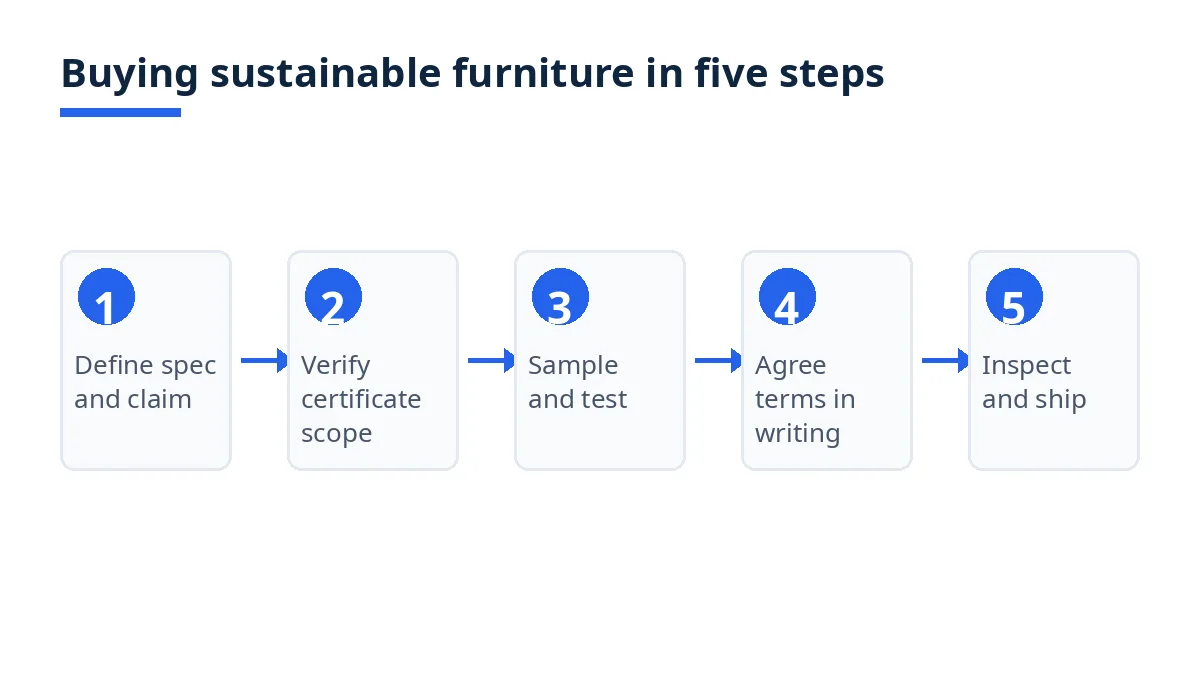
Define the specification and the claim. Write both before you shop for either: HS heading, species or board type, the exact certified claim or EU due diligence file you need, dimensions, finish, target quantity and destination.
Shortlist and verify suppliers. Build a shortlist from association lists and supplier listings, confirm the factory exports, then run the document and claim checks above, including the certificate scope check in the scheme's own search.3 7 9
Sample and test. Order samples against the specification, made from production material where the claim matters, test them, and approve a counter-sample in writing.
Agree commercial terms in writing. Fix MOQ per model and batch, itemised unit price with validity period and certified material line, the Incoterm with its named place, staged lead time, payment terms and inspection point, all in the purchase order.10
Produce, inspect and ship. Monitor material import and machining first, inspect finished goods against the counter-sample, confirm the claim wording on the sales documents and the origin and harvest evidence your duty and due diligence positions depend on, then ship.5 11
Related guides
Read how to import from Bangladesh for the general import sequence, the furniture industry in Bangladesh pillar for the full category picture, and Bangladesh export data for category scale. Sustainable home textiles from Bangladesh covers the neighbouring soft decor category, and Incoterms for shipments from Bangladesh covers the delivery terms in detail.
FAQs
Is Bangladesh a good place to source furniture & home decor?
Bangladesh is a credible option where the claim is managed as evidence, factory by factory and consignment by consignment. The base is real: a domestic market estimated at Tk 300 billion, about 2.5 million people employed, and exports of USD 45.53 million in FY2024-25 on the EPB series.1 The constraint is equally specific: around 25 companies currently export on the BFIOA chairman's count, domestic timber is not FSC-certified on the BIDA reporting, so certified production rests on imported certified timber under chain of custody, and lack of proper certifications is a cause the industry itself names for the export decline.3 1 Source the certificate and the material file, not the country label.
What is the typical MOQ?
There is no published typical MOQ, and no official body sets one. Each factory quotes its MOQ from its production stage and, on a certified order, from the material batch it must import to run your model: a panel minimum per board type, a timber parcel per species, or a finishing minimum per finish. State your target quantity per model and finish in your enquiry, so quotes compare directly.
How long is the lead time?
There is no standard lead time: yours is the sum of its stages, certified material import and clearance, machining, finishing, upholstery where it applies, inspection and booking, and transit. The first stage is the one a domestic order does not carry, because certified timber and board are imported for export production.3 Ask for the stages separately and agree in writing what starts the clock.
Which certifications matter?
The requirements that matter are the ones your destination market and your buyers require for the exact product and claim. For a certified wood claim, the operative evidence is a chain of custody certificate in the factory's own name whose scope names its site and your product group, under FSC or under PEFC, which provides independent verified assurance that the certified forest-based material in a product originates from sustainably managed forests.7 9 For EU wood furniture, Regulation (EU) 2023/1115 adds a legal layer above both schemes: traceability to the plot of land, a 31 December 2020 cut-off, and a due diligence declaration by the EU operator.5 Audits named in a buyer's vendor manual sit on top of that file and replace no part of it.
Next steps on Exportain
Browse Bangladeshi suppliers by product and material, check Exportain trade intelligence, and post a free RFQ at Exportain RFQs with your specification, quantity, destination and the exact certification or due diligence file you need.
Sources
- Furniture exports decline amid rising costs, policy gaps. The Financial Express, (accessed )
- Furniture exports rising. Can govt recognition spur the growth further?. The Daily Star, (accessed )
- Furniture industry eyes $500m export boost in five years with focus on technology and design. The Business Standard, (accessed )
- Classification Detail: HS Code 94. United Nations Statistics Division (accessed )
- Fighting deforestation and forest degradation: Regulation (EU) 2023/1115 summary. European Commission, EUR-Lex (accessed )
- Unleashing the Export Potential of Bangladesh's Furniture Industry: An Analysis of Prospects and Policy Support. Bangladesh Enterprise Institute (accessed )
- Chain of Custody Certification. Forest Stewardship Council (accessed )
- Supplier verification: Earn trust badges buyers can see. Exportain (accessed )
- Get certified. Programme for the Endorsement of Forest Certification (accessed )
- Incoterms® rules. International Chamber of Commerce (ICC) (accessed )
- Trade arrangements. European Commission, Access2Markets (accessed )
About the author
Sourcing from Bangladesh?
Post a request for quotation and suppliers on Exportain can send you their quotes directly.
Post an RFQ