Polo Shirts Price in Bangladesh: FOB Cost Breakdown for Buyers
How a polo shirts price in Bangladesh is built: fabric, collar and placket, making, logo work, testing, packing, transport and margin, line by line.
Short answer
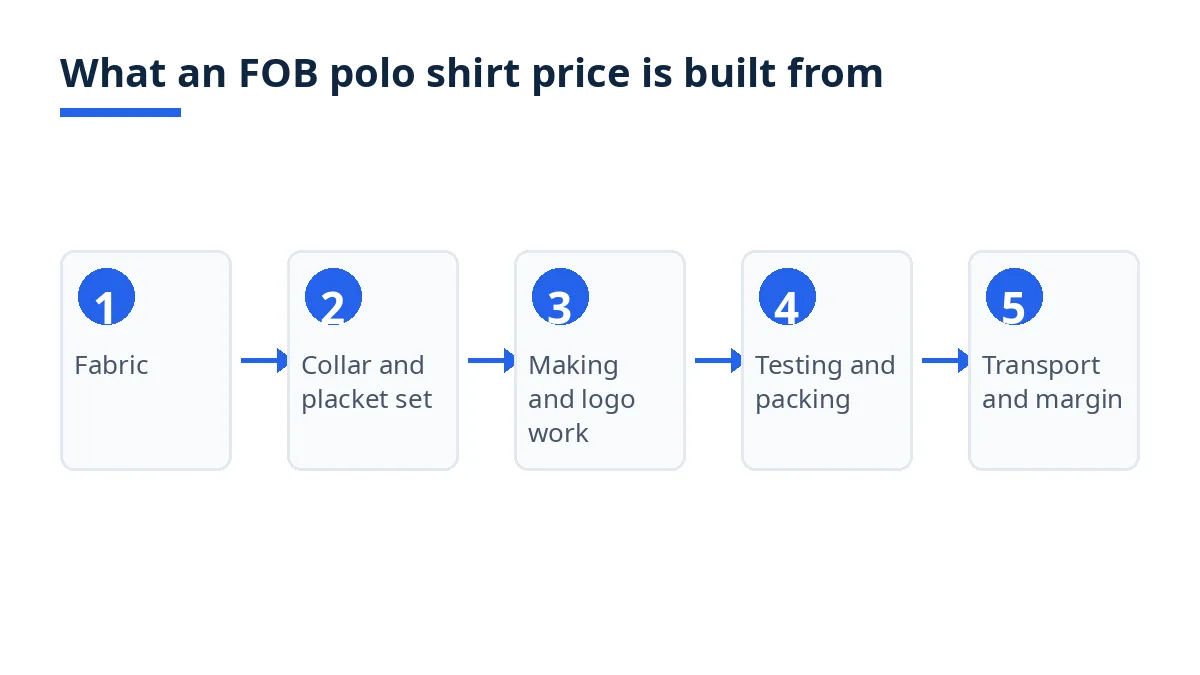
There is no standard polo shirts price in Bangladesh that a buyer can look up, because no official source publishes one. Each factory builds its FOB price line by line for your specification: fabric, collar and placket set, making, logo work, testing, packing, inland transport and margin. Compare itemized quotations on one Incoterm and one tech pack, and treat any worked numbers as example figures only.
On this page
Key takeaways
There is no standard polo shirts price in Bangladesh, because each factory builds its FOB price line by line for your specification.
Fabric is usually the largest line, and composition, knit type, weight and color move it most.
The collar and placket set and logo work are polo-specific lines that a plain T-shirt price does not include.
Compare itemized quotations line by line on one tech pack and one Incoterm, with set-up charges shown apart from the per-piece lines.
Exportain verification is a document and photo review, not a factory inspection, and a badge is not a guarantee.
A polo shirts price in Bangladesh is not a market rate you can look up. It is a figure a factory builds line by line for your specification, and no official source publishes a standard per-piece price. This guide shows what the free on board (FOB) price is built from, what moves each line, and how to compare itemized quotations on one term.
The Bangladesh Knitwear Manufacturers and Exporters Association (BKMEA), established in 1996, is the apex trade body for the knitwear sector and currently represents approximately 2,540 knitwear member factories.1 Knitwear exports reached $5.963 billion in July to September 2026, up 6.88 percent year on year, within ready-made garment exports of $10.578 billion, according to data released by the Export Promotion Bureau (EPB).2 Several factories can build a price for your shirt, but each build starts from a different specification, so the scale produces no shared price.
What the FOB price is built from
What should I know first about polo shirts?
Classification and labelling sit underneath the price. In the Harmonized System, chapter 61 covers apparel and clothing accessories, knitted or crocheted, and heading 6105 covers men's or boys' shirts, knitted or crocheted.3 The subheadings split by fiber: 610510 for cotton, 610520 for man-made fibers, and 610590 for other textile materials.3 If you sell into the European Union, Regulation (EU) No 1007/2011 states that a textile product shall be labelled or marked with the name and percentage by weight of all constituent fibres in descending order.4 The composition you declare is the composition the factory must buy, so it belongs in the tech pack before any price is built. See the HS code for polo shirts guide.
FOB is a boundary, not a costing method. The International Chamber of Commerce states that the Incoterms 2020 rules set out 11 rules with a clear allocation of cost, risk and obligations.5 Under an FOB quotation, the unit price must carry the garment and the seller-side costs up to the agreed delivery point under that rule. A price quoted ex works stops earlier and covers less. Every line below sits inside an FOB build; if a quotation uses another term, ask which lines move in or out.
Cost line | What it covers | What moves it |
|---|---|---|
Fabric | Yarn or bought fabric, knitting, dyeing and finishing for the body and sleeves | Composition, knit type such as pique, fabric weight, dyed-to-order color |
Collar and placket set | Knitted collar and cuffs, placket construction, buttons and buttonholes | Collar size and color range, placket length, button type |
Making | Cutting, sewing, thread and trims, pressing | Operations, stitch specification, size range |
Logo work | Embroidery or print on the garment | Method, stitch count or number of colors, size and placement |
Testing and inspection | Lab tests you require and bulk inspection against the sample | Test list for the destination, inspection level |
Packing | Labels, hang tags, folding, polybags and export cartons | Private labels, tag and carton specification |
Inland transport and export handling | Moving cartons to the port or depot and seller-side export filing work | Factory distance from the port, document set |
Margin | The factory margin over its built cost | Capacity, size per color, payment terms |
Fabric is usually the largest line, and the line most sensitive to your choices. A heavier fabric uses more material per shirt, a dyed-to-order color carries the dye lot with it, and a blend changes the yarn the factory buys. When two quotations differ mainly on fabric, the shirts differ, not only the prices.
Collar, placket and logo work are polo-specific lines. A plain T-shirt has no knitted collar set, no placket and often no chest logo. Each part adds material and operations, priced from your specification. A quotation that folds these into one making figure cannot be checked line by line.
Testing, packing and inland transport are real lines, not padding. Testing follows the destination rules you must meet, packing follows your label, tag and carton specification, and inland transport follows the distance to the port named in the term. Ask for each as its own line.
Why this matters for buyers and sellers
For the buyer, the unit price decides margin on stock that must sell through by size and color. A price built on a lighter fabric or a simpler collar produces a different shirt. For the seller, each line is a cost committed against your specification: fabric dyed in your color and labels printed with your brand cannot be sold to another buyer.
Two controls protect both sides. The first is an inspection plan agreed before production. ISO 2859-1 defines a system of acceptance sampling plans for inspection by attributes, indexed by acceptance quality limit (AQL) for lot-by-lot inspection.6 AQL is the maximum average percentage of defective items considered acceptable during random sampling, and it determines sample sizes and acceptance or rejection thresholds.6 The second is one delivery term for every quotation, because the Incoterms 2020 rules allocate cost, risk and obligations for each rule,5 so a breakdown is comparable only when every factory builds to the same boundary.
Step-by-step: how it works
Work through the steps in order.
Send one tech pack to every candidate. State fabric composition and knit type, fabric weight, collar and cuff construction, placket and buttons, a size chart, logo method and placement, label wording, the quantity split per color and size, packing, and the delivery term and named place.
Ask for the price built line by line. Request fabric, collar and placket set, making, logo work, testing, packing, inland transport and margin as separate lines, with set-up charges shown apart.
Check the company behind the quotation. Record whether the company will cut and sew in its own factory or place the order with a factory it selects, with the legal company name. Ask to see the trade licence and, for an exporter, the Export Registration Certificate (ERC).
Approve samples in writing. Order a proto sample, then a pre-production sample in your actual fabric, color, collar, placket, logo and labels. Measure and wash it, then approve it in writing, or list corrections in writing. The sample is the standard each price line was built against.
Compare the breakdowns on one Incoterm. Line the quotations up line by line on the same term.5 Where one line is far below the others, ask what specification sits behind it before you treat the total as a saving.
Agree the inspection plan before production. Write the inspection level and AQL values into the purchase order, following ISO 2859-1,6 and name who inspects. Use the polo shirts quality control checklist for collar shape, placket alignment and buttons.
See polo shirts manufacturers in Bangladesh for the factory checks.
Costs, timelines and documents
What are the typical costs and timelines?
There is no typical FOB price, minimum order quantity (MOQ) or lead time a guide can state as fact, because each factory builds all three from your specification.
Example figures: one men's cotton pique polo shirt, quoted FOB, built as fabric $2.10, collar and placket set $0.35, making $0.85, logo embroidery $0.20, testing and inspection $0.10, packing $0.15, inland transport and export handling $0.20, and margin $0.45, for a total of $4.40 per piece. These figures illustrate how a breakdown adds up. They are not a market price or an offer, and your specification will produce a different build.
Read the example for its structure. Fabric is the largest line, so a change in composition or weight moves the total more than a change in packing. Set-up charges for logo work or label print runs may sit outside the per-piece build, so ask where they appear. If a quotation gives only a total, you cannot run this check.
For timelines, sampling depends on fabric availability and correction rounds, and bulk production on dyeing, trim delivery and line capacity. Ask for sampling, fabric ready, production and inspection dates as separate lines.
Each stage should rest on a document. The order stage is the tech pack, the itemized quotation and the purchase order, agreeing on specification, price build, Incoterm and payment terms. The production stage is the written sample approvals and the inspection report. The export stage is the commercial invoice, packing list, EXP form, certificate of origin and Bill of Export.
Which documents are needed?
For export clearance in Bangladesh, goods may not be loaded unless an export declaration, the Bill of Export or Shipping Bill, is submitted to Customs and approved.7 Enclosed documents include the export contract or purchase order where there is no export letter of credit, the commercial invoice, the packing list, the EXP form certified by an authorized dealer, and a certificate of origin issued by the EPB or a Chamber of Commerce and Industry.7 Keep the itemized quotation and written sample approval with the export set.
Bangladesh-specific rules and tips
Confirm association claims at the source. If a supplier claims BKMEA membership, confirm it with the association itself. BKMEA represents the knitwear sector and its member factories,1 so membership signals an active knitwear business. It does not establish the price build for your shirt.
Keep one legal name across every paper. The export declaration names the exporter and the foreign buyer,7 so the name on the trade licence, quotation, proforma invoice and payment account should match. If names differ, get the reason in writing before any payment.
Price the split, not only the total. Dyeing, collar knitting and label printing run per color, so the same total split across more colors raises the build per piece. State your split per color and size and check that the quotation was built on it. The MOQ explained guide covers how minimums interact with the split.
Ask which lines are bought in. Buttons, specialty yarns and some labels may be bought in for your specification, and a bought-in line can move with the factory's supplier.
Mistakes and red flags
What are the most common mistakes?
Comparing totals built on different specifications. A lower total on a lighter fabric, a simpler collar or a different term is a different shirt or a different boundary.5 Compare line by line, on the same tech pack and the same Incoterm.
Accepting a single lump-sum price. Without a breakdown, you cannot tell whether testing, packing or inland transport is included, and you cannot price a specification change later.
Treating an example or a stock price as your price. A figure built for another specification, split or term does not transfer to your order. The only price that applies is a build against your tech pack.
Negotiating the total instead of the lines. Pressing the total usually moves the specification, not the margin: a lighter fabric or a simpler collar appears at delivery. Negotiate a named line, and record any specification change in writing.
Approving the sample verbally. The pre-production sample is the physical version of the price build. Without a written approval, there is no standard to inspect bulk against.
Treating a profile or a badge as verification. A profile is a starting point for enquiries. A badge is not a guarantee of production capacity, product quality or delivery.8
Checklist
Before you confirm, every line should be answered in writing.
Tech pack sent to every candidate: fabric, collar, placket, logo, labels, sizes, packing.
Itemized quotations on the same specification and Incoterm, margin and set-up charges apart.5
Fabric line checked against composition, knit type and weight in the tech pack.
Collar and placket set, logo work, testing, packing and inland transport each priced as its own line.
Quantity split per color and size stated; build confirmed against that split.
Factory or trading company status recorded; trade licence and ERC checked.
Pre-production sample measured, washed and approved in writing.
Inspection level and AQL values in the purchase order; inspector named.6
Export set agreed: invoice, packing list, EXP form, certificate of origin, Bill of Export.7
How Exportain helps
On Exportain, browse suppliers in the knitwear categories and post a request for quotation (RFQ) on the RFQ board with your tech pack summary, quantity split, destination and delivery term, so suppliers build prices against the same specification. Compare the itemized replies line by line on one term. When you accept a quotation, Exportain creates one order and issues one proforma invoice from the accepted terms.8
Read the badges for what they record. Exportain Verified means Exportain has checked identity, phone, email and business registration, and Export Verified means it has checked the Export Registration Certificate (ERC).8 Factory Verified means it has reviewed photos of the manufacturer factory, while Trading Company Verified means it has reviewed photos of the trading company office or warehouse.8 Verification is a document review by staff, free, and never granted by membership plans.9 It is not a factory inspection,8 9 so sample approval and inspection stay with you. See how supplier verification works on Exportain.
FAQs
What should I know first about polo shirts?
Know what the price is built from before you ask for one. An FOB price is built from fabric, the collar and placket set, making, logo work, testing, packing, inland transport and margin, for your specification and term. Men's knitted polo shirts sit under HS heading 6105, split by fiber into 610510 for cotton and 610520 for man-made fibers.3
What are the typical costs and timelines?
There are no typical figures a buyer can rely on, because each factory builds its price, MOQ and lead time for your specification. Fabric is usually the largest line; collar and placket construction, logo work, the split, packing and the term move the rest.5 Sampling rounds, dyeing, trim delivery and line capacity drive the timeline.
Which documents are needed?
The order documents are the tech pack, the itemized quotation and the purchase order. The export set is the Bill of Export, the commercial invoice, the packing list, the EXP form certified by an authorized dealer, and a certificate of origin issued by the EPB or a Chamber of Commerce and Industry, with the export contract or purchase order enclosed where there is no export letter of credit.7
What are the most common mistakes?
The most common mistakes are comparing totals built on different specifications or terms,5 accepting a lump-sum price, treating a figure built for another order as your price, and approving the sample verbally. A badge is not a guarantee of capacity, quality or delivery,8 and verification is a document and photo review, not a factory inspection.8 9
Next steps on Exportain
Browse suppliers, then post your tech pack summary, split and delivery term on the RFQ board and ask each reply for an itemized FOB breakdown. Before bulk production starts, read how to import polo shirts from Bangladesh.
Sources
- BKMEA at a Glance. BKMEA (accessed )
- Exports up over 6% to $13.1bn in Q1 of current fiscal. United News of Bangladesh (accessed )
- Classification Detail — HS Code 6105. United Nations Statistics Division (accessed )
- Regulation (EU) No 1007/2011 on textile fibre names and related labelling and marking of the fibre composition of textile products. European Union, (accessed )
- Incoterms® 2020. International Chamber of Commerce (ICC) (accessed )
- ISO 2859-1:2026 - Sampling procedures for inspection by attributes — Part 1: Sampling schemes indexed by acceptance quality limit (AQL) for lot-by-lot inspection. ISO (accessed )
- Customs Clearance Procedures for Export. Bangladesh Customs, National Board of Revenue (accessed )
- Trust & Safety Center. Exportain (accessed )
- Supplier verification: Earn trust badges buyers can see. Exportain (accessed )
About the author
Sourcing from Bangladesh?
Post a request for quotation and suppliers on Exportain can send you their quotes directly.
Post an RFQ