HS Code for Polo Shirts: Classification Guide for Importers
Knitted polo shirts split between heading 6105 for men and boys and heading 6106 for women and girls, with the subheading set by fibre. This guide explains what decides the code and how to confirm the full national code in the US, EU and UK.
Short answer
Knitted or crocheted polo shirts have no single hs code for polo shirts. Men's or boys' styles point indicatively to heading 6105 and women's or girls' styles to heading 6106, with the six-digit subheading set by fibre, for example 6105.10 or 6106.10 for cotton. Only the first six digits are shared worldwide, so confirm the full 8- to 10-digit national code in the destination tariff before filing.
On this page
Key takeaways
Heading 6105 covers men's or boys' shirts, knitted or crocheted, and heading 6106 covers women's or girls' blouses, shirts and shirt-blouses.
The six-digit subheading is set by fibre: .10 for cotton, .20 for man-made fibres and .90 for other textile materials under both headings.
A collar and a partial opening at the neckline make a polo a shirt under 6105 or 6106, not a T-shirt under 6109, and a woven polo belongs in Chapter 62.
Only the first six digits are harmonized worldwide; the full code runs to eight digits in the EU and ten digits in the US and UK.
Confirm the full national code in the destination official tariff, and use a binding ruling for borderline garments.
If you import knitted polo shirts, the hs code for polo shirts is the line your customs entry and duty calculation depend on. The Harmonized System behind that code is a multipurpose international product nomenclature developed by the World Customs Organization (WCO), used by more than 200 countries and economies as a basis for their customs tariffs and trade statistics.1 A polo shirt has no single code: the wearer decides between two headings, and fibre decides the subheading. This guide gives the indicative headings and explains how to confirm the full national code before you ship.
Quick answer: indicative headings 6105 and 6106
The indicative headings for knitted or crocheted polo shirts are 6105 for men's or boys' shirts and 6106 for women's or girls' blouses, shirts and shirt-blouses. In the Harmonized Tariff Schedule of the United States (HTS), published by the U.S. International Trade Commission (USITC), heading 6105 covers "Men's or boys' shirts, knitted or crocheted" and heading 6106 covers "Women's or girls' blouses and shirts, knitted or crocheted."2 The fibre lines follow the same pattern under each heading: .10 for cotton, .20 for man-made fibres and .90 for other textile materials, so a men's knitted cotton polo points to 6105.10 and a women's to 6106.10.2
Treat both headings as indicative until verified for your exact garment. They cover only knitted or crocheted garments that meet the Chapter 61 shirt definition. A woven polo-style shirt belongs in Chapter 62. Confirm the full 8- to 10-digit national code with your customs broker or through a binding ruling before you file.
How HS codes are structured
The HS nomenclature is arranged in a legal and logical structure: sections, chapters at two digits, headings at four digits and subheadings at six digits.3 Countries then add their own digits for duty rates, statistics and controls, and the EU Combined Nomenclature integrates the HS and adds eight-digit subdivisions.3
Level | Digits | For polo shirts |
|---|---|---|
Chapter | 2 digits (61) | Articles of apparel and clothing accessories, knitted or crocheted |
Heading | 4 digits (6105 or 6106) | Men's or boys' shirts, or women's or girls' blouses, shirts and shirt-blouses, knitted or crocheted |
Subheading | 6 digits (for example 6105.10) | The same garments, split by fibre |
National extension | 8 to 10 digits | Set by the importing country for its own tariff and statistics |
Chapter matters because Chapter 61 applies only to made up knitted or crocheted articles, so construction decides the chapter before styling is considered.2 If you are new to the system, read the HS code explainer first, then how to classify your product.
The diagram below summarises the four levels, from the two-digit chapter to the national code you file at destination.
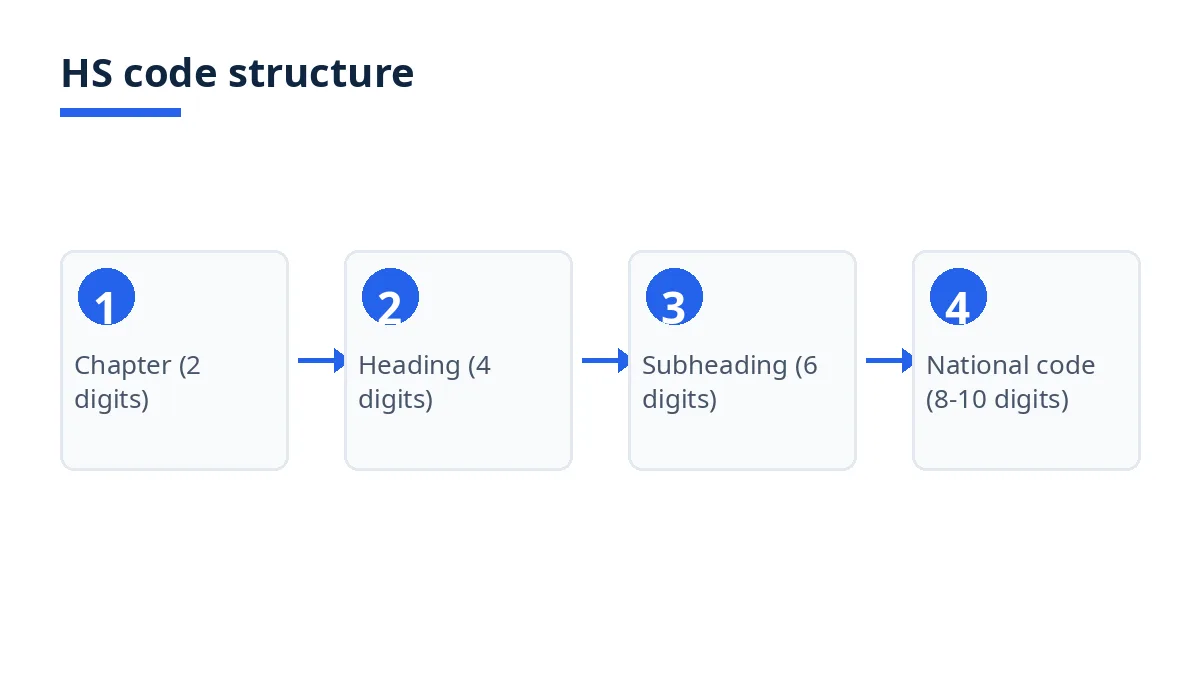
Two shipments can share 6105.10 and still need different full codes. The first six digits travel with the goods; the rest belong to the importing country.
Factors that decide the code for polo shirts
Classification follows the wording of the headings and chapter notes, not the name a retailer gives the garment. Check these factors in order.
Knitted or crocheted construction. Both headings require a knitted or crocheted garment, and Chapter 61 applies only to made up knitted or crocheted articles.2 Access2Markets makes the same split: shirts fall under 6105 if knitted or crocheted, or 6205 if not, and shirts and shirt-blouses under 6106 if knitted or crocheted, or 6206 if not.4 Confirm construction from the supplier specification, not a photograph.
Shirt features: collar and opening. The Chapter 61 notes define shirts and shirt-blouses as garments designed to cover the upper part of the body, having long or short sleeves and a full or partial opening starting at the neckline, and state that they may also have a collar.2 Access2Markets draws the boundary from the other side: a T-shirt has no collar and no opening in the neckline, and a partial front opening takes a garment out of heading 6109 and usually into 6105 or 6106.4 The collar and placket are what make a polo a shirt, not a T-shirt.
Fabric name, including piqué. Many polo shirts are knitted in piqué, a textured knit. The fabric name alone does not set the code: a knitted piqué polo is tested against the same shirt definition as any other knit. Record the construction in words on the specification sheet, for example knitted cotton piqué, so the broker works from the garment, not the style name.
Who the garment is for. Men's and boys' polo shirts go to 6105; women's and girls' go to 6106. Chapter 61 sets a closure test: left over right closure at the front marks men's or boys' garments, and right over left marks women's or girls' garments, unless the cut clearly indicates otherwise, and garments that cannot be identified as either go to the women's or girls' headings.2 Access2Markets gives the same test for a men's shirt.4
Fibre content. The subheading follows fibre: .10 for cotton, .20 for man-made fibres and .90 for other textile materials, under both headings.2 For a blend, record the tested composition in percentages by weight. A garment described only as a cotton blend cannot be placed on the cotton line with confidence.
Chapter-note exclusions. Headings 6105 and 6106 do not cover garments with pockets below the waist, with a ribbed waistband or other tightening at the bottom, or with an average of less than 10 stitches per linear centimeter in each direction, and heading 6105 does not cover sleeveless garments.2 Record hem finish, pocket position and stitch density, because any one of them can move the garment out of these headings.
National codes: US HTS, EU CN and TARIC, UK commodity code
United States: HTS, ten digits. The eight-digit rate lines include 6105.10.00, "Of cotton," for men's or boys' shirts and 6106.10.00, "Of cotton," for women's or girls' blouses and shirts, and two statistical digits complete the ten-digit code.2 Never copy a ten-digit code from an invoice without checking the current HTS revision.
European Union: CN at eight digits, TARIC for measures. The Combined Nomenclature (CN) integrates the HS and adds eight-digit subdivisions for EU needs, so a line that starts as 6105.10 or 6106.10 runs to eight digits in the CN.3 For an actual import, check the measures on that line in TARIC for the entry date and origin Bangladesh, because preferential treatment depends on origin rules and proof of origin, not the code alone.
United Kingdom: commodity code. The UK starts from the same stem and requires the full commodity code in the UK Trade Tariff. On the tariff page for commodity code 6105100000, "Of cotton," the Chapter 61 notes repeat the same shirt definition and exclusions.5 Confirm the full code and measures for goods from Bangladesh on the import date, rather than reusing an EU or US code.
Other destinations, including the UAE. Every HS destination shares the first six digits and sets its own lines after them. Confirm the full code in the destination tariff, or through your broker, before goods leave Bangladesh.
How to confirm the code officially
Use this sequence for each style, and keep the evidence with the shipment file.
Write a precise description: construction, fibre percentages by weight, collar and placket, sleeves, hem finish, pockets and wearer group.
Start from the official tariff for the destination: the USITC HTS, TARIC or the UK Trade Tariff. Read the heading text and chapter notes, not only the search result line.
Check published rulings for similar garments. For the United States, the USITC advises traders to research classification in the Customs Rulings Online Search Service (CROSS), where the correct classification of many items can be found.6
For a borderline garment, apply for a binding decision before you ship. In the EU, a Binding Tariff Information (BTI) decision needs a separate application for each type of product and a detailed description.7 In the United Kingdom, a legally binding decision is generally valid for 3 years and gives the correct commodity code through an Advance Tariff Ruling.8 In the United States, request a binding ruling from U.S. Customs and Border Protection when no CROSS ruling covers the merchandise.6
Give your broker the description and confirmed code, and use the same code on the invoice, packing list and declaration.
Compare suppliers against the same specification so classification stays stable. Browse suppliers by category and align fibre content and construction before ordering samples.
Common classification mistakes
Putting polo shirts under the T-shirt heading 6109. A polo has a collar and a partial opening at the neckline. A T-shirt has neither.4 Work from tariff descriptions, not retail names.
Using the men's heading for women's styles, or the reverse. The wearer decides between 6105 and 6106. A women's polo entered under 6105 is wrong even when the fibre digits match.2
Ignoring the woven alternative. A woven polo-collar shirt does not belong in Chapter 61. It falls under 6205 for men or boys and 6206 for women or girls.4
Copying a code from another product or country. A six-digit match does not mean the national code or duty measure also matches.
Missing the chapter-note exclusions. Pockets below the waist, a tightened hem, coarse stitch density, or, under 6105, a sleeveless design can move the garment out of these headings.2
Treating the code as permanent. Tariffs are revised. Recheck the code when the tariff edition, specification or destination changes.
Related duties and documents
The code decides which duty line and measures customs applies, but this guide states no duty rate. Rates and preferences depend on destination, origin, tariff edition and entry date, and they change. Read the rate beside the confirmed code in the official tariff for your entry date, and check whether preferential treatment for Bangladesh is available and what proof of origin it requires.
Keep the same code on the commercial invoice, the packing list and any origin declaration, and keep the tariff printout with the order file. See the Bangladesh export data overview for wider trade context.
FAQs
What is the HS code for polo shirts?
There is no single code for every polo shirt. The indicative headings are 6105 for men's or boys' shirts and 6106 for women's or girls' blouses, shirts and shirt-blouses, both knitted or crocheted, with the subheading set by fibre: 6105.10 and 6106.10 for cotton, .20 for man-made fibres and .90 for other textile materials.2 Extend the stem to the full national code and verify it for your exact garment before use.
Is the HS code the same in every country?
Only the first six digits are harmonized. Countries build their national tariffs on the six-digit HS structure.3 Beyond six digits, each country sets its own lines: eight digits in the EU Combined Nomenclature, and ten digits in the US HTS and UK commodity code.
How do I confirm the correct code?
Describe the garment precisely, look the code up in the destination tariff, and read the heading text and chapter notes. Check published rulings, such as CROSS for the United States.6 For a borderline garment, apply for a binding decision before shipping: a BTI in the EU,7 an Advance Tariff Ruling in the United Kingdom,8 or a binding ruling from U.S. Customs and Border Protection.6
What happens if I use the wrong code?
Duty, licensing and quota treatment are worked out from the code on the declaration, so a wrong code means those treatments come from the wrong line. GOV.UK notes that a binding decision helps calculate customs duties, licensing requirements, quotas and other restrictions in advance.8 Correct a known error promptly with your broker.
Next steps on Exportain
Browse Bangladeshi suppliers whose range matches your specification, and read how to import from Bangladesh for the steps around ordering and shipping. Use the find suppliers in Bangladesh guide to shortlist suppliers, and confirm the full national code before the first order ships.
Sources
- What is the Harmonized System (HS)?. World Customs Organization (accessed )
- Harmonized Tariff Schedule of the United States Revision 18 (2026), Chapter 61. U.S. International Trade Commission (accessed )
- Harmonized system HS. Statistical Office of the Slovak Republic (accessed )
- Classifying textiles. European Commission, Access2Markets (accessed )
- Commodity code 6105100000: Of cotton - Northern Ireland Online Tariff. GOV.UK, UK Trade Tariff (accessed )
- MTB 2019: Get Out Ahead of the Pack with a Binding Ruling from CBP. U.S. International Trade Commission (accessed )
- European Binding Tariff Information (EBTI). European Commission, Taxation and Customs Union, (accessed )
- Check what you'll need to get a legally binding decision on a commodity code. GOV.UK, HM Revenue and Customs (accessed )
About the author
Sourcing from Bangladesh?
Post a request for quotation and suppliers on Exportain can send you their quotes directly.
Post an RFQ