Top Polo Shirts Manufacturers in Bangladesh: How to Find and Verify Them
How to find and evaluate polo shirt manufacturers in Bangladesh: tech pack, verification checks, samples, AQL inspection, price drivers and export documents.
Short answer
To find polo shirts manufacturers in Bangladesh you can rely on, skip ranked lists and run seven checks on each candidate: a written tech pack, factory or trading company status in writing, registration documents with matching names, association claims confirmed at the source, samples approved in writing, an AQL inspection plan, and quotations compared on one Incoterm.
On this page
Key takeaways
There is no ranked list in this guide: a shortlist is built by testing each factory against your own specification, documents and samples.
Men's knitted polo shirts are recorded under HS heading 6105 by fibre, with 610510 for cotton and 610520 for man-made fibres.
MOQ, price and lead time are set by each factory for your specification, so compare itemized quotations on the same tech pack and delivery term.
Approve the pre-production sample in writing and inspect bulk against it under an agreed AQL plan.
Exportain verification is a document and photo review, not a factory inspection, and a badge is not a guarantee.
If you are searching for polo shirts manufacturers in bangladesh, the useful output is not a ranked list of company names. It is a shortlist you have tested yourself: factories that can make your exact polo shirt, at your quantity, to a sample you approved in writing. This guide shows how to build that shortlist and what to check before you pay.
Polo shirts are knitwear, and knitwear is a large, organised sector in Bangladesh.The Bangladesh Knitwear Manufacturers and Exporters Association (BKMEA), established in 1996, is the apex trade body for the knitwear sector and currently represents approximately 2,540 knitwear member factories.1 Knitwear exports reached $5.963 billion in July to September 2026, up 6.88 percent year on year, within ready-made garment exports of $10.578 billion, according to data released by the Export Promotion Bureau (EPB).2 That scale gives you choice. It does not tell you which factory can make your shirt, so the checks below matter more than any list.
What should you know first about polo shirts?
Classification. In the Harmonized System, chapter 61 covers apparel and clothing accessories, knitted or crocheted, and heading 6105 covers men's or boys' shirts, knitted or crocheted.3 The six-digit subheadings split by fibre: 610510 for cotton, 610520 for man-made fibres, and 610590 for other textile materials.3 Most men's polo shirts are recorded under heading 6105 by fibre, but classification turns on the garment as made, so record the indicative subheading and confirm the full national code for your exact style in your destination tariff before you calculate duty and landed cost. The HS code for polo shirts guide sets out the code in detail. For women's and girls' styles, confirm the heading in the same tariff rather than copying the men's code.
Fibre labelling for the destination. If you sell into the European Union, Regulation (EU) No 1007/2011 requires a textile product to be labelled or marked with the name and percentage by weight of all constituent fibres in descending order.4 The labelling must be durable, easily legible, visible and accessible, and, for a label, securely attached.4 A polo shirt adds parts a T-shirt does not always have, including a knitted collar, a placket with buttons, and often chest embroidery or print, so put the fibre wording, collar construction, placket and button specification, and logo placement in the tech pack.
Who makes the shirt. A manufacturer cuts and sews in its own factory. A trading company places your order with a factory it selects. Both models can deliver, but record in writing which one you have contracted with before you compare prices.
The checks that matter: how to find and evaluate manufacturers
Work through these checks in order. Each one names what to ask for, why it matters, and how to fix a weak answer.
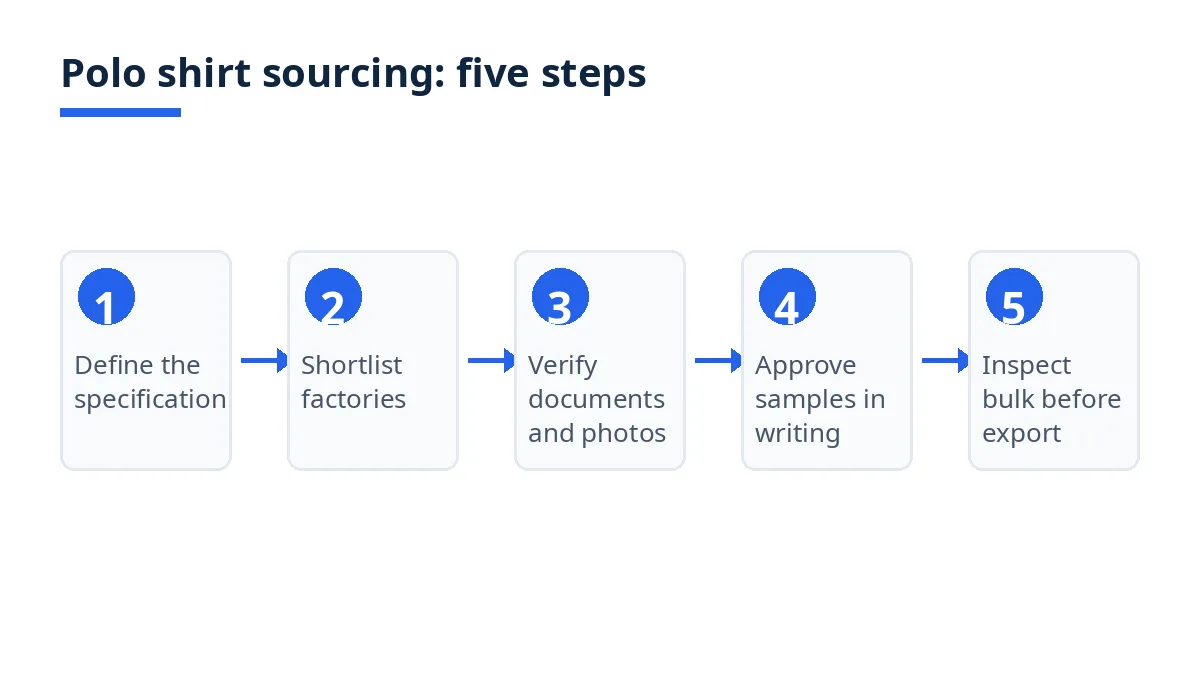
Check 1: A complete specification, not a photo. Ask for a quotation against a written tech pack: fabric composition and knit type (pique or another knit), fabric weight, collar and cuff construction, placket length and button type, size chart for every size, stitch details, logo method, size and placement, label wording and placement, and packing by size and color. Why it matters: without those points in writing, each factory quotes a different shirt and prices cannot be compared. How to fix a weak answer: send the tech pack and ask for a fresh, itemized quotation against it.
Check 2: Factory or trading company, stated in writing. Ask whether the company will cut and sew the order in its own factory, and record the answer with the legal company name. Why it matters: your contract, your inspection and the export filing all depend on who makes the goods. How to fix a weak answer: if the company is a trading company, ask which factory will produce the order and state that arrangement in the purchase order.
Check 3: Registration and export documents. Ask to see the trade licence and, for an exporter, the Export Registration Certificate (ERC), and check that the name matches the quotation and the payment account. Why it matters: the export filing names the exporter and the foreign buyer, so a mismatch can delay the shipment. How to fix a weak answer: if names differ, get the reason in writing and corrected documents before any payment.
Check 4: Association membership, confirmed at the source. If a supplier claims BKMEA membership, confirm the claim with the association itself. BKMEA represents the knitwear sector and its member factories,1 so membership signals an active knitwear business. Why it matters: membership does not certify that the company can produce your polo shirt. How to fix a weak answer: treat an unconfirmed claim as no claim, and judge the factory on samples and documents.
Check 5: Samples approved in writing. Order a proto sample to check style and fit, then a pre-production sample in your actual fabric, color, collar, placket, logo and labels, packed as bulk will be packed. Measure and wash the pre-production sample, and approve it in writing, or list corrections in writing. Why it matters: the approved sample is the standard the bulk inspection is judged against. How to fix a weak answer: if a factory asks you to skip the pre-production sample, hold the order until it is approved, because bulk repeats whatever the sample shows.
Check 6: An inspection plan agreed before production. Agree the sampling plan in the purchase order. ISO 2859-1 defines a system of acceptance sampling plans for inspection by attributes, indexed by acceptance quality limit (AQL) for lot-by-lot inspection.5 AQL is the maximum average percentage of defective items considered acceptable during random sampling, and the AQL value determines sample sizes and acceptance or rejection thresholds.5 Why it matters: a sampling plan checks collar shape, placket alignment, buttons, logo position and measurements across the lot, not in one carton. How to fix a weak answer: write the inspection level and AQL values into the order, name who inspects, and use the polo shirts quality control checklist for garment-level checks.
Check 7: One delivery term for every quotation. Ask every candidate to quote on the same Incoterm and named place. The International Chamber of Commerce states that the Incoterms 2020 rules set out 11 rules with guidance for selecting the right term, and a clear allocation of cost, risk and obligations.6 Why it matters: a price quoted ex works and a price quoted free on board cover different costs, so the cheaper figure may simply include less. How to fix a weak answer: re-quote every candidate on the identical tech pack and delivery term, and state the rule and named place in the purchase order and invoice.
What drives polo shirt cost and lead time?
No honest guide can give you a standard polo shirt price, a standard minimum order quantity (MOQ) or a standard lead time, because each factory sets all three for your specification. Name the drivers in your enquiry instead, so the quotation is itemized and comparable.
Fabric: composition, knit type and weight, and whether the fabric is stocked or knitted and dyed for your order. A dyed-to-order color usually carries a higher minimum than a stocked color.
Collar, placket and buttons: the knitted collar and cuff set, placket construction and button type each add a step a plain T-shirt does not have.
Logo work: embroidery or print method, stitch count or number of colors, size and placement decide set-up work spread across the run.
Quantity split: the total matters less than the split per color and size. Small runs per color raise set-up cost per unit.
Finishing and packing: private labels, hang tags, folding, polybags and carton specification each add a priced step.
Delivery term: the point at which cost and risk pass from seller to buyer changes what the unit price must cover.6
Ask each factory to state its own MOQ for your specification and to separate fabric, making, logo work, trims and packing in the quotation. The MOQ explained guide covers how minimums are set. For timelines, sampling depends on fabric availability and correction rounds, and bulk on fabric production or dyeing, trim delivery, line capacity, and the inspection and export steps. Build your schedule from the dates each factory gives you, with a buffer for sample corrections.
Summary table: the shortlist at a glance
Check | What you ask for | What a sound answer looks like |
|---|---|---|
Specification | Itemized quotation against your tech pack | Fabric, collar, placket, logo, labels and packing priced separately |
Maker status | Factory or trading company, in writing | Producer named; name matches contract and export filing |
Registration | Trade licence and ERC, names compared | Licence, quotation and payment account carry the same legal name |
Membership | BKMEA claim confirmed with BKMEA | Association confirms the company1 |
Samples | Proto sample, then pre-production sample | Approval or corrections recorded in writing and dated |
Inspection | Inspection level and AQL values in the order | Plan follows ISO 2859-1 and names who inspects5 |
Delivery term | Same Incoterm from every candidate | Rule and named place agree across quotation, order and invoice6 |
Costs, timelines and documents
The documents fall into three groups. The order group is the tech pack, the itemized quotation and the purchase order, and specification, price, MOQ, lead time, Incoterm and payment terms must agree across all three. The production group is the written sample approvals, fabric and trim confirmations and the inspection report. The export group is the commercial invoice, packing list, EXP form, certificate of origin and Bill of Export, with description, quantity and value matching the purchase order.
For export clearance in Bangladesh, goods may not be loaded unless an export declaration, the Bill of Export or Shipping Bill, is submitted to Customs and approved.7 Enclosed documents include the export contract or purchase order where there is no export letter of credit, the commercial invoice, the packing list, the EXP form certified by an authorized dealer, and a certificate of origin issued by the EPB or a Chamber of Commerce and Industry.7
Mistakes and red flags
Treating a list as verification. A directory entry, an association listing or a marketplace profile is a starting point for enquiries. None of them tests whether a factory can make your polo shirt. Sending a picture instead of a tech pack. A photo shows a style, not a specification. Without fabric, collar, placket, measurements and logo placement in writing, each factory quotes a different garment.
Approving the sample verbally. If the approval, or the corrections, are not in writing, there is no standard to inspect bulk against.
Comparing prices quoted on different terms. A lower price on a lighter fabric, a simpler collar or a different delivery term is not a saving. Compare only quotations on the same specification and the same Incoterm.6
Reading a badge as a guarantee. Exportain states the limit in plain terms: a badge is not a guarantee of production capacity, product quality or delivery.8 Samples and inspection remain your controls, whoever you buy from.
How Exportain helps
On Exportain, you can browse suppliers in the knitwear categories, read each profile for its products and location, and post a request for quotation (RFQ) with your tech pack summary, quantity, destination and delivery term, so factories quote against the same specification. When you accept a quotation, Exportain creates one order and issues one proforma invoice from the accepted terms: quantity, unit price, currency and Incoterm as quoted.8
Read the badges for what they record. Exportain Verified means Exportain has checked identity, phone, email and business registration, and Export Verified means it has checked the Export Registration Certificate (ERC).8 Factory Verified means Exportain has reviewed photos of the manufacturer factory, while Trading Company Verified means it has reviewed photos of the trading company office or warehouse.8 Supplier verification is a document review by Exportain staff, and every submission is reviewed before a badge is approved.9 Verification is free, and membership plans never grant a trust badge.9 It is a document and photo review, not a factory inspection,8 9 so sample approvals and bulk inspection stay with you. The guide to how supplier verification works on Exportain sets out each check.
FAQs
What is the biggest mistake when sourcing polo shirts from Bangladesh?
The biggest mistake is treating a list, a profile or a badge as verification, and then ordering from a photo instead of a tech pack. A badge is not a guarantee of production capacity, product quality or delivery,8 and a photo does not set fabric, collar, placket or measurements. Without a written specification and a written sample approval, you have no standard when bulk arrives.
How can I avoid it?
Run the checks in this guide in order. Send one tech pack to every candidate, compare itemized quotations on the same Incoterm,6 confirm factory or trading company status and document names in writing, approve the pre-production sample in writing, and write the inspection level and AQL values into the purchase order before production starts.5 Together, the steps replace trust with records.
Who is responsible for checking quality and documents?
You are, with the factory. The factory must produce to the approved sample, and you must set that standard, check names across the licence, quotation and payment account, and inspect bulk against the sample. Exportain reviews documents and photos for its badges, and that review is not a factory inspection and not a guarantee.8 9 Customs approval of the Bill of Export is a filing check, not a quality check on your shirts.7
Where can I get help with verification and sourcing?
Start with the sources in this guide: BKMEA for knitwear sector and membership questions,1 your destination tariff for the final HS code,3 and the polo shirts quality control checklist for garment-level inspection points. On Exportain, the verification guide explains what each badge records, and the RFQ board lets factories quote against your specification.
Next steps on Exportain
Browse suppliers in the knitwear categories and note which profiles carry which badges, then post your tech pack summary on the RFQ board so manufacturers quote against the same specification. Before your first bulk order ships, read how to import polo shirts from Bangladesh for the steps that follow approval and inspection.
Sources
- BKMEA at a Glance. BKMEA (accessed )
- Exports up over 6% to $13.1bn in Q1 of current fiscal. United News of Bangladesh (accessed )
- Classification Detail — HS Code 6105. United Nations Statistics Division (accessed )
- Regulation (EU) No 1007/2011 on textile fibre names and related labelling and marking of the fibre composition of textile products. European Union, (accessed )
- ISO 2859-1:2026 - Sampling procedures for inspection by attributes — Part 1: Sampling schemes indexed by acceptance quality limit (AQL) for lot-by-lot inspection. ISO (accessed )
- Incoterms® 2020. International Chamber of Commerce (ICC) (accessed )
- Customs Clearance Procedures for Export. Bangladesh Customs, National Board of Revenue (accessed )
- Trust & Safety Center. Exportain (accessed )
- Supplier verification: Earn trust badges buyers can see. Exportain (accessed )
About the author
Sourcing from Bangladesh?
Post a request for quotation and suppliers on Exportain can send you their quotes directly.
Post an RFQ