Quality Control Checklist for Polo Shirts From Bangladesh
A numbered, printable QC checklist for polo shirts from Bangladesh: measurements, collar, placket and button checks, common defects, lab test records and packing checks before shipment.
Short answer
A polo shirts quality control checklist is a numbered pre-shipment check of a polo shirt order against the approved sample, tech pack and purchase order. It covers quantity, fabric and shade, collar, placket and buttons, measurements, workmanship, labels, functional tests and packing, with each defect classified as critical, major or minor and compared with the agreed AQL acceptance limits before the lot is released.

On this page
Key takeaways
Inspect against the approved sample, tech pack and purchase order, never from memory: collar, placket, buttons and embroidery are the polo-specific failure points.
Agree the AQL levels and defect classes in writing before sampling, commonly AQL 0 for critical, 2.5 for major and 4.0 for minor defects in apparel.
Record actual measurements against tolerance for every size, and draw the final sample from packed cartons, not only from loose pieces.
A wrong care or fiber label is a compliance defect, not a minor cosmetic point, and a failed lot should be reworked and re-inspected before release.
Use this polo shirts quality control checklist before a polo shirt order from Bangladesh leaves the factory. It turns your approved specification for style, measurements, fabric, collar, placket, colors, embroidery and packing into pass-or-fail checks an inspector can complete piece by piece, size by size and carton by carton before shipment.
A polo shirt has parts a plain T-shirt does not have: a shaped collar, a buttoned placket and often chest embroidery. Each can fail in a way that is easy to see at inspection and hard to fix after shipment.
Why this checklist matters
A polo order is usually produced in several sizes and often several colors, so a small error can multiply quickly. One wrong measurement point can affect an entire size, and one faulty collar setting can repeat across a whole sewing line.
Knitwear is a large part of Bangladesh apparel exports. Knitwear exports rose 6.88 percent to $5,963.76 million in the first quarter of FY2026-27, while total ready-made garment exports reached $10,578.56 million in the same period, according to data released by the Export Promotion Bureau (EPB).1
A written checklist creates a shared standard for buyer, factory and any independent inspector, catches problems while correction is still possible, and leaves a dated record linked to the purchase order.
For sampling, many buyers use acceptance quality limit (AQL). ISO 2859-1 defines a system of acceptance sampling plans for inspection by attributes, indexed by the AQL, so organizations can assess quality from sample-based inspections instead of checking every item.2 AQL is the maximum average percentage of defective items considered acceptable during random sampling, and the standard uses it to determine sample sizes and acceptance thresholds.2
Before you start
Do not start until the references are in the room. Gather:
The purchase order: style, colors, sizes, quantities, destination and packing instructions.
The approved pre-production sample and any later approved sample.
The tech pack: measurement chart with tolerances, fabric and weight, collar and cuff construction, placket length, button specification, label requirements, and embroidery artwork.
Approved color references, such as lab dips or a swatch for each color, including separate references for collar and cuffs.
Measuring tools: a flexible tape, a ruler, and a flat, well-lit table.
The agreed acceptance standard, including the AQL level and defect limits for each defect class.
A camera for defect and packing photographs.
In apparel practice, brands commonly set AQL 0 for critical defects, AQL 2.5 for major defects and AQL 4.0 for minor defects, following ISO 2859-1 and General Inspection Level II.3 Agree your own levels in writing before the inspection. Confirm the quantity presented and that cartons are accessible, so samples can be drawn from across the order, not only from top cartons. Our guides to AQL — acceptance quality limit and pre-shipment inspection explain how sampling and final inspection fit together.
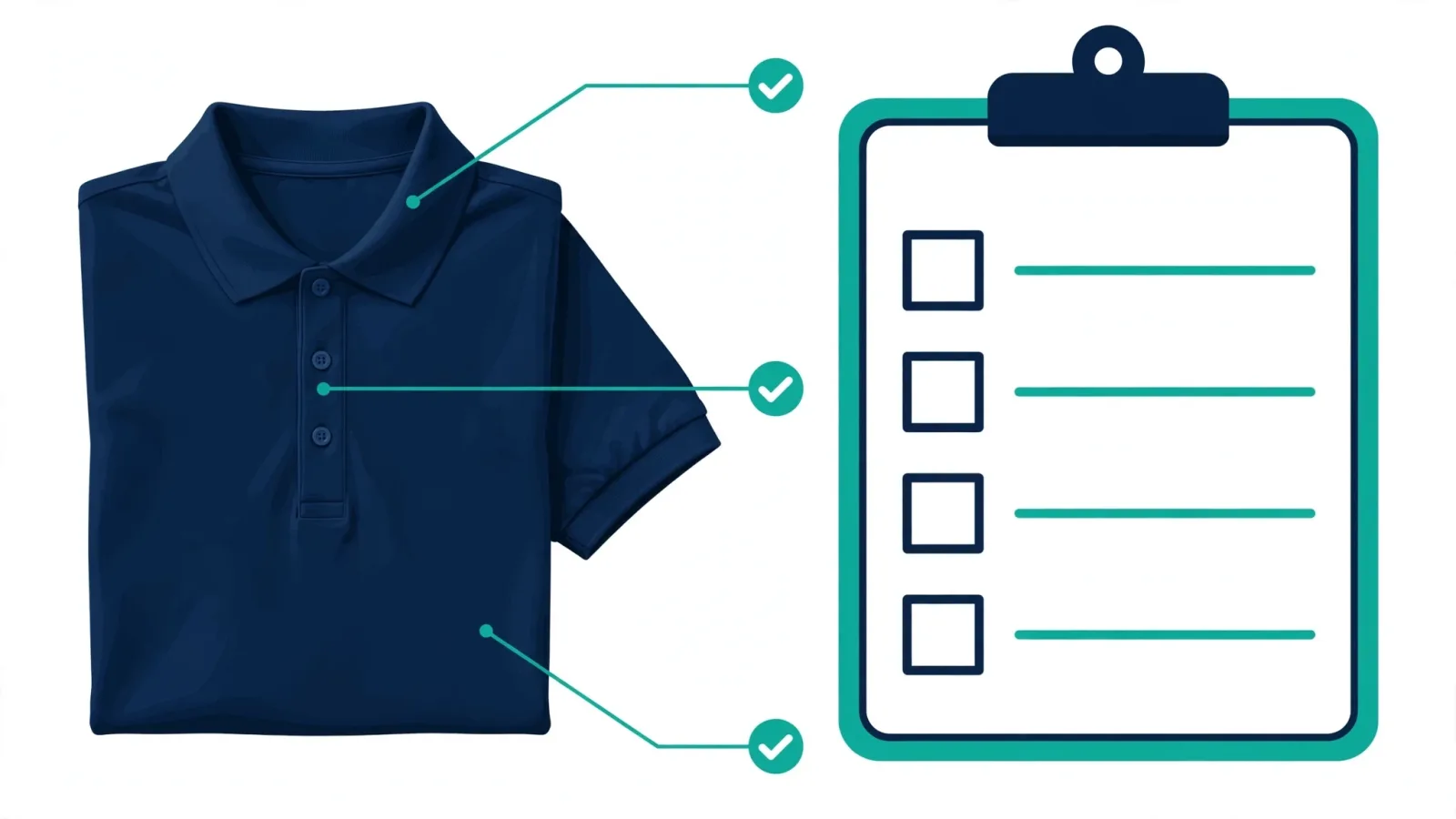
The full checklist
Work through each section in order. Classify each defect as critical, major or minor under the agreed standard, and compare the totals with the acceptance limits.
A. Quantity and style verification
Style number, description and colors match the purchase order.
Total quantity and quantity per size and color match the order, allowing only variations the buyer approved in writing.
The product matches the approved sample for fabric, construction, collar style, trims and finish.
B. Fabric and color
Fabric composition and appearance match the approved swatch, with no holes, stains or knitting faults beyond the approved standard.
Color of body, collar, cuffs and placket matches the approved reference under consistent, neutral light. Check every color for shade variation.
Embroidery or print matches approved artwork for design, colors, size and placement, with no loose threads or puckering around the motif.
C. Collar, placket and buttons
The collar sits flat and even on both sides, its points are symmetrical, and stitching is straight and secure.
The placket is straight, lies flat without puckering or twisting, aligns at the bottom, and its length matches the specification.
Buttons are the correct type, size and color, positioned on the placket marks, and securely attached. Buttonholes are cleanly cut and correctly sized.
Where a spare button is specified, it is attached at the required position.
D. Measurements
Measure sampled pieces flat, without stretching, at every point on the chart, typically chest, body length, shoulder, sleeve, collar width, placket length and hem.
Record each measurement against the size and its tolerance. Flag any point outside tolerance and measure further pieces in that size.
Check that left and right sides are symmetrical, and that measurements are consistent across colors in the same size.
Measurement deviations beyond the agreed tolerance are treated as major defects in apparel AQL practice.3 Record the actual measurement, not only pass or fail.
E. Workmanship and defects
Seams are complete, even and secure, with no skipped or broken stitches, open seams or untrimmed threads.
Shoulder, side, sleeve and hem stitching is straight. Hems are even and do not twist, and sleeve cuffs sit flat.
No stains, oil marks, dirt, holes, snags, needle damage or shiny pressing marks appear on sampled pieces.
Labels are correct and legible: size, care and fiber content match the order and destination requirements, and any required origin label is present.
Under the Federal Trade Commission (FTC) Care Labeling Rule, manufacturers and importers of clothing must state on a care label what regular care is needed for the ordinary use of the garment, in general either a washing or a dry cleaning instruction, and must have reliable evidence that the garment will not be harmed when cleaned according to that instruction.4 A wrong care label is therefore a compliance defect.
F. Simple functional and wash-related checks
Gently pull main seams to confirm they do not open or crack.
Open and close the placket several times. Buttons and buttonholes should work smoothly and the placket should return to lying flat.
Stack folded pieces of the same size. Obvious length or width differences should be re-measured, not ignored.
Where wash testing is part of the agreed program, confirm the method and result are recorded. ISO 6330 specifies domestic washing and drying procedures for textile testing, applicable to fabrics, garments and other textile articles, and it is used for evaluations that include dimensional change and color fastness to domestic laundering.5
G. Pressing, folding and packing
Pieces are clean and properly pressed without scorch or shine. Collars are pressed flat and plackets are not creased off-center.
Individual packing matches the instruction, with correct size identification and any inserts or hangtags attached.
Size and color ratio in each carton matches the packing list. Carton markings show style, color, sizes, quantities and carton number.
Cartons are sound, correctly closed and suitable for the agreed transport. Total carton count matches the packing list.
Draw a final sample from packed cartons, not only from loose pieces, and recheck style, size, collar, label and packing before signing.
See also how to import polo shirts from Bangladesh.
Common failures and how to fix them
Collar faults. Curling, a wavy edge or one side sitting higher usually comes from uneven attachment or an off-grain cut. Isolate affected pieces, re-set or replace collars that cannot be pressed to standard, and re-inspect.
Placket puckering and misalignment. Puckering, twisting or an uneven finish usually comes from uneven feeding during sewing or mismatched cutting. Faulty plackets generally need re-sewing rather than pressing.
Loose or misplaced buttons. Buttons sewn with too few stitches loosen in wear, and a button off its mark makes the placket gape. Re-sew or reposition them and check buttonhole alignment.
Embroidery faults. Compare placement, puckering, loose threads and thread colors against the approved artwork. Puckered or misplaced embroidery usually cannot be repaired without a visible trace, so replace affected pieces.
Measurement drift. One size moves outside tolerance because a pattern, cutting or sewing setting has shifted. Isolate that size, measure a larger sample, and rework or replace failing pieces.
Shade variation. Pieces in the same color differ, or collar and cuffs do not match the body, usually because fabric or trim lots were mixed. Sort suspect cartons under consistent light and replace mismatched pieces.
Wrong labels or packing ratio. A correct garment with a wrong label is still a failed product, and a wrong carton ratio disrupts distribution on arrival. Relabel or repack affected cartons completely, then draw a fresh sample to verify.
Summary table
Section | What is checked | Result to record |
|---|---|---|
Quantity and style | Quantities per size and color vs order | Counts, any variance |
Fabric and color | Fabric and shade vs references | Pass or fail per color |
Collar, placket, buttons | Symmetry, alignment, button security | Defects per point |
Measurements | Every chart point per size | Measurements against tolerance |
Workmanship | Seams, hems, stains, labels | Critical, major or minor counts |
Functional checks | Seam strength, placket, wash record | Method and result |
Packing | Folding, ratio, carton marks | Sample result, carton total |
If defect counts in any class reach the reject number, hold the lot, complete the agreed rework, and re-inspect before release.
Frequently asked questions
When should this checklist be used?
Use it at the pre-shipment stage, when production is complete and packing is finished or at the stage agreed with the inspector, so loose pieces and packed cartons can both be checked. Parts of it can also be used during production.
Who should complete it?
An inspector working from the approved sample, tech pack and purchase order should complete it: the buyer representative, an independent provider, or a factory quality manager, provided the standard was agreed in advance and findings are recorded with measurements and photographs.
What are the most common failures?
The most common failures are collar curling or uneven setting, placket puckering or misalignment, loose or misplaced buttons, off-center embroidery, measurements outside tolerance, shade variation, stitching defects, stains, and packing errors including wrong ratios and labels.
Can a third party do it?
Yes. A third party provider can complete it at the factory on the buyer's behalf, using the buyer's approved references and standard, and report measurements, defect counts and photographs to the buyer. Confirm the references, sample size and acceptance limits in advance, and that packed cartons will be sampled.
Next steps on Exportain
Browse Bangladeshi suppliers for polo shirts and other knitwear, review how to buy, and post an RFQ with your tech pack, size breakdown and agreed AQL levels. Read the AQL testing guide before you confirm the inspection booking.
Sources
- RMG exports rise 6.10pc to US$10.58b in July-Sept of FY27. The Financial Express, (accessed )
- ISO 2859-1:2026 - Sampling procedures for inspection by attributes — Part 1: Sampling schemes indexed by acceptance quality limit (AQL) for lot-by-lot inspection. ISO (accessed )
- AQL Inspection in Apparel: A Practical Guide (2026). Wave PLM (accessed )
- New Jersey Garment Importer To Pay $4,000 Civil Penalty over Alleged Mislabeling of Care Instructions. Federal Trade Commission (accessed )
- ISO 6330:2021 Textiles — Domestic washing and drying procedures for textile testing. International Organization for Standardization (accessed )
About the author
Sourcing from Bangladesh?
Post a request for quotation and suppliers on Exportain can send you their quotes directly.
Post an RFQ