Pharmaceuticals Sourcing Guide for Bangladesh: Specs, Vetting and Testing
A method-first sourcing guide for pharmaceuticals from Bangladesh: write the product and site specification, vet DGDA licences, registrations and GMP evidence, test production samples and stability data, then contract and ship under the labeled storage condition.
Short answer
Sourcing pharmaceuticals from Bangladesh works as a method, not a catalogue purchase. Define the exact product and site in a written specification, vet the manufacturer against its DGDA licence, product registration and GMP evidence, test samples and stability data for the destination climate, then contract on batch documents, inspection and temperature-controlled shipment.
On this page
Key takeaways
Source by method, not by catalogue: fix the exact product, strength, pack, API source and manufacturing site in a written specification first, because the DGDA licence, the product registration and every destination record must all describe that same product made at that same site.
Vet in a fixed order: product match, DGDA site licence and product registration by number, GMP inspection evidence for the named site, the destination record, the API source and batch traceability, and only then a site visit or appointed audit against the document pack.
Registration and listing are never approval: FDA states that registering an establishment and listing drugs does not indicate the products are approved, EU GMP standing is read in the public EudraGMDP database, and WHO prequalification attaches to the exact API or finished product assessed.
There is no industry-wide MOQ, price or lead time for pharmaceuticals from Bangladesh; all three are quoted per manufacturer, per product and per destination file, and the lead time includes a registration link that no manufacturer can schedule.
Sourcing pharmaceuticals from Bangladesh is a regulated buying exercise, not a catalogue purchase. A medicine that is legal to make in Bangladesh still needs a lawful route into your market, a manufacturing site you have checked document by document, and batch evidence that survives the journey. This pillar guide is the method: how to write the product and site specification, how to vet a supplier in steps, which documents make up the pack, how sampling, testing and stability evidence fit together, and how to contract and ship under temperature control. It is written for importers, distributors and sourcing agents in the United States, the United Kingdom, the European Union and the United Arab Emirates. Industry scale and export figures are covered in the companion pillar on the pharmaceuticals industry in Bangladesh; this guide keeps figures out and the procedure in.
Market overview with latest data
The market fact that shapes every sourcing decision is regulatory, not commercial. In Bangladesh, the Directorate General of Drug Administration (DGDA) is the national regulatory authority for all kinds of medicines, medical devices, vaccines and other biological products.1 A Bangladeshi manufacturer therefore works inside a licensing and registration system at origin, and your order works inside a second system at destination. The two systems do not substitute for each other: a DGDA licence authorizes manufacture in Bangladesh, and a destination marketing authorization, registration or listing route authorizes sale in your market. Plan the purchase as two files that must agree on the same product, the same site and the same specification.
That is why this guide states no export total of its own. The size of the trade, its growth and its destination mix are set out with their sources in the pharmaceuticals industry in Bangladesh pillar, where the Export Promotion Bureau shipment series and the Bangladesh Bank receipts series are kept separate. What matters at the point of sourcing is narrower: whether the exact product you want is registered, whether the exact site that will make it is licensed and in good manufacturing standing, and whether the evidence for both can be produced before you pay a deposit. The sections below turn those three questions into a sequence you can run on any product, from a high-volume generic tablet to a refrigerated biological. One timing point belongs in every plan: registration work at destination runs on regulatory time, not production time, and it starts before supplier selection ends, because the site named in your destination file is the site you must vet.
Main products and production clusters
Read the product range through the specification you will have to write, because each product family carries a different file. The families buyers usually separate are:
Product family | What the specification must fix | Evidence that decides the order |
|---|---|---|
Finished medicines in solid oral forms | Active ingredient, strength, dosage form, pack size, shelf life and storage statement | DGDA product registration for the exact product, site licence, batch records and stability data |
Finished medicines in liquid, sterile or inhaled forms | Sterility or microbial limits where they apply, container-closure system, in-use period | Sterile or specialized manufacturing evidence in the GMP file, container-closure stability data |
Active pharmaceutical ingredients (APIs) | Identity, assay and impurity limits, retest period, packaging | API manufacturing evidence, stability data supporting the retest period |
Vaccines and biological products | Cold-chain storage condition, lot identity, potency testing route | Lot-level documentation and an unbroken refrigerated transport record |
Medical supplies and devices | Intended use, materials, sterility where claimed, labeling language | DGDA device regulation status at origin and the destination device route |
Production, in the World Health Organization (WHO) sense, covers all operations in the preparation of a pharmaceutical product, from receipt of materials through processing, packaging and repackaging, labeling and relabeling, to completion of the finished product.2 Your specification has to cover that whole span, not only the finished pack. Two points decide most specifications. First, the API source: name the API manufacturer and site in the specification, because a finished product is only as stable as the ingredient file behind it, and changing the API source after registration can reopen the destination file. Second, the pack and storage statement: the container-closure system and the labeled storage condition are part of the registered product, so a cheaper blister or bottle is a regulatory change, not a purchasing detail.
Clusters matter to this guide only as a vetting point. Wherever a plant sits, the unit you are buying from is one licensed site making one registered product, and the checks below are run per site and per product. A supplier with several plants does not transfer the standing of one plant to another, and a registration for one strength does not cover another strength.
How to find and verify suppliers
Build the shortlist from more than one channel so that claims can be cross-checked: regulator and association routes at origin, your destination regulator's public records for any existing listings, and marketplace listings such as Bangladeshi suppliers for first contact. Then vet in a fixed order, cheapest checks first, so weak candidates leave the process before you spend on audits or laboratory work.
Step 1: Match the product before the company. Ask each candidate one question first: can you supply this exact product, at this strength, in this pack, made at a site you name, for this destination market. A candidate that answers with a general catalogue has not answered. Record the named site for every product, because every later check is site-specific.
Step 2: Confirm the origin licence and registration. The DGDA runs online systems for drug licence applications and renewals and for vaccine and biosimilar registration applications, and it is the authority behind both.3 Ask for the site manufacturing licence number and validity, and the product registration or marketing authorization number for the exact product, then check that the company name, site address and product details on the documents match the company and site in Step 1. In the companion guide to sustainable pharmaceuticals in Bangladesh, the same licence-and-registration check is set out as the starting point for environmental and green claims; run it once and use the file for both purposes.
Step 3: Read the GMP evidence, not the GMP claim. WHO describes good manufacturing practice (GMP) as the part of a quality management system that ensures products are consistently produced and controlled to the quality standards appropriate to their intended use and as required by the marketing authorization.2 Ask for the most recent GMP inspection outcome for the named site, the inspecting authority, and the scope of production covered. A certificate that names a different site, a different dosage form or an expired period does not evidence your order.
Step 4: Check the destination record for the same product and site. The route differs by market, and the quality and compliance section below summarizes each one. At this step the task is only consistency: the product, strength, site and company in the destination record must be the same product, strength, site and company as in Steps 1 to 3. Any mismatch is resolved on paper before samples are ordered.
Step 5: Check the API source and the batch system. Ask which API manufacturer and site supply the active ingredient, what evidence covers that supply, and how a finished batch traces back to API lots. For EU supply, the finished product manufacturer carries an obligation to ensure the active substances it uses were made in compliance with GMP, so this question is part of the legal file, not a courtesy.4
Step 6: Visit or appoint an auditor, after the documents pass. A site visit confirms that the paper file describes a working plant: warehouse segregation, water and air systems, laboratory capability and batch record practice. Send an auditor with the document pack from the table below and ask for findings against that pack, so the report closes specific gaps instead of recording a general impression.
The document pack to assemble before contracting is:
Document | What you check on it |
|---|---|
Site manufacturing licence (DGDA) | Company name, site address, validity, licensed activities |
Product registration or marketing authorization (DGDA) | Exact product, strength and pack, registration number, validity |
GMP certificate or inspection report for the site | Inspecting authority, date, scope, any non-compliance outcome |
Destination-market record | EudraGMDP entry, FDA registration and listing, or WHO prequalification listing for the same product and site, as the market requires |
API source declaration | API manufacturer, site, and the GMP evidence behind the supply |
Specification and methods file | Finished product specification, test methods, and who tests each attribute |
Stability summary | Conditions, time points and results behind the shelf life and storage statement |
Sample batch documents | Certificate of analysis for the sample batch, tied to a batch number |
On Exportain, read supplier badges for what they are. Verification is free, Exportain staff review every submission, and approved checks earn badges shown on the company page, product listings and quotations; it is a document and photo review, not a factory inspection, and membership plans never grant a badge.5 Use a badge as a first filter only. Exportain is a marketplace and is not a party to your contract for goods; the licence, registration and batch checks above remain yours or your appointed auditor's to run.
Two red flags end a conversation early: a supplier that will not name the manufacturing site for a quoted product, and a supplier that offers a registration or GMP document for a different product or site as evidence for yours. Both break the single rule of this method, which is that every document must describe the same product made at the same site.
MOQ, pricing and lead times
There is no industry-wide minimum order quantity (MOQ), standard price or standard lead time for pharmaceuticals from Bangladesh, and no official body publishes one. All three are quoted per manufacturer, per product and per destination file, against a written specification. What follows is how each is built, so quotes can be compared on equal terms.
MOQ. The minimum is set by the production and registration file, not by your carton count. A finished product order carries the manufacturer's batch size for that product, the packaging run minimum for the registered pack, and, where your destination file names the product, any batch quantity the file assumes. State your target quantity per product, per strength and per pack in the inquiry, and ask the manufacturer to quote its MOQ on the same basis, with the batch size stated separately from the packing minimum, so you can see which element sets the floor.
Pricing. A unit price is built from the API cost at the contracted source, excipients and processing, the registered pack and its printing, per-batch quality control testing, the documentation work the destination file requires, and export costs to the agreed Incoterm point. Two quotes for the same generic name can therefore differ honestly, through different API sources, pack materials or testing scopes. Compare quotes only at the same specification, API source and Incoterm, and ask each manufacturer to itemize the pack and testing elements in writing.
Example figures. For illustration only: a buyer specifies 500,000 tablets of one registered generic product in one pack size, FOB Chattogram, from two manufacturers. Example figures: Manufacturer A quotes USD 0.048 per tablet, itemized as product and pack USD 0.041, per-batch testing allocation USD 0.004 and export costs USD 0.003, which totals USD 24,000 for the order. Example figures: Manufacturer B quotes USD 0.044 per tablet with no itemization, which totals USD 22,000. Example figures: the gap is USD 2,000 on these numbers. The example shows the method, not a market price: the buyer asks Manufacturer B for the same itemization, and for the API source and testing scope behind the quote, before treating the gap as a saving, because in this category an unitemized gap is usually a different pack, a different API source or a thinner testing file.
Lead times. A pharmaceutical lead time is a chain with a regulatory link: destination file readiness where a new registration or variation is needed, API procurement, production scheduling for the batch, in-process and finished testing, batch documentation and release, then packing, inspection and shipment under the storage condition set out in the shipping section. Ask for the lead time broken into those stages, agree what starts the clock, normally written order confirmation plus an approved specification and artwork, and keep registration time outside the production promise: a manufacturer can schedule a batch, but it cannot schedule a regulator.
Quality, certifications and compliance
Quality in this category is decided by three layers that must all hold at once: the origin file (DGDA licence, product registration and GMP standing for the site), the destination file (the authorization, registration or listing route your market requires), and your own specification, sampling and testing plan for the order in front of you. A weakness in any one layer is not cured by strength in the others.
GMP as the manufacturing reference. WHO GMP is aimed primarily at diminishing the risks inherent in pharmaceutical production, which fall into two groups: cross-contamination and mix-ups, and false labeling; above all, manufacturers must not place patients at risk through inadequate safety, quality or efficacy.2 In the United States, the Food and Drug Administration (FDA) ensures drug quality by monitoring manufacturers' compliance with its Current Good Manufacturing Practice (CGMP) regulations, which set minimum requirements for the methods, facilities and controls used in manufacturing, processing and packing, and the approval process for new and generic marketing applications includes a review of the manufacturer's CGMP compliance.6 In the European Union, any manufacturer of medicines intended for the EU market must comply with EU GMP no matter where in the world the manufacturer is located, and medicines must meet the requirements of the marketing authorization.4 Read these three statements together and the sourcing rule follows: name the market first, because the market decides which GMP frame your site's evidence will be judged against.
How do you sample and test an order?
Sampling and testing convert the specification into evidence for the batch you are actually buying. Work in this order:
Pre-shipment samples from production, not from a sample room. Ask for samples drawn from the production batch, identified by batch number, with the manufacturer's certificate of analysis for that batch.
Test against the registered specification. The attributes and methods are the ones in the specification file from the document pack: identity, assay, dissolution or content uniformity where the specification sets them, microbial limits where they apply, and pack and label checks against approved artwork.
Use a laboratory you can name. Agree in the contract which laboratory tests, which methods it follows, and what happens on an out-of-specification result, before production starts. WHO prequalification extends to medicines quality control laboratories, eligible to apply on a similar dossier-and-inspection route, so laboratory standing is itself a checkable record where that route is used.7
Retain samples and records. Keep retained samples and the batch documents for the shelf life of the product, so a complaint or a regulator's question can be answered from the batch file rather than from memory.
What stability evidence should you ask for?
Stability evidence is what allows a shelf life and a storage statement to appear on the label at all. The WHO guideline on stability testing of active pharmaceutical ingredients and finished pharmaceutical products sets out the core stability data package required for registration of APIs and finished products, and the purpose of stability testing is to provide evidence of how the quality of an API or finished product varies with time under environmental factors such as temperature, humidity and light.8 Ask for the stability summary behind your product: the conditions studied, the time points, the container-closure system tested, and the results supporting the labeled shelf life. Check two consistencies. The pack tested must be the pack you are buying, because the guideline treats the container-closure system as part of the stability picture.8 The labeled statement must match the data: the WHO recommended labeling statements tie the statement to the conditions under which stability was demonstrated, for example "Store in a refrigerator (2 °C to 8 °C)" for products demonstrated at 5 °C plus or minus 3 °C, and the same guidance notes that good distribution practice is to be observed during storage, shipment and distribution.8 The data decide the statement; buyer and seller cannot agree a hotter route than the data support.
Destination routes, summarized. The full claims-verification treatment, including how to read each database entry and what it does not prove, is in the companion guide to sustainable pharmaceuticals in Bangladesh. The short route map for this method is:
European Union. Manufacturing and import authorizations and GMP certificates sit in EudraGMDP, a publicly accessible EU database that contains manufacturing and import authorizations, registrations of active substance manufacturers, GMP certificates and non-compliance statements; after an inspection, the competent authority issues a GMP certificate or a non-compliance statement, which is entered in the database.4 Separately, the European Commission records that APIs imported into the EU must be accompanied by a written confirmation from the competent authority of the exporting country that standards of GMP and control similar to those of the EU apply, unless a listed-country route or waiver applies.9
United States. Drug manufacturers must register their establishments with FDA and list each drug made there for commercial distribution, updating the listing twice a year, in June and December; FDA states plainly that registering an establishment and listing drugs does not indicate that the products are approved or that FDA has verified the information provided.10 Treat an FDA registration or listing record as evidence of registration and listing only, and look for the product's own approval route separately.
WHO prequalification. Any manufacturer of APIs or finished pharmaceutical products can seek evaluation of a product eligible for assessment; WHO reviews the submitted information, may request more, and may inspect the manufacturing sites, and a product that meets the requirements is added to the relevant WHO list.7 Prequalification attaches to the exact API or finished product assessed, not to the company as a whole.
Patent clearance is part of compliance. A generic product can be registered and still infringe a patent in the destination market. Under the WTO TRIPS Agreement as the WTO's technical note describes it, patents must be available for inventions that are new, involve an inventive step and are capable of industrial application, the patent term must expire no earlier than 20 years from the filing date, and least-developed countries have an extended transition, most recently to 1 July 2034 for the substantive obligations described in the note, with the mailbox and exclusive marketing rights obligations waived for least-developed country members until 1 January 2033.11 Run a destination patent check per product with your own adviser before contracting; the transition position at origin does not decide infringement at destination.
Shipping, Incoterms and duties
Medicines ship under their labeled storage condition, and that condition is a contract term, not a logistics preference. The wholesale distribution of medicinal products is governed in the EU by good distribution practice (GDP) because the quality and integrity of medicinal products can be affected by a lack of adequate control in distribution, and the European Commission has published GDP guidelines for medicinal products and for active substances.9 Build the shipment plan from the stability file: the labeled statement from the compliance section, the pack's protection against moisture and light, and a transport record that can show the condition was held. For refrigerated products, agree the temperature range, the monitoring device and its placement, who reads the record on arrival, and what happens to the consignment if the record shows an excursion. Those four points belong in the purchase order, because after arrival they cannot be reconstructed.
Incoterms® 2020 is the current edition of the ICC rules, in force since 1 January 2020; the rules are eleven three-letter trade terms that clarify the tasks, costs and risks involved in the delivery of goods from sellers to buyers.12 In your own words, the rules you will meet most often on pharmaceutical orders work as follows:
Rule | Who arranges and pays main freight | Where risk passes to the buyer | Practical note for medicines |
|---|---|---|---|
EXW (Ex Works) | Buyer | At the seller's premises | Buyer carries export clearance and the full cold-chain record from the factory gate |
FOB (Free On Board) | Buyer | When goods are on board the vessel at the named loading port | Common for sea shipments; name the port, for example FOB Chattogram, Incoterms® 2020, and state who controls temperature before loading |
CIF (Cost, Insurance and Freight) | Seller, plus minimum insurance | When goods are on board at the loading port | Seller-arranged freight is convenient, but risk still passes at loading; specify the temperature record either way |
DAP (Delivered at Place) | Seller | At the named destination place, ready for unloading | Keeps transport control with the seller longest; buyer still clears import and pays duty unless the contract says otherwise |
Always write the rule with its named place and edition, for example "FOB Chattogram, Incoterms® 2020", and add the storage condition beside it in the order documents, because an Incoterm allocates tasks, costs and risks but does not by itself set a temperature. Exportain does not book freight or clear customs, so the freight forwarder and customs broker are separate appointments to name in the paperwork.5
Duties are decided by the product classification, the origin of the goods and the destination's tariff and preference scheme, in that order. This guide states no duty rate: rates vary by product line and entry date, and a wrong rate here becomes a wrong landed cost in your plan. Read the duty beside your confirmed classification in the destination tariff for the planned entry date, price any preference claim only with the origin evidence in hand, and keep the patent and registration position separate from the duty position, because a duty-free entry is still not a lawful sale without the destination file.
The buying process below pulls these threads together.
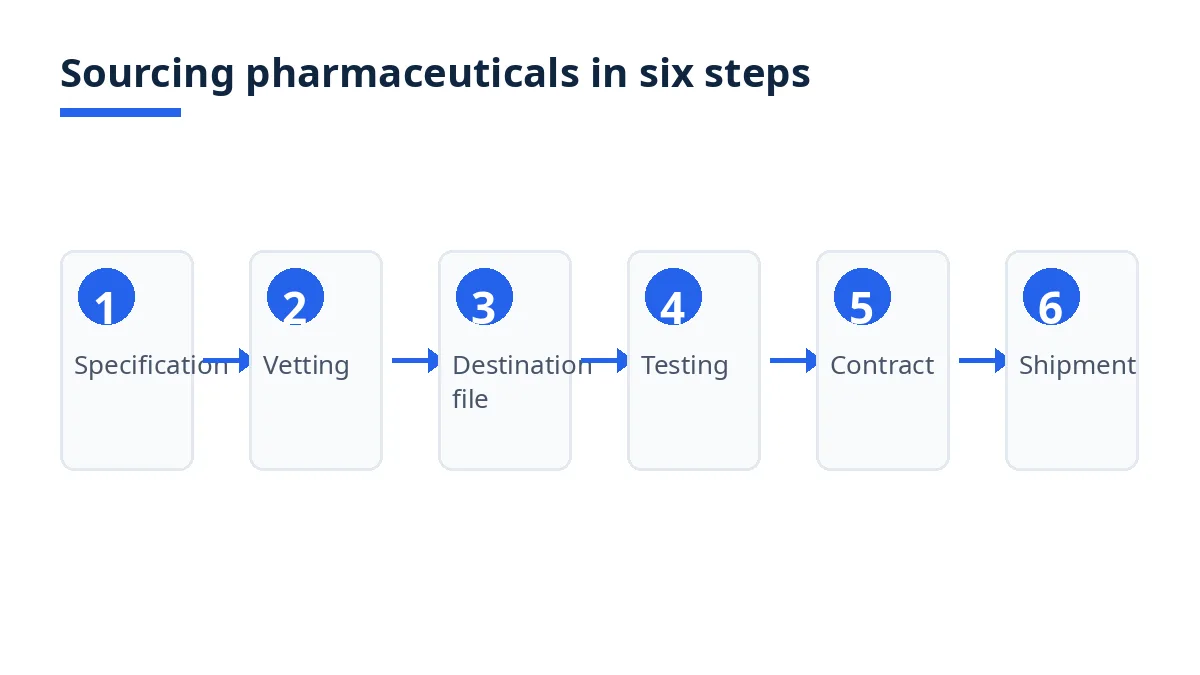
Step-by-step buying process
Define the product and site specification. Write the product before you shop for it: active ingredient, strength, dosage form, pack, API source, shelf life, storage statement and destination market, with the destination route the product will use.
Shortlist and vet suppliers. Build the shortlist, name the manufacturing site per product, and run the six vetting steps in order, assembling the document pack before any price negotiation.1 3
Confirm the destination file. Match the destination record to the same product, strength, site and company: EudraGMDP for the EU route, FDA registration and listing read as registration only for the US route, or the WHO prequalification list for the exact product where that route applies.4 10 7
Sample, test and read the stability file. Draw samples from a production batch, test against the registered specification through a named laboratory, and check the stability summary supports the shelf life and the labeled storage statement for the pack you are buying.8
Agree commercial terms in writing. Fix MOQ per product and pack, the itemized unit price with its validity period, the Incoterm with its named place, the staged lead time and its start point, payment terms and the inspection point, all in the purchase order.12
Produce, inspect and ship under control. Monitor API arrival and batch production, inspect finished goods and batch documents against the specification, then ship under the labeled storage condition with the temperature record agreed in advance.9
Related guides
Read the pharmaceuticals industry in Bangladesh pillar for the industry data, products and clusters behind this method, and the guide to sustainable pharmaceuticals in Bangladesh for the deeper treatment of certification claims, environmental clearance and green factory evidence. How to import from Bangladesh sets out the general import sequence, and the guide to Incoterms for shipments from Bangladesh works through the delivery terms in more detail.
FAQs
Is Bangladesh a good place to source pharmaceuticals & medical supplies?
Bangladesh is a workable sourcing origin where the buyer runs the method in this guide: a written product and site specification, a DGDA licence and product registration checked by number, GMP evidence for the named site, and a destination file that matches the same product and site.1 2 The constraints are equally concrete: destination registration runs on regulatory time, FDA registration and listing never amount to product approval, and every claim has to be re-checked per product and per site.10 Judge the origin order by order, not on the country label.
What is the typical MOQ?
There is no published typical MOQ for pharmaceuticals from Bangladesh, and no official body sets one. Each manufacturer quotes its MOQ from its own file: the production batch size for the product, the packaging run minimum for the registered pack, and any quantity the destination file assumes. State your target quantity per product, per strength and per pack in the inquiry, and ask for the batch size and the packing minimum stated separately, so you can see which element sets the floor and compare two manufacturers on the same basis.
How long is the lead time?
There is no standard lead time, because the chain includes a regulatory link that no manufacturer controls. Your lead time is the sum of its stages: destination file readiness where a registration or variation is needed, API procurement, batch production, finished testing, batch documentation and release, packing and inspection, and shipment under the labeled storage condition. Ask for the stages separately in writing, agree what starts the clock, and keep any pending registration time outside the production promise.
Which certifications matter?
The documents that matter are the ones your destination market and your product require, in this order. At origin, the DGDA site manufacturing licence and the product registration for the exact medicine, with GMP evidence for the named site; WHO frames GMP as the system that ensures products are consistently produced and controlled to the standards required by the marketing authorization.1 2 At destination, the record for your market: a GMP certificate or non-compliance position readable in EudraGMDP for the EU, an FDA approval route for the United States separate from establishment registration and drug listing, or a WHO prequalification listing for the exact API or finished product.4 10 7 Management or environmental certificates offered on top of that file are covered in the sustainable pharmaceuticals in Bangladesh guide; they do not replace the legal file.
Next steps on Exportain
Browse Bangladeshi suppliers by pharmaceutical product, use Exportain trade intelligence to check the market picture behind this guide, and post a free RFQ at Exportain RFQs with your product specification, target quantity, pack and destination market, so manufacturers quote against the same written brief and the same destination file.
Sources
- Strengthening National Regulatory Authority. World Health Organization (accessed )
- Guidelines: Production - WHO good manufacturing practices. World Health Organization (accessed )
- Directorate General of Drug Administration. Directorate General of Drug Administration (DGDA) (accessed )
- Good manufacturing practice. European Medicines Agency (accessed )
- Supplier verification: Earn trust badges buyers can see. Exportain (accessed )
- Current Good Manufacturing Practice (CGMP) Regulations. U.S. Food and Drug Administration (accessed )
- How does medicines prequalification work?. World Health Organization (accessed )
- Annex 10: Stability testing of active pharmaceutical ingredients and finished pharmaceutical products (WHO Technical Report Series 1010). World Health Organization (accessed )
- Good Manufacturing and Distribution Practices. European Commission (accessed )
- Electronic Drug Registration and Listing System (eDRLS). U.S. Food and Drug Administration (accessed )
- Intellectual property (TRIPS) and pharmaceuticals - technical note. World Trade Organization (accessed )
- Incoterms® rules. International Chamber of Commerce (ICC) (accessed )
About the author
Sourcing from Bangladesh?
Post a request for quotation and suppliers on Exportain can send you their quotes directly.
Post an RFQ