Top Pajamas and Sleepwear Manufacturers in Bangladesh: How to Find and Verify Them
Bangladeshi pajama and sleepwear supply is organised by garment type, not by ranking: eight types, what each suits, what drives price and MOQ, and how to verify each one before ordering.
Short answer
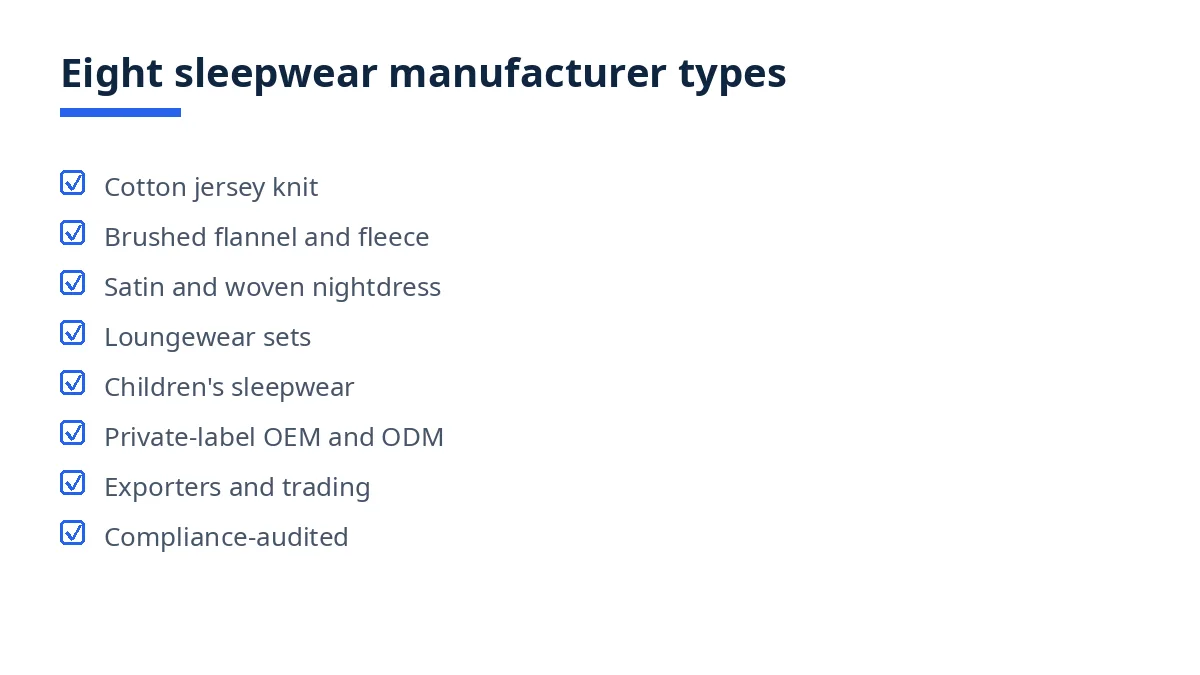
Pajamas and sleepwear manufacturers in Bangladesh fall into eight types: cotton jersey knit makers, brushed flannel and fleece makers, satin and woven nightdress makers, loungewear-set makers, children's sleepwear specialists, private-label OEM and ODM suppliers, exporters and trading companies, and compliance-audited factories. Match the type to your garment, fabric and fit, then verify membership, documents, a repeatedly washed sample and inspection terms before paying.
On this page
Key takeaways
Sleepwear spans knit and woven production, so shortlist by garment type: jersey, flannel and fleece, satin and woven nightdresses, loungewear sets and children's sleepwear each need a different factory skill.
Bangladesh's knitwear base is large: BKMEA represents approximately 2,540 knitwear member factories, and knitwear exports earned US$5.963 billion in the first quarter of fiscal 2026-27.
Sleepwear fails on wash and fit: fabric hand after washing, leg twist, waistband roll, satin seam slippage, trim fraying and shade match across a set are the checks that matter.
Children's sleepwear is a compliance product: in the United States, sleepwear outside the infant and tight-fitting definitions falls under 16 CFR part 1615 for sizes 0 through 6X and part 1616 for sizes 7 through 14.
Verification is a sequence the buyer runs: association membership, document review, a repeatedly washed sample in production fabric and trims, and an agreed AQL inspection before payment.
A pajama set is judged differently from daywear. It is worn for hours against the skin, washed often, and bought in relaxed fits where a small grading error shows as a twisted leg or a cuff that rides up overnight. That changes what a buyer should look for in a Bangladeshi supplier. A factory that sews sharp woven shirts may still struggle with a brushed flannel that pills after five washes, and a knit factory that makes fine jersey tees may not hold a satin nightdress seam. Knitwear shipments earned US$5.963 billion in the first quarter of fiscal 2026-27, up 6.88 per cent year on year, within ready-made garment exports of US$10.578 billion, according to Export Promotion Bureau (EPB) data.1 The Bangladesh Knitwear Manufacturers and Exporters Association (BKMEA) states that it represents approximately 2,540 knitwear member factories.2 Classification is part of the brief. Woven nightdresses and pajamas for women and girls fall under Harmonized System heading 6208, with separate subheadings for cotton (620821), man-made fibres (620822) and other textile materials (620829).3
The list: pajamas and sleepwear manufacturers in Bangladesh by type
The eight types below describe how sleepwear is actually produced and sold from Bangladesh. A single company can appear in more than one type, and a type states what the factory controls day to day: its fabric, its cutting and sewing, its trims, or its export paperwork. Shortlist by the type that matches your garment, then run the checks under each heading before any deposit.
1. Cotton jersey knit sleepwear makers
These factories knit or buy cotton jersey and cut and sew it into pajama sets, sleep tees, shorts and long pants. Jersey is the forgiving end of sleepwear: it stretches a little, drapes softly and suits everyday sets in solid colours and simple prints. The risk is not dramatic failure but slow drift. Jersey that is cut without attention to grain relaxes into a twist after washing, and a set approved in a medium can sit differently at the ends of a relaxed size range, where ease is generous and small measurement errors hide until the garment is worn.
Ask the factory to show its size grading for relaxed fits, not just a standard size chart. The approval sample should be cut from bulk jersey, washed at least twice, and measured flat and on a form across the smallest, middle and largest sizes. Check the leg for twist, the waistband for roll, and the shoulder and side seams for alignment after washing.
2. Brushed flannel and fleece sleepwear makers
Flannel and fleece makers serve the cold-season end of the market: brushed cotton flannel pajamas, fleece sets and robes for winter programs. The fabric surface is the product. Flannel is a raised surface fabric, a category the US Consumer Product Safety Commission (CPSC) lists alongside fleece and terry cloth, and raised surfaces behave differently from flat jersey in washing and in flammability testing.4
Approve the sample in the exact brushed fabric, wash it repeatedly, and look for pilling, surface thinning, colour loss and shrinkage in length, since a flannel leg that shortens by a few centimetres is a failed set even if the seams are sound. Ask whether brushing and finishing happen in-house or at an outside unit, where shade and hand most often change between sample and bulk.
3. Satin and woven nightdress makers
Satin nightdresses, woven pajama sets and dressing gowns are cut-and-sew work, and their failures are sewing failures: seam slippage on a slippery satin, puckered French seams, a neckline that gaps, or a bias-cut skirt that drops unevenly after hanging. These makers work with woven fabrics rather than knits, so their skill is pattern accuracy, seam choice and pressing, and their fabric knowledge runs to weave, lustre and drape rather than stretch and recovery.
Put the construction details in the tech pack and judge the counter-sample against them one by one: seam type, hem finish, button quality, and the hang after 24 hours on a hanger. Ask for a sample in the production satin, not a substitute weave, because a different satin changes both the look and the seam behaviour.
4. Loungewear-set makers
Loungewear sits between sleepwear and daywear: coordinated tops and pants, ribbed cuffs and hems, jogger-style sleep pants and soft sets sold as one outfit rather than as separates. The commercial point is the set. A top and a pant that are dyed in different lots, or graded by different hands, arrive as two garments that do not look like a pair, and a set program fails on presentation before anyone tests a seam.
Shortlist makers who plan sets as a single unit. Ask how the top and pant are dyed and cut together, and whether the rib at cuffs and waistbands comes from the same dye lot. Lay the full set out after washing and compare the shade of top, pant and ribbing under daylight.
5. Children's sleepwear specialists
Children's sleepwear is a compliance product first and a garment second, and it deserves its own supplier type. In the United States, children's sleepwear that does not meet the definitions of an infant garment or a tight-fitting garment is subject to the flammability standards in 16 CFR part 1615 for sizes 0 through 6X and part 1616 for sizes 7 through 14.4 A factory that makes adult pajamas well may have no experience with the tight-fitting pattern blocks, the labelling and the testing records those standards require.
Before discussing price, ask which of the two routes the factory works to for your sizes: a flame-resistant fabric that passes the test, or a tight-fitting design built to the dimensional limits in the standard.
6. Private-label OEM and ODM sleepwear suppliers
Private-label suppliers organise their work around the buyer's brand. Under an original equipment manufacturing (OEM) arrangement the factory makes to your tech pack; under an original design manufacturing (ODM) arrangement it offers its own developed sleepwear styles for you to label. For sleepwear, the difference shows in fit blocks and fabric libraries. An OEM supplier needs your relaxed-fit block and your fabric specification; an ODM supplier needs to show you the blocks and fabrics it already runs, so you can judge the hand, the wash behaviour and the size grading before you commit.
For OEM orders, send a tech pack that covers fabric and weight, relaxed-fit measurements at every size, trims, labels, wash-care instructions and packing, and mark the counter-sample against it line by line. For ODM orders, check that the styles on offer are the supplier's own, confirm the size curve behind each style, and settle in writing who owns any pattern or grading files created for your brand.
7. Exporters and trading companies
Trading companies hold export licences and sell sleepwear made in partner factories, pooling capacity across several plants and handling documentation and shipment. They suit a buyer who wants several sleepwear types in one order, or whose quantities are too small or too mixed for a single factory.
Name the producing factory for each style in the order terms before any deposit moves, and ask what happens if that factory is full or rejects the style. A strong export record proves the trader can ship, not that a partner factory can hold a satin seam or a brushed finish.
8. Compliance-audited factories
Some factories carry current audits or certifications under the schemes their buyers require. BGMEA notes that factories in Bangladesh are assessed against frameworks including BSCI, WRAP, SMETA, ICS, the Higg Index, ZDHC, GOTS and OEKO-TEX.5 For sleepwear buyers, these matter most on retail programs with a code of conduct, a chemical restriction list, or a fibre claim such as organic cotton.
Treat every certificate as a document with a boundary. Confirm the certificate number with the issuing body, check that the factory address on it is the site that will cut and sew your pajamas, and read the expiry date, the standard named and the product scope.
Summary table
Type | Best for | Main check before ordering |
|---|---|---|
Cotton jersey knit makers | Everyday jersey sets, relaxed fits | Washed sample graded across the size range |
Brushed flannel and fleece makers | Winter pajamas, robes | Repeated wash test for pilling and shrinkage |
Satin and woven nightdress makers | Nightdresses, woven sets, gowns | Seam and hang check in production satin |
Loungewear-set makers | Coordinated sets, ribbed cuffs | Shade match of top, pant and ribbing after washing |
Children's sleepwear specialists | Kids sizes, US market | Flammability route, test reports, pattern measurements |
Private-label OEM / ODM | Own-label brands and retailers | Tech pack match, pattern and file ownership |
Exporter / trading company | Mixed orders, one contract | Producing factory named in writing |
Compliance-audited factory | Retail codes, fibre claims | Issuer confirmation, scope, address, expiry |
What drives price and MOQ for pajamas and sleepwear
Compare quotations part by part rather than by the final number. Fabric is usually the largest part: fibre, fabric weight, brushing or satin finishing, and any certified fibre all move the price, and a set that pairs a satin top with a jersey pant carries two fabric costs, not one. Quantity spreads the fixed costs of pattern work, dye lots and line setup over more pieces, which is why the unit price falls as quantity rises and why each style, colour and size curve carries its own MOQ. Trims add their own lines: buttons, lace, drawcords, ribbing and printed labels are each priced and each can fail separately, so a cheap quote that leaves out a trim upgrade is not a comparable quote.
Packing is priced apart: sets must stay matched and nightdresses must arrive uncreased, so retail-ready packing, hangers, tissue, polybags and barcoding each add cost. Ask every shortlisted supplier to quote the identical specification, the same delivery term and the same packing, then query any line that diverges instead of accepting the total. For how minimums behave across a range of styles and colours, read the guide to MOQ in the supply chain.
How to verify a supplier before you pay
Check association membership. A knitwear exporter should appear in BKMEA member records and a woven garment exporter in BGMEA member records; BGMEA runs a member search on its own site.2 5 Membership shows the company is registered in the trade and says nothing about its sleepwear quality, so treat it as step one, not the result.
Review the documents. Trade licence, Export Registration Certificate (ERC) and factory or office photos are the standard set. On Exportain, profile badges record only the document and photo checks the Exportain team has reviewed and approved.6
Approve a washed sample in production fabric and trims. Wash it repeatedly, measure it against your relaxed-fit size chart at the smallest, middle and largest sizes, and check the sleepwear failure points: fabric hand after washing, leg twist, waistband roll, seam slippage on satin, trim fraying and shade match across a set. Keep one sealed sample as the shipment reference.
Set the inspection standard in the order. Agree the acceptance quality limit (AQL) and inspection level before production. ISO 2859-1 specifies sampling schemes indexed by AQL for lot-by-lot inspection, giving an inspector a published rule for accepting or rejecting a shipment instead of an opinion.7
Put payment and shipment conditions in writing. Agree inspection and shipment conditions before settling, and keep every change in the same message thread so the agreed terms are recorded.
The Exportain guide to how supplier verification works explains what each badge covers, and the pajamas and sleepwear quality control checklist turns step 3 into garment-level checks.
How Exportain helps
A buyer journey on Exportain starts with a search, not a message. Published products are searchable by keyword and category and filterable by the Exportain Verified badge, sample availability, OEM or ODM capability, MOQ or lead time.8 Each profile then shows verification level, location, main products and declared certifications.8 The buyer converts that shortlist into a request for quotation (RFQ) — quantity, target price, destination, Incoterm, required certifications, deadline — and suppliers in the category quote against it.8
Run the garment checks above on your shortlist, including suppliers found on the platform. On Exportain, verification is a document and photo review by the Exportain team, not a factory inspection, and membership never grants a badge.6
FAQs
What is the biggest mistake?
Ordering sleepwear by the quoted price before matching the garment to the factory type. A jersey maker, a satin nightdress maker and a trading company quoting a partner factory are three different offers at three different prices, and the cheapest may quote a different fabric, a different fit block or a different wash standard from the one you specified.
How can I avoid it?
Write one specification covering construction, fibre and fabric weight, relaxed-fit measurements at every size, trims, labels and packing, and send the identical document to every supplier you quote. Name the producing factory in the order terms, approve a repeatedly washed sample in production fabric, and set the inspection level in writing before production starts.
Who is responsible?
Responsibility splits at the specification. The factory is responsible for making pajamas and sleepwear to the agreed specification and the approved sample. The buyer is responsible for writing a specification that is complete and checkable, and for inspecting against it before shipment.
Where can I get help?
Use three separate records, and do not let one stand in for another: the BKMEA and BGMEA member listings for registration, the certificate issuer for any audit or fibre claim, and an inspection provider for the pre-shipment check.5
Next steps on Exportain
Start on Bangladeshi suppliers, narrowing the sleepwear listings by badge, MOQ and OEM or ODM capability. Read how supplier verification works on Exportain before ordering, so you know what each badge actually covers. Then post a free RFQ carrying your sleepwear specification, size range, destination and Incoterm, and weigh the quotations that return. For the steps after ordering, the guide to importing pajamas and sleepwear from Bangladesh covers ordering and shipping.
Sources
- Merchandise exports rise 6.34pc to $13.09b in Q1 FY27: EPB. The Financial Express, (accessed )
- BKMEA at a Glance. BKMEA (accessed )
- HS, 2012 - Code 6208. United Nations Statistics Division (UNSD) (accessed )
- Clothing Business Guidance. U.S. Consumer Product Safety Commission (accessed )
- BGMEA | Home. Bangladesh Garment Manufacturers and Exporters Association (BGMEA) (accessed )
- Supplier verification: Earn trust badges buyers can see. Exportain (accessed )
- ISO 2859-1:2026 — Sampling for Inspection by AQL. American National Standards Institute (ANSI) (accessed )
- How to source and buy from Bangladesh. Exportain (accessed )
About the author
Sourcing from Bangladesh?
Post a request for quotation and suppliers on Exportain can send you their quotes directly.
Post an RFQ