Quality Control Checklist for Pajamas and Sleepwear From Bangladesh
A numbered QC checklist for pajamas and sleepwear from Bangladesh: set measurements, seams and elastic, wash tests, colour fastness, labels, children's flammability evidence and packing.
Short answer
Use this pajamas and sleepwear quality control checklist to check set measurements, seams and waistband elastic, colour fastness to washing, size change after washing, fibre and care labels, children's sleepwear flammability evidence and packing before shipment from Bangladesh. Agree tolerances, test methods and AQL acceptance numbers in the purchase order first, record actual measurements, and hold any lot that fails a critical check.
On this page
Key takeaways
Agree the sample, size tolerances, wash-test method and AQL acceptance numbers before inspection, and draw the sample randomly across sizes, colors and cartons.
Wash a sample set as the care label directs and re-measure it, because pajamas that pass dry can shrink, twist or pucker after the first wash.
Check tops and bottoms as matched sets from the same dye lot, and check waistband elastic and drawstrings on every sampled set.
For children's sleepwear sold in the United States, settle the flammability route before production and hold the test evidence with the shipment file.
If you import pajama sets, nightdresses, robes or lounge sets, this pajamas and sleepwear quality control checklist gives you a practical way to check a shipment before it leaves Bangladesh. Sleepwear is worn against the skin for long hours and washed often, so a set can pass on the table and still shrink, twist or lose waistband elastic after the first wash. ISO 2859-1 defines acceptance sampling plans for inspection by attributes, and it uses the acceptance quality limit (AQL) to determine sample sizes and acceptance and rejection thresholds.1
Why this checklist matters
Sleepwear fails in use more often than it fails on the inspection table. Sets can change size after washing, a top and bottom cut from different dye lots can reach the customer as two shades, and a waistband that feels firm at packing can roll or relax within a few wears. Scratchy inside seams, misplaced labels and stiff print areas also drive returns, because the garment sits against the skin all night.
Children's sleepwear adds a legal risk. In the United States, children's sleepwear that does not meet the definition of an infant garment or a tight-fitting garment is subject to the sleepwear flammability standards in 16 CFR part 1615 for sizes 0 through 6X or 16 CFR part 1616 for sizes 7 through 14, and the infant and tight-fitting criteria are based on sizing and measurement guidelines.2 That route must be settled before production: it affects the pattern, the fabric and the shipment evidence. Set the acceptance numbers for critical, major and minor defects in the purchase order itself.1 The AQL acceptance quality limit explainer sets out how those limits work.
Before you start
Do not begin until the reference material is complete: the approved pre-production sample set, the purchase order and technical pack, the size chart with tolerances, the label wording for each destination, the wash-test method, and the packing specification.
Agree the sampling plan in advance, using the AQL approach described above.1 Sample complete sets, drawn randomly across sizes, colors and cartons. A during-production check catches pattern, elastic and shade problems early; the final check verifies packed goods. The guide to pre-shipment inspection explains how a final check is timed.
Check the label plan before bulk labels are printed. Under Regulation (EU) No 1007/2011, a textile product sold in the EU must be labelled with the name and percentage by weight of all constituent fibres in descending order, and the labelling must be durable, easily legible, visible and accessible.3 For children's sizes sold in the United States, confirm which flammability route the style follows and record it in the technical pack.2
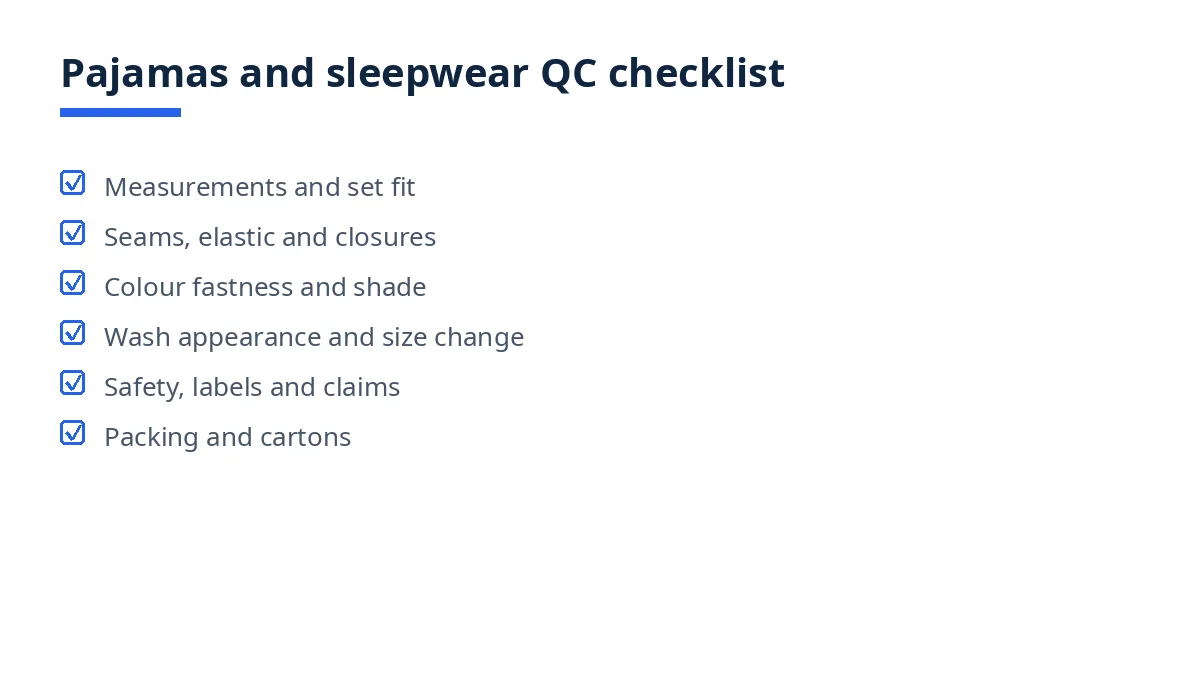
The diagram below summarizes the six blocks of the checklist.
The full checklist
Mark every line pass, fail or not applicable, with a photo for every failure.
Measurements and set fit
Select complete sets across all sizes and colors and measure the top at body length, chest width, sleeve length and neck opening.
Measure the bottom at waist relaxed and extended, hip, outseam or inseam and leg opening, and compare every value with the chart tolerance.
Record actual measurements per size rather than pass marks only, so size drift stays visible.
Check that each top is paired with the correct bottom size, and check fit on a form in the base and largest sizes where the order allows it.### Seams, elastic and closures
Check seams for skipped or broken stitches, seam opening, puckering and uneven stitch density, pulling each seam gently by hand, and check inside seams for rough thread ends.
Pull-test the high-stress joins: crotch and inseam, shoulder, side seams, waistband joins and pocket corners.
Check that waistband elastic stretches evenly, returns without rippling or rolling, and is anchored so it cannot twist in the casing.
Check drawstrings and cords against the technical pack, and confirm cord ends are secured.
Check buttons, snaps, zips and ties for function and secure attachment.
Where seam strength is tested in a laboratory, confirm the method and limit were agreed in advance. ISO 13935-1 specifies a strip test for the maximum force to seam rupture, with force applied perpendicularly to the seam, for woven fabrics including fabrics with stretch from an elastomeric fibre, on straight seams.4
Colour fastness and shade
Check shade consistency within each set, between the top and the bottom, and against the approved lab dip, under one light.
Confirm that tops and bottoms in one set come from the same dye lot, and record the lot for any set that mixes lots.
Review washing fastness evidence where the order requires it. ISO 105-C06 specifies methods for the resistance of colour to domestic and commercial laundering using a reference detergent, and a single test closely approximates one laundering.5
Check two-tone and printed styles closely for staining or print loss where a dark panel or print sits against a light ground.### Wash appearance and size change
Wash one sampled set per style and color as the care label directs, using the procedure agreed in the technical pack. ISO 6330 specifies domestic washing and drying procedures for textile testing that apply to garments, with the reference detergents and ballasts, and a complete test consists of a washing and a drying procedure.6
Re-measure the washed set at the same chart points and compare the change with the tolerance agreed in the purchase order.
Check the washed set for twisting, puckering, print cracking and loss of waistband recovery, and compare its shade with an unwashed set.
Safety, labels and claims
For children's sleepwear for the United States, confirm the shipment file holds the flammability evidence for the route in the technical pack: 16 CFR part 1615 for sizes 0 through 6X or 16 CFR part 1616 for sizes 7 through 14, for sleepwear outside the infant and tight-fitting definitions.2
Verify that fibre, care, size and origin labels are present, legible and correctly positioned, in the language the destination requires. For the EU, check fibre names and percentages by weight in descending order against Regulation No 1007/2011.3
Check that care symbols and washing instructions match the wash test the sample set passed.
If a harmful-substances claim will appear on the product, check the certificate scope. Under OEKO-TEX STANDARD 100, the label is awarded only if all components of an item meet the criteria, including fabric, threads, lining, dyes, finishes, prints and accessories.7
Packing and cartons
Confirm that sets are folded and packed as matched pairs, with ratios, polybags and hangtags matching the packing specification, and any destination warning wording on the bag.
Check that barcode stickers scan and match the size, color and style on the purchase order.
Weigh and measure sample cartons, and check markings, ratios and carton count against the packing list.
Common failures and how to fix them
The most frequent failure is size change after the first wash: the set passes dry, then shrinks or twists at home, usually because the bulk fabric differs from the approved sample or no wash test was run before cutting. Hold cutting until a bulk-fabric wash test has been re-measured against the agreed tolerance. The second common failure is shade mismatch inside a set, where tops and bottoms were cut from different dye lots. Require lot-matched cutting for set components and check pairs under one light during production.
Waistband failure appears as elastic that rolls inside its casing, relaxes after washing or is anchored at one point only. Correct the casing and anchoring on a test garment, wash it, and re-check recovery before the line restarts. Seam opening at the crotch usually traces to stitch density set for a stable fabric on a style that stretches in wear: reset the stitch, pull-test a sewn sample, and only then release bulk sewing. Proof the fibre percentages and care wording against the destination rules before labels are printed, not at final inspection.
When failures exceed the agreed acceptance level, options are re-inspection after sorting or rework, partial acceptance for minor documented defects only, or rejection of the lot. Record the outcome in writing.
Summary table
Use this summary as the cover sheet for your printable checklist.
Section | What is checked | Typical evidence |
|---|---|---|
Measurements and set fit | Top and bottom chart points, set pairing | Measurements per size |
Seams, elastic and closures | Seam quality, waistband return, cords, fastenings | Pull checks and defect photos |
Colour fastness and shade | Shade match within sets, washing fastness | Reports per color and dye lot |
Wash appearance and size change | Size change, twisting, puckering after washing | Washed-set measurements |
Safety, labels and claims | Flammability route, fibre and care labels | Test evidence and label proofs |
Packing and cartons | Set packing, barcodes, ratios, markings | Packing list and carton count |
How Exportain helps
Exportain connects buyers with Bangladeshi suppliers of sleepwear and other garments. You can browse suppliers and use inspection services to plan shipment checks. Supplier profiles show which document and photo checks have been recorded. Those checks are reviews of documents and photos, not factory inspections, and they do not replace your own inspection, testing or contract.
FAQs
When should this checklist be used?
Use it at least at final inspection, when goods are finished and largely packed. For larger and first orders, also use it during production, with the wash test run early.
Who should complete it?
The buyer, the buyer's local agent or an independent inspector can complete it. Whoever does the work must use the approved sample set, size chart and packing specification, sample complete sets randomly, and record measurements and defect evidence.
What are the most common failures?
Size change after the first wash, shade mismatch between the top and bottom of a set, waistband elastic that rolls or relaxes, and seam opening at the crotch are the failures buyers report most often on sleepwear orders. Label and barcode mismatches are also common.
Can a third party do it?
Yes. A third-party inspector can apply it independently, provided you share the approved references, tolerances, wash-test method, sampling plan and acceptance levels, plus the children's flammability route, in advance.
Next steps on Exportain
Before production, agree your size chart, tolerances, wash-test method, label wording and sampling plan, then read how to import pajamas and sleepwear from Bangladesh for the full order sequence and the baby clothes quality control checklist if your range includes infant sizes. Browse suppliers and post your requirement so suppliers reply against the same checklist.
Sources
- ISO 2859-1:2026 - Sampling procedures for inspection by attributes — Part 1: Sampling schemes indexed by acceptance quality limit (AQL) for lot-by-lot inspection. ISO (accessed )
- Clothing Business Guidance. U.S. Consumer Product Safety Commission (accessed )
- Regulation (EU) No 1007/2011 on textile fibre names and related labelling and marking of the fibre composition of textile products. European Union, (accessed )
- ISO 13935-1:2014 - Textiles — Seam tensile properties of fabrics and made-up textile articles — Part 1: Determination of maximum force to seam rupture using the strip method. International Organization for Standardization (accessed )
- ISO 105-C06:2010 - Textiles — Tests for colour fastness — Part C06: Colour fastness to domestic and commercial laundering. International Organization for Standardization (accessed )
- ISO 6330:2021 - Textiles — Domestic washing and drying procedures for textile testing. International Organization for Standardization (accessed )
- OEKO-TEX STANDARD 100 for textiles tested for harmful substances. Hohenstein (accessed )
About the author
Sourcing from Bangladesh?
Post a request for quotation and suppliers on Exportain can send you their quotes directly.
Post an RFQ