How to Import Pajamas and Sleepwear From Bangladesh in 2026: Complete Buyer Guide
How to import pajamas and sleepwear from Bangladesh step by step: specification, supplier verification, MOQ and samples, AQL inspection, children's sleepwear rules, HS 6107, 6108 and 6208 duty checks and a landed cost table.
Short answer
To import pajamas and sleepwear from Bangladesh, write a full specification covering fabric, sizes, prints, trims, labelling and packing, send it to several exporters, and verify each supplier through documents, bank-name checks and a paid sample. Approve a pre-production sample, agree an AQL inspection plan, confirm your nightwear heading and duty on the official tariff, and compare quotes on landed cost per set.
On this page
Key takeaways
Start with a complete specification covering fabric, sizes, prints, trims, labelling and packing before asking for a price, so quotes stay comparable.
Nightwear splits across headings 6107, 6108 and 6208 by construction, wearer and fibre, so classify every style and verify duty on an official tariff source before ordering.
There is no single typical MOQ, price or transit time for sleepwear orders. Confirm each one in writing for your exact specification.
Children's sleepwear carries flammability rules in the United States under 16 CFR parts 1615 and 1616, so build the requirement into the specification before production.
Approve a pre-production sample in writing, inspect packed goods before shipment, and compare suppliers on total landed cost per set, not factory price alone.
To import pajamas and sleepwear from Bangladesh well, treat nightwear as a comfort product with strict rules attached. A pajama set fails in ways a basic T-shirt does not: the elastic gives up after washing, the top and bottom arrive in different shades, the seams scratch the skin, or a children's style falls under a flammability rule that was never built into the specification. This guide follows the full route from specification to delivery, so each risk is handled while it is still cheap to fix.
Pajamas and sleepwear cover two-piece jersey sets, woven cotton and flannel sets, nightdresses, nightshirts, chemises, robes, shorts sets and children's sleepwear. Each type sits in a different factory specialisation and often in a different tariff heading. Decide which products you are buying before you search for suppliers, because a shortlist built around your real product will outperform a general list of garment exporters.
Why source pajamas and sleepwear from Bangladesh
Bangladesh earns most of its merchandise export income from ready-made garments, and sleepwear sits inside that system. Export Promotion Bureau figures reported for July to September of fiscal year 2026-27 put ready-made garment exports at $10.578 billion in the quarter, up 6.10 percent year on year, with knitwear at $5.963 billion and woven garments at $4.614 billion.1 A pajama buyer is therefore working with factories, dye houses, trim suppliers and freight forwarders that handle export orders as routine business.
The knitwear base matters most for jersey pajamas, the volume core of most sleepwear ranges. The Bangladesh Knitwear Manufacturers and Exporters Association, the apex trade body for the knitwear sector, states that it represents approximately 2,540 knitwear member factories.2 Woven sleepwear, such as cotton poplin and flannel sets, draws on the woven garment base. Association listings also give you a public reference point when checking whether a supplier is a genuine, active exporter.
Three practical points follow. First, the skills sleepwear needs are present at scale: jersey and interlock knitting, flannel handling, printing, elastic application and retail-ready set packing. Second, the supporting industry is close by, so fabric, trims, labels and packing can be coordinated within the same clusters. Third, none of this removes the need for due diligence, and the rest of this guide is about choosing well.
Find and verify suppliers
Begin with a written specification and send the identical document to every supplier you approach. Cover the style, fabric composition and finished weight, sizes with measurements and tolerances, colours or print artwork, trims such as elastic, drawstrings, buttons and piping, branding and care labels, packing format, quantity per style and colour, and the destination port and delivery term you want quoted. Point-by-point replies against the same specification are what make quotations comparable.
Build the shortlist through more than one channel, including Exportain, referrals and trade directories, and apply the same checks to every candidate. Ask each supplier for the legal business name, factory address and registration details, whether it manufactures in its own factory or uses subcontractors, its main sleepwear products, monthly capacity, export markets served, and its sample policy and payment terms. Keep every answer in writing.
Then verify, rather than collect, that information. Cross-check the company name and address against public sources such as association listings. Confirm that the name on the quotation, the pro forma invoice and the bank account match exactly. Ask what is made in-house and what is subcontracted, because the answer decides where your quality risk sits. If a supplier mentions a certificate or audit, ask for the document itself, check the factory name, product scope and expiry date, and confirm it with the issuing body where a public check exists. A logo on a website is not evidence.
Use product evidence as the final filter. A paid sample order shows how a factory handles your specification, your questions and your deadline. For a first order of any size, an independent factory visit or a third-party audit is a reasonable cost. Be cautious with any supplier that pressures you to pay a personal account or changes bank details at the last moment. Pay only to the company bank account named on your contract and pro forma invoice, and re-verify any change to bank details through a separate channel before you pay.
MOQ, pricing and samples
There is no single typical minimum order quantity for pajamas and sleepwear from Bangladesh, and a general figure quoted without your specification would mislead you. MOQ depends on the fabric, whether it is stocked or must be produced and dyed to order, the number of colours and sizes, the print type, and the factory's lines. A plain jersey set in a stock fabric will usually carry a lower minimum than a yarn-dyed flannel set or an all-over print. Ask each supplier to state the MOQ per style, per colour and per size ratio in writing.
Pricing needs the same discipline. A meaningful quote needs the complete specification plus the price basis: which delivery term applies, which named place it covers, what the quote includes and excludes, the currency, and how long the quotation stays valid. Do not compare one supplier's factory price with another price that quietly includes different packing or freight. Bring every quote back to the same specification and term, then compare them using the landed cost method later in this guide.
Samples are where a specification becomes real. Expect a development sample to check style and fit, a pre-production sample in the correct fabric and trims, and shipment samples from bulk production. Check sleepwear samples for what customers notice at night: seam comfort, elastic recovery after stretching and washing, print hand feel, and whether the top and bottom match exactly in shade. Wash-test the sample and re-check measurements after washing. Approve bulk production only once the pre-production sample is signed off in writing, and keep a sealed reference sample.
Quality control and certifications needed
Quality control should be planned before production, not improvised at the end. Agree the quality standard with your supplier in advance: measurement tolerances, how defects will be classified, the inspection method, and the remedy if an inspection fails, such as rework, sorting or re-inspection.
A practical control plan has three checkpoints. First, an inline check during production, which catches systematic problems, such as a wrong elastic width, a misaligned print or a shade difference between tops and bottoms, while they can still be corrected. Second, a final random inspection of finished, packed goods before shipment, covering workmanship, measurements, shade matching, labelling, packing and carton marking, with samples drawn from packed cartons rather than a hand-picked bundle. Third, document checks, so the inspection report, packing list and test reports match what is shipped. For the sampling itself, ISO 2859-1 defines sampling schemes indexed by acceptance quality limit (AQL) for lot-by-lot inspection, so buyer and supplier can agree the sample size and the acceptance and rejection numbers in advance.3
Children's sleepwear carries safety rules that adult nightwear does not, and they must be built into the specification before production. In the United States, the Consumer Product Safety Commission explains that children's sleepwear that is not an infant garment or a tight-fitting garment is subject to 16 CFR part 1615, the flammability standard for sizes 0 through 6X, or 16 CFR part 1616, the equivalent standard for sizes 7 through 14, while infant and tight-fitting garments fall under the general clothing flammability standard in 16 CFR part 1610.4 Whether your style counts as tight-fitting is decided by sizing and measurement criteria, so confirm the position for your exact product and market with your testing laboratory or customs broker before the fabric is cut. Other markets apply their own rules, including restrictions on cords and drawstrings in children's clothing, and those need the same early check.
Labelling is a second area where the rule is written down. For the European Union, Regulation (EU) No 1007/2011 covers textile fibre names and the related labelling and marking of fibre composition, so set your fibre content label text from the destination rule before bulk labels are printed.5 Set care and size labelling the same way.
Certifications should always be checked by scope, not by logo. A factory may hold social or management-system certifications, and fabrics may be certified to standards such as OEKO-TEX Standard 100, which OEKO-TEX describes as a label for textiles tested for harmful substances, covering the article from yarn to finished product, with every thread, button and accessory tested.6 Ask for the certificate, check which site and product scope it covers, confirm it is current, and verify it with the issuer where possible. Never print a certification claim on your product or listing unless the certificate genuinely covers that product and supply chain.
Incoterms, shipping and transit time
The delivery term in your contract decides who arranges transport, who pays for each leg and where risk passes. The Incoterms rules published by the International Chamber of Commerce are eleven three-letter trade terms that clarify the tasks, costs and risks involved in delivering goods from sellers to buyers, and the current edition, Incoterms 2020, entered into force on 1 January 2020.7 Under FOB, the supplier delivers the goods on board at the named load port and you arrange the main carriage and insurance. Under CIF, the supplier arranges freight and minimum insurance to your destination port, but risk still passes to you when the goods are loaded, and destination charges, duty and delivery remain yours. Under DDP, the seller takes on most of the journey, which gives you less visibility and control. For a first order, many buyers use FOB with their own forwarder. Whichever term you choose, name it precisely, with the port or place, in the contract.
Most Bangladesh garment exports move by sea, with air freight used for urgent or small shipments. Sea freight is the standard choice for sleepwear because orders are usually bulky relative to their value, and carton volume has a direct effect on freight cost per set. Ask how many sets go into each polybag and export carton, plus carton dimensions and gross weight, so your forwarder can quote on the real packed volume.
Transit time has two parts, and neither can be given as one fixed number. Production time depends on fabric availability, order size and the factory's schedule, and it lengthens when fabric must be knitted, dyed or printed to order. Sea transit from Bangladesh to ports in the USA, UK, EU and UAE varies by carrier, route and transshipment port, and schedules change. Ask your supplier for a production estimate for your order and your forwarder for the current sailing schedule and a door-to-door estimate, then build buffer time into your selling season.
Import duty, taxes and documents
Duty and tax are set by your destination country, not by Bangladesh or your supplier, and the rate follows the tariff classification. Nightwear is split first by construction, then by wearer and fibre. For knitted or crocheted garments, the United States Harmonized Tariff Schedule places men's or boys' nightshirts and pajamas under heading 6107, with subheading 6107.21 for cotton and 6107.22 for man-made fibres.8 For woven garments, the same schedule places women's or girls' nightdresses and pajamas under heading 6208, at 6208.21 for cotton and 6208.22 for man-made fibres, with men's or boys' woven nightshirts and pajamas under heading 6207.9 Knitted women's nightdresses and pajamas sit under heading 6108 instead, and babies' garments have their own heading, 6111 for knitted articles for young children of a body height not exceeding 86 cm, as the GOV.UK tariff chapter notes explain.10
Because neighbouring lines carry different rates, two worked examples show why the exact line matters. On the United States schedule, the general rate shown for cotton nightshirts and pajamas under 6107.21 is 8.9 percent, while the general rate for the man-made fibre line 6107.22 is 16 percent; the woven women's lines show the same pattern, at 8.9 percent for cotton under 6208.21 and 16 percent for man-made fibres under 6208.22.8 9 On GOV.UK, heading 6108 lists nightdresses and pyjamas of cotton at commodity code 6108 3100 00 with a third country duty of 12.00 percent, stated here before any preference.10 These are rates for those exact lines only. Your line may differ, and a preferential rate only helps if your goods meet its rules of origin and you hold the proof of origin it requires. Confirm your code and rate in the official tariff for your market before you order: the USITC Harmonized Tariff Schedule for the United States, EU TARIC for the European Union and the UK Trade Tariff for the United Kingdom. UAE buyers should confirm the current position through official UAE customs sources.
Taxes at import, such as VAT or sales tax, depend on your country's rules and your own tax status, and some buyers can recover import VAT while others cannot. A local customs broker can confirm the treatment for your business.
The standard document set typically includes a commercial invoice, a packing list showing carton contents, weights and measurements, the bill of lading or air waybill, a certificate of origin where one is required or a preference is claimed, and the inspection and test reports agreed in the contract. On the export side, Bangladesh Customs requires a Bill of Export for customs clearance, enclosed with documents that include the commercial invoice, the packing list and a certificate of origin issued by the Export Promotion Bureau or a Chamber of Commerce and Industry.11 Check draft documents before the vessel sails. Errors in names, weights or carton counts are much easier to correct before shipment than after arrival.
Landed cost example
The table below shows how to build a landed cost for a pajama set order. It is a worked structure, not a price quote: every figure must come from your own supplier quotation, forwarder quotation and the official tariff for your destination.
Cost element | How to obtain the figure | Your figure |
|---|---|---|
Goods at factory, on your delivery term | Supplier quotation for the confirmed specification | To be quoted |
Inland transport and export handling, if not included | Supplier or forwarder quotation | To be quoted |
International freight | Freight forwarder quotation for your route and packed volume | To be quoted |
Marine insurance | Insurer or forwarder quotation | To be quoted |
Import duty | Official tariff rate for your exact code and destination | To be confirmed |
Import taxes, VAT or sales tax treatment | Customs broker or tax adviser | To be confirmed |
Customs brokerage and port or terminal charges | Broker and forwarder quotations | To be quoted |
Local delivery to your warehouse | Carrier or forwarder quotation | To be quoted |
Total landed cost per set | Total of all lines divided by the number of sets | Calculate per order |
Two habits protect your margin. First, cost the order using packed carton volume, not just unit count, because freight for bulky sleepwear is driven by volume as much as weight. Second, re-run the calculation whenever the specification, quantity or delivery term changes.
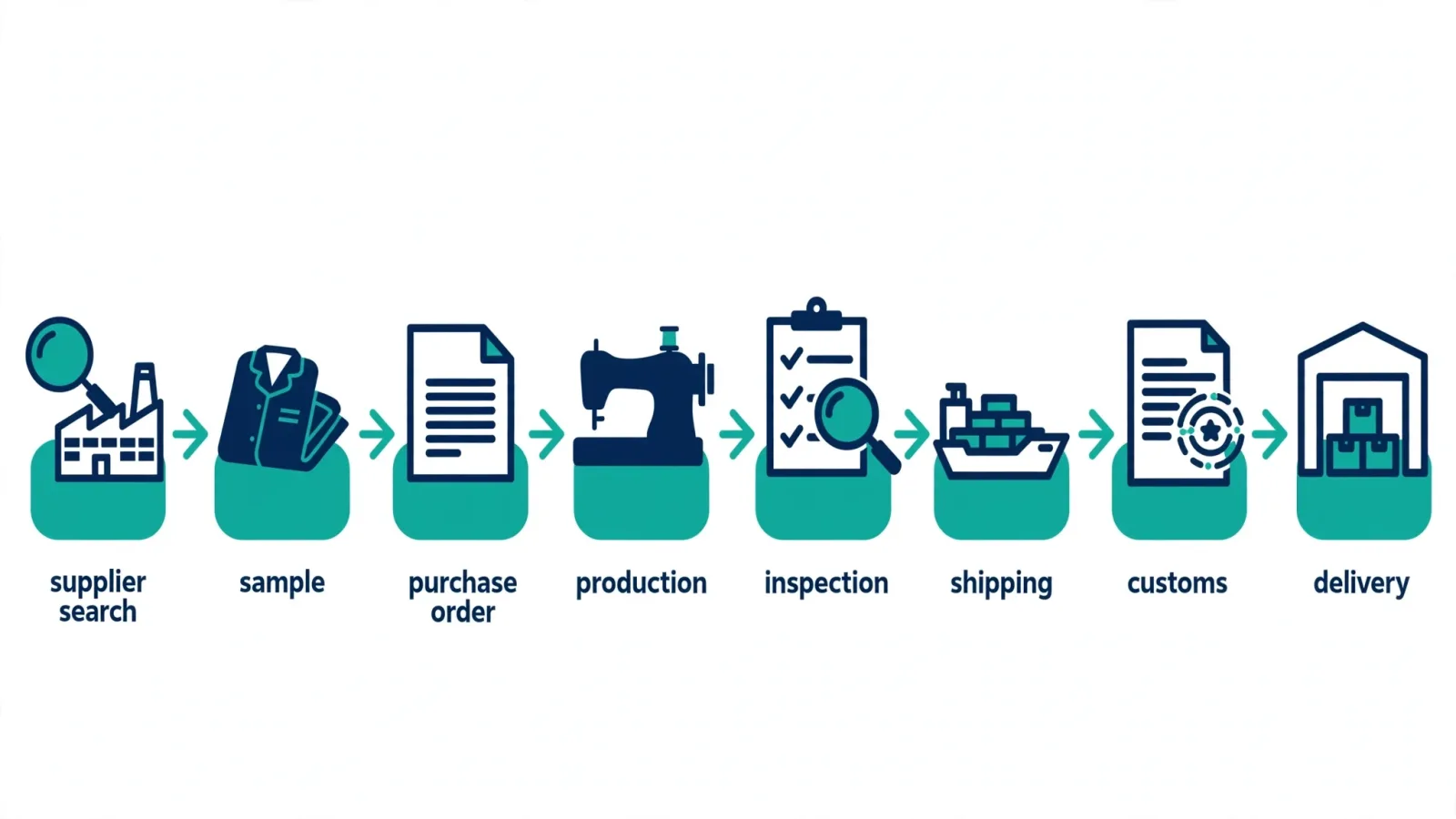
Step-by-step import checklist
Define the product: style, fabric, sizes, colours, prints, trims, labelling and packing, in a written specification or tech pack.
Research the rules for your market, including labelling, safety requirements and any children's sleepwear rules that apply to your size range.
Shortlist suppliers that actually make your type of sleepwear, and send every candidate the same specification.
Request like-for-like quotations against that specification, and compare MOQ, lead time and what each quote includes.
Verify the chosen supplier: registration, factory capability, what is made in-house, certifications checked with issuers, and references.
Order and approve development samples, then a pre-production sample in the correct fabric and trims, and sign it off in writing.
Confirm your product's tariff classification and duty in your destination's official tariff, and build the full landed cost.
Place the purchase order with the specification, quality standard, inspection plan, delivery term, payment terms and shipment window stated clearly.
Pay only as agreed in the contract, only to the verified company bank account, and re-verify any change to bank details separately.
Monitor production, run an inline check, and complete a final random inspection on finished, packed goods before shipment.
Check draft shipping documents before departure, then track the shipment with your forwarder.
Clear customs through your broker, pay duty and taxes as assessed, and arrange delivery to your warehouse.
Inspect the delivered goods against the approved sample, record any issues with evidence, and review the order with your supplier before reordering.
How Exportain helps
Exportain helps you run this process with clearer comparison. You can browse Bangladeshi pajama and sleepwear suppliers in one place, send the same specification to more than one exporter, and compare replies fairly on MOQ, price basis and lead time.
Supplier profiles on Exportain show which document and photo checks have been recorded for that supplier. Those checks are reviews of documents and photos, not factory inspections, and they do not replace your own verification, sampling, inspection or customs broker. Post an RFQ with your specification pack, then use the landed cost table to compare replies.
FAQs
What is the typical MOQ for pajamas and sleepwear from Bangladesh?
There is no single typical figure. MOQ depends on the fabric, whether it is stocked or produced to order, the number of colours, sizes and prints, and the factory. Plain jersey sets in stock fabrics generally carry lower minimums than custom-dyed flannel or printed styles. Ask each supplier to state the MOQ per style and per colour for your specification, and confirm how the unit price changes at higher quantities.
How long does shipping take?
The total timeline combines production lead time with transport time, and both vary. Production depends on fabric availability, order size and the factory's schedule. Sea transit depends on the carrier, route and transshipment points, and schedules change. Ask your supplier for a production estimate and your forwarder for the current sailing schedule and door-to-door estimate, then add buffer time.
What import duty applies?
Duty is set by your destination country and follows your product's tariff classification, which depends on whether the garment is knitted or woven, who it is for, and its fibre. Confirm the code and rate in the official tariff for your market, and check whether a preferential arrangement for Bangladeshi origin applies and what proof of origin it requires. Your customs broker can confirm both before you order.
How do I verify a supplier?
Start with the basics: legal name, registration and factory address, whether it manufactures in its own facility, what it subcontracts, and its export markets and references. Confirm the same name appears on the quotation, pro forma invoice and bank account. Verify any certification directly with the issuing body and check its scope. Approve samples in stages, keep a sealed approved sample, and consider an independent audit for a first order.
Next steps on Exportain
Read the general guide on how to import from Bangladesh, then structure your enquiry with the guide on how to write an RFQ. Before you confirm an order, work through the landed cost for imports from Bangladesh method and post your sleepwear specification on Exportain to compare quotes on the same terms.
Sources
- Merchandise exports rise 6.34pc to $13.09b in Q1 FY27: EPB. The Financial Express, (accessed )
- BKMEA at a Glance. BKMEA (accessed )
- ISO 2859-1:2026 - Sampling procedures for inspection by attributes — Part 1: Sampling schemes indexed by acceptance quality limit (AQL) for lot-by-lot inspection. International Organization for Standardization (accessed )
- Clothing Business Guidance. U.S. Consumer Product Safety Commission (accessed )
- Regulation (EU) No 1007/2011 on textile fibre names and related labelling and marking of the fibre composition of textile products. European Union, (accessed )
- OEKO-TEX Standard 100. OEKO-TEX (accessed )
- Incoterms® rules. International Chamber of Commerce (ICC) (accessed )
- Harmonized Tariff Schedule - Heading 6107: Men's or boys' nightshirts, pajamas, knitted or crocheted. U.S. International Trade Commission (accessed )
- Harmonized Tariff Schedule - Heading 6208: Women's or girls' nightdresses and pajamas, not knitted or crocheted. U.S. International Trade Commission (accessed )
- Heading 6108: Women's or girls' nightdresses and pyjamas, knitted or crocheted - Northern Ireland Online Tariff. GOV.UK (accessed )
- Customs Clearance Procedures for Export. Bangladesh Customs, National Board of Revenue (accessed )
About the author
Sourcing from Bangladesh?
Post a request for quotation and suppliers on Exportain can send you their quotes directly.
Post an RFQ