Mock Order Meaning: Practical Guide
What mock order meaning covers in Bangladesh sourcing: a written trial that tests product, documents and communication before a purchase order, and how it differs from MOQ and an RFQ.
Short answer
A mock order is a trial or practice order a buyer and supplier run before a confirmed purchase order. Mock order meaning turns on status, not size: the exercise tests the specification, sample, documents, packing and communication on a small scale, and it becomes binding only when both sides later confirm a formal purchase order.
On this page
Key takeaways
A mock order is a trial exercise agreed in writing. It is not a confirmed purchase order and creates no bulk commitment by itself.
Mock order quantity is a test quantity set by agreement. It differs from MOQ, the smallest quantity a supplier will sell in one order.
Judge the whole trial: specification match, sample, documents, packing and communication, not the sample alone.
Convert a passed trial formally, with an RFQ and a purchase order that carry the corrected specification, price and terms.
Understanding mock order meaning starts with status, not size. A mock order is a trial or practice order that a buyer and a supplier run together before any confirmed purchase order, so both sides can test the product, documents and working relationship before the main shipment. This guide for buyers sourcing from Bangladesh explains what a mock order is, how it differs from a minimum order quantity, a request for quotation and a purchase order, and how to convert a passed trial into a formal order.
The risk is simple: a document called an order can set a factory planning materials and production time, so name the stage correctly, in writing.
What a mock order is — and what it is not
A mock order is an agreed rehearsal of a real order. Framing a first order as a trial or test order signals to the factory that the buyer is evaluating it for larger future business, and many factories accept a smaller initial order on that basis.1 The rehearsal uses the real specification, documents and packing, at a trial quantity set by agreement, and produces evidence: a checked sample, a checked document set, and a record of communication and stage dates.
A trial order is not a small bulk order; it is a controlled test of the whole supply chain in one shipment, covering production quality, packaging integrity, documentation completeness and logistics reliability.2 Judge it on all four, not on the sample alone.
A mock order is not a purchase order. A purchase order states the types, quantities and agreed prices of goods or services, and sending one constitutes a legal offer to buy; a contract usually forms only when the seller accepts it.3 A mock order records the opposite: this stage is a test, and a bulk commitment follows only through a separate, formal purchase order.
It is not a quotation or a pro forma invoice either. Many export transactions begin with an inquiry, followed by a request for a quotation, and a pro forma invoice is a quotation prepared in the format of an invoice.4 Pro forma invoices are not used for payment purposes and should be clearly marked "pro forma invoice."4 Apply the same labeling habit to a mock order.
It is also not a minimum order quantity. An MOQ is the fewest number of units required to be purchased at one time, set by the supplier as the smallest amount it will sell in one transaction.5 The mock order quantity is a test quantity chosen by agreement. Confusing the two produces the most common dispute, covered below. See MOQ and minimum order quantity for the full guide.
Term | What it is | Binding bulk commitment? |
|---|---|---|
Mock order | An agreed trial run testing specification, sample, documents and packing | No. Converts only through a formal purchase order |
Sample order | An order for samples, to check quality before a trial or bulk run | No. Covers the samples only |
MOQ | The fewest units a supplier will sell in one order | Not a document. A condition of a real order |
RFQ | A request for quotation setting out the specification for pricing | No. It asks for prices |
Pro forma invoice | A quotation in invoice format, marked "pro forma invoice," not used for payment | No. States expected sale terms |
Purchase order | The buyer's formal offer stating goods, quantities and agreed prices | Yes, once the seller accepts it |
Why this matters for buyers and sellers
For buyers, the mock stage is where errors are cheapest. A size, material, color, label or packing detail that is wrong in the trial costs a sample and a courier fee to correct. The same error found after bulk production means rework, delay or a shipment you cannot sell. The trial also tests the supplier: written answers, confirmed changes, and stage dates that hold.
For sellers, a well-run trial is evidence of capability. A supplier that confirms the specification in writing, flags a problem early and delivers a matching sample gives a buyer a concrete reason to place the larger order. A supplier that treats the trial casually gives the buyer a reason to stop, politely and early.
Step-by-step: how it works
Run the mock order as a structured exercise with a recorded decision at the end.
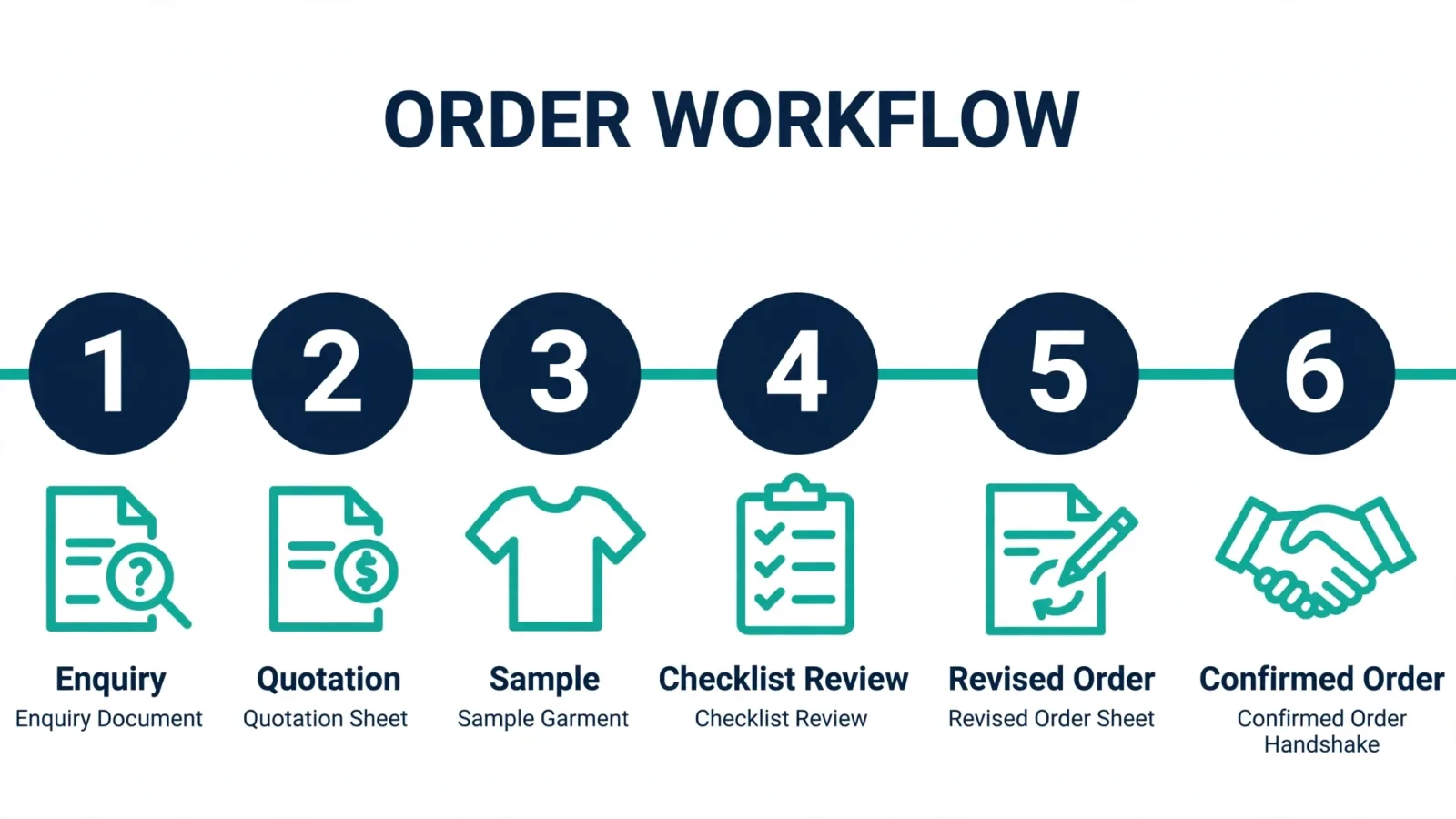
Step 1: Define what the trial must prove
State the purpose in one or two sentences: a new specification, a new supplier, a packing change, or the full workflow. A trial that tests everything usually tests nothing well.
Step 2: Write the specification the trial will use
List the product, materials, sizes, colors, labeling and packing, with photographs or drawings where they help. Use the specification you intend for the real order, versioned and dated. If it is not ready, write the request first: the guide on how to write an RFQ lists the fields a complete request contains.
Step 3: Agree in writing that it is a mock order
Confirm, on the document itself, that this is a mock or trial order and not a confirmed purchase order. Do not rely on a verbal understanding or a chat message. A complete header covers:
The words "Mock order — trial only, not a confirmed purchase order"
The trial purpose and specification reference, with version and date
The trial quantity, stated separately from the supplier's MOQ
The trial price basis, labeled as a trial price, not the bulk price
Sample and dispatch costs, and who pays each one
A date for each stage, and the decision rule: convert, revise once, or stop
Step 4: Keep two quotations separate
Ask the supplier to quote the mock stage and, separately, the full order. A sample-stage price reflects a short run and is not the production price. Record both figures in the trial file, each labeled with its quantity.
Step 5: Check the sample against the specification, point by point
Compare what arrives against the written specification: measurements, materials, construction, finish, labeling and packing. Photograph every difference and describe it in words. Note gaps in the specification itself as findings about the brief, not the supplier.
Step 6: Test the documents and the communication
Review each trial document for accuracy, and note how the supplier handled the exercise: response speed, written confirmations, and stage dates met. Where payment will later run by letter of credit, check now that names, addresses and product descriptions match across documents.
Step 7: Record the decision: convert, revise or stop
If the trial passed, convert it: issue a formal request for quotation with the corrected specification, then a purchase order both sides confirm. If one named point failed, rerun that point only. If the trial failed on capability or reliability, stop and record why. Never let a passed trial drift into production on an informal message.
Costs, timelines and documents
What does a mock order cost?
There is no standard price, because the cost depends on what is being tested. A document-only test may involve no product cost. A physical trial usually involves making and sending a sample, and both sides agree in advance who pays each part and whether any of it is credited if a full order follows.
Example figures: a supplier sets an MOQ of 1,000 polo shirts per color. You agree a mock order of 120 shirts in one color, at a trial unit price above the bulk price because the run is short, plus a courier charge. Both figures go into the trial file, labeled with the trial quantity. They show how to record a trial; they are not a market rate.
How long does a mock order take?
The timeline is a sequence of agreed stage dates, not a single estimate: specification confirmed, sample made, dispatched, feedback returned, decision recorded. Complexity, materials, revisions and shipping time all move those dates, and slow feedback from your side extends the trial by the same amount.
Which documents belong in the mock order file?
Keep one file per trial: the specification and its versions, the labeled mock order, the trial quotation, any pro forma for that stage, change confirmations, and your feedback. If the trial converts, add the formal RFQ and the purchase order with the corrected specification.
That file also prepares the real shipment. For an export consignment from Bangladesh, the Bill of Export must be enclosed with the export letter of credit or, where there is none, the export contract or purchase order or an approved export guarantee, a signed commercial invoice, a packing list, the EXP form certified by Authorized Dealers, the certificate of origin, and the exporter's VAT registration certificate and taxpayer identification number.6 Rehearsing the invoice and packing list early removes the most common cause of later corrections. Agree the delivery term as well: the Incoterms rules are eleven three-letter trade terms, and Incoterms 2020 entered into force on 1 January 2020.7 Compare EXW and the FOB term, and plan goods checks with the pre-shipment inspection guide.
Bangladesh-specific rules and tips
Many products sourced from Bangladesh are made to a buyer's specification rather than sold from stock, which is why the trial stage carries so much weight. In apparel and textiles, write fabric composition, weight, stitching, sizing tolerance and labeling into the specification and check the sample against each point. A difference accepted silently now becomes the standard for the full run.
Work in writing, keep one current specification version, and confirm every agreed change in writing the same day.
Check export readiness during the trial, not after it. Ask how the supplier documents and packs export orders, and whether they work with freight and inspection providers where your order needs them. The ERC certificate guide explains this export registration. The point is to learn whether the full chain exists.
Respect the supplier's side. A mock order takes real time and materials, and framing it honestly matters: factories accept smaller trial orders when they believe the buyer is evaluating them for larger future business.1 Give prompt feedback and state your next step and its timing.
Mistakes and red flags
The most frequent mistake is failing to label the trial. If the document says order and nothing else, expect the other side to treat it as one. Write mock order or trial order on the document itself.
The second mistake is a vague specification. Good quality, standard packing and similar to the photo are not specifications. If the sample disappoints and the brief was vague, the trial cannot show whether the supplier failed or the brief failed.
The third mistake is confusing the trial quantity with the MOQ. The trial quantity is the number you agreed to test; the MOQ is the supplier's floor for a production order. A passed trial does not waive the MOQ.
Other common mistakes: assuming a sample is free, treating a trial price as the production price, judging the supplier on the sample alone, and letting a passed trial drift into production informally.
Supplier red flags include refusing to confirm details in writing, quoting a full-order price before seeing a specification, and asking for full commercial payment at the mock stage without a clear written basis. Buyer red flags include demanding extensive free trial work with no stated next step and changing the specification repeatedly without written confirmation.
Checklist
The trial purpose is written in one or two sentences.
The document is labeled as a mock or trial order, not a confirmed purchase order.
The full specification is attached, versioned and dated.
The trial quantity is stated, separate from the supplier's MOQ.
Sample and dispatch costs, and who pays them, are agreed in writing.
The trial quotation is kept separate from the full-order quotation.
A date is agreed for each stage.
The sample is checked point by point against the specification.
Differences are recorded in writing, with photographs.
Documents and communication are reviewed, not only the product.
A decision is recorded: convert, revise once, or stop.
If converting, the RFQ and purchase order carry the corrected specification.
How Exportain helps
Exportain is a B2B marketplace where international buyers find Bangladeshi suppliers, post requests for quotation and compare replies against one written specification. That structure fits the mock stage: each supplier responds to the same brief, so trial results are comparable. Buyers can review the verification information recorded for a supplier before a trial. Those checks are reviews of documents and photos, not factory inspections or guarantees, and they do not replace your own sample check, purchase order or inspection. Exportain is not a party to your contract for goods, and it does not inspect goods, book freight or clear customs. The how to buy guide sets out the buyer journey.
FAQs
What should I know first about Mock Order Meaning?
Know the status first. A mock order is a trial or practice order agreed in writing, not a confirmed purchase order, and it becomes binding only when both sides later confirm a formal purchase order. It needs a real specification, a trial quantity separate from the supplier's MOQ, and a recorded decision at the end.
What are the typical costs and timelines?
There is no typical figure for either. A document-only test may cost nothing beyond time, while a physical trial involves sample and dispatch costs split by written agreement. Timelines depend on complexity, materials, revisions and shipping, so agree a date for each stage. A trial price is never the bulk price.
Which documents are needed?
For the trial: the written specification, the labeled mock order, the trial quotation, any pro forma for that stage, change confirmations, and your written feedback. If the trial converts, add the formal RFQ and the purchase order. For the later export shipment, Bangladesh Customs requires the Bill of Export to be enclosed with the export letter of credit or, where there is none, the export contract or purchase order, the commercial invoice, the packing list, the certified EXP form and the certificate of origin, among other documents.6
What are the most common mistakes?
Failing to label the trial, writing a vague specification, confusing the trial quantity with the MOQ, assuming a sample is free or a trial price is the production price, judging only the sample, and letting a passed trial drift into production without a formal purchase order. Written confirmation at each stage prevents all of them.
Next steps on Exportain
Write your specification first, then post an RFQ so suppliers reply against the same brief and you can agree a clearly labeled mock order with the strongest respondent. You can also post through the RFQ page and browse suppliers by category.
Sources
- MOQ Meaning: What Minimum Order Quantities Look Like When Sourcing Products. Cosmo Sourcing, (accessed )
- The Ultimate PPF Sourcing Checklist: Samples to Bulk Orders. KOOPPF (accessed )
- Purchase Order (PO). AcqNotes (accessed )
- Quotations and Pro Forma Invoices. U.S. Commercial Service, (accessed )
- Minimum Order Quantity (MOQ): Formula, Tips, & Benefits. NetSuite, (accessed )
- Customs Clearance Procedures for Export. Bangladesh Customs, National Board of Revenue (accessed )
- Incoterms® rules. International Chamber of Commerce (ICC) (accessed )
About the author
Sourcing from Bangladesh?
Post a request for quotation and suppliers on Exportain can send you their quotes directly.
Post an RFQ