Top Mangoes Manufacturers in Bangladesh: How to Find and Verify Them
How to find mango manufacturers in Bangladesh and check them before you order: the main belts, the varieties and their picking windows, orchard and packhouse checks, GLOBALG.A.P. and phytosanitary papers, Brix testing and a paid trial order.
Short answer
Find mango manufacturers in Bangladesh by belt and variety: shortlist firms in Rajshahi, Chapainawabganj, Naogaon, Satkhira or Rangpur inside the picking window for your variety, then check their papers, visit the orchard and packhouse, and test the fruit. Ask for the GLOBALG.A.P. certificate and GGN, the phytosanitary certificate, a Brix range per variety read by refractometer, and a small paid trial order inspected by a third party before you pay the balance.
On this page
Key takeaways
Rajshahi and Chapainawabganj account for over two-thirds of Bangladesh's mango production, and export picking follows a district-by-district calendar.
Ask for the variety, the upazila and the picking date of the lot, and refuse fruit offered before its calendar date.
Check the GLOBALG.A.P. certificate and GGN, the phytosanitary certificate and the packhouse hygiene routine before you commit.
Agree a Brix range per variety read by refractometer at 20 degrees Celsius, and pay the balance only after a third-party inspection of a small trial order.
A mango manufacturer in Bangladesh is rarely just a factory: some own orchards and pack their own fruit, some run packhouses buying from many growers, some trade without a tree or a packing line.
What kinds of mango manufacturers will you meet?
Four shapes of business dominate this trade.
An orchard-owner exporter grows its own fruit and grades and packs on site, controlling variety and picking date, but volume is limited to its own orchards.
A packhouse operator owns grading and packing lines and buys fruit from growers across a district. It can build a large lot, but it does not control what went into the orchard, so ask for spray records.
A trader-exporter buys fruit from growers and packhouses, grades and packs it, and ships it under its own name. Volumes can flex, but you are trusting its buying judgment rather than its own trees.
A grower group pools fruit from member orchards and sells it together. Group certification is available for cooperatives with three or more members, letting small orchards share the cost of an audit.1 Ask every candidate the same question: which of the four shapes is it, and how much of a normal export lot comes from its own orchards rather than bought-in fruit?
Where do mango manufacturers cluster?
Mango growing centres on the northwest: Rajshahi and Chapainawabganj account for over two-thirds of the country's production.2 Export picking follows a calendar set variety by variety and district by district, drawn up by the Department of Agricultural Extension, and Bangladeshi mangoes are exported to 37 countries.3
Belt | Known for | Export picking starts |
|---|---|---|
Chapainawabganj | The mango capital; Kansat bazar wholesale market4 | 26 May |
Rajshahi | Himsagar, Langra, Amrapali, Fazli; Baneshwar market2 | 25 May |
Naogaon | Nak Fazli geographical indication4 | 1 June |
Satkhira | The earliest belt3 | 5 May |
Rangpur | Haribhanga3 | 30 May |
Dates move a little each year.4
Which varieties should a manufacturer be able to supply?
Pick the variety for your market and your selling window; the dates in the table come from the 2026 calendar.3
Variety | Export picking, Rajshahi / Chapainawabganj | Fruit | Suits |
|---|---|---|---|
Himsagar (Khirsapat) | 30 May / 4 June | Fragrant, fibreless2 | Premium retail |
Langra | 12 June / 14 June | Stays green when ripe2 | South Asian markets |
Haribhanga | 20 June in Chapainawabganj | Rangpur's pride4 | Mid-season retail |
Amrapali (BARI Aam-3) | 25 June / 27 June | Small, deeply sweet2 | Volume retail |
Fazli | 26 June / 30 June | Large, late in the season2 | Late-season supply |
A firm offering Himsagar in April is offering fruit picked before its calendar date; immature fruit does not ripen properly and tastes sour or only slightly sweet.3
Geographical indications belong to individual varieties, not to a place name: Khirsapat (2019), Fazli, Langra and Ashwina (2023), Nak Fazli (2025), Haribhanga and Himsagar.4 There is no geographical indication for "Rajshahi mango" as such, so when a seller uses that phrase, ask which variety and district it means.4
Where do you find mango manufacturers?
Three routes produce most shortlists. First, exporter directories and trade fair exhibitor lists from the season. Second, referrals from buyers already importing Bangladeshi fruit, from freight forwarders, and from packhouse operators who can name the orchards they buy from. Third, B2B platforms: search Exportain supplier profiles for mango exporters and compare two or three firms on the same variety and pack.
For season windows and freight, the Exportain primer on bringing mangoes in covers the journey; this page is about the firm behind the fruit.
What should you check on an orchard visit?
Walk the orchard with the picking calendar in hand, and ask for the variety, upazila and picking date of the lot, not just the district name.4
First, variety identity: the trees, fruit shape and ripening behaviour should match the variety named in the quotation. Langra, Fazli and Himsagar stay largely green when ripe, so colour alone does not prove ripeness.4 Second, maturity: the picking date should sit on or after the calendar date for that variety in that district, and the fruit should be mature-green and firm.5 Third, spray records: what was sprayed, when and how long before harvest, plus a residue test result. Fourth, harvest practice: how the fruit is picked, whether stems are cut cleanly and how fast it reaches shade.
Watch for forced ripening: fruit ripened with calcium carbide, which is banned, often looks evenly bright yellow while the flesh near the stone is still hard and sour and the aroma is weak.4
What should the packhouse be able to show you?
A packhouse turns orchard fruit into a graded export lot. Walk the line while it runs, or ask for a video walk-through.
Grading comes first: damaged, diseased and green fruit is pulled out, and the rest is split into size bands agreed in writing. Codex sizes mangoes by weight: A 200 to 350 grams, B 351 to 550 grams, C 551 to 800 grams, none under 200 grams.5
Packing is the last step: every carton is marked with the variety, the size band, the lot number, the net weight and the country of origin. Codex requires a package to contain fruit of one origin, one variety, one quality and one size, and non-retail containers must show the exporter or packer name, variety, origin, class, size and net weight.5
Hygiene is the third check. Codex recommends mangoes be prepared and handled under the General Principles of Food Hygiene and the Code of Hygienic Practice for Fresh Fruits and Vegetables.5 Ask to see the wash water routine and the desapping area, and whether the packhouse runs a HACCP-based food safety plan, who is trained on it and when it was last reviewed.
Which certificates matter, and how do you check them?
Paperwork does not prove quality, but it shows whether a firm is set up to export and whether an independent body has audited its farm or packhouse.
Certificate or document | What it covers | How to check it |
|---|---|---|
GLOBALG.A.P. IFA certificate | Good agricultural practice on the farm1 | Ask for the GGN and expiry date |
HACCP-based food safety plan | Hazards and controls in the packhouse | Ask for the plan and last review date |
Phytosanitary certificate | Confirms the consignment meets the destination country's plant-health rules6 | Check the number, variety and quantity against the invoice |
Export registration, trade licence, tax registration | The firm is registered to trade and to export | Check names, addresses and expiry dates match |
GLOBALG.A.P. is the certificate European retail buyers ask for most often. Its core standard is Integrated Farm Assurance (IFA), now at version 6, which has applied to audits since 1 January 2024.1 An accredited certification body carries out the audit, and the certificate is valid for one year minus one day, so ask for the current certificate.1 It is not a legal requirement, but it is a market requirement for some supermarket chains. The certificate carries a unique GGN number; ask for it and check it.1
Think of the phytosanitary certificate as travelling with the shipment, not the sales contract. Bangladesh's plant protection authority prepares it under ISPM 12, the IPPC's model-certificate standard, after the lot has been examined or tested; it states that the fruit satisfies the plant-health conditions of the country receiving it.6 Treat a certificate as worthless when it cannot be read clearly, leaves fields blank, has passed its validity, shows unauthorised changes, or arrives as an uncertified copy.6 Before loading, line up variety, quantity, marks and consignee against the invoice. The full document set is laid out in the Exportain export-documents walkthrough; the mango HS code walkthrough covers classification.
How do you test maturity and quality before you commit?
Agree the test in writing before you pay anything: grade, size code, count per carton and tolerance for defects go into the purchase order. The Exportain mango quality-control checklist lays out the inspection points carton by carton.
Maturity is the first test. The Codex standard requires mangoes to be sufficiently developed and display satisfactory ripeness.5 Agree a Brix range per variety, and write the reading method beside it: soluble solids by refractometer at 20 degrees Celsius, using IFU No.8 or AOAC 932.12.7
Size and grade are the second test. Check the size code against the Codex bands above, confirm the class in writing and confirm the tolerance: ten percent of a Class I package may fall to Class II.5 Cut fruit from several cartons and check the flesh.
A trial order is the third test. Start with a small paid order by air freight, of the exact variety and size you plan to order, and book an independent pre-shipment inspection at packing. The Exportain pre-shipment inspection walkthrough explains what the inspector checks before the first lot flies; settle the balance only once the report is in hand.
A six-step check before you place an order
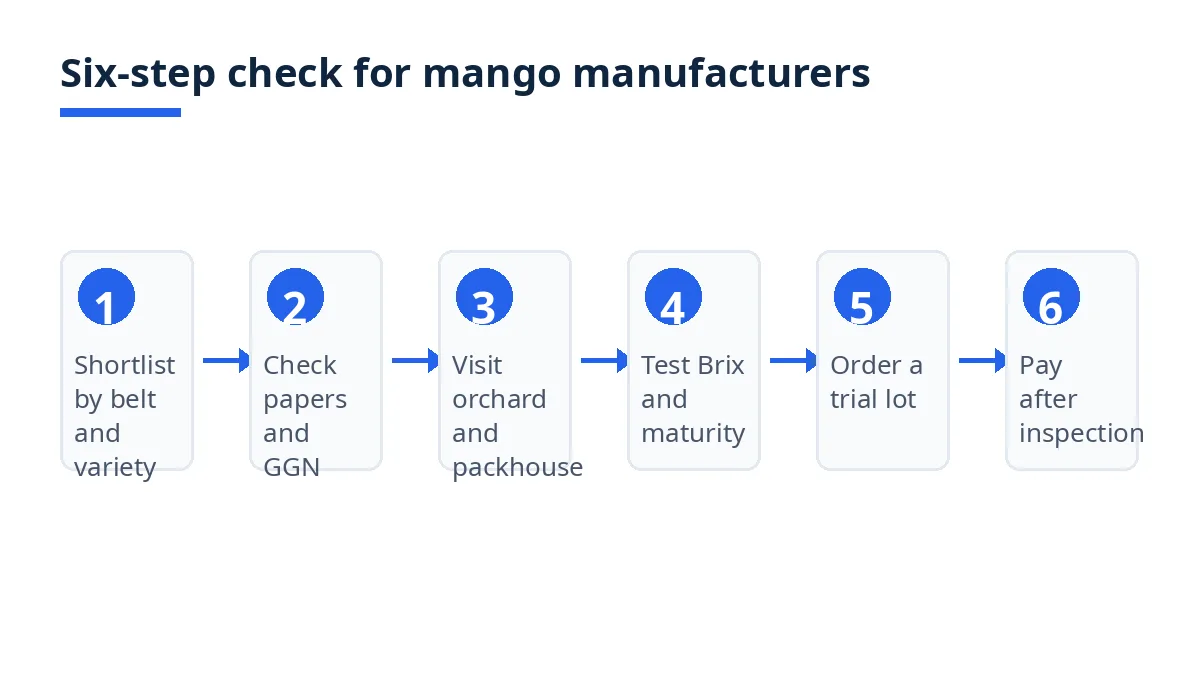
Shortlist by belt and variety: firms working in the belt for your variety, inside its window.
Check the papers: export registration, trade licence, tax registration, GLOBALG.A.P. certificate and GGN, with dates and names matched.
Visit the orchard and the packhouse: variety, picking date, spray records, grading line and hygiene.
Test Brix and maturity: agree the Brix range, the reading method, the grade and the defect tolerance in writing.
Order a trial lot: a small paid order by air freight, inspected by a third party.
Pay after inspection: pay the balance only after the inspection report arrives.
A worked example: testing a new manufacturer with a trial order
Figures below are invented; dates and rules are real.
Example figures: a buyer in the United Kingdom supplies premium retail with Himsagar and has three candidates: an orchard-owner exporter in Chapainawabganj, a packhouse operator in Rajshahi and a grower group in Naogaon. The buyer asks all three for the same facts: picking date and upazila, a GGN wherever GLOBALG.A.P. is claimed, and the export registration certificate.
The Chapainawabganj exporter quotes Himsagar picked on 22 May, a fortnight ahead of the 4 June calendar date, and its brochure certificate carries no GGN to check.3 That firm is out. The Rajshahi packhouse buys its fruit in, yet hands over intake records, a running line graded to size B and a current GLOBALG.A.P. certificate whose GGN matches.1 The Naogaon group shows a picking date of 8 June with spray records and a residue test result.3 1
The buyer walks the two remaining sites in one week and puts the specification on paper: Himsagar, Class I, size B from 351 to 550 grams, a Brix range read by refractometer at 20 degrees Celsius, and an independent inspection at packing.5 7 The trial is a small paid air-freight lot, settled in full only once the inspection report is in hand.
Warning signs that should slow you down
Treat any of these as a reason to pause or walk away.
Fruit of a named variety turns up weeks ahead of its calendar picking date.3 4
A seller leans on "Rajshahi mango" as a geographical indication yet will not say which variety or district the claim covers.4
The GLOBALG.A.P. certificate has lapsed, names a different company, or gives no GGN to verify.1
The phytosanitary certificate shows changes nobody authorised, or a quantity that disagrees with the invoice.6
The seller wants everything paid before any inspection takes place, or will not allow an independent inspector in.
The fruit is uniformly bright yellow, smells faint and stays hard and sour near the stone.4
Next steps on Exportain
Write down the three firms you would trust with a trial lot, then send each the same short brief — variety, district, picking window, class, size code, carton count, destination — and ask each to answer the six checks in writing. When the replies come back, put the brief into a request for quotation on Exportain, so the quotes you compare cover the same fruit, grade and pack. Before any money moves, the Exportain letter-of-credit walkthrough explains the instrument; the buying walkthrough covers ordering through the platform.
Sources
- GLOBALG.A.P: What It Is, Requirements, and How to Get Certified. Acerta, (accessed )
- Bangladesh Mango Tourism: Discover the Sweetest Summer Experience in South Asia. Stourism, (accessed )
- Mango Harvest Calendar 2026: Dates by District and Variety. Agro News Today, (accessed )
- Rajshahi mango: Origin, Season & How to Spot the Real One. Midmart (accessed )
- Codex Standard for Mangoes (CODEX STAN 184). FAO (accessed )
- ISPM 12: Guidelines for the issuance of phytosanitary certificates. International Plant Protection Convention (accessed )
- Aseptic mango puree for manufacturers: Brix, pH and variety. VinFruits Global, (accessed )
- Mangoes
- phytosanitary certificate
- Bangladesh mangoes
- mango manufacturers
- Himsagar
- GLOBALG.A.P.
- Brix testing
About the author
Sourcing from Bangladesh?
Post a request for quotation and suppliers on Exportain can send you their quotes directly.
Post an RFQ