Typical MOQ for Mangoes in Bangladesh (and How to Negotiate It Down)
What is the typical MOQ for mangoes from Bangladesh, why sellers set it, and how to negotiate it down: channels, size codes, season timing, trial orders and the contract clauses that protect a smaller first order.
Short answer
A typical mango MOQ from Bangladesh is an air-freight trial of 200 to 500 kg, or 1 to 2 tonnes per variety and size code for an orchard-direct lot (example figures; no published minimum exists). Sellers set the floor from the harvest lot, the grading run, the carton order, the flight booking and one phytosanitary certificate per consignment. The levers that move it are one variety and size code, a 4 kg carton, a premium, a written reorder, a flexible ship date and a split shipment.
On this page
Key takeaways
No published MOQ exists for Bangladeshi mangoes: example starting points run from a 200 to 500 kg air-freight trial to 1 to 2 tonnes per variety and size code for an orchard-direct lot.
The floor is set by the harvest lot, the grading run, the carton order, the flight booking and one phytosanitary certificate per consignment.
One variety, one size code and the standard 4 kg carton remove the extra grading pass and the printed carton run.
Mature-green fruit holds 2 to 4 weeks at 13 degrees Celsius, so a first order must fit inside its ripening window.
Under UCP 600 Article 31 partial shipments are allowed unless the credit prohibits them, but an Article 32 instalment schedule ends the credit if one date is missed.
A buyer in London who sells about 300 kg of mangoes a week asks a Bangladeshi exporter for a first order and hears the same figure twice: two tonnes, one variety, one shipment. Two tonnes is more than six weeks of sales, and mature-green fruit does not wait six weeks. This guide closes that gap.
What is inside a mango MOQ?
A minimum order quantity is the smallest amount a supplier will sell on one order, and for mangoes that one number hides four minimums: variety, size code, pack, and shipment.1 Ask which unit the quoted figure uses before you negotiate anything: two tonnes per order is a different deal from two tonnes per variety.
The pack has its own minimum too. The standard export pack is a 4 kg cardboard carton, usually holding 7 or 8 mangoes in the Netherlands, the United Kingdom and France, and 6 or 7 in Germany, where larger fruit sells better.2 At 8 fruit per carton, two tonnes is 500 cartons and about 4,000 pieces of fruit.
Under the Codex standard, size is set by fruit weight: code A 200 to 350 grams, code B 351 to 550 grams, code C 551 to 800 grams, and every package must hold fruit of one origin, one variety, one quality and one size.3 Size 7 to 8 means fruit of about 500 to 570 grams each.4 Treat the quoted MOQ as a starting position, not a law of nature: a supplier sets its minimum to cover setup time, its own material minimums, and a run that is worth its floor space.1
What is the typical MOQ for mangoes from Bangladesh?
There is no published MOQ for Bangladeshi mangoes. The channel decides how far below a full lot you can go, and the figures below are example figures.
Order channel | Example starting point | What sets the floor |
|---|---|---|
Air-freight trial through an exporter | 200 to 500 kg, or 50 to 125 cartons | Freight per kg and one certificate per consignment |
Consolidated air shipment | 500 kg to 1 tonne, or 125 to 250 cartons | The exporter's consolidation lot and flight booking |
Orchard-direct lot, per variety and size | 1 to 2 tonnes, or 250 to 500 cartons | The harvest lot and the grading run for that size code |
Shared reefer slot by sea | 2 to 5 tonnes in a shared container | The container load and the cold chain slot |
Bangladesh grows 2.4 to 2.5 million tonnes of mangoes a year but exported only 2,194 tonnes in 2025, up 66 percent on 2024, led by the United Kingdom with 686 tonnes.5 Amrapali accounts for about 80 percent of shipments, and exporting runs from late May to late September.5
The cold chain sets the other boundary. Mature-green mangoes hold best at 13 degrees Celsius and 90 to 95 percent relative humidity, with a postharvest life of 2 to 4 weeks in air.6 A trial order flies because the fruit cannot spend weeks in transit.
Why do mango sellers set a minimum at all?
Five steps set the number you are quoted. First, the harvest lot: mangoes are picked mature-green in a short window, and a lot is picked, graded and packed as one run.
Second, grading. Europe almost exclusively requires Class I mangoes.2 Class I allows slight skin defects and healed bruises up to 3, 4 or 5 square centimetres.3
Fourth, freight. Air freight is the normal choice for a first mango order, and high air freight charges already limit what Bangladesh can export.5 A part load wastes booked cargo space and cold room time, so the flight booking, not the tonne, is often the unit the exporter quotes.
Fifth, the phytosanitary batch. A phytosanitary certificate states that a consignment was inspected and meets the plant health rules of the destination country, in the ISPM 12 format.7 Fruit fly decides market access for mangoes, and a certificate is required to import mangoes into Europe.2 The certificate follows the consignment, not the contract, so a split order needs a certificate for each part. Only the organisation that issued a certificate can alter or replace it, and one with unauthorised alterations or conflicting information is invalid.7
When in the season is a smaller order easiest to place?
The same exporter can quote a different MOQ in June and in September. Exporting runs from late May to late September, and the season opens with smaller fruit.5 2 Early in the season the lots are small, so a small order competes with every other buyer for the same first pickings. Mid-season, a small order can join a run that exists anyway. Late in the season the lots thin out.
Amrapali dominates the export trade at about 80 percent of shipments, so its peak is the easiest window for a small Amrapali order.5 Suppliers also have quieter periods between larger clients' seasonal runs, when a smaller order that fills idle capacity is worth more.1 Offer a ship window instead of a fixed date.
Which negotiation levers work for mangoes?
Ask the seller directly what sets the minimum, then pull the lever that answers it.1
Take one variety, one size code and the standard 4 kg carton. One variety in code B, packed 7 or 8 to a carton, removes the extra grading pass and the printed carton run.1
Pay a higher unit price on the small run. A premium of 15 to 30 percent is often the difference between a flat no and a yes.1 Compare landed cost per kg, not unit price alone.
Combine varieties into one total quantity, so two varieties share one freight booking. Keep the varieties in separate cartons.3
Ride on a grading run that is already booked. Hand the exporter your ship window instead of a fixed date, and let your cartons join a run scheduled for another buyer, which costs the packhouse almost nothing extra.1
Put a repeat order on paper before the first one ships: the trial size, what triggers the next order, and the date it would go. A realistic 6 to 12 month forecast shows the seller your first order starts a relationship.1
Shorten the payment clock. Cash up front helps a seller who must buy the harvest lot before your fruit is picked, but the risk moves to you, so use it only with a seller you have checked. Prefer a letter of credit: paying by letter of credit in Bangladesh.
Share the load. Ask whether another buyer's shipment to your region can carry your cartons on the same flight or in the same reefer. Each consignment still needs its own phytosanitary certificate.7
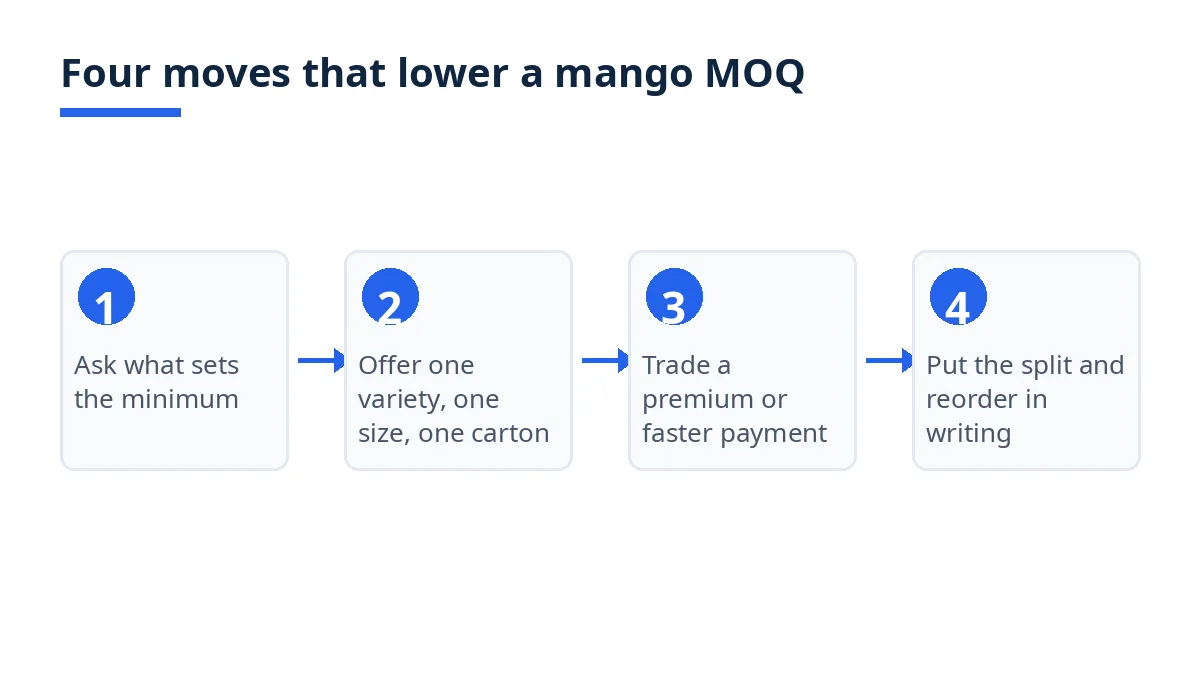
Do not promise volume you cannot back up: a 20 to 40 percent reduction is a realistic ask, while 90 percent below it usually asks the seller to run the order at a loss.1
How do trial orders and shared loads work for fruit that ripens in transit?
Treat a trial order as a paid test, not a free sample: agree the repeat-order terms before money moves.1 Flying a small trial lets you check the variety, size code and packing, but the freight per kg is high. Hold the trial at 13 degrees Celsius through packing and transport, and ripen it at 20 to 22 degrees at destination, where uniform ripening takes 5 to 9 days.6
A shared load divides one freight booking across two or more buyers. In a shared load your cartons travel with another buyer's fruit, so agree in writing whose temperature logger governs the load. In Europe, if just one package is found contaminated with fruit fly, the whole batch has to be destroyed, so a shared load carries a shared risk.2 Ask for the phytosanitary certificate for your consignment alone.7
What belongs in the order about quantity?
State the quantity in kilograms, cartons and fruit count: 2 tonnes in 4 kg cartons at 8 fruit per carton is 500 cartons and about 4,000 pieces of fruit. Name the size code with its weight band from the Codex standard, so a code B order cannot be filled with code A fruit.3
Write five protections into the order. First, the smallest quantity on each order and each reorder, with the price that applies at each quantity band. Second, the partial shipment rule: under UCP 600 Article 31, partial shipments are allowed unless the letter of credit expressly prohibits them.8 Third, the instalment warning: under Article 32, if any instalment is not shipped within its period, the credit ceases to be available for that instalment and any subsequent ones.8 Fourth, inspection at loading, with the right to turn away a lot that falls outside the agreed size code and class. Fifth, the document set for each shipment and the latest ship date.7 Match each clause against the paperwork every Bangladesh export needs.
A worked example: how a London retailer cut a 2-tonne quote to size
Example figures: a London retailer selling South Asian groceries moves about 300 kg of mangoes a week and wants to test Amrapali. The exporter quotes two tonnes in 4 kg cartons at 8 fruit per carton: 500 cartons, about 4,000 pieces of fruit, more than six weeks of sales. Mature-green fruit holds 2 to 4 weeks at 13 degrees Celsius, so the tail of the order would ripen before the shop could sell it.6 The exporter names the grading run and the freight booking.
The buyer answers with four trades: the standard 4 kg carton at size 7 to 8, the count the United Kingdom trade already prefers, instead of a printed retail carton;2 a ship date that can move inside a three-week window in mid-season; a higher per-kg price on the first shipment, in exchange for a written reorder minimum for the next two orders; and the price split in two, with the second half payable only once the loading inspection confirms the size code and the Class I limits.
The exporter accepts the full two tonnes on those terms, split across two air shipments of about one tonne each a fortnight apart, each with its own invoice, packing list, air waybill and phytosanitary certificate.7 The letter of credit allows partial shipments, so each presentation draws against the same credit without an amendment.8 The buyer still takes two tonnes, but the fruit arrives in two lots inside its ripening window and the cash goes out in two parts.
Which mistakes cost mango buyers the most?
Haggling over the per-kg price while freight goes uncounted. A small order can end up the dearest one once air freight is spread over fewer kilograms.1
Reading the minimum as one number for the whole order. It can sit separately on the variety, the size code, the pack, or each shipment.1
Ordering ripe fruit. Ripe mangoes are held at 10 degrees Celsius, while mature-green fruit holds for 2 to 4 weeks at 13 degrees.6 Order mature-green fruit and ripen it at destination.
Overpromising reorders. A commitment you cannot meet damages the relationship, and 90 percent below the stated minimum asks the seller to run the order at a loss.1
Shaking hands on the deal and writing nothing down. Quantity, reorder minimum, price bands and payment terms belong in the purchase order or the sales contract.1
Treating the phytosanitary certificate as paperwork for big orders only. A small order needs one too, and a certificate whose quantity or consignee disagrees with the invoice can hold the load at the border.7
Accepting an instalment schedule in the letter of credit without noticing it. A missed instalment date ends the credit for every instalment after it.8
Put the MOQ in writing as kilograms, cartons, fruit count, variety, size code and pack, with the price that applies at each quantity band and the repeat-order terms beside it.
Next steps on Exportain
Write your RFQ around the quantity you can sell through before the fruit ripens: name the variety, the size code, the carton count, the destination airport and the ship window you can accept, then compare two or three written quotes for the same carton and count. Before you post it, check the step-by-step mango import walkthrough, what to inspect carton by carton and which HS code your mangoes fall under. When the specification is set, put your RFQ on Exportain and let the quotes compete on the same numbers.
Sources
- How Do I Negotiate a Lower Minimum Order Quantity (MOQ) with a Manufacturer?. Sourcify, (accessed )
- Entering the European market for mangoes. CBI, (accessed )
- Codex Standard for Mangoes (CODEX STAN 184). FAO (accessed )
- Mango quality standards and export insights. Wikifarmer (accessed )
- Mango exports rebound as quality, production improve. The Daily Star, (accessed )
- Mango. UC Davis Postharvest Research and Extension Center (accessed )
- Phytosanitary certificate: an importer's guide. Trackberry (accessed )
- Partial Shipments: What UCP 600 Actually Says vs What Everyone Thinks. SmartLC (accessed )
- MOQ
- minimum order quantity
- Mangoes
- Air freight
- phytosanitary certificate
- Bangladesh mango exports
- mango trial order
- mango size codes
About the author
Sourcing from Bangladesh?
Post a request for quotation and suppliers on Exportain can send you their quotes directly.
Post an RFQ