How to Import Spice Mixes From Bangladesh in 2026: Complete Buyer Guide
How to import spice mixes from Bangladesh: fixing the recipe and reference blend, the validated kill step, EU aflatoxin and ochratoxin limits, labelling for the EU and the US, HS 0910.91 classification, and the documents for a first shipment.
Short answer
To import spice mixes from Bangladesh, fix the recipe in writing first: every component, its share, its tolerance and its grind size, with a sealed reference blend kept by both sides. Approve a production sample, then require a validated kill step and a test panel on the finished blend lot covering aflatoxins, ochratoxin A, Sudan dyes, Salmonella and pesticide residues. Label the blend from the frozen recipe, classify it under HS 0910.91, and hold the balance payment until the laboratory reports and the document set arrive.
On this page
Key takeaways
Fix the recipe in writing, with shares, tolerances and grind sizes, and keep a sealed reference blend per recipe version.
Every spice needs a validated kill step before sale; ask for the validation record for your blend.
For the EU, aflatoxin B1 is capped at 5 µg/kg and total aflatoxins at 10 µg/kg for listed dried spices and mixtures containing them, and ochratoxin A at 15 µg/kg.
Label from the frozen recipe: ingredients in descending order of weight, with Annex II allergens emphasised; sesame is a major allergen in the US since January 1, 2023.
A spice mix of components from different Chapter 9 headings points to heading 0910, mixtures line 0910.91.
A spice mix is a recipe, not a single ingredient. The recipe decides the flavour, the tests, the label and the customs code, so a buyer who orders a blend without fixing the recipe in writing buys a different product every time.
What is a spice mix in trade terms?
A spice mix is two or more spices combined to a fixed recipe, ground or left whole, and sold under one name. Garam masala, curry powder, biryani masala and kebab masala are each defined by their recipe.
A blend differs from a single spice in three ways: the specification is the recipe, with each component named, weighed and given a tolerance; the tests run on the finished blend; and the customs code follows the mixture rule, not the largest ingredient.
Which blends do buyers order from Bangladesh?
The four blends below cover most first orders. Form matters: a whole-spice blend and a ground blend of the same recipe sit on different customs lines. State the form in the order and confirm it on the label proof.
Blend | Buyer use | Form | Fix in the recipe |
|---|---|---|---|
Garam masala | Finishing blend for curries | Ground | Roast step, grind size |
Curry powder | Base blend for curries and sauces | Ground | Turmeric and chili shares |
Biryani masala | Layered rice dishes | Whole or ground | Whole, ground or both |
Kebab masala | Marinades for grilled meat | Ground | Chili heat, salt share |
Who owns the recipe, and how do you protect it?
Decide ownership before the first sample is ground. The recipe can be yours, supplied to the maker with an agreement not to sell it on; the supplier's house blend, bought as sold with the right to reject drifting batches; or a joint development, where the contract says who may use it and after the relationship ends.
Put four items in writing: the recipe, with every component named, its share, its tolerance, and the grind size; the reference blend, a sealed sample of the approved recipe kept by both sides; the change rule, under which nothing changes without your written approval; and confidentiality, covering who sees the recipe in the plant and what happens to it if the order ends. A changed recipe reorders the label and can change the customs code, so keep one sealed reference blend per recipe version, labelled with the recipe number and approval date.
How does a blend move from recipe to packed cartons?
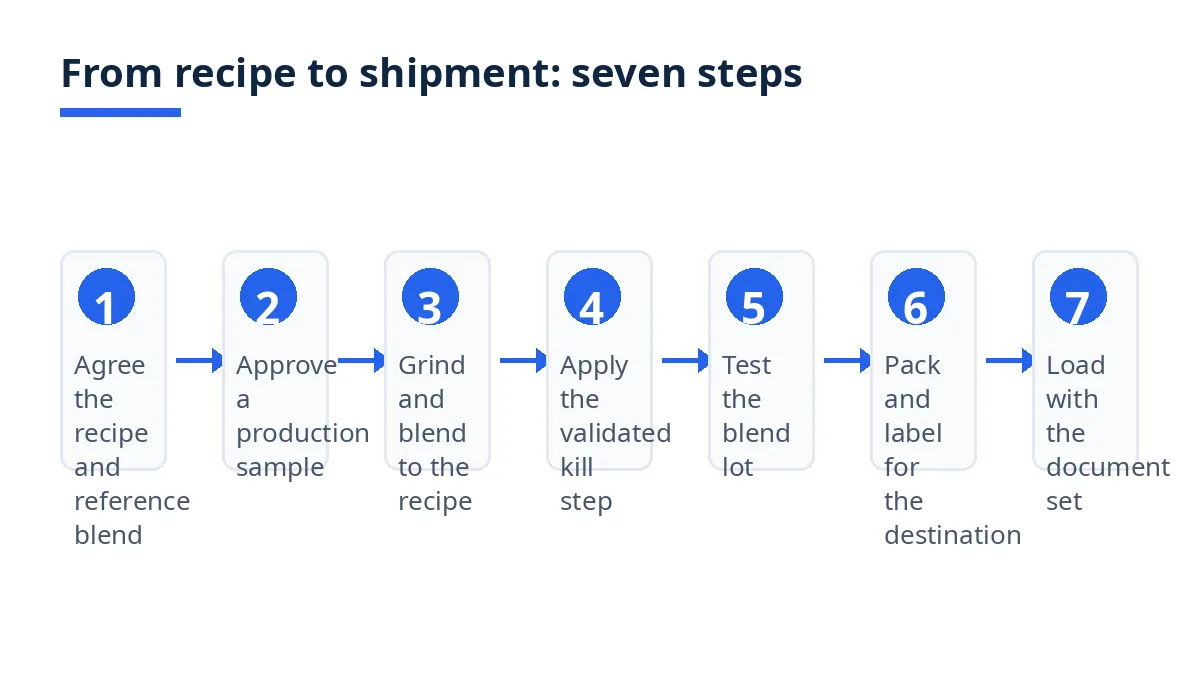
A blend order runs through seven steps.
Agree the recipe and the reference blend. Send the recipe in writing: shares, tolerances, grind sizes and the destination test panel.
Approve a production sample. The supplier grinds and blends a small batch to the recipe. You check it against your reference, cook with it, and approve it in writing; nothing scales up before this approval.
Source and clean the components. Each component is bought, cleaned and checked before grinding; a damp or mouldy component contaminates the whole blend.
Grind and blend to the recipe. Components are ground to the recipe fineness, weighed in recipe order and mixed until uniform; fineness is checked per component.
Apply the validated kill step. Every spice needs a validated kill step before sale; for Salmonella the methods include steam and heat treatment, irradiation and fumigation.1 Ask which method the supplier uses, and for the validation record for your blend.
Test the blend lot. The finished blend is sampled and tested against the destination limits. Hold the lot until the results arrive.
Pack and label for the destination. Pack with moisture protection, print the label from the approved proof, and mark each carton with blend name, lot number and net weight.
Do not skip the production sample: grind size, colour and flavour are settled there, while they can still be corrected cheaply.
What should you test before you pay the balance?
Test the finished blend, not only its components: a contaminant in one component is diluted by the rest, so a blend-level screen can miss it. A clean component cannot rescue a dirty one: under the EU contaminant rules, food that meets the maximum levels shall not be mixed with food that exceeds them.2 Name the methods and acceptance numbers in the order before production starts.
Test | Catches | EU limit |
|---|---|---|
Aflatoxins B1 and total | Mould toxins | B1 5, total 10 µg/kg2 |
Ochratoxin A | Mould toxin | 15 µg/kg, 20 µg/kg for Capsicum2 |
Sudan dyes | Illegal colour | No permitted level; any detection is a hold |
Salmonella and microbiology | Pathogens | Salmonella must be absent3 |
Pesticide residues | Residues above destination limits | EU maximum residue levels under Regulation (EC) No 396/20053 |
For compound foods with no specific maximum level for the finished product, the proportions of the ingredients are taken into account when the limits are applied.2 That is why the recipe shares matter to the laboratory as well as to the cook. In 2025, 279 spice and herb issues were reported through the EU Rapid Alert System for Food and Feed, with pesticide residues the most common cause, followed by plant toxins, then microbiological and mycotoxin contamination.3 Spice mixes from Pakistan were checked for aflatoxins at 30 percent of consignments in 2024/2025, down from 50 percent after compliance improved.3
Sampling a blend needs more care than sampling a single spice. ISO 948 describes taking increments from different positions in the lot, combining them into a bulk sample, and dividing that into laboratory samples, with one sealed reference sample kept for disputes.4 For a consignment of mixtures, the EU sampling card calls for one aggregate sample from at least five conventional points: one at the top, three at different depths in the middle and one at the bottom.5 The recommended final sample is 100 to 500 g, or 1 kg for mixtures.5 Sample across bags and cartons at random, and require the blend lot number on every report. Set a moisture limit in the order too: a blend dry at mixing can still cake if one component carries moisture.
How do you label a spice mix for the EU and the US?
The label is built from the recipe, so approve the label proof only after the recipe is frozen; any change that reorders the components needs a new label check.
For the European Union, Regulation (EU) No 1169/2011 requires the ingredient list to show all ingredients in descending order of weight, as recorded at the time of their use in manufacture.6 A recipe change that moves one component above another therefore changes the label. Allergens in Annex II, including celery, mustard and sesame seeds among 14 entries, must be emphasised in the ingredient list.6 The other mandatory particulars are name, net quantity, date marking, storage conditions, operator name and address, origin where required, and nutrition declaration.6
For the United States, the Food Allergen Labeling and Consumer Protection Act of 2004 named eight major food allergens, and the FASTER Act of 2021 added sesame as the ninth, effective January 1, 2023.7 Sesame, or an ingredient containing protein derived from it, must be clearly labelled on packaged foods regulated by the FDA from that date.7 The label must identify the food source of every major food allergen in the product, in parentheses after the ingredient name or in a "Contains" statement beside the ingredient list.7 A blend with mustard or sesame therefore carries an allergen declaration in both markets, and a blend made on a shared line after a mustard or sesame blend needs the line records checked before the label is approved. Ask your broker how the destination rules treat origin for a mixture.
Which HS code does a spice mix take?
A spice mix of components from different Chapter 9 headings points to heading 0910, mixtures line 0910.91. Chapter 9 Note 1 says mixtures of products of the same heading stay in that heading, while mixtures of products of different headings are classified in heading 0910, and subheading 0910.91 covers mixtures referred to in Note 1(b).8 The note has no predominant-ingredient test.
Adding other substances does not affect classification provided the mixture retains the essential character of those goods; otherwise it is not classified in Chapter 9, and a mixed condiment or mixed seasoning is classified in heading 2103.8 A dry blend with a little salt usually keeps its Chapter 9 character, while a wet paste built around oil and water may not, so a paste needs its own check. The classification method, with worked mixture examples, is laid out in the spice-mix HS-code walkthrough.
What documents and shipment terms close the order?
Ask for the set below with the lot number on each document, and hold the balance payment until the set is complete.
Document | Must show |
|---|---|
Commercial invoice | Blend name, recipe version, quantity, pack size, unit price, Incoterm |
Packing list | Carton count, net and gross weight, marks and lot numbers |
Certificate of origin | Origin agreed with your broker |
Laboratory reports | Full test panel for the blend lot, with methods and results |
Kill-step record | Treatment method and validation |
Bill of lading | Consignee, port pair, container and seal numbers |
Confirm three points in writing. First, the container: clean, dry and odour-free, with moisture protection, since a damp blend cakes and loses aroma. Second, the Incoterm: agree who carries freight and insurance and where risk passes; FOB, CIF and FCA for a spice shipment are weighed in this Incoterm comparison for spice shipments. Third, the inspection point: book the check through the pre-shipment inspection walkthrough, measure the lot against the blend quality-control checklist, and settle the AQL sampling level before the inspector arrives. Ask your broker whether the destination requires a phytosanitary certificate before loading.
A worked example: a first order of biryani masala
Example figures: a UK spice brand wants a first order of biryani masala under its own label, 10,000 retail packs of 100 g, FOB Chattogram. The buyer sends its recipe, and the supplier returns a production sample plus a quote of USD 0.42 per pack, itemised as components and grinding, kill step and testing, packing, and export costs. The buyer approves the sample after cooking with it, and the order names the test panel: aflatoxins, ochratoxin A, Sudan dyes, Salmonella and pesticide residues.
The label proof is approved from the frozen recipe, with ingredients in descending order of weight and mustard emphasised as an allergen, and the blend is classified under heading 0910, mixtures line 0910.91.8 6 Payment is split 30 percent on order confirmation and 70 percent after the loading inspection and the document set arrive, and the retained sample is sealed and kept by both sides. The example shows the sequence, not a market price.
Which mistakes cost blend buyers the most?
Ordering by blend name alone, with no written recipe, so each batch is a new product.
Testing the components and skipping the finished blend, so a dye or toxin is diluted past detection.
Approving the label before the recipe is frozen, then changing a share so the ingredient order no longer matches.
Forgetting the allergen line: a blend with mustard or sesame, or made after one on a shared line, ships without the required declaration.
Classifying by the largest ingredient instead of running the mixture rule.
Paying the balance before the laboratory reports and the document set arrive.
Skipping the sealed reference sample, so a flavour dispute has no evidence.
Fix the recipe in writing, test the finished blend, approve the label from the frozen recipe, and keep a sealed reference sample.
Next steps on Exportain
Put the blend, the full recipe with shares and tolerances, the pack size, the destination test panel and the target delivery window into a quotation request on Exportain, attaching your reference blend details so every supplier prices the same product you will approve. While quotes come in, the specification sheet and supplier checks behind a first order are covered in the Bangladesh tea-and-spice buying companion, and how the Bangladesh spice trade is organised is mapped in the Bangladesh spice-trade overview.
Sources
- Food Safety and Treatment Methods. American Spice Trade Association (accessed )
- Commission Regulation (EU) 2023/915 on maximum levels for certain contaminants in food. EUR-Lex, (accessed )
- What requirements must herbs and spices meet to be allowed on the European market?. CBI (accessed )
- ISO 948:1980, Spices and condiments — Sampling. International Organization for Standardization, (accessed )
- Sampling: Coffee, tea, spices, beans, nuts and dried fruit. European Commission (accessed )
- Regulation (EU) No 1169/2011. European Union (accessed )
- The Food Allergy Safety, Treatment, Education, and Research Act of 2021. FoodSafety.gov, (accessed )
- Chapter 9: Coffee, tea, maté and spices. World Customs Organization (accessed )
- Bangladesh exports
- spice mixes
- garam masala
- curry powder
- HS code 0910.91
- food safety testing
- spice labelling
About the author
Sourcing from Bangladesh?
Post a request for quotation and suppliers on Exportain can send you their quotes directly.
Post an RFQ