Wholesale Mangoes From Bangladesh: Prices, MOQ and Reliable Suppliers
Wholesale mangoes from Bangladesh, priced by variety, week and market: dated prices from Baneshwar to Dhaka, MOQ bands by channel, supplier types, the 13°C cold chain and how to judge a supplier before you pay.
Short answer
Wholesale mangoes from Bangladesh trade by variety, week and market. In June 2026 Amrapali sold for Tk 40 to 50 per kilogram at Baneshwar market in Rajshahi and Tk 80 to 90 in Dhaka, while sampled export deals ran 2.50 to 4.00 US dollars per kilogram. Buy mature-green fruit graded to an agreed size code, hold it near 13 degrees Celsius, and tie the balance of payment to the shipping documents and a phytosanitary certificate.
On this page
Key takeaways
Amrapali sold for Tk 40 to 50 per kg at Baneshwar in June 2026 and Tk 80 to 90 in Dhaka, so the market where you buy sets the price as much as the variety.
Bangladesh grows 2.4 to 2.5 million tonnes of mangoes a year but exported only 2,194 tonnes in 2025, so domestic demand sets wholesale prices.
No published standard fixes a mango MOQ; mandi traders sell by the crate, aggregators by the truckload and exporters by the shipment.
Mature-green mangoes hold for two to four weeks at 13 degrees Celsius; ripe fruit leaves almost no room for a delay.
Only five hot water treatment units serve the whole country, so confirm the treatment slot before you book freight.
A wholesale mango buyer in Bangladesh buys orchard lots by the maund, the crate or the truckload, in a season of about four months. The price depends on the variety, the week, the market and how far the fruit still has to travel.
This guide covers the varieties that move in volume, dated prices by variety and market, order sizes by channel, the orchard-to-warehouse journey, and the checks that separate a steady supplier from a one-season trader. If this is your first shipment, the wider import steps are walked through in our mango import walkthrough; this page stays on wholesale prices and suppliers.
What does buying wholesale mangoes mean in Bangladesh?
Wholesale buying means buying in bulk before retail, and in Bangladesh that stage sits close to the orchard. Tridge describes the domestic value chain as orchard, then local assembly and wholesale markets, then sorting, grading and packing, then distribution to retailers.1 For export, the chain runs from orchard selection through packing and handling to inspection and certification by the Plant Quarantine Wing of the Department of Agricultural Extension, then shipment.1
Three places set the wholesale price: the orchard belt of the northern districts; the source market, such as Baneshwar in Rajshahi;2 and the city wholesale market in Dhaka. A buyer at the source market pays less and takes on more work, while a buyer in Dhaka pays more and takes on less. Lots are priced by weight, usually per kilogram or per maund, a unit of about 40 kilograms.2
Which varieties move in wholesale volumes, and when?
Each year Bangladesh produces 2.4 to 2.5 million tonnes of mangoes, yet only seven or eight varieties leave the country.3 Amrapali makes up about 80 percent of shipments, while Himsagar, Langra, BARI-4 and Fazli cover most of what remains.3 The main harvest window runs from late May to early July, with timing set by variety.1
Variety | Role in the trade | Dated wholesale price evidence |
|---|---|---|
Himsagar | Main exported variety3 | Tk 79 per kg, June 20244; Tk 1,300 to 1,600 per maund at Baneshwar, June 20262 |
Langra | Main exported variety3 | Tk 80.86 per kg, June 20244 |
Amrapali | About 80 percent of shipments3 | Tk 72.58 per kg in Naogaon, June 20244; Tk 40 to 50 per kg at Baneshwar, June 20262 |
Gopalbhog | Exported variety4 | Tk 1,000 to 1,400 per maund at Baneshwar, June 20262 |
Fazli | Main exported variety3 | No dated wholesale price found in these sources |
A maund is about 40 kilograms, so those Baneshwar figures work out to about Tk 32.50 to 40 per kilogram for Himsagar and Tk 25 to 35 for Gopalbhog.2 The table is dated evidence, not a price list.
What do wholesale mangoes cost right now?
Prices move with the variety, the week and the market, so read every figure below as dated evidence, not as a price that stands.
In June 2024, a heatwave cut yields and pushed prices to record levels. The Department of Agricultural Marketing put Himsagar at Tk 79 per kg, up from Tk 41 the previous June, and Langra at Tk 80.86 per kg, up from Tk 39. Amrapali fetched Tk 72.58 per kg in Naogaon, while Dhaka retail prices ran Tk 120 to 180 per kg.4 Orchard owners put the yield fall at more than 40 percent, the Department of Agricultural Extension estimated 15 to 20 percent, and traders said exports had fallen 30 percent.4
In June 2026, the source market told a different story. At Baneshwar, Amrapali sold for Tk 40 to 50 per kilogram, the same fruit for Tk 60 to 70 in Rajshahi city and Tk 80 to 90 in Dhaka. Himsagar sold at Tk 1,300 to 1,600 per maund at Baneshwar, and Gopalbhog at Tk 1,000 to 1,400 per maund.2 Traders put packaging at about Tk 300 per maund and transport at another Tk 12 to 13 per kilogram, before margins.2
Export prices sit above domestic wholesale prices. Tridge records sampled export transactions at 2.50 to 4.00 US dollars per kilogram in June and July 2026.1
How does the season move the wholesale price?
Three forces do most of the work: weather, domestic demand and freight. The June 2024 heatwave shows the first: a poor fruit set cut the crop, and wholesale prices roughly doubled within a year while exports fell by about a third.4
Domestic demand comes second. Bangladesh exported only 2,194 tonnes of mangoes in 2025, up 66 percent on 2024, out of a crop of 2.4 to 2.5 million tonnes.3 The domestic market absorbs nearly everything the country grows.
Freight comes third. When air freight is dear, exporters buy less, and more fruit stays in the domestic chain. Freight costs had climbed to two or three times the usual rates before the 2025 rebound.3
What order sizes do wholesale sellers work with?
No published standard fixes the minimum order for wholesale mangoes. The size follows the channel: a mandi trader sells by the crate and the maund, an aggregator by the truckload, and an exporter by the shipment. The bands below are example figures. Confirm the band with each seller before you budget.
Order band | Example size |
|---|---|
Trial crate lot | 10 to 20 crates, about 250 to 500 kg |
Small wholesale | 1 to 2 tonnes |
Truckload | 5 to 10 tonnes |
Export shipment | 500 kg to 2 tonnes by air, or a reefer container by sea |
Season contract | 50 tonnes and above across the season |
A trial lot is the cheapest way to learn how a seller grades.
Who sells wholesale mangoes, and how do the channels differ?
Orchard owners sell the crop where it grows, often through forward booking before harvest. The price is the most direct, and the buyer takes on the sorting, packing, treatment and transport.
Mandi traders and aggregators buy from many orchards and sell at source markets such as Baneshwar. They offer volume and daily prices. The trade-off is mixed grading: a lot assembled from several orchards needs a written size and grade standard or it arrives mixed.5
Packhouse exporters grade, pack, treat and certify the fruit for export, and they carry the documents an importer needs. Treatment capacity is thin: Bangladesh has only five hot water treatment units and no vapour heat treatment facilities.5 Only one Bangladeshi entity currently holds GlobalG.A.P. certification.5
Processors buy ripe or second-grade fruit for pulp, juice and drying, not for fresh export.
How does a wholesale order travel from orchard to warehouse?
A wholesale order moves through six stages, and the fruit is at risk in every one of them. The diagram below sets out the flow.
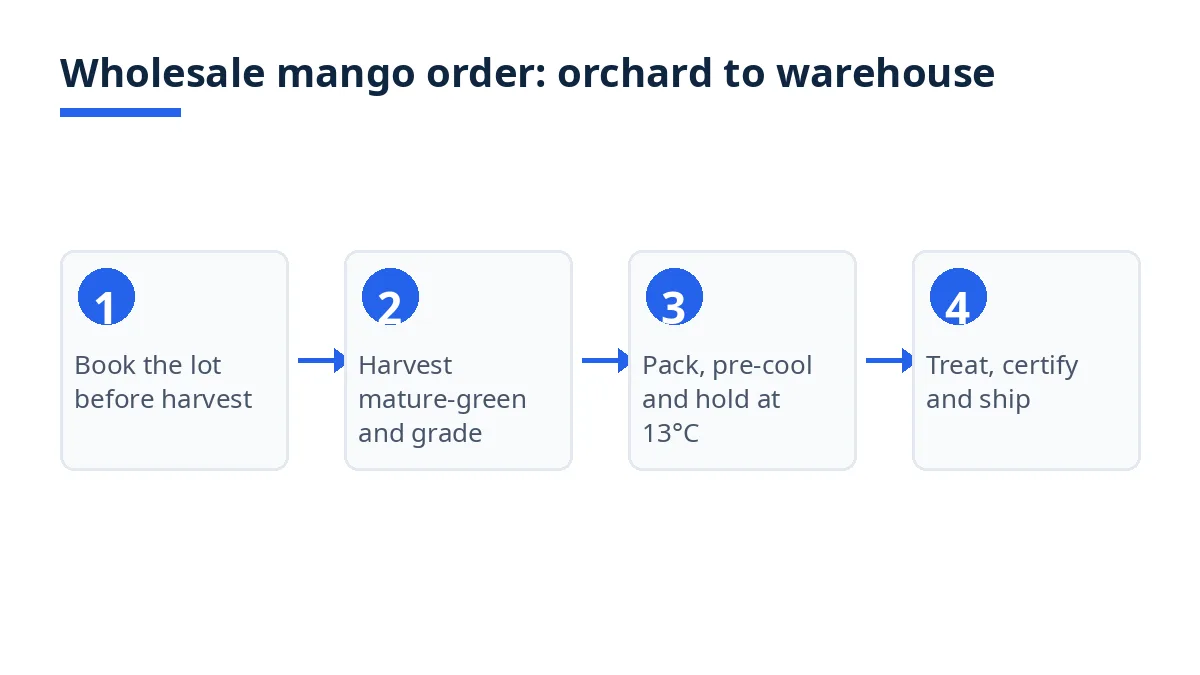
Book the lot before harvest, and put the variety, quantity, harvest week, size code and grade in writing.
Harvest mature-green. Fruit taken down before it is mature never gains its full flavour and suffers more from chilling injury and heat damage, while fruit that stays on the tree until it is ripe often breaks down inside.6
Grade and pack. Fruit is graded by size, weight, colour and maturity, and larger fruit needs two to four days more to ripen than smaller fruit.6 Size codes run A to D by weight, and the common export pack is a 4 kg box holding 7 or 8 mangoes.7
Pre-cool and hold the cold chain. Fruit is pre-cooled to 10 to 12 degrees Celsius and stored at 13 degrees, where it can keep for three to four weeks.6 Moving the fruit in temperature-controlled trucks stretches its shelf life from 5 to 10 days to over 15 days.5
Treat and certify. A phytosanitary certificate is required to import mangoes into Europe, and fruit fly is the pest that decides market access.7 Exports to the United States must be hot water treated.7 With only five hot water treatment units in the country, confirm the treatment slot before you book freight.5
Ship and ripen at destination. Mangoes keep ripening after picking. Sea fruit is picked unripe while air fruit is picked later and arrives riper.7 Ripening rooms finish the job at 20 to 23 degrees Celsius.6
Post-harvest loss runs at 24 percent nationally, so budget for that loss in the order quantity rather than discovering it at arrival.5
What should you agree in writing before you pay?
A wholesale mango order needs five things in writing: the specification, the price basis, the payment terms, the documents and the delivery plan.
The specification names the variety, size code, class, count per carton, maturity stage and defect limits. European buyers almost always ask for Class I mangoes, which must be of good quality, sound and clean.7 Agree the ripeness and sugar content with your buyer as well.7
The price basis names the unit, the market and what is included. State whether the price is per kilogram or per maund, whether packaging and transport are inside the quote, and which market the price was struck in. A Baneshwar price and a Dhaka price for the same variety can sit Tk 30 to 40 apart per kilogram.2
The payment terms name the advance, the balance and the trigger for each, usually an advance, with the balance settled when the shipping documents are presented, often under a letter of credit. Check the payment trigger against the letter-of-credit explainer and the 30/70 TT explainer before you sign. Spot-market trading carries no guarantees and prices can move sharply.7
The document set and the delivery plan name the papers, the harvest week, the treatment date and the freight booking. The phytosanitary certificate must match the shipment exactly. Our documents guide for exporters itemises the full set. Fresh mangoes fall under HS code 080450.7
How do you judge a wholesale mango supplier?
Start with the licence: an exporter of agro-products needs a Department of Agricultural Marketing licence, valid for one year.
Then check grading with your own eyes. Ask for photographs of a graded sample from the lot you would receive, and at inspection work through the inspection checklist for mangoes carton by carton. Ask for recent shipments: Bangladesh shipped to 26 countries in 2025, led by the United Kingdom with 686 tonnes.3 A seller who can name recent loads is describing a real trade. Run a trial lot before any season commitment.
A worked example: 5 tonnes of Amrapali from Baneshwar to Dhaka
Example figures: a Dhaka wholesaler buys 5 tonnes of Amrapali at Baneshwar in June. Fruit at Tk 45 per kilogram, the middle of the sourced range of Tk 40 to 50, comes to Tk 225,000.2 Packaging at Tk 300 per maund adds Tk 37,500 for 125 maunds, and transport at Tk 12.50 per kilogram adds Tk 62,500.2 The landed cost is Tk 325,000, or Tk 65 per kilogram, against a Dhaka price of Tk 80 to 90.2 The gap covers handling, margins and loss.
Which wholesale buying mistakes cost the most?
Chasing the lowest quote. A price far under the market usually points to a mixed or ungraded lot.
Ordering ripe fruit for a long journey. Fruit left on the tree until ripe often breaks down inside, while mature-green fruit holds for two to four weeks at 13 degrees Celsius.6 8 Order mature-green fruit and ripen it at destination.
Mixing sizes in one carton. Larger fruit needs two to four days more to ripen, so a mixed carton ripens unevenly.6
Booking freight before the treatment slot. With only five hot water treatment units in the country, a booked flight without a slot is a wasted booking.5 Confirm the treatment date first.
Skipping the residue test. If one package is found contaminated the whole batch has to be destroyed.7
Paying everything up front to a supplier you have never traded with. Keep the first payment small and link the rest to the shipping documents.
Next steps on Exportain
Write down the variety, size code, quantity and destination you need, then post a request for quotation on Exportain and ask each seller to price that lot. Check the replies against the dated prices in this guide, cross-check the wider import steps in the mango import walkthrough, put the winning lot through the inspection checklist for mangoes, and start with a trial lot. Post your request at /rfqs/new or browse current listings under /suppliers.
Sources
- Fresh Mango Bangladesh Suppliers, Trade & Prices | Market Overview 2026. Tridge (accessed )
- Transport costs push up mango prices. Business Mirror, (accessed )
- Bangladesh mango exports rise 66% in 2025. FreshPlaza (accessed )
- Mango prices record high as heatwaves cut output. The Financial Express, (accessed )
- Advancing Mango Production & Forward Marketing in Bangladesh. LightCastle Partners, (accessed )
- Mango – Post-harvest & Processing. International Tropical Fruits Network (accessed )
- Entering the European market for mangoes. CBI, (accessed )
- Mango: Postharvest Research and Extension Center Produce Facts. University of California Davis (accessed )
- Himsagar
- wholesale mangoes
- mango prices Bangladesh
- mango MOQ
- Amrapali
- mango suppliers Bangladesh
- HS code 080450
- mango cold chain
About the author
Sourcing from Bangladesh?
Post a request for quotation and suppliers on Exportain can send you their quotes directly.
Post an RFQ