How to Import Basmati-Style Rice From Bangladesh in 2026: Complete Buyer Guide
How to import basmati-style rice from Bangladesh: the long-grain spec, cooking test, HS 1006.30, export documents, phytosanitary certificate and fumigation, step by step.
Short answer
To import basmati-style rice from Bangladesh, order long-grain aromatic rice by measured spec, not by name: grain length at least 6.5 mm, length-to-width ratio at least 3.5, moisture at 14 percent maximum, and a cooking elongation ratio of 1.70. Cook-test a lot sample, agree the contract on the approved sample, classify the load under HS 1006.30, and ship with a phytosanitary certificate from the Department of Agricultural Extension and a completed phosphine fumigation.
On this page
Key takeaways
Basmati-style rice is long-grain aromatic rice measured against the basmati profile, not GI basmati: name the variety and the style descriptor exactly, with no GI claim.
Write the spec on measured grain: length-to-width ratio 3.0 or more or kernel length 6.6 mm or more under Codex, moisture at 14 percent maximum for humid destinations, and a cooking elongation test.
Rice leaves Bangladesh only with commerce ministry approval, and the invoice must carry the exporter's ERC number and the HS code.
Phosphine fumigation takes a minimum of seven days in a gas-tight enclosure, and the phytosanitary certificate must match the invoice on quantity, variety and consignee.
A buyer who wants long-grain aromatic rice for biryani counters faces a naming problem before any price talk: the grain Bangladesh sells as basmati-style is not GI basmati, and it is not the short-grain aromatic rice the country is best known for either. This guide walks through the import process, from specification and sampling to contract, documents, fumigation and loading.
What does "basmati-style" mean, and what is it not?
Basmati is a special long-grain aromatic rice grown in specific areas of the Indo-Gangetic Plains, registered as a geographical indication in Pakistan under the Geographical Indications (Protection and Registration) Act 2020.1 Its profile lists long slender kernels with a high length-to-breadth ratio, aroma in which 2-acetyl-1-pyrroline (2-AP) is predominant, and cooked grains that keep their shape.1 Rice grown in Bangladesh sits outside that area, so it cannot be sold as GI basmati.
That is what the word "style" is doing in the offer: it signals grain grown or milled to resemble basmati, not a named basmati variety. The registered figures give the style its target: a minimum pre-cooked grain length of 6.50 mm, an average breadth of 1.9 mm or less, a minimum length-to-breadth ratio of 3.50, a minimum average cooked length of 12.00 mm, and a minimum elongation ratio on cooking of 1.70.1 The order should state its own limits rather than borrowing the GI numbers. Bangladesh has its own rice GIs too: Kataribhog and Kalijira received GI certificates in June 2021.2
Which Bangladeshi varieties sit behind a basmati-style offer?
Mills build basmati-style lots from Bangladesh's aromatic varieties, selecting the longest, most slender grain they can mill. Kataribhog, the traditional aromatic of Dinajpur, is the longest-grained and the usual starting point. Kalijira is small and strongly aromatic, so it earns the style name only when length is measured. Chinigura is a fine, small-grained aromatic, and the market name most often attached to BRRI dhan34, so ask which paddy is in the lot. BRRI dhan34, released in 1997, is almost similar to chinigura with nearly double the yield.
BRRI has developed eight fine and aromatic rice varieties, including BRRI dhan34, BRRI dhan37, BRRI dhan38, BRRI dhan70, BRRI dhan75 and BRRI dhan80.3 BRRI dhan70 is identical to the well-known kataribhog variety, with a bigger grain.3 Most Bangladeshi aromatic varieties are short-grain by the Codex measure, so ask for the measured length and ratio of the lot rather than trusting the variety name. Our guide to importing aromatic rice from Bangladesh covers the short-grain varieties in full.
How do you write a basmati-style specification that a mill can meet?
Start with grain shape. Under the Codex Standard for Rice, milled rice counts as long grain when its length-to-width ratio is 3.0 or more, or, under the kernel-length option, when the kernel measures 6.6 mm or more.4 State which option your contract uses, and require the measurement on whole kernels from the lot that ships. The TDAP basmati figures above are a reference for the style, not the order limit: they describe GI basmati, so write your own limits beside them.
Then comes moisture. The Codex ceiling is 15 percent by mass, though the standard itself flags that hotter, damper destinations and longer voyages may call for a tighter cap.4 If your market is humid, put 14 percent in the contract as the ceiling and insist the figure comes from a test on your lot, not a mill-wide average.
Next, milling and breakage. The Codex standard sorts milled rice into three milling grades — undermilled, well-milled and extra well-milled — according to how much germ and bran has been stripped away.4 Polish harder and the grain turns whiter, yet the bran that carries aroma goes with it, so name the grade in the order. For breakage, Codex treats a kernel as head rice when it keeps at least 75 percent of a whole kernel's average length; anything shorter counts as broken, and the tiniest fragments — those slipping through a 1.4 mm sieve — are chips.4 Pin the contract to one of those definitions, cap broken grain beside it, and take your extraneous-matter caps from the Codex figures for milled rice.4 Our basmati-style rice quality control checklist turns these points into a lot-by-lot inspection sheet.
How do you find and check a seller?
Check the seller's export standing before you pay anything. All exporters in Bangladesh must acquire an Export Registration Certificate (ERC) from the Export Promotion Bureau, and the commercial invoice must include the ERC number and the HS code of the goods.5 Ask for the ERC number with the first quote, and check that it appears on the invoice when the documents arrive.
Confirm the export permission as well. Rice is not exported from Bangladesh without special approval from the commerce ministry, although packaged aromatic rice is regularly exported.3 Ask the seller to confirm that the approval covers your shipment and your destination before you pay a deposit.
How do you test a sample before you order?
Do not commit to a first shipment on the strength of a photograph in a catalogue. Request a trial portion — 1 kg at minimum — taken from the very lot you intend to purchase, then cook it exactly as your end customers would. That cooking trial decides whether the style claim holds: count out equal numbers of raw and cooked grains, work out cooked length over raw length, and set the outcome against the elongation figure written in your spec. Properly cooked basmati-style grains stay separate, soft and fluffy rather than sticky, so clumping or a pasty texture signals the wrong variety or the wrong milling.1 Check the scent at three stages — dry grain, grain soaked in warm water, and the cooked dish — and compare each against the sealed reference sample you approved. Before any money moves, obtain a certificate of analysis for that specific lot, and fix your acceptance rules in advance with our AQL acceptance quality limit explainer.
What does the order-to-shipment process look like, step by step?
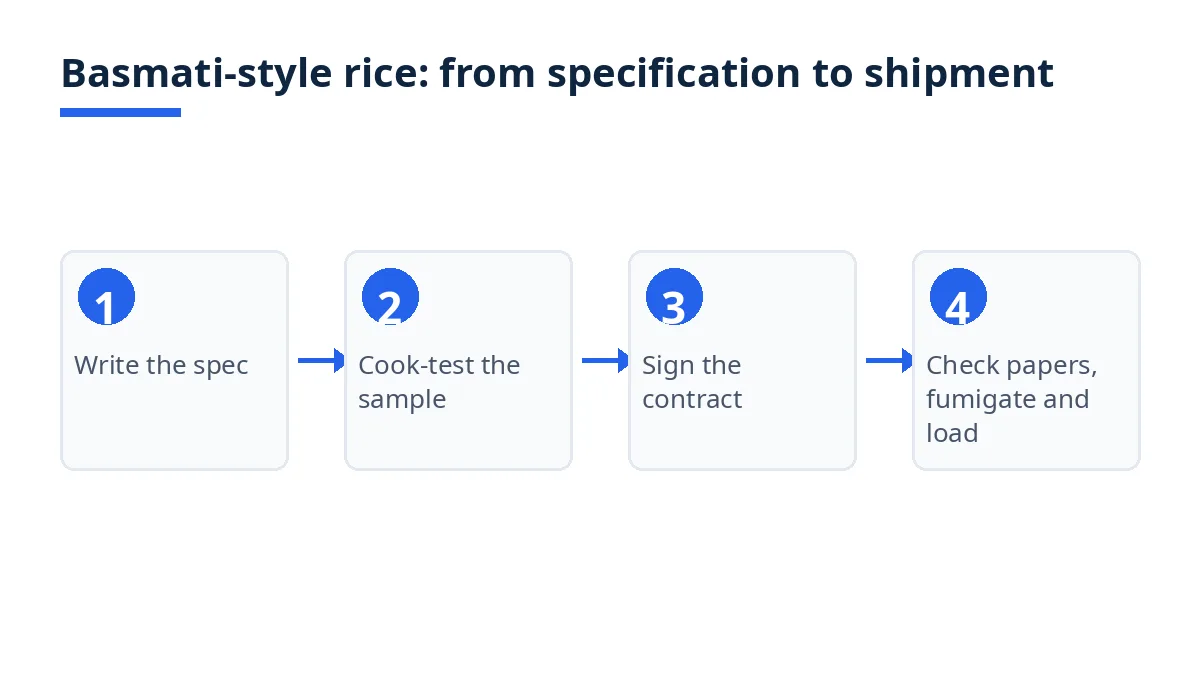
The import process runs in eight steps, and each step has one document or decision that gates the next. Skipping a gate moves the problem to the port, where it costs more to fix.
Send the specification to sellers as a request for quotation, naming variety, grain length and ratio, moisture and broken limits, milling degree, pack and destination.
Shortlist the replies, confirm the ERC number and the commerce ministry approval.
Receive a lot sample, cook-test it, and agree the laboratory scope.
Sign the contract: variety, limits, milling degree, pack, price, Incoterm, payment terms, inspection point, and latest ship date.
The seller mills, sorts and packs the lot. Arrange a pre-shipment inspection now, with the approved sample beside the inspector.
The laboratory issues the lot certificate of analysis, and fumigation is completed where required.
The seller assembles the document set: commercial invoice, packing list, certificate of origin, phytosanitary certificate and bill of lading.
Check the container is clean, dry and free of odours, then load and ship.
Which HS code and export papers does the shipment need?
Most retail basmati-style rice ships as milled rice under HS 1006.30. Under heading 1006 the WCO nomenclature splits rice into four subheadings:6
Subheading | Covers |
|---|---|
1006.10 | Rice still in the husk |
1006.20 | Husked (brown) rice |
1006.30 | Rice semi-milled or wholly milled, polished or glazed or not |
1006.40 | Broken rice |
The chapter note keeps rice inside heading 1006 whether it is husked, milled, polished, glazed, parboiled or broken.6 Because countries add extra digits after the six-digit code, have your broker confirm the full national code before the invoice is raised. Our classification walkthrough for this style works through the questions that decide the code.
Think of the phytosanitary certificate as travelling with the goods, not with the deal. ISPM 12, the IPPC standard behind it, puts issuance in the hands of the exporting country's plant-protection authority, acting through public officers with the technical qualifications for the job, and the document certifies that the shipment passed inspection or testing and satisfies the destination country's plant-health rules.7 It loses its standing if it cannot be read, if something is missing, if its validity has run out, or if its details contradict each other.7 Before dispatch, match the certificate number, variety, quantity and consignee against the invoice.
When does fumigation come in, and what should you ask for?
Two different fumigations can touch a basmati-style shipment. The first treats the grain itself against storage insects. The second treats wooden packaging, such as pallets or crates, and a fumigation certificate for the wood packaging is often required, issued by approved providers to verify that the wood was treated according to international standards.5
For the grain, phosphine is the usual fumigant. It is released from aluminium phosphide or magnesium phosphide when they come into contact with moisture in the air, and fumigation must only be undertaken by trained personnel.8 The treatment must take place inside a gas-tight container or enclosure, such as a freight container, a sealed tank, or a store covered with a non-porous fumigation sheet held down with sand snakes.8 Fumigation with phosphine takes a minimum of seven days to complete, and ending it early is very likely to leave insects alive, so the treatment fails and will probably need to be repeated.8 Once fumigation is complete, air the stack or container fully — a process taking 2 to 8 hours depending on stack size.8
How should basmati-style rice be packed and labelled?
Packing protects the grain and the aroma, so treat it as part of the specification. Under Codex, rice goes into containers that keep its hygiene, nutrition, technological and eating qualities intact, while sacks have to be clean, strong and tightly sewn or sealed.4
Labelling needs the same care. The product name on the label has to match the definitions set out in the Codex standard; on non-retail containers, the container itself must carry the product name, the lot identification, and the manufacturer or packer's name and address.4 Every pack should show the variety name, the descriptor "basmati-style", the milling grade, the country of origin, the lot number and the net weight — and check the artwork against the order before it goes to print. A label reading "Basmati" without "style" is a naming failure that can hold the shipment at the border.
A worked example: a first trial order for a Gulf retailer
Example figures: a retailer in Dubai orders 10 tonnes of well-milled basmati-style rice from a mill in Dinajpur, packed in 5 kg retail pouches, FOB Chattogram, under HS 1006.30. The order names the variety as BRRI dhan70, a grain length of 6.5 mm minimum, a length-to-width ratio of 3.5 minimum, moisture capped at 14 percent and broken grain capped at 2 percent, with the elongation ratio on cooking set at 1.70 and the cooking method named in the order.
Before loading, the buyer cook-tests a 1 kg sample, receives the lot certificate of analysis, and the seller completes a seven-day phosphine fumigation and supplies the invoice, packing list, phytosanitary certificate and certificate of origin.
Which mistakes cost basmati-style buyers the most?
Buying the word "basmati" instead of the measured grain, and receiving a short aromatic lot.
Accepting a variety name as proof, when only a measured length and ratio can show whether the lot earns the style name.
Skipping the cooking test, and learning after arrival that the grains fatten instead of lengthening.
Agreeing moisture at the Codex maximum of 15 percent for a long voyage to a humid market, then finding mould or off smells on arrival.4
Ending phosphine fumigation early, which leaves insects alive and can build resistance to the gas.8
Shipping with a phytosanitary certificate that conflicts with the invoice, which makes the certificate invalid.7
Paying a deposit before the seller confirms the commerce ministry approval covers the shipment.3
Next steps on Exportain
Write your specification first, with variety, grain length and ratio, moisture and broken limits, milling degree, pack and destination on one page. Then post a request for quotation carrying that full specification, so every seller who replies quotes the same grain. When the quotes come in, weigh them against the lot sample and the certificate of analysis rather than the unit price alone, and browse the supplier listings to shortlist mills that already handle aromatic rice for your market.
Sources
- Book of Specifications for “Basmati”. Trade Development Authority of Pakistan (accessed )
- Six products get GI tag. The Financial Express, (accessed )
- Aromatic rice: High-yielding varieties hold sway. The Business Standard (accessed )
- Standard for Rice (CXS 198-1995). Codex Alimentarius (accessed )
- Essential export documents for shipping from Bangladesh. DHL (accessed )
- HS Nomenclature 2017, Chapter 10: Cereals. World Customs Organization (accessed )
- Phytosanitary Certificates (Revision of ISPM No. 12). International Plant Protection Convention (accessed )
- Maintaining Quality of Food and Feed Grain Through Trade and Processing. Food and Agriculture Organization of the United Nations (accessed )
- Bangladesh exports
- phytosanitary certificate
- basmati-style rice
- long-grain rice
- HS code 1006.30
- rice import
- fumigation
About the author
Sourcing from Bangladesh?
Post a request for quotation and suppliers on Exportain can send you their quotes directly.
Post an RFQ